
Core Components of Control Systems HVAC
Control systems HVAC are the automated brains behind every modern commercial cooling setup — managing temperatures, airflow, and equipment operation so your building stays comfortable without constant manual intervention.
Here’s what HVAC control systems do at a glance:
| Function | What It Controls | Why It Matters |
|---|---|---|
| Temperature regulation | Cooling setpoints, supply air | Maintains occupant comfort |
| Humidity management | Moisture levels (25–60% RH) | Prevents mold, protects assets |
| Ventilation control | Outside air intake (20 CFM/person) | Ensures healthy indoor air quality |
| Pressure management | Building pressure (0.01–0.05 in. w.c.) | Blocks contaminants, reduces infiltration |
| Equipment sequencing | Chillers, fans, valves, dampers | Saves energy, reduces wear |
Think of it this way: your AC equipment is sized for the hottest day of the year — but that extreme condition rarely happens. Without a control system, that equipment would run full-blast on a mild day, overcooling the space and wasting energy. Controls solve that problem by constantly matching output to actual demand.
For property managers and business owners, this isn’t just a comfort issue. Uncontrolled or poorly controlled cooling systems lead to equipment failures, spiking energy bills, and unhappy occupants — all of which hit the bottom line hard.
I’m Jill Frattini, a Service Coordinator at Ohio Heating in Columbus, OH, with several years of hands-on experience coordinating commercial HVAC projects where reliable control systems HVAC performance is non-negotiable. In this guide, I’ll walk you through everything you need to know to make smart decisions about your building’s cooling controls.
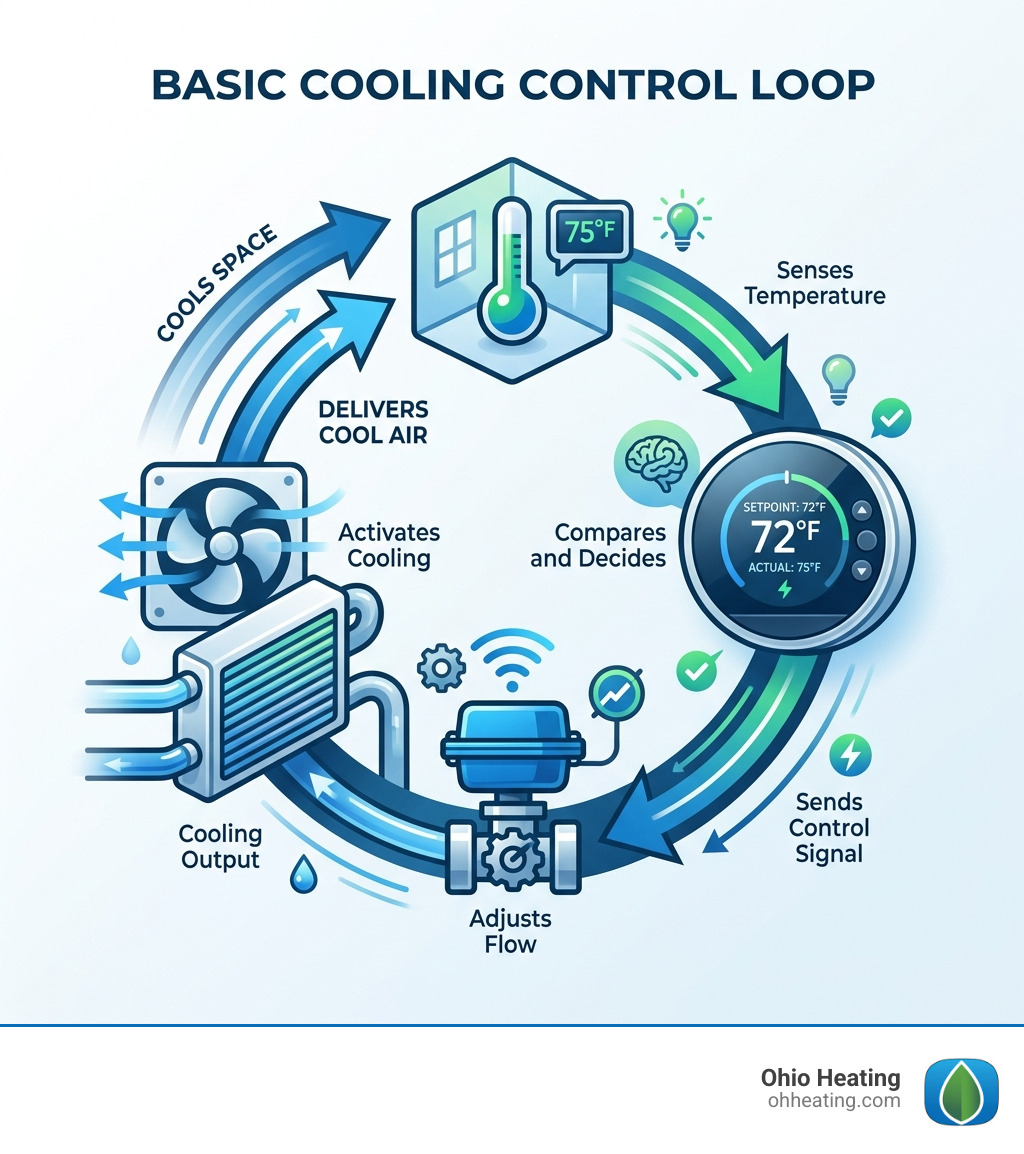
To understand how we keep your facility cool, we first need to look at the “anatomy” of the system. A cooling control system isn’t just one device; it is a network of four primary elements working in harmony. At Ohio Heating, we specialize in Ohio Control Solutions that integrate these components to ensure your building operates like a well-oiled machine.
- Sensors (The Eyes and Ears): These devices measure the “Process Variable” (PV), such as the current room temperature or humidity.
- Controllers (The Brain): The controller receives the data from the sensor, compares it to your desired “Setpoint” (SP), and decides what needs to happen next.
- Controlled Devices (The Muscle): These are the physical components that take action, such as a chilled water valve opening or a fan speed increasing.
- Energy Source (The Fuel): Every system needs power to move parts and send signals, whether it’s electricity or compressed air.
This interaction creates a feedback loop. If the sensor detects the room is at 74°F but the setpoint is 72°F, the controller identifies the “error” and tells the cooling valve to open. As the room cools, the sensor reports the new temperature back to the controller, which then throttles back the cooling as the setpoint is reached.
Precision Parameters in Control Systems HVAC
Maintaining comfort in a place like Central Ohio isn’t just about “feeling cold.” We follow strict industry standards to ensure a healthy environment. According to ASHRAE 55-1992, temperature uniformity is critical; if one corner of your office is 68°F and the other is 78°F, your occupants will be miserable regardless of the average.
Other vital parameters include:
- Relative Humidity (RH): ASHRAE recommends keeping RH between 25% and 60%. In our humid Ohio summers, keeping this below 60% is vital for preventing mold growth and keeping the air from feeling “heavy.”
- Ventilation Rates: Per ASHRAE 62-1999, we aim for a minimum of 20 CFM (cubic feet per minute) of outside air per occupant. This dilutes CO2 and indoor contaminants.
- Building Pressure: We strive for a stable positive pressure of 0.01 to 0.05 inches w.c. This prevents “infiltration”—the fancy word for hot, humid outside air leaking in through cracks and doors.
Controller Logic and Signal Processing
How does the “brain” actually talk to the “muscles”? It uses specific logic and signals.
- Direct Acting: If the temperature goes up, the output signal goes up (e.g., opening a cooling valve wider).
- Reverse Acting: If the temperature goes up, the output signal goes down.
- Analog vs. Digital: Modern systems use analog inputs (like a 0-10V DC or 4-20 mA signal) to represent a range of values, allowing for precise “modulation” rather than just simple on/off switching.
Evolution of AC Control Technologies
Control technology has come a long way since we started serving Columbus in 1999. Understanding what you have in your building is the first step toward optimization.
| System Type | Primary Mechanism | Pros | Cons |
|---|---|---|---|
| Pneumatic | Compressed Air (3-13 psig) | Reliable, explosion-proof | High maintenance, leaks, no data |
| Electric/Electronic | Low Voltage/Transistors | Simple installation | Limited logic capabilities |
| Direct Digital Control (DDC) | Microprocessors/Software | Highly precise, remote access | Higher initial cost |
While many older buildings in Central Ohio still utilize Pneumatic Systems in Columbus Ohio, we are increasingly helping clients transition to a BAS System in Columbus Ohio (Building Automation System).
Modern DDC systems allow for IoT integration, meaning we can diagnose a cooling issue in your Dublin warehouse from our office in Columbus before your employees even notice the temperature rising. This shift from reactive to proactive maintenance is a game-changer for operational reliability.
Advanced Control Strategies for Cooling Efficiency
To get the most out of your control systems HVAC, we implement Advanced HVAC Control Strategies and Algorithms – HVAC Systems Encyclopedia. Simple on/off cycling—where the AC is either 100% on or 100% off—is inefficient and hard on the equipment.
Instead, we use:
- Modulation: Gradually adjusting the cooling output to match the heat load perfectly.
- Staging and Sequencing: If you have multiple chillers or compressors, we “sequence” them so they share the workload, preventing one unit from wearing out while the others sit idle.
- PID Control: This stands for Proportional-Integral-Derivative. It’s a mathematical formula that helps the system reach the setpoint quickly without “overshooting” and getting too cold.
- Cascade Control: Using one control loop to provide the setpoint for another. For example, the room temperature controller tells the supply air controller what temperature the air needs to be.
Research into the Theory and applications of HVAC control systems – A review of model predictive control (MPC) shows that predictive models are the future. These systems look at weather forecasts and occupancy schedules to “pre-cool” a building before the afternoon sun hits, saving significant energy.
Implementing Smart Control Systems HVAC
Smart energy management isn’t just a buzzword; it’s a financial strategy. By focusing on Energy Management, we can implement strategies like:
- Optimal Start/Stop: The system learns how long it takes to cool your building and starts the AC at the exact right moment to hit the setpoint by 8:00 AM—not a minute sooner.
- Demand Limiting/Load Shedding: During peak utility price periods, the system can slightly raise setpoints or dim lights to save you money.
- ASHRAE Guideline 36: This is the “gold standard” for high-performance sequences. It includes “Trim and Respond” logic, which dynamically resets the supply air temperature or chilled water temperature based on which zones actually need cooling. If no one is asking for 55°F air, the system might “reset” the supply air to 60°F, saving the chiller a massive amount of work.
Optimizing Airflow and Refrigerant Control
The physical way we move cooling around your building is through valves and dampers. Choosing the right hardware is essential for Our Products to perform as intended.
- Valves: We use 2-way valves for variable flow systems and 3-way mixing or diverting valves to maintain constant flow while changing the temperature.
- Dampers: In ductwork, opposed blade dampers are generally superior for control because they provide a more linear change in airflow as they open, compared to parallel blade dampers.
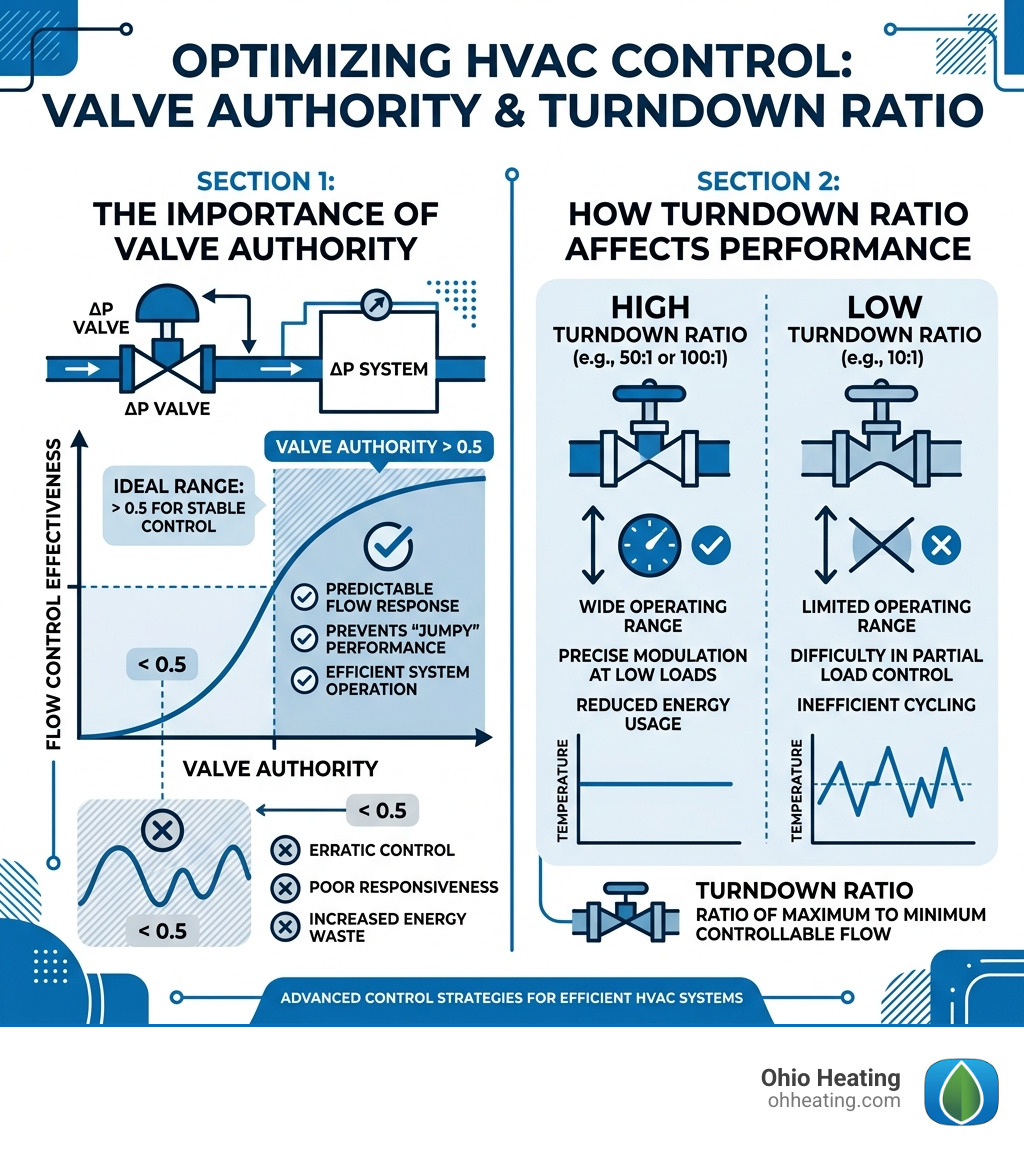
One concept we always stress is Valve Authority. This is the ratio of the pressure drop across the valve compared to the rest of the system. If the authority is too low (below 0.5), the valve becomes “jumpy”—it might be 90% open but only providing 10% of the cooling, or vice versa. Proper actuator sizing ensures the motor has enough torque to close these valves against the high pressure of a commercial pump.
Benefits of Modern AC Automation
Investing in a comprehensive Building and Energy Management system offers rewards far beyond just a comfortable office.
- Energy Savings: Advanced strategies like chilled water reset can save 15-25% on cooling costs.
- Equipment Longevity: By reducing “short-cycling” (turning on and off too frequently), we extend the life of your expensive compressors and motors.
- Proactive Maintenance: Control systems HVAC can log data and trigger alarms. If a fan belt is slipping, the system sees the drop in static pressure and alerts us before the motor burns out.
- Carbon Footprint Reduction: Using less electricity directly correlates to lower emissions, helping your business meet sustainability goals.
Frequently Asked Questions about AC Controls
What is the difference between open-loop and closed-loop AC control?
An open-loop system is like a kitchen timer; it runs for a set amount of time regardless of the result. If you set your AC to run for 2 hours, it won’t care if the room is 60°F or 80°F when it finishes. A closed-loop system uses a sensor for feedback. It measures the room temperature and stays on until the setpoint is reached, making it the standard for HVAC applications.
Why is valve authority critical for stable cooling?
If a valve has low authority, it loses its ability to “fine-tune” the flow. This leads to “hunting,” where the system gets too cold, shuts off, gets too warm, and turns on again. This constant swinging is uncomfortable for occupants and causes unnecessary wear on the equipment.
How does demand control ventilation improve air quality?
Demand control ventilation uses CO2 sensors to see how many people are in a room. If a conference room is empty, the system reduces the outside air intake to save energy. If the room fills up and CO2 levels rise, the system automatically opens the dampers to bring in fresh air, ensuring everyone stays alert and healthy.
Conclusion
In commercial cooling, your equipment is only as good as the system that controls it. At Ohio Heating, we’ve spent decades mastering the art and science of control systems HVAC to serve the businesses of Columbus and Central Ohio. Whether you need a simple repair of a pneumatic thermostat or a full-scale DDC integration for a multi-story facility, our focus is always on operational reliability and your bottom line.
Don’t let an outdated control system drive up your energy bills or leave your tenants in the heat. Explore our conventional controls or contact us today to see how we can bring precision and efficiency to your building’s climate.