
What Does Central Air Repair Actually Cost? (Quick Answer)
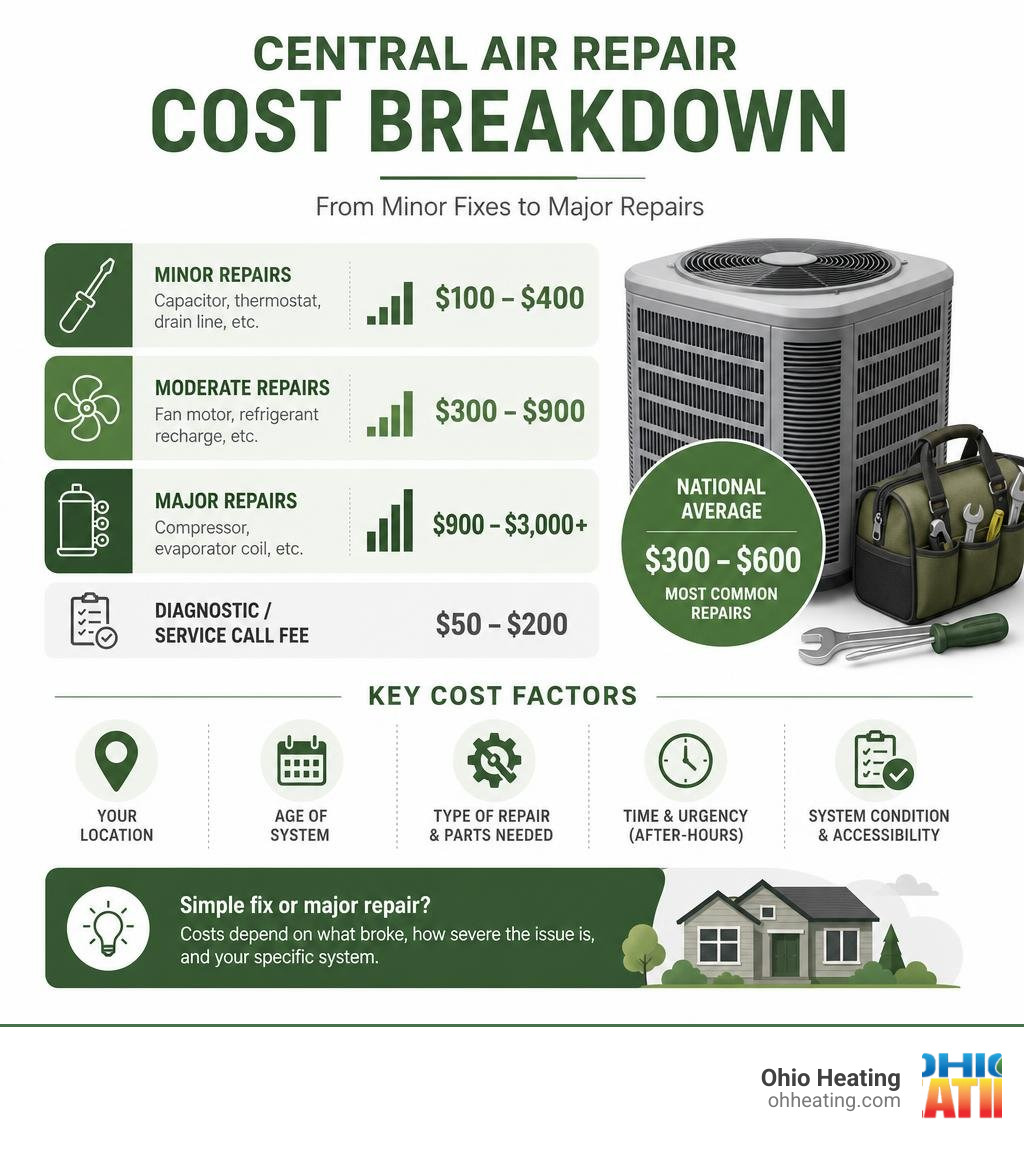
The cost of central air repair typically falls between $150 and $2,500 for most homeowners, depending on what broke and how severe the damage is.
Here’s a fast breakdown to help you estimate your situation:
| Repair Type | Typical Cost Range |
|---|---|
| Minor repair (capacitor, thermostat, drain line) | $100 – $400 |
| Moderate repair (fan motor, refrigerant recharge) | $300 – $900 |
| Major repair (compressor, evaporator coil) | $900 – $3,000+ |
| Diagnostic / service call fee | $50 – $200 |
| National average (most common repairs) | $300 – $600 |
These are national figures. Your actual bill depends on your location, the age of your system, and whether you need emergency service.
When your AC stops working on a hot day, the first question most people ask is: “How much is this going to cost me?” That’s a fair question — and the honest answer is that it varies quite a bit. A simple capacitor swap might run you $150. A failing compressor can push $2,500 or more. Knowing the difference before a technician arrives puts you in a much stronger position.
I’m Jill Frattini, Service Coordinator at Ohio Heating in Columbus, OH, and I’ve spent years helping property managers and homeowners navigate the cost of central air repair — from routine fixes to major component failures. In the sections below, I’ll walk you through everything you need to make a confident, informed decision.
Understanding the Cost of Central Air Repair: National and Local Benchmarks
When you start researching the cost of central air repair, you will quickly notice a wide spread of numbers online. Nationally, most homeowners pay an average of $300 to $600 for common, single-component fixes. However, the total cost of professional cooling repair can range from a low of $100 for basic maintenance-related adjustments to upwards of $5,000 for complex, multi-component system overhauls.
To understand where your repair might land, let’s look at the basic tiers of AC repairs:
| Repair Tier | Average Price Range | Typical Components Involved |
|---|---|---|
| Minor Repair | $100 – $400 | Run capacitor, thermostat calibration, contactor, drain line flush |
| Moderate Repair | $300 – $900 | Condenser fan motor, blower motor, refrigerant leak patch & recharge |
| Major Repair | $900 – $3,000+ | Compressor replacement, evaporator coil, condenser coil |
To get a realistic picture of what you will actually pay, you have to look at how these totals are calculated. A typical repair bill is made up of three core parts:
- The Diagnostic or Service Call Fee: This usually runs between $50 and $200. This fee covers the technician’s time, travel, and expertise to identify exactly what is wrong with your air conditioner.
- Labor Rates: Professional cooling technicians typically command $75 to $150+ per hour, depending on the local market and the complexity of the job.
- Parts and Materials: This is where the price can fluctuate wildly. A small electrical part costs very little, while a major mechanical component like a compressor carries a heavy manufacturer price tag.
If you want to dive deeper into how local conditions shape these numbers, check out our guide on What to Expect: Average AC Repair Prices in Columbus, Ohio. For a broader perspective on national averages across different types of cooling equipment, you can also consult Angi: How Much Does AC Repair Cost?.
Breakdown of Common AC Repairs and Component Pricing
When an air conditioner fails, it is rarely the entire system that goes bad all at once. Usually, a single part has worn out, failed electrically, or suffered mechanical damage.
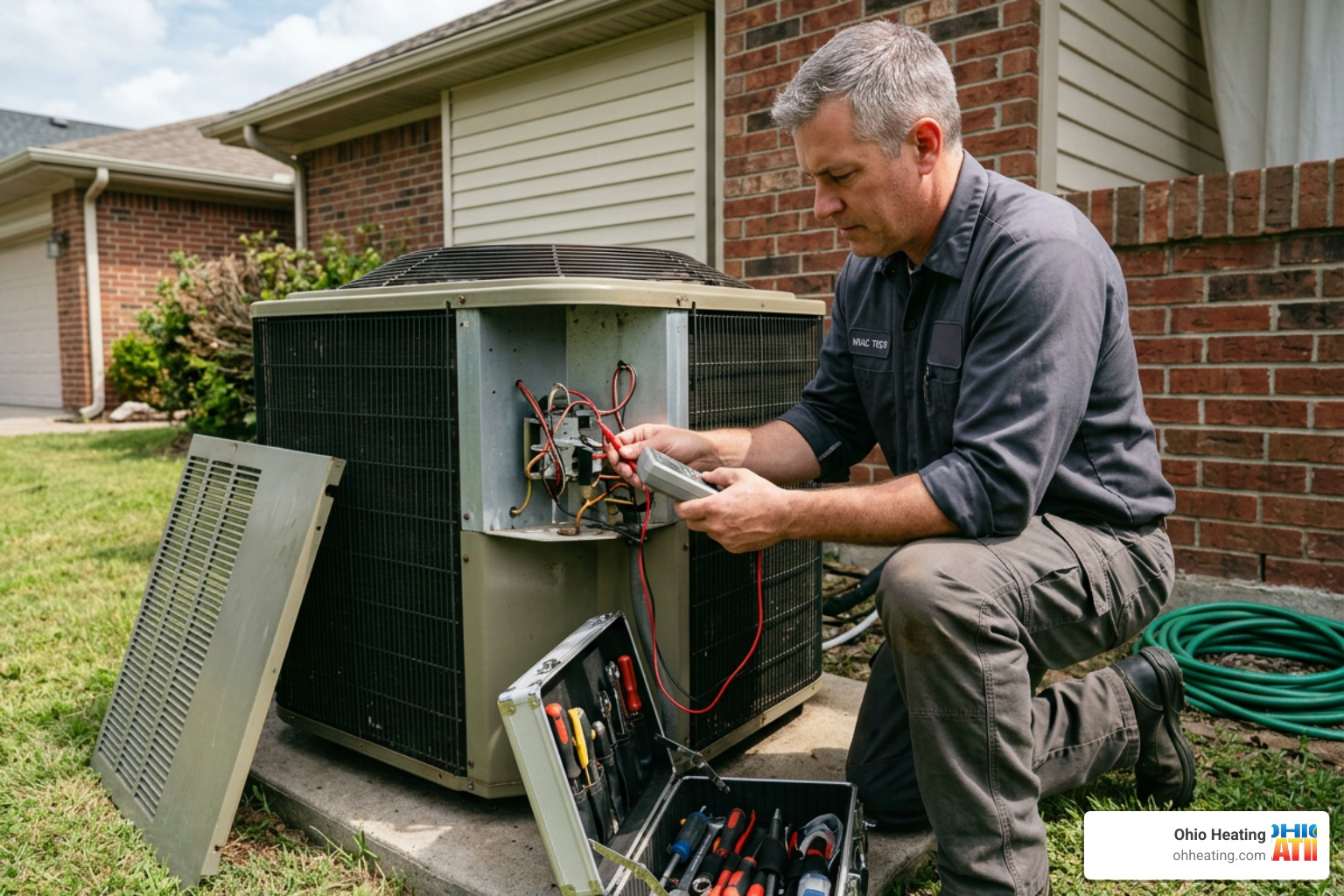
The overall complexity of the repair and the markup on wholesale parts will determine your final invoice. Let’s break down these common repairs by their severity and typical costs.
The Cost of Central Air Repair for Minor Components
Minor repairs are usually electrical or simple mechanical fixes. They are fast to diagnose and can often be completed in under an hour once the technician has the part on hand.
- Capacitor Replacement ($100 – $400): The run capacitor is essentially a temporary battery that gives your compressor and fan motor the electrical push they need to start up. Because they handle high voltage, they are prone to burning out during hot Columbus summers. This is the single most common AC repair we perform.
- Thermostat Fixes ($90 – $600): Sometimes the cooling system is perfectly fine, but the thermostat is failing to send the signal to turn on. Replacing a basic thermostat is inexpensive, while upgrading to a high-end smart thermostat will sit at the higher end of the range.
- Contactor Swap ($100 – $300): The contactor is an electrical switch that controls the flow of electricity to your compressor and outdoor fan. Over time, the contacts can pit or weld shut, preventing the system from running or causing it to run constantly.
- Clogged Condensate Drain Line ($80 – $250): As your AC cools your home, it pulls moisture out of the air. If the drain line gets clogged with algae or debris, water can back up, triggering a safety switch that shuts down the system. Flushing the line is a quick, routine fix.
If your system is completely unresponsive and you suspect one of these electrical parts has failed, read our troubleshooting guide on what to do when your AC Won’t Turn On.
Moderate AC Repairs: Fan Motors and Refrigerant Leaks
Moderate repairs require more diagnostic time, heavier labor, and intermediate parts.
- Condenser or Blower Fan Motor ($300 – $1,500): Your AC relies on two main fans: the outdoor condenser fan (which expels heat) and the indoor blower fan (which circulates cool air). If a motor burns out, it must be replaced to prevent the system from overheating or freezing up.
- Refrigerant Leak Detection and Repair ($300 – $1,500+): Your system operates on a closed loop of refrigerant. If a leak develops, simply adding more refrigerant is a temporary band-aid (and bad for the environment). A permanent fix requires finding the leak, patching or replacing the damaged copper line, evacuating the system, and recharging it with the proper amount of R-410A refrigerant.
- Refrigerant Recharge ($100 – $600): Depending on how much refrigerant was lost, recharging a system with modern R-410A refrigerant typically costs $25 to $100 per pound for the material alone, plus labor.
If you suspect your system is low on cooling power or has a physical leak, you can learn about the repair process in our detailed article on AC Refrigerant Leak Fix.
Major Component Failures: Compressors and Coils
Major repairs represent the most expensive scenarios in residential cooling. These parts are incredibly labor-intensive to replace and require advanced technical skills, including soldering copper lines and pulling deep vacuums on the system.
- Compressor Replacement ($900 – $3,000): The compressor is the “heart” of your air conditioner, pumping refrigerant through the system. If the compressor locks up or suffers an electrical failure, replacing it is a major undertaking.
- Evaporator Coil Replacement ($1,000 – $5,000+): Located inside your home, the evaporator coil absorbs the heat from your indoor air. Because these coils are made of copper and aluminum, they are susceptible to corrosion and leaks. Replacing a coil often requires custom sheet metal work and refrigerant handling.
- Condenser Coil Replacement ($1,000 – $4,000): The outdoor coil releases the heat absorbed from your home. If it becomes severely damaged by hail, debris, or corrosion, it must be replaced.
Before agreeing to a massive repair bill on your outdoor unit, make sure you understand your options by reading Residential AC Compressor Repair: What You Need to Know and our guide on AC Compressor Replacement.
Key Factors That Influence Your Final AC Repair Bill
If you ask three different homeowners in Central Ohio what they paid for an AC repair, you will likely get three completely different answers—even if they all had the same part replaced.

Several variables dictate the final number on your invoice:
- System Age and Condition: Older cooling systems are often harder to source parts for. If your unit is over a decade old, finding a compatible fan motor or coil might require extra search time or custom shipping, which adds to the cost.
- SEER and Efficiency Ratings: High-efficiency systems (such as those with variable-speed compressors or communicating thermostats) use highly specialized parts. While they save you money on your monthly electric bills, their replacement parts are significantly more expensive than those of standard-efficiency units.
- Geographic Location: Labor rates and operational costs vary across the country. In dense urban areas or regions with high costs of living, AC repair company overhead is higher, which is reflected in hourly labor rates. Here in the Columbus, OH metro area, rates are competitive but reflect the high level of professional training required for safe refrigerant handling.
- Emergency vs. Scheduled Service: If your AC breaks down on a mild Tuesday morning in May, you can easily book a standard appointment. But if it fails on a Saturday afternoon during a 95-degree heatwave in July, you may need emergency service. Emergency or after-hours service can carry diagnostic surcharges of $75 to $250, or labor rates that are double to triple the standard hourly rate.
- Warranty Coverage: If your system is still covered by the manufacturer’s warranty (typically 5 to 10 years from installation), the replacement part itself may be free. However, you will still be responsible for the cost of labor, shipping, and any necessary refrigerant, as standard manufacturer warranties rarely cover labor.
If you find yourself stuck in a cooling emergency, refer to our resource on Emergency AC Fix: How to Get Same-Day Service and learn How to Prepare for AC Emergencies: Safety Measures to Take. For a thorough breakdown of how manufacturers structure their warranty programs, you can read the Average Central Air Conditioning Repair Cost – Trane®.
Repair vs. Replacement: When to Invest in a New AC System
At some point, every homeowner faces the ultimate dilemma: Do I keep patching up this old air conditioner, or is it time to cut my losses and replace the entire system?
Air conditioners typically have a useful lifespan of 10 to 15 years. While proper maintenance can stretch that lifespan closer to 20 years, an older unit will naturally become less efficient and more prone to breakdowns. Furthermore, modern equipment must comply with strict SEER2 energy efficiency standards, meaning a new system will consume significantly less electricity than a unit built a decade ago.
Evaluating the Cost of Central Air Repair Against Replacement
To make the right financial decision, we recommend using a few simple rules of thumb:
- The 50% Rule: If the cost of a single repair exceeds 50% of the cost of a brand-new AC installation, you should almost always choose replacement.
- The “Age times Repair” Rule: Multiply the age of your system by the cost of the repair quote. If the result is greater than $5,000, replacement is generally the more sensible long-term investment. For example, a $600 repair on an 8-year-old system equals $4,800 (repair is worth it). A $1,200 repair on a 12-year-old system equals $14,400 (it is time to replace).
- The R-22 Refrigerant Factor: If your system was installed before 2010, it likely uses R-22 refrigerant (commonly known as Freon). Due to environmental regulations, R-22 has been completely phased out. Finding R-22 is incredibly difficult, and a simple recharge can cost upwards of $2,000. If an R-22 system develops a refrigerant leak or compressor failure, replacing the system is the only logical choice.
A brand-new central AC replacement in 2026 typically ranges from $7,500 to $15,000 depending on the size of your home and the efficiency rating you select. To avoid sticker shock and understand what goes into a modern installation quote, take a look at Don’t Get Quoted 30k: Understanding New AC Unit Costs.
For an in-depth breakdown of installation costs by home square footage and system tonnage, you can view the Central AC Replacement Cost 2026 guide or check out the pricing tools on Forbes Home: Central Air Conditioner Installation Cost.
Frequently Asked Questions about Central Air Repair Costs
How much does a typical AC diagnostic or service call fee cost?
A standard diagnostic or service call fee generally ranges from $50 to $200. This is a flat rate charged by the company to send a certified technician to your home with a fully stocked service vehicle.
It is important to understand that this fee covers the business costs of sending a professional to your door: technician wages, ongoing training, vehicle maintenance, specialized diagnostic tools, and liability insurance. Most reputable companies charge this fee during standard business hours to ensure they can provide thorough, accurate troubleshooting without rushing.
What are the signs that my air conditioner needs immediate repair?
You don’t always have to wait for your system to stop blowing air entirely to know there is a problem. Catching issues early can save you hundreds of dollars in repair costs. Watch for these common warning signs:
- Warm Air: If your system is running but blowing lukewarm air, it could indicate a failed compressor, a bad capacitor, or a refrigerant leak.
- Weak Airflow: Poor airflow often points to a failing blower motor or a severely clogged air filter.
- Strange Noises: Squealing, grinding, clanking, or hissing sounds are clear indicators of mechanical wear or refrigerant leaks.
- Frequent Cycling: If your AC turns on and off every few minutes, it is short-cycling, which puts massive strain on the compressor.
For a complete checklist of what to look out for, read our guide on Signs Your Air Conditioning Needs Repair: What to Look For.
How can I lower my central air conditioning repair costs?
The easiest way to control your cooling costs is through proactive maintenance:
- Change Your Air Filters Regularly: A dirty filter restricts airflow, forcing your system to work harder, run hotter, and burn out components like blower motors and capacitors prematurely. Change them every 30 to 90 days.
- Keep the Outdoor Unit Clear: Ensure there are at least two feet of clear space around your outdoor condenser. Keep it free of grass clippings, weeds, leaves, and debris so it can shed heat efficiently.
- Invest in a Maintenance Contract: Joining a seasonal maintenance program ensures your system is cleaned and inspected before the hot weather hits. Technicians can catch a weakening capacitor or a tiny refrigerant leak before it turns into an expensive emergency breakdown.
- Schedule Repairs Off-Peak: If you notice a minor issue in the spring, don’t wait until the first 90-degree day of summer to call. Scheduling repairs during off-peak times can help you avoid emergency dispatch fees.
Conclusion
The cost of central air repair doesn’t have to be a source of stress. By understanding the typical price ranges for common parts—from a simple $150 capacitor to a more involved motor or refrigerant repair—you can make smart, budget-conscious decisions for your home.
At Ohio Heating, we have been keeping Columbus and Central Ohio homes cool and comfortable since 1999. Our team of certified technicians is dedicated to providing honest, transparent pricing and reliable service. We never push unnecessary upgrades, and we always explain your options clearly so you can choose the path that makes the most sense for your family.
If your system is struggling, making strange noises, or if you find your AC Blowing Warm Air, don’t wait for a total system failure. Contact us today to schedule a professional diagnostic visit and restore your home’s comfort!