
HVAC for large buildings: Ultimate Guide 2025
Why HVAC Systems Are the Backbone of Large Commercial Buildings
HVAC for large buildings is the critical infrastructure that determines occupant comfort, productivity, and health. These complex systems are far more than simple heaters or air conditioners; they are sophisticated networks designed to handle massive spaces and constant demand.
For property managers, understanding this system is essential. Commercial buildings account for 18% of all U.S. energy consumption, and HVAC drives approximately 40% of that usage. An efficient system can reduce energy bills by up to 30%, while preventative maintenance can lower energy costs by another 5-40%.
The primary system types include:
- Central Plants with Chillers: Best for very large facilities.
- Packaged Rooftop Units (RTUs): Ideal for low-to-mid-rise buildings.
- Variable Refrigerant Flow (VRF): Offers superior zoning and efficiency.
A modern commercial HVAC system is an integrated network of chillers, air handlers, ductwork, and controls. The difference between a well-designed system and a poorly maintained one directly impacts utility bills, tenant satisfaction, and equipment replacement budgets.
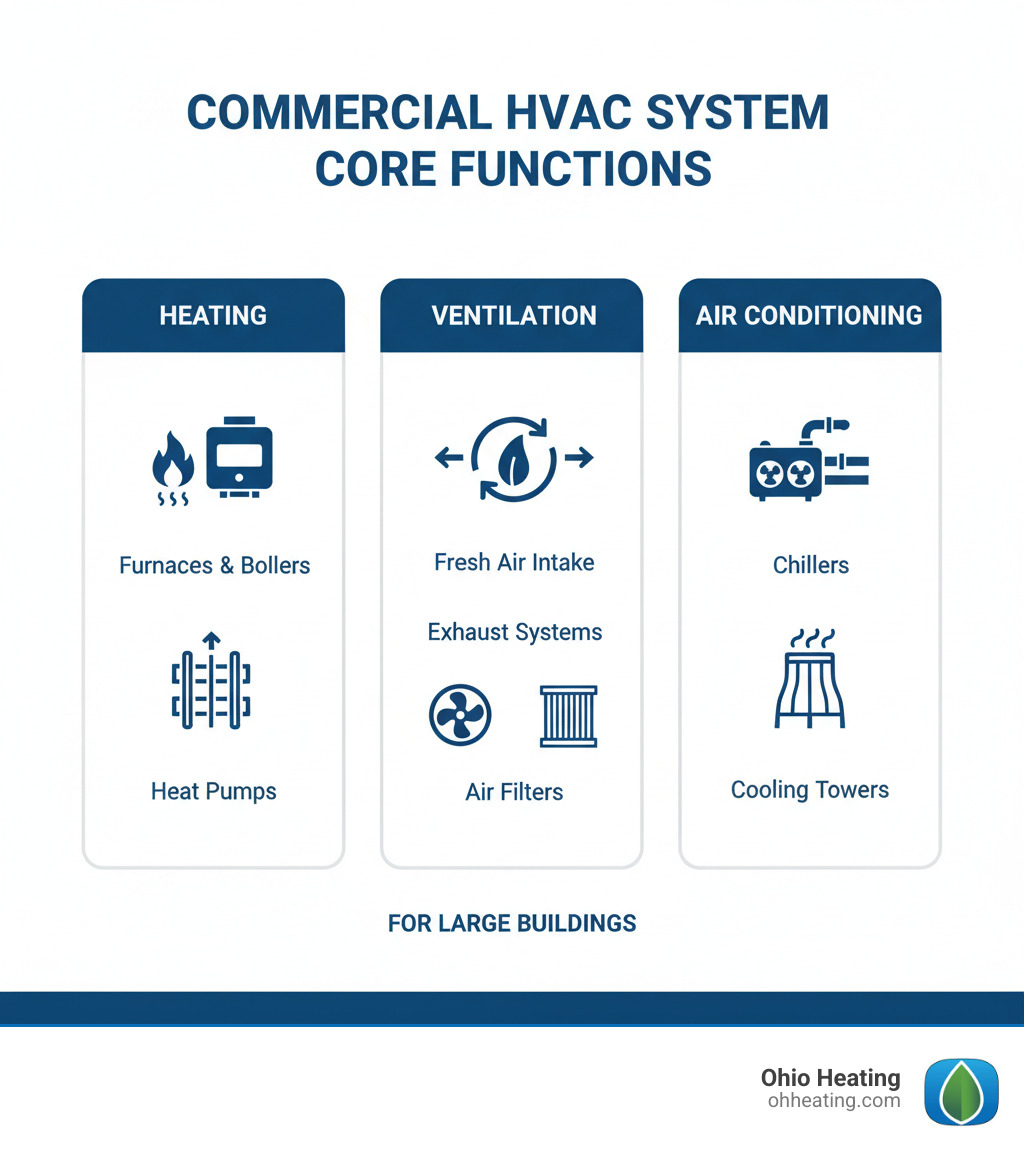
This guide breaks down the unique challenges of large buildings, the main system types, the technologies that boost efficiency, and how to maintain your investment for maximum performance and longevity.
The Unique Challenges of Climate Control in Large Structures
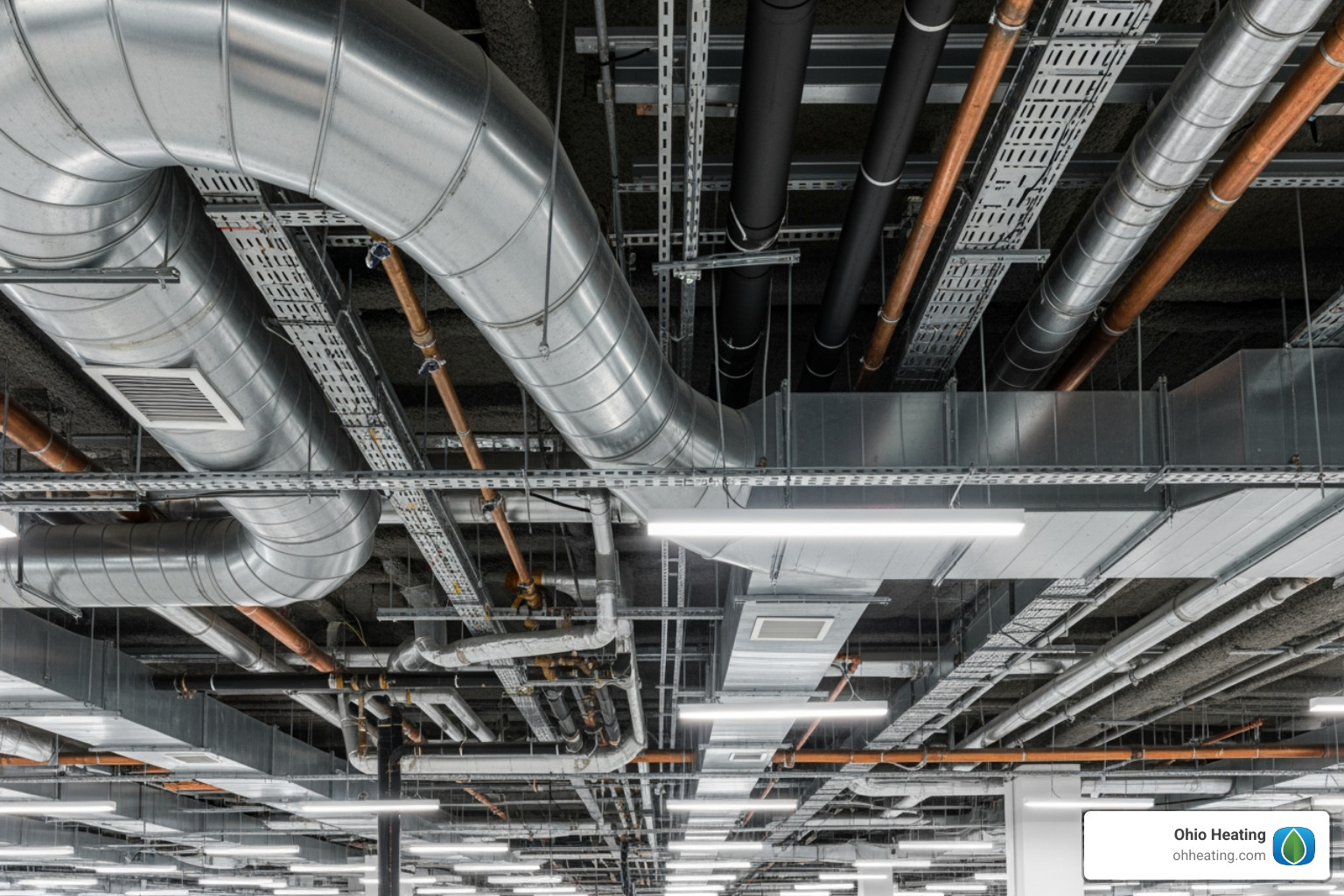
Keeping a large commercial building comfortable isn’t as simple as setting a thermostat. HVAC for large buildings must overcome several unique challenges that residential systems aren’t built to handle.
-
Scale and Capacity: A home may need a 3-ton air conditioner, but a large commercial building requires equipment measured in hundreds of tons. These industrial-grade systems are built from the ground up to move staggering volumes of air.
-
Variable Heat Loads: A building’s heating and cooling needs change constantly. An office filling with people and computers at 9 AM generates a surge of heat that disappears by 6 PM. The HVAC system must respond to these swings efficiently.
-
Building Orientation and Pressure: The sun heats the east and west sides of a building at different times, creating zones with competing needs. In high-rises, vertical pressure and temperature differences add another layer of complexity, making uniform comfort from top to bottom a challenge.
-
Diverse Space Usage: A mixed-use building may have retail shops, offices, a restaurant kitchen, and a data center all under one roof. Each space has wildly different requirements—from 24/7 precision cooling for servers to standard office comfort—that must be managed by the same infrastructure.
-
Ventilation and Air Quality: Large buildings require robust ventilation to manage CO2 buildup, odors, and airborne contaminants. Maintaining high indoor air quality is critical for occupant health and productivity, not just comfort.
Managing these factors requires sophisticated Building and Energy Management systems that can monitor, adjust, and optimize performance in real-time. This is what separates adequate HVAC from exceptional climate control.
Primary Types of Commercial HVAC Systems
Choosing the right HVAC for large buildings means matching the system to your property’s specific needs. You wouldn’t use a compact car to haul construction materials, and the same logic applies here. Let’s review the three main types of commercial HVAC systems.
Central Plants & Chiller Systems
Found in large hospitals, university campuses, and major office buildings, central plants are the heavyweights of commercial climate control.
How They Work: A central chiller cools water (typically to 45°F), which is then piped to Air Handling Units (AHUs) throughout the building. The AHUs blow air over coils filled with this chilled water to cool your spaces. The absorbed heat is then expelled outdoors by cooling towers.
- Water-cooled chillers use cooling towers and are extremely efficient for the massive loads of large-scale facilities.
- Air-cooled chillers use fans instead of towers, making them simpler and suitable for mid-sized buildings.
Pros: Central plants offer high efficiency for large loads and have a long, reliable service life. Maintenance is centralized in a mechanical room.
Cons: They have a very high initial cost, require a large footprint for equipment, and water-cooled systems need ongoing water treatment.
Central systems are a proven workhorse, and at Ohio Heating, we specialize in both Chilled Water Air Handler in Columbus, Ohio and Commercial and Industrial Cooling Towers.
Packaged Rooftop Units (RTUs)
These familiar metal boxes are the practical, all-in-one solution for most low-to-mid-rise commercial buildings like retail stores, warehouses, and smaller offices.
How They Work: An RTU contains all heating, cooling, and ventilation components in a single package. It pulls in outside air, mixes it with return air, filters it, conditions it, and pushes it into the building through ductwork.
Pros: RTUs are space-saving because they live on the roof. Installation is modular and more straightforward than a central plant. Using multiple units allows for simple zoning.
Cons: Their rooftop location exposes them to harsh weather, and their lifespan is typically 15-20 years. Technicians require safe roof access for maintenance. A common issue is malfunctioning economizers, which wastes energy.
Our team at Ohio Heating provides expert Rooftop Installation and Repair to keep these units running efficiently.
Variable Refrigerant Flow (VRF) Systems
VRF systems are the modern efficiency champions, prized for their flexibility and low operating costs.
How They Work: Instead of water or air, VRF systems circulate refrigerant from a single outdoor unit to multiple indoor units. The most advanced heat recovery models can provide simultaneous heating and cooling, transferring heat from a warm, sunny office to a cool, shaded one. This makes them incredibly efficient.
Pros: VRF systems are up to 30% more efficient than traditional ducted systems. They offer excellent zoning control for individual comfort, are quiet, and require minimal ductwork, making them ideal for retrofits. We also offer Ductless HVAC for Commercial Buildings for this purpose.
Cons: They have a higher initial cost and require specialized expertise for design, installation, and service. You can learn more about VRF systems and their technology.
Comparison Table: Commercial HVAC System Types
| Feature | Central Plants (Chillers) | Packaged Rooftop Units (RTUs) | Variable Refrigerant Flow (VRF) Systems |
|---|---|---|---|
| Best Application | Very large buildings, campuses, industrial facilities | Low-to-mid-rise commercial (retail, warehouses, smaller offices) | Offices, hotels, schools, multi-family, buildings with diverse needs |
| Energy Efficiency | High (especially water-cooled for large loads) | Moderate to good (with economizers & advanced tech) | Excellent (up to 30% more efficient than ducted) |
| Installation Cost | High (complex infrastructure) | Moderate (modular, less complex than central) | High (sophisticated technology) |
| Zoning Capability | Good (with AHUs and VAV boxes) | Moderate (multiple RTUs for different zones) | Excellent (individual control per indoor unit) |
| Lifespan | Long (20+ years) | Moderate (15-20 years with maintenance) | Good (15-20 years) |
Key Components and Advanced Technologies in HVAC for Large Buildings
A modern commercial HVAC system is an integrated network. Understanding its key components and technologies reveals how HVAC for large buildings achieves comfort and efficiency.
Core Components and How They Work Together
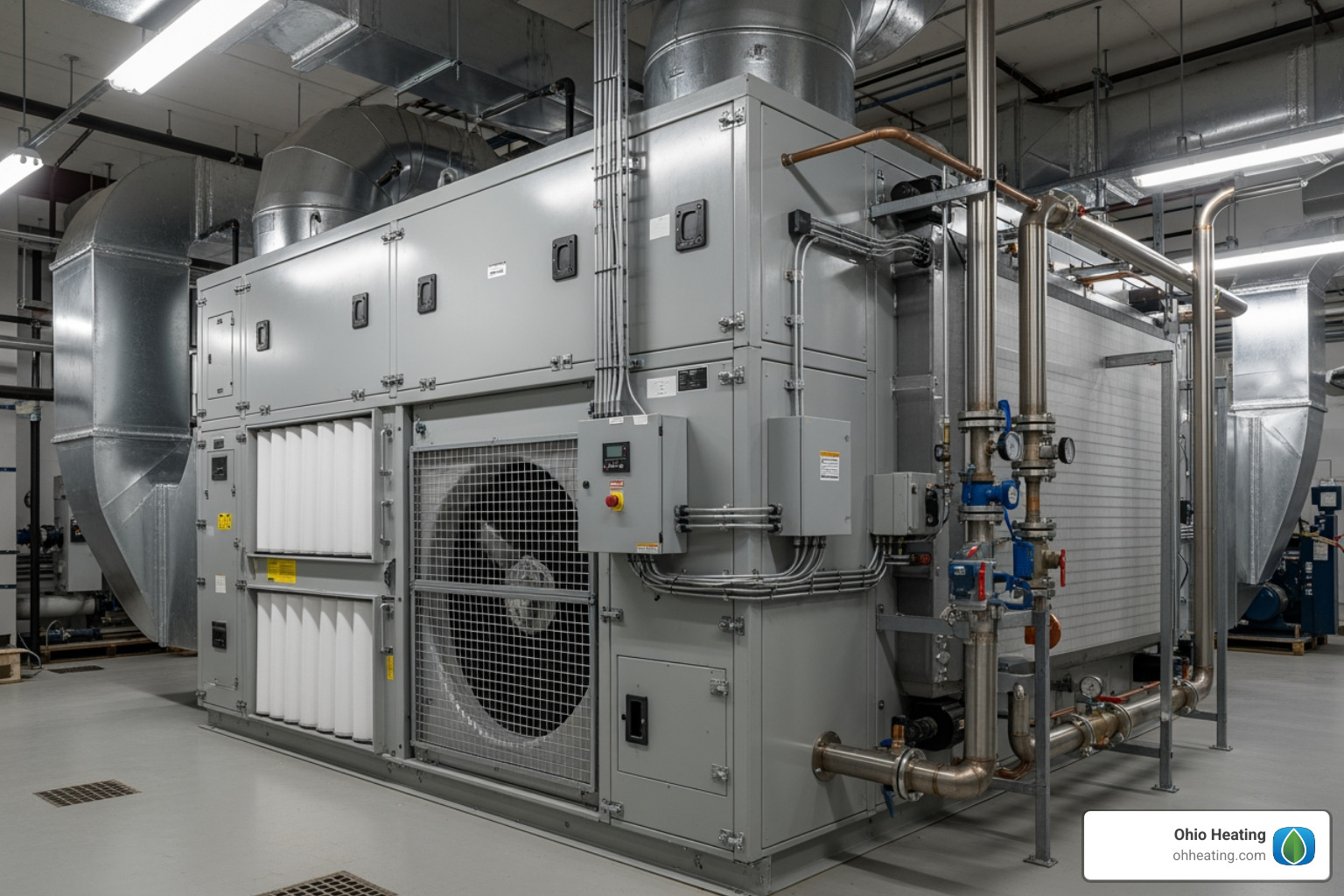
- Air Handling Units (AHUs): These are large cabinets containing fans, filters, and coils that condition air before distributing it through the building. An AHU can be as large as a small room, handling tens of thousands of cubic feet of air per minute.
-
Ductwork and Piping: This is the circulatory system. Ductwork carries conditioned air to rooms, while piping transports chilled or hot water to the AHUs. Proper design and Ductwork and Piping Repair are essential to prevent energy waste.
-
Ventilation Systems: These systems continuously bring in fresh outdoor air to dilute indoor pollutants and exhaust stale air, which is crucial for health and productivity.
-
Make-Up Air Units: In areas with high exhaust rates like commercial kitchens, these units replace the exhausted air with 100% fresh outdoor air to maintain proper building pressure.
-
Pumps and Valves: Pumps move water through heating and cooling loops, while valves regulate flow to different zones based on demand.
The Critical Role of Zoning and Controls
How do you cool a sunny conference room while keeping a shaded office comfortable? The answer is zoning. Zoning divides a building into distinct areas that can be controlled independently, each with its own thermostat.
This is achieved with zone dampers in the ductwork that open or close to control airflow. The entire operation is managed by a Building Automation System (BAS), which acts as the brain. A well-designed BAS System in Columbus, Ohio can save 5% to 20% on energy costs by not conditioning unoccupied spaces, while also dramatically improving occupant satisfaction.
Advanced Technologies Enhancing HVAC for Large Buildings
Today’s systems use sophisticated technology to maximize performance.
-
Smart Controls (DDC): Direct Digital Controls use a network of sensors to monitor conditions and make real-time adjustments to optimize comfort and minimize energy use.
-
Energy Recovery Ventilators (ERVs): These devices capture energy from stale exhaust air and use it to pre-heat or pre-cool the fresh incoming air, significantly reducing the HVAC system’s workload.
-
Economizers: When outdoor conditions are cool and dry, economizers provide “free cooling” by bringing in outside air instead of running the compressor. However, they require regular maintenance to function correctly.
-
Variable Frequency Drives (VFDs): Instead of running at full power, VFDs allow motors in compressors and fans to operate at variable speeds, precisely matching demand. This saves energy, reduces noise, and extends equipment life.
These technologies help buildings Boost Commercial AC Efficiency with Smart Energy Solutions, cutting energy bills while improving comfort.
How Building Type Influences HVAC for Large Buildings
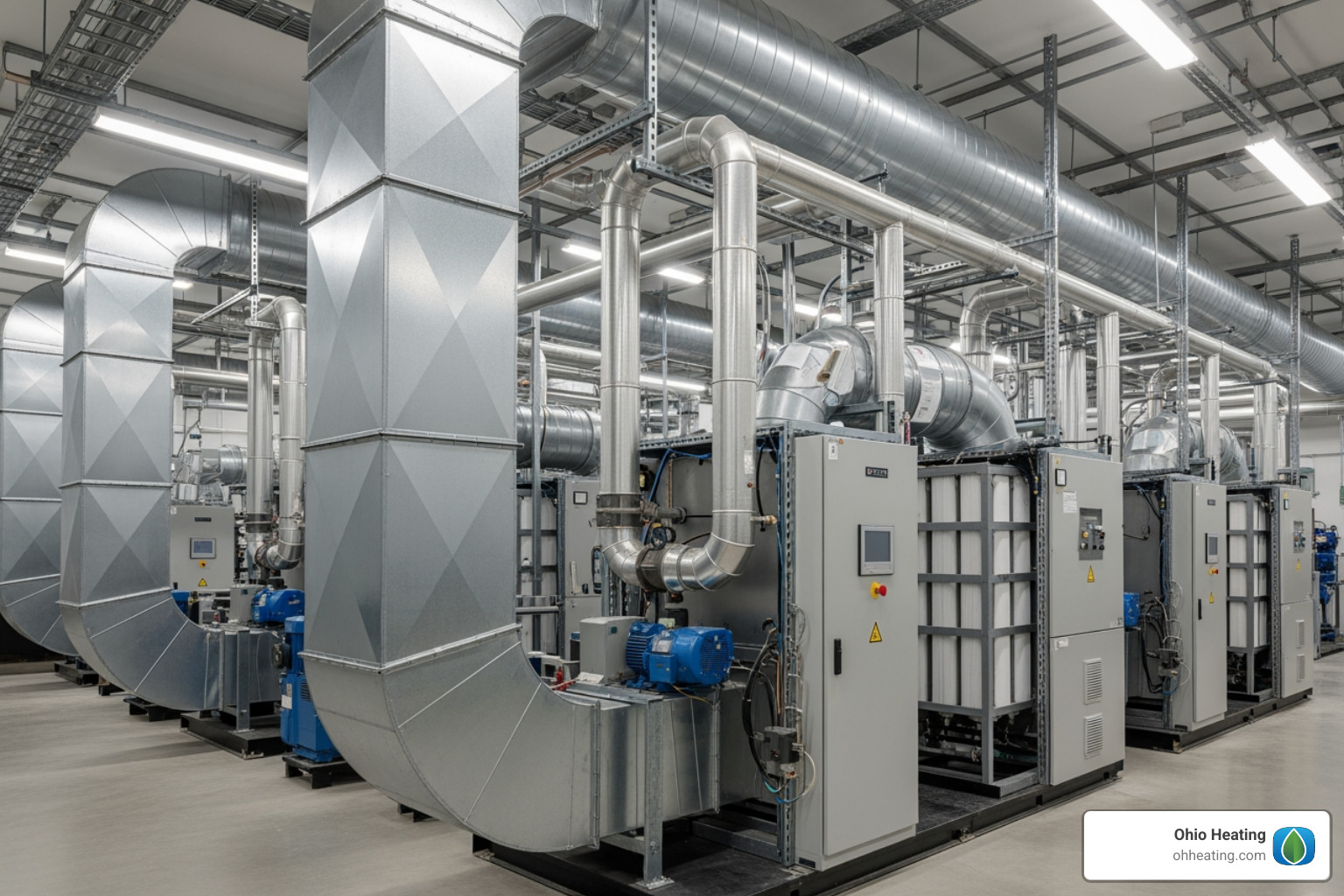
Different facilities have different needs. There is no one-size-fits-all solution.
-
Hospitals: Require extreme reliability with redundant systems, hospital-grade HEPA filtration, and precise humidity and pressure control to prevent the spread of infection.
-
Data Centers: Need 24/7 precision cooling to handle the constant, high-density heat generated by servers. Reliability and efficiency are non-negotiable.
-
Office Buildings: Focus on zoning to manage variable occupancy and energy efficiency. Good indoor air quality is key to employee productivity.
-
Universities: Often require hybrid systems to serve a mix of spaces, including lecture halls, labs with special ventilation needs, and dormitories. A Case Study on a University HVAC system shows this complexity.
System Maintenance, Benefits, and Future Trends
For HVAC for large buildings, proper management is key to maximizing lifespan, efficiency, and return on investment. Maintenance isn’t an expense; it’s a strategy.
Proactive Maintenance for Commercial Systems
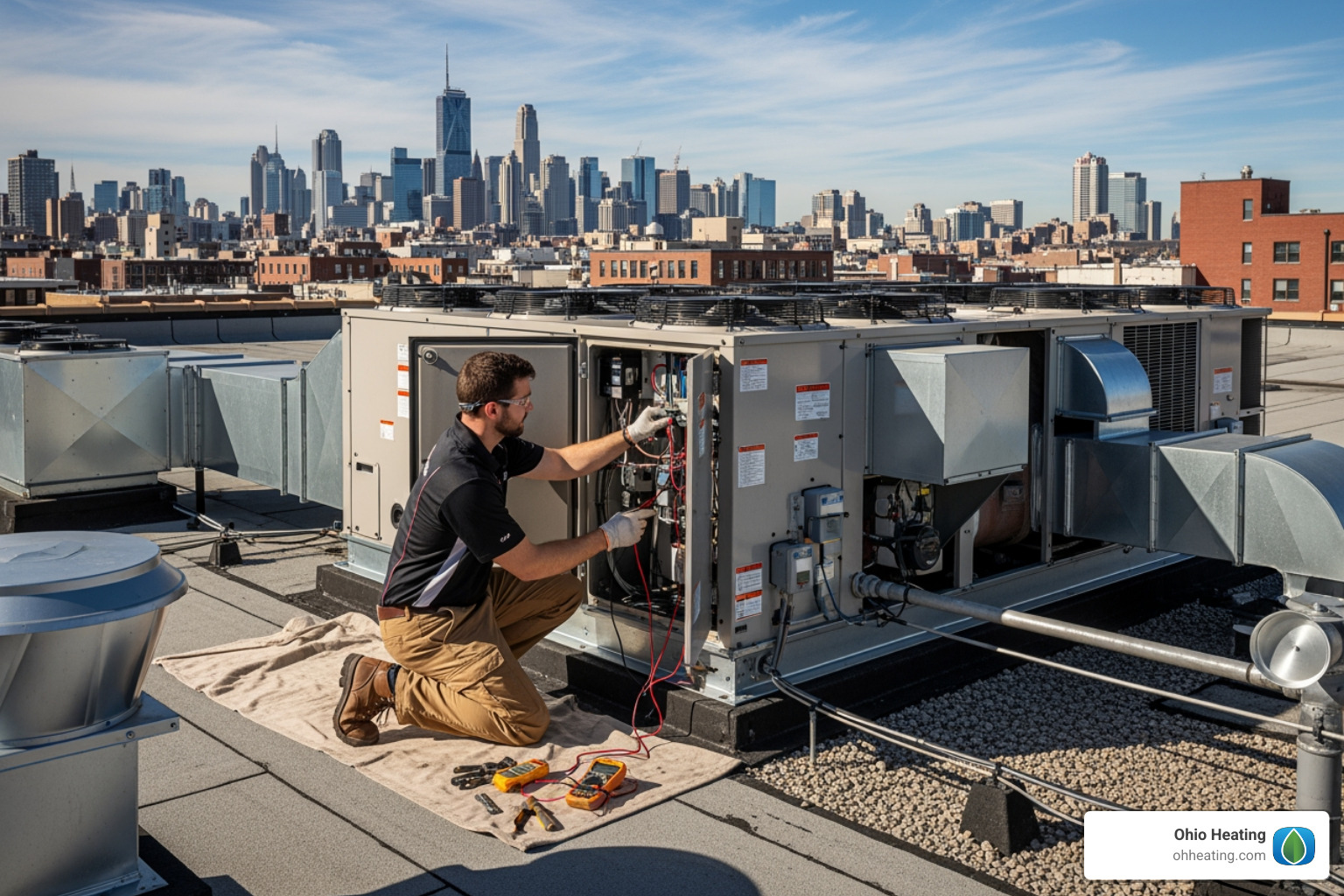
Reactive maintenance—fixing things only when they break—leads to costly downtime and emergency repairs. Preventative maintenance, on the other hand, is a scheduled approach that can lower energy costs by 5% to 40%.
Our technicians follow detailed maintenance checklists that include:
- Filter Changes: Dirty filters restrict airflow and waste energy. They should be replaced 4-12 times a year.
- Coil Cleaning: Just a thin layer of dirt on a coil can reduce cooling efficiency by over 20%. Regular cleaning is essential.
- Refrigerant Level Checks: Incorrect levels reduce cooling capacity and can damage the compressor.
- Economizer Checks: Malfunctioning economizers waste “free cooling” opportunities and are a common issue.
We recommend professional preventative maintenance at least quarterly, supplemented by monthly in-house checks. Our Maintenance Services are designed to prevent the Common Issues Causing Commercial HVAC System Failures.
The Benefits of a Well-Maintained System
Diligent maintenance delivers measurable benefits that impact your bottom line.
- Lower Operational Costs: Efficient systems can reduce energy bills by up to 30%.
- Improved Occupant Comfort & Productivity: Comfortable people are more productive and satisfied.
- Better Indoor Air Quality: Clean filters and proper ventilation lead to a healthier indoor environment.
- Extended Equipment Lifespan: A well-maintained chiller can last over 20 years; a neglected one may fail years earlier, saving you from premature replacement costs.
- Minimized Environmental Impact: Less energy consumption means a smaller carbon footprint, which is key to understanding Why Energy Efficient HVAC Systems Matter.
Future Outlook: Sustainability and Efficiency
The future of HVAC for large buildings is being shaped by technology and sustainability.
- Green Building Standards: Certifications like LEED are pushing the industry toward higher efficiency.
- Electrification and Heat Pumps: Advanced heat pumps are making it possible to efficiently heat large buildings with electricity, even in cold climates.
- Low-GWP Refrigerants: The industry is transitioning to refrigerants with lower Global Warming Potential (GWP), as detailed in resources like the 2023 ASHRAE Handbook—HVAC Applications.
- AI-Driven Predictive Maintenance: AI will analyze real-time data to predict failures before they happen, optimizing maintenance schedules.
- Smart Grid Integration: Systems will communicate with the electrical grid to adjust energy use based on demand and pricing, lowering costs.
Frequently Asked Questions about HVAC in Large Buildings
How often does a large commercial HVAC system need maintenance?
For most large buildings, we recommend professional preventative maintenance at least quarterly (four times a year). This allows technicians to perform thorough inspections and adjustments. Between these visits, your in-house staff should perform monthly checks, such as inspecting and changing air filters. This combined approach is the best way to ensure efficiency, prevent costly breakdowns, and lower energy costs by 5-40%. Our Maintenance Services can be custom to your building’s specific needs.
What’s the biggest factor in choosing a new commercial HVAC system?
There isn’t one single factor. The optimal choice for HVAC for large buildings is a balance of several key considerations:
- Building Size and Use: A warehouse has different needs than a hospital.
- Upfront Installation Costs: Budgets are a reality, and systems vary widely in price.
- Long-Term Energy Efficiency: A cheaper system may cost more over its lifespan in energy bills.
- Local Climate: The system must handle Central Ohio’s hot summers and cold winters efficiently.
A thorough assessment by an experienced HVAC professional is essential to weigh these factors and determine the best solution for your property.
Can you upgrade an old building with a modern, efficient HVAC system?
Absolutely. Retrofitting older buildings with modern HVAC technology is one of the most effective ways to improve energy efficiency and occupant comfort. Many owners worry about the disruption, but modern systems are designed for this.
For example, ductless VRF systems are ideal for retrofits because they don’t require extensive new ductwork. We help many clients with Ductless HVAC for Commercial Buildings. Likewise, new high-efficiency rooftop units can often replace old ones with minimal structural changes. Our team handles Rooftop Installation and Repair across Columbus.
An upgrade can reduce energy bills by up to 30%, offering a significant return on investment while improving your building’s value and comfort.
Conclusion
Managing HVAC for large buildings is fundamental to creating an environment where people can thrive. From the unique challenges of scale to the different system types—central plants, RTUs, and VRF—the right choice directly impacts your building’s performance.
As we’ve seen, a properly maintained system is a strategic asset. It keeps occupants comfortable, reduces operational costs by up to 30%, extends equipment life, and minimizes your environmental footprint. It’s the difference between a building that struggles and one that excels.
At Ohio Heating, we’ve been helping Columbus businesses achieve that excellence since 1999. We understand your commercial property is a major investment, and we have the expertise to guide you through every step, from design and installation to comprehensive maintenance that ensures year-round reliability.
Ready to optimize your building’s climate control? Learn more about our Commercial HVAC Services and find how Ohio Heating can deliver big comfort for your big building.