
Beyond HVAC: Unpacking Building Comfort Solutions
Why Building Comfort Solutions Matter for Your Property
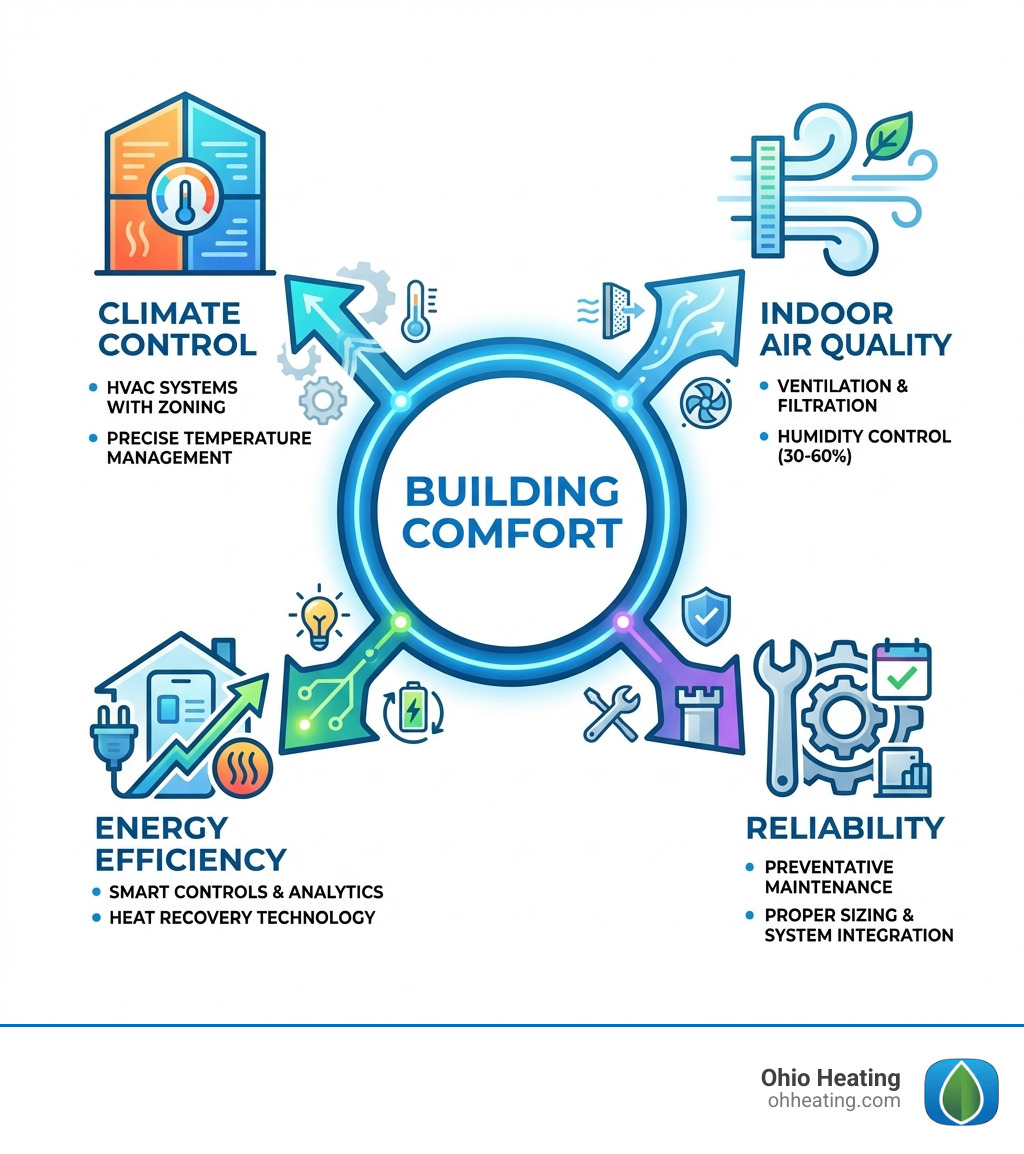
Building comfort solutions are integrated systems that combine HVAC technology, indoor air quality management, automation controls, and ventilation to create healthy, productive indoor environments. These solutions go beyond basic heating and cooling to address humidity, air quality, noise levels, and energy efficiency—all while adapting to the unique needs of your facility.
Key Components of Building Comfort Solutions:
- Climate Control Systems: Variable Refrigerant Flow (VRF), hydronic systems, and multi-stage HVAC equipment that provide precise temperature management
- Indoor Air Quality (IAQ): Ventilation systems, energy recovery ventilators, and humidity control that maintain healthy air (identified by the U.S. EPA as one of the top five environmental risks)
- Smart Building Management: Automated controls, data analytics, and BMS integration that optimize performance and reduce energy costs by 25-40%
- Zone Control: Individual temperature settings for different rooms or areas, eliminating hot and cold spots
- Energy Efficiency: Systems that can achieve 35-45% cooling energy savings through optimized setpoints and heat recovery technology
Buildings are like people—no two are alike. Each has its own design, size, shape, and age. Yet for decades, the HVAC industry offered property managers and building owners the same one-size-fits-all solutions. Modern building comfort solutions change that approach entirely.
Today’s systems can be configured in over a million different ways. They recover heat from one zone to warm another. They monitor CO2 levels to adjust ventilation automatically. They predict maintenance needs before equipment fails. And they do all this while using significantly less energy than traditional systems.
For property managers and business owners, the stakes are high. Poor indoor air quality leads to tenant complaints and potential health issues. Temperature inconsistencies drive up energy bills and reduce occupant productivity. Equipment failures cause costly emergency repairs and operational disruptions. A comprehensive building comfort solution addresses all these challenges through integrated design rather than patchwork fixes.
The science behind these systems has evolved dramatically. We now understand that thermal comfort involves six primary factors—not just air temperature. We know that proper ventilation requires specific outdoor airflow rates based on occupancy and building type. We’ve learned that humidity control between 30-60% prevents both mold growth and respiratory irritation. And research shows that giving occupants individual control over their environment can boost productivity by 2.7% to 7%.
Whether you manage a commercial office building, educational facility, healthcare center, or multifamily residential property, the principles remain the same. Your system should maintain consistent comfort, protect indoor air quality, operate reliably, and minimize energy waste. It should adapt to changing needs rather than forcing occupants to adapt to its limitations.
I’m Jill Frattini, a Service Coordinator at Ohio Heating in Columbus, where I’ve spent several years helping commercial and residential clients implement effective building comfort solutions that balance occupant needs with operational efficiency. Throughout my career in the HVAC industry, I’ve seen how the right system design prevents costly problems while creating environments where people can thrive.
Simple Building comfort solutions glossary:
The Core Technologies of Modern Building Comfort Solutions
At the heart of any high-performance structure are the technologies that move energy and air. In the past, we relied on “brute force” heating and cooling—large furnaces or chillers that were either 100% on or 100% off. Today, building comfort solutions use sophisticated, modular technologies that provide “just right” conditioning.
Variable Refrigerant Flow (VRF) Technology
VRF systems are a game-changer for Central Ohio buildings. Unlike traditional systems that move air through massive ducts, VRF moves refrigerant directly to the zone that needs it. This allows for incredible flexibility; a single outdoor unit can connect to as many as 32 indoor units.
One of the most impressive features of VRF is heat recovery. Imagine a restaurant in Columbus during a brisk October afternoon. The kitchen is sweltering from the ovens, while the dining area near the windows is chilly. A VRF heat recovery system can actually take the heat removed from the kitchen and “push” it to the dining room. This simultaneous heating and cooling is not just comfortable—it’s incredibly efficient.
Inverter-Driven Compressors
Standard compressors are like a light switch (on or off). Inverter-driven compressors, found in advanced building comfort solutions, are like a dimmer switch. They vary their speed to match the exact load of the building. This prevents the “blast of cold air” followed by “stuffy silence” cycle, resulting in more stable temperatures and lower energy bills.
Hydronic Systems and Smart Automation
Hydronic systems use water as a heat transfer medium, which is far more efficient than air. When paired with smart automation, these systems can adjust flow rates based on real-time occupancy data.
| Feature | Traditional Forced-Air | Modern VRF / Modular Systems |
|---|---|---|
| Zoning | Limited (Dampers) | Precise (Individual Units) |
| Compressor | Single or Two-Stage | Variable-Speed (Inverter) |
| Efficiency | High Energy Loss in Ducts | Minimal Loss; Heat Recovery |
| Noise | Loud Start/Stop Cycles | Whisper-Quiet Operation |
| Simultaneous H/C | No | Yes (with Heat Recovery) |
Customizing Building Comfort Solutions for Diverse Facilities
We don’t treat a hospital the same way we treat a historic home in German Village. Each facility type has specific demands:
- Residential Needs: Homeowners in Central Ohio often struggle with “muggy” second floors in summer or “bone-dry” air in winter. Solutions here focus on multi-stage equipment and whole-home humidification.
- Commercial Scalability: For office buildings, the focus is on tenant billing and zone control. Systems like the CITY MULTI allow managers to track exactly how much energy each tenant uses.
- Healthcare Requirements: These facilities require precision pressure control and high-efficiency filtration to prevent cross-contamination.
- Educational Environments: Did you know that nearly one in thirteen school-aged children suffers from asthma? Proper IAQ in schools accounts for over 10 million missed school days annually. We focus on quiet operation and high ventilation rates to keep students focused and healthy.
- Historical Renovations: When you can’t tear open walls for massive ducts, ductless VRF or small-duct hydronic systems provide a “invisible” comfort solution.
To ensure these systems work as intended, we often recommend professional air balance services to verify that every room receives the exact CFM (cubic feet per minute) of air it was designed for.
Long-term Reliability of Building Comfort Solutions
A high-tech system is only as good as its installation and upkeep. Reliability starts with a Manual J load calculation. If a system is too large, it “short cycles,” wearing out the compressor and leaving the air humid. If it’s too small, it runs constantly and fails prematurely.
We emphasize preventative maintenance because small issues—like a dirty condenser coil—can increase energy use by up to 37%. Our technical training ensures that every system we commission in Columbus is set up to meet manufacturer specifications, protecting your 15-to-20-year investment.
Prioritizing Indoor Air Quality and Ventilation
If temperature is the “body” of comfort, air quality is the “soul.” The U.S. EPA identifies poor IAQ as a top environmental risk. In our region, where we spend a significant amount of time indoors during humid summers and freezing winters, managing what we breathe is vital.
The Role of Ventilation and ERVs
Modern buildings are built “tight” to save energy, but this can trap pollutants like CO2, VOCs, and even mold spores. Scientific research on mold and humidity shows that once relative humidity passes 60%, you are at high risk for black mold.
To combat this without wasting energy, we use Energy Recovery Ventilators (ERVs). These devices swap out stale indoor air for fresh outdoor air, but they use the energy from the outgoing air to “pre-condition” the incoming air. An ERV can recover almost half of the heat energy that would otherwise be lost.
Standards and Monitoring
We follow ASHRAE 62.1 standards to determine the minimum ventilation rates for commercial spaces. In many modern building comfort solutions, we install CO2 sensors. Since humans breathe out CO2, these levels act as a proxy for occupancy. If a conference room is empty, the system scales back; if it’s full, the system ramps up fresh air intake. You can find more details on evaluating these levels in the official ventilation assessment guide.
Humidity Control: The 30-60% Rule
In Central Ohio, winter humidity can drop to 15%—drier than the Sahara Desert! This leads to itchy skin, bloody noses, and even “creaky” hardwood floors. Conversely, summer humidity can make a room feel “wet cold.” We aim for a “sweet spot” of 30-60% relative humidity. This range is safe for your health, your furniture, and your energy bill.
Addressing Noise and Pressure Imbalances
Comfort isn’t just felt; it’s heard. A loud HVAC system that requires you to turn up the TV or shout in a boardroom is not a “solution.” High-end indoor units now operate as low as 24 decibels—quieter than a whisper.
We also address “pressure imbalances.” Have you ever noticed a door that whistles or slams shut on its own when the AC kicks on? That’s a sign of poor air return. In residential settings, we use jump ducts or transfer grilles. These are hidden paths that allow stale air to return to the furnace even when bedroom doors are closed, preventing drafts and cold spots.
The Science of Thermal Comfort and Energy Efficiency
Thermal comfort is more than just a number on a thermostat. It is defined as “that condition of mind which expresses satisfaction with the thermal environment.” To achieve this, we look at the six primary factors of thermal comfort:
- Air Temperature: The actual heat of the air.
- Radiant Temperature: The heat coming off surfaces (like a cold window or a sun-warmed wall).
- Air Velocity: The speed of air moving across your skin (drafts).
- Humidity: The moisture content in the air.
- Metabolic Rate: How much physical activity the occupant is doing.
- Clothing Insulation: What the occupant is wearing.
Advanced Comfort Models
We use thermal comfort calculations based on the PMV (Predicted Mean Vote) and PPD (Predicted Percentage of Dissatisfied) indices. The goal is typically to satisfy at least 80% of occupants.
Interestingly, we can achieve massive energy savings just by adjusting our expectations. Research shows that increasing the cooling setpoint by just 2°C (about 3.6°F) can produce 35-45% cooling energy savings if we provide occupants with small fans or allow for more casual dress codes. This is known as the Adaptive Comfort Model.
Sustainable Design and LEED Standards
Many of our commercial clients in Columbus aim for LEED certification. LEED v5 emphasizes occupant productivity and carbon minimization. We help meet these goals through:
- Individual Thermal Controls: Giving users +/- 5°F of local control can increase productivity by up to 7%.
- Mixed-Mode Conditioning: Using natural ventilation (operable windows) when the Ohio weather permits, and switching to high-efficiency mechanical cooling only when necessary.
Smart Integration and Data-Driven Management
The “brain” of modern building comfort solutions is the Building Management System (BMS). Gone are the days of walking from room to room to check thermostats.
IoT and Predictive Maintenance
By integrating HVAC with the Internet of Things (IoT), we can collect real-time data. Software like Honeywell Forge uses smarter analytics to yield better decisions. For example, a museum in Copenhagen used this data to improve comfort while freeing up 20% of their maintenance staff’s time. Instead of fixing things when they break, the system predicts when a filter is clogged or a motor is vibrating abnormally.
Operational Convenience
A centralized controller can manage up to 2,000 indoor units from a single dashboard. This allows for:
- Remote Access: Adjusting building temps from a smartphone.
- Tenant Billing: Precisely calculating energy use for individual office suites.
- Scheduling: Ensuring the heat is off when the building is empty, but perfectly comfortable 30 minutes before the first employee arrives.
Frequently Asked Questions about Building Comfort
What defines a complete building comfort solution?
A complete solution is an integrated approach that manages temperature, humidity, air purity, and acoustics. It isn’t just about a furnace and an AC; it includes the controls, the ventilation (like ERVs), and the ductwork design (like air balancing) to ensure the environment is healthy and productive.
How do these systems improve energy efficiency?
They use variable-speed technology to avoid the energy spikes of starting and stopping. They also use heat recovery to move existing heat around the building rather than creating new heat. Finally, smart automation ensures energy is only used in zones that are actually occupied.
Why is humidity control essential for indoor comfort?
Humidity dictates how we perceive temperature. High humidity prevents sweat from evaporating, making us feel “sticky” and hot even if the air is 72°F. Low humidity causes respiratory issues and static electricity. Keeping air between 30-60% RH is the “gold standard” for comfort and health.
Conclusion
Optimizing a building is a journey, not a destination. Whether you are looking to increase occupant satisfaction, meet sustainability goals, or simply stop the “thermostat wars” in your office, building comfort solutions provide the framework to succeed.
At Ohio Heating, we’ve been the trusted partner for Columbus and Central Ohio since 1999. We understand the local climate challenges and the technical requirements of modern structures. From initial load calculations to long-term airflow balancing services, we are here to ensure your building works for you—not the other way around. Ready to breathe easier? Let’s build a more comfortable future together.