
Keep Your Boiler Happy: A Simple Guide to Water Treatment
Why Boiler Water Treatment Protects Your Investment
Boiler water treatment is the process of managing water chemistry to prevent scale, corrosion, and fouling that can damage your heating system and waste energy. Here’s what you need to know:
Key Components of Boiler Water Treatment:
- External Treatment – Softening, deaeration, and filtration before water enters the boiler
- Internal Treatment – Chemical additives to control pH, prevent scale, and scavenge oxygen
- Blowdown – Regular removal of concentrated solids and sludge
- Monitoring – Weekly water testing to maintain proper chemical balance
Why It Matters:
- Prevents 2-5% fuel waste from scale buildup
- Stops corrosion that leads to tube failures
- Maintains steam quality for efficient heat transfer
- Reduces maintenance costs and extends equipment life
Across industries, boilers are essential for generating steam and hot water. Whether you’re managing an apartment complex, office building, or manufacturing facility, your boiler is only as reliable as the water flowing through it. When that water contains minerals, dissolved gases, or other impurities, it becomes a threat to your system’s performance and longevity.
Think of untreated boiler water like driving a car without changing the oil. At first, everything seems fine. But over time, deposits form on heat transfer surfaces, oxygen eats away at metal components, and efficiency drops. A scale layer just 1/8 inch thick can reduce your boiler’s efficiency by 8.5 percent, turning what should be a cost-effective heating solution into an energy drain.
The good news? Proper water treatment is straightforward when you understand the basics. It combines mechanical equipment like water softeners and deaerators with chemical additives and regular monitoring. The result is clean steam, protected metal surfaces, and a boiler that runs efficiently for years.
I’m Jill Frattini, a Service Coordinator at Ohio Heating with several years of HVAC industry experience working with commercial and residential heating systems. Throughout my career, I’ve seen how proper Boiler water treatment prevents costly breakdowns and keeps systems running smoothly through Ohio’s demanding winters.
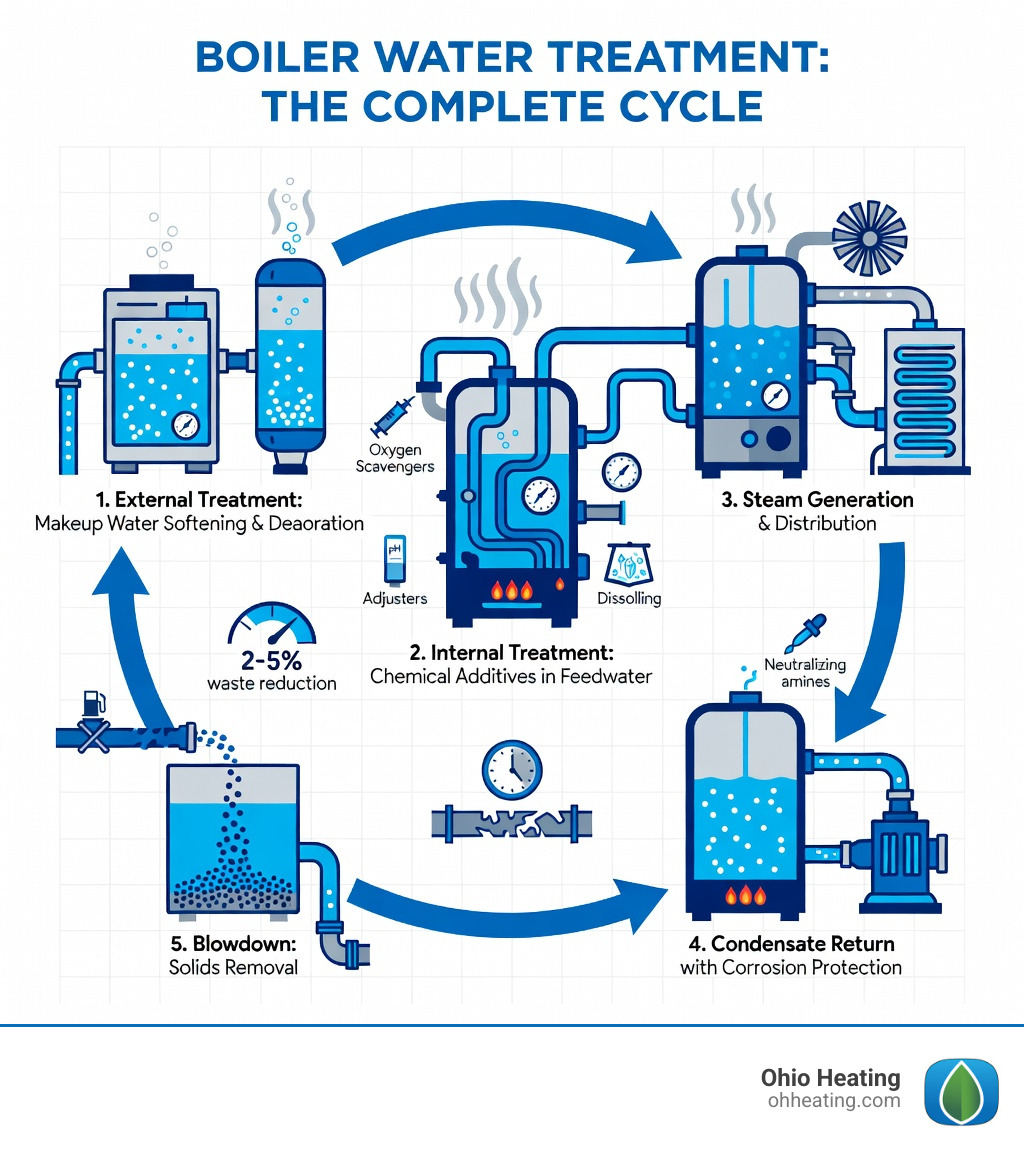
Key Boiler water treatment vocabulary:
Why The Essentials of Boiler Water Treatment Matter
At Ohio Heating, we often tell our clients that the water inside a boiler isn’t just “water”—it’s the lifeblood of the system. In Central Ohio, where well water can have as high as 1,250 ppm of dissolved solids, ignoring water quality is a recipe for disaster. Proper Boiler water treatment is essential because it directly impacts your bottom line.
When a boiler operates with untreated water, the primary victim is efficiency. Fuel wasted due to scale accumulation can range from 2% to 5% depending on the thickness of the deposit. While that might sound small, for a large commercial facility, that’s thousands of dollars literally going up the chimney. By investing in energy-efficient boilers, you’re already ahead of the game, but even the best tech can’t overcome the insulating properties of mineral scale.
Beyond fuel costs, we have to consider the environment. Higher fuel consumption leads to increased carbon emissions. Furthermore, poor water chemistry accelerates the aging of your equipment. Instead of a boiler lasting 25 years, you might find yourself looking for boiler installation insights for Columbus homeowners much sooner than expected.
Safety is the most critical factor. Untreated water leads to “hot spots” where scale prevents water from cooling the metal. This can cause the metal to overheat and rupture, leading to catastrophic failure. Following boiler care strategies for Columbus businesses ensures that your system remains a safe, reliable asset rather than a liability. To get the best results, you must Learn the industrial boiler water treatment basics and apply them consistently.
Common Problems Caused by Untreated Water
If you’ve ever seen the inside of a neglected boiler, it looks a bit like a cave filled with stalactites. Untreated water introduces several “villains” into your system:
- Scaling: This is the most common issue. Minerals like calcium and magnesium precipitate out of the water and bake onto the hot metal surfaces. This creates a hard, rock-like layer that acts as an insulator, forcing the boiler to work harder to transfer heat.
- Oxygen Pitting: Dissolved oxygen is incredibly aggressive at high temperatures. It creates tiny, deep holes in the metal (pitting) that can eat through a boiler tube in a shockingly short amount of time.
- Acid Attack: If the pH of your water drops too low, the water becomes acidic. This causes general thinning of the metal surfaces. Carbonic acid is a frequent culprit here, often formed when CO2 dissolves into the condensate.
- Fouling: This occurs when suspended solids, like sand or iron, settle in low-flow areas of the boiler, creating a “sludge” that prevents proper circulation.
Recognizing these issues early is key. We recommend keeping an eye out for Signs your boiler is running inefficiently, such as rising fuel bills or unusual noises.
Preventing Foaming and Carryover in Boiler Water Treatment
Have you ever watched a pot of pasta boil over? That’s essentially what “foaming” is in a boiler. When the water contains too many dissolved solids or certain organic contaminants (like oils), the bubbles on the surface don’t pop. Instead, they build up into a thick foam.
When this foam gets sucked into the steam outlet, it’s called carryover. This is bad news because it carries liquid water and chemicals into your steam pipes, which can damage control valves, restrict steam traps, and even cause “water hammer”—a violent banging that can rupture pipes.
To prevent this, we use anti-foaming agents and maintain strict control over Total Dissolved Solids (TDS). Under constant load, entrained moisture should be less than 2%. If you notice your steam quality dropping or your water level surging wildly, you might need Urgent boiler repair: 5 critical signs you can’t ignore.
Managing Blowdown and TDS in Boiler Water Treatment
Since a boiler evaporates pure water into steam, the minerals left behind become more and more concentrated. To keep these solids under control, we perform a “blowdown.”
- Surface Blowdown: Removes the “creamy” top layer of water where dissolved solids and oils congregate.
- Bottom Blowdown: A quick, high-pressure blast from the bottom of the boiler to eject heavy sludge and suspended solids.
About 1,000 ppm is generally considered the safe maximum for TDS in many boiler systems. If you exceed this, you risk scaling and foaming. However, you don’t want to blow down too much, as you’re literally throwing away heated, treated water. It’s a delicate balance of energy conservation and system health. For those in our service area, we provide expert Boiler repair and maintenance in Bexley, Ohio to help manage these cycles perfectly.
Internal vs. External Treatment Methods
We generally divide Boiler water treatment into two categories: what happens before the water hits the boiler and what happens inside the boiler.
| Feature | External Treatment (Pre-Boiler) | Internal Treatment (In-Boiler) |
|---|---|---|
| Location | Feedwater lines, softeners, deaerators | Inside the boiler drum/tubes |
| Primary Goal | Remove impurities (hardness, gases) | Condition water and protect metal |
| Equipment | Water Softeners, RO Systems, Deaerators | Dosing pumps, chemical tanks |
| Methods | Ion exchange, filtration, heating | Chemical reactions, sludge conditioning |
External treatment is always the first line of defense. It is much more reliable to remove a mineral than to try to “neutralize” it inside the boiler. We use water softeners to swap calcium for sodium and deaerators to heat the water and vent out dissolved oxygen. For high-pressure systems, Reverse Osmosis (RO) or demineralization is often necessary to remove almost all Boiler water impurities.
Internal treatment acts as a safety net. Even the best softener might let a little hardness through. Internal chemicals react with that hardness to turn it into a soft, non-adherent sludge that can be easily removed via blowdown.
Essential Chemicals and System Parameters
Maintaining the right “recipe” for your boiler water is a science. At Ohio Heating, our technicians use specialized testing kits to monitor these levels.
The Chemical Toolbox:
- Oxygen Scavengers: Chemicals like sodium sulfite or hydrazine “eat” the remaining oxygen. 70°F water contains 8.6 ppm of oxygen, while 212°F water at 0 psig contains 0.0 ppm. Heating is the first step; scavengers do the rest.
- Scale Inhibitors & Phosphates: These keep minerals in suspension or turn them into soft sludge.
- pH Adjusters: We aim for a boiler water pH of 11. This high alkalinity helps form a protective “magnetite” layer on the steel, which prevents further corrosion.
- Neutralizing Amines: These are added to protect the condensate return lines. As steam cools back into water, it can become acidic; amines keep the pH between 7.5 and 8.5 to protect the return piping.
If you are starting up a new system or putting one into “layup” for the summer, special care is needed. A “boil-out” with caustic chemicals removes oils left over from manufacturing. For wet storage, we spike the sulfite levels to 200 ppm to ensure no oxygen can attack the metal while it’s sitting idle. We offer comprehensive Boiler repair and maintenance in Powell, Ohio to assist with these seasonal transitions.
Specialized Considerations for Different Boiler Types
Not all boilers are created equal, and their water treatment needs vary wildly.
- Fire-tube Boilers: These are the workhorses of many Columbus buildings. They are more forgiving of water quality but still require diligent blowdown to manage sludge.
- Water-tube Boilers: These operate at higher pressures and have much higher heat transfer rates. They require extremely pure water (often RO treated) because even a tiny bit of scale can cause a tube to overheat and burst instantly.
- Clayton & Miura Boilers: These are “specialty” boilers. Clayton boilers use a helical coil and are “once-through” systems. Because the tubes are small, you cannot use phosphate programs that create sludge, or you’ll plug the coil. Miura boilers are known for their quick 5-minute startups but require very consistent water softening.
- Aluminum Heat Exchangers: Some modern high-efficiency boilers use aluminum. Unlike steel boilers that love a pH of 11, aluminum will dissolve at that level! These systems typically require a pH between 6.0 and 8.5.
Whether you have a standard unit or a specialty system, we provide commercial boiler sales and repair tailored to your specific equipment. We also specialize in Boiler installation and replacement in Gahanna, Ohio for those looking to upgrade to modern, high-efficiency models.
Frequently Asked Questions about Boiler Maintenance
How often should I test my boiler water?
For most commercial systems, we recommend maintaining weekly logs. This includes testing for hardness, pH, sulfite levels, and TDS. If you have a high-pressure or high-demand system, daily testing may be required. Having a professional consultant or an Ohio Heating technician supervise your program ensures that small imbalances don’t turn into expensive repairs.
What are the risks of ignoring water treatment?
The most immediate risk is efficiency loss, leading to higher fuel bills. Long-term risks include tube ruptures, which cause costly downtime and potential safety hazards for building occupants. In a worst-case scenario, a completely neglected boiler can experience a pressure vessel failure.
How does oxygen affect my boiler system?
Oxygen is the “silent killer.” It causes oxygen pitting, where concentrated corrosion eats small holes through the metal. As water heats up, its ability to hold oxygen decreases. This is why we use deaerators to heat feedwater to near-boiling (212°F) to vent the gas before it enters the boiler.
Conclusion
A “happy” boiler is one that is clean, balanced, and consistently monitored. At Ohio Heating, we’ve been serving the Columbus and Central Ohio area since 1999, ensuring that businesses and homeowners don’t have to worry about their heating systems failing when the temperature drops.
Boiler water treatment isn’t just a chore—it’s an investment in operational reliability. By combining data-driven insights with professional monitoring, you can save thousands in fuel costs and avoid the headache of emergency repairs.
Ready to ensure your system is in top shape? From routine maintenance to Boiler sales and service, our team is here to help. Let us take the guesswork out of your water chemistry so you can focus on what you do best. Contact us today to set up a custom treatment plan for your boiler!