
Why Commercial Temperature Control is the Hero Your Building Deserves
Why Commercial Temperature Control Matters More Than You Think
Commercial temperature control is the process of managing heating, cooling, and ventilation in non-residential buildings to keep occupants comfortable, protect equipment, and maintain safe conditions around the clock.
Here’s a quick snapshot of what it covers:
- What it is: Systems and methods that regulate indoor temperatures in offices, retail spaces, hotels, data centers, warehouses, and more
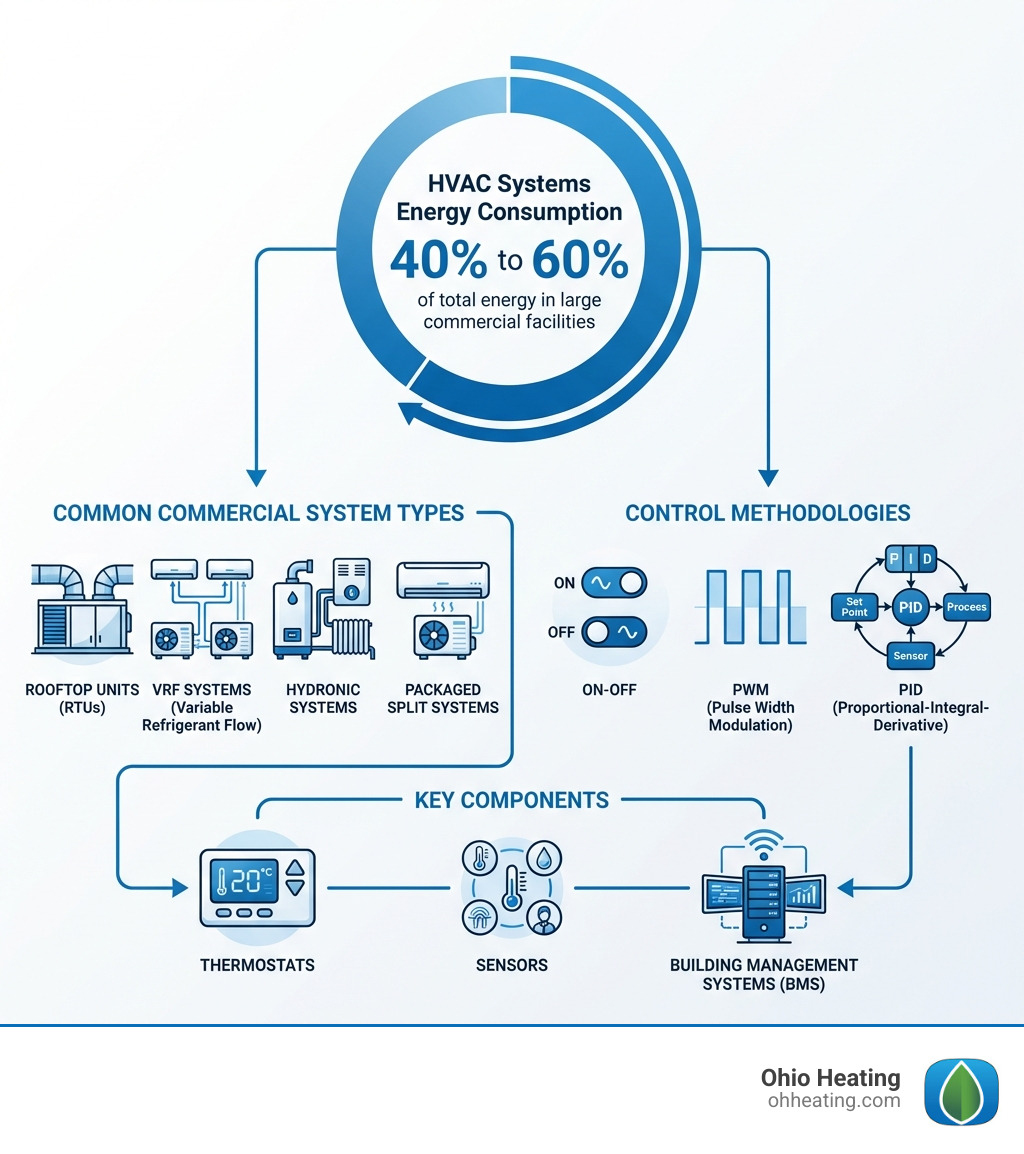
- Why it matters: HVAC systems account for 40–60% of total energy use in large commercial facilities — making control a direct driver of operating costs
- Common system types: Rooftop units (RTUs), hydronic/chilled-water systems, Variable Refrigerant Flow (VRF), and packaged split systems
- Control methods: On-off switching, Pulse Width Modulation (PWM), and PID (Proportional-Integral-Derivative) closed-loop control
- Key components: Thermostats, sensors, electronic controllers, heat exchangers, and Building Management Systems (BMS)
- Who needs it: Property managers and business owners responsible for occupant comfort, asset protection, and operational continuity
When temperature control fails in a commercial building, the consequences are immediate — uncomfortable tenants, damaged inventory, equipment shutdowns, and expensive emergency repairs. And because HVAC systems carry such a heavy share of a building’s energy budget, even small inefficiencies add up fast.
I’m Jill Frattini, Service Coordinator at Ohio Heating in Columbus, OH, where I’ve spent years coordinating HVAC, refrigeration, and boiler services — giving me a front-row seat to the real-world challenges of commercial temperature control. In this guide, I’ll walk you through everything you need to know to make smarter decisions for your facility.
Key terms for Commercial temperature control:
Understanding Commercial Temperature Control and Its Critical Role

In facility management, commercial temperature control isn’t just about making sure people aren’t wearing parkas at their desks. It is a sophisticated orchestration of mechanical and electronic systems designed to maintain a specific environment. Unlike residential systems, which might only care about one or two rooms at a time, commercial systems must manage massive volumes of air across diverse zones—from a sun-drenched glass lobby to a windowless server room.
For many businesses in Columbus, Ohio, this control is the difference between profit and loss. In a retail setting, a failed cooling system means customers leave. In a warehouse, it could mean thousands of dollars in spoiled inventory. Understanding Industrial HVAC Systems: How They Work is the first step in realizing that these systems are high-performance machines that require a different level of expertise than your home furnace. At Ohio Heating, we specialize in these complex environments, providing the Commercial HVAC services necessary to keep Central Ohio businesses running smoothly.
The Importance of Commercial Temperature Control in Modern Facilities
Modern buildings are incredibly dynamic. Think about an office building on a typical Ohio day: the east side of the building might be baking in the morning sun while the west side is still chilly. A high-quality commercial temperature control system must react to these changes in real-time.
Beyond simple comfort, precise control is mandatory for:
- Scientific Labs: Where a two-degree fluctuation can ruin months of research.
- Data Centers: Where hardware generates immense heat and requires 24/7 cooling to prevent catastrophic failure.
- Indoor Air Quality (IAQ): Proper temperature management is linked to humidity control. If the temperature isn’t managed correctly, humidity can spike, leading to mold growth and poor air quality. Temperature and humidity controls for air-conditioning in commercial applications are essential for achieving “hygroscopic comfort”—the perfect balance where air movement, purity, and temperature meet.
Commercial vs. Residential and Industrial Systems
While the basic science of moving heat remains the same, the scale and priorities of these systems differ wildly.
- Scale and Load: Residential systems are built for intermittent use. Commercial systems face “heavy heat loads” from occupants, computers, and lighting, often requiring continuous operation.
- Zoning Complexity: Your home might have one or two zones. A commercial building in Columbus might have dozens, each requiring its own setpoint. This is where Air Balance in Columbus Ohio becomes critical. Without proper balancing, one office will be an icebox while the next is a sauna.
- Industrial Precision: Industrial HVAC often prioritizes process endurance over occupant comfort. While commercial systems focus on the “people,” industrial systems focus on the “product” or “machine,” often requiring even tighter tolerances.
Advanced Methodologies for Commercial Temperature Control
How does a building actually “decide” when to turn the heat on or off? It comes down to the control methodology used by the system’s brain—the controller or Nano PLC.
| Methodology | How It Works | Best For | Pros | Cons |
|---|---|---|---|---|
| On-Off | Full power until setpoint is reached, then zero power. | Simple heaters, small pumps. | Inexpensive, easy to set up. | Constant “overshooting” of temperature; wear on equipment. |
| PWM | Switches power on/off in rapid pulses to simulate variable speed. | Electric heat coils, fans. | More precise than on-off; no mechanical wear. | Can cause electrical noise; less precise than PID. |
| PID | Mathematical “closed-loop” that adjusts output based on error. | Large AHUs, chilled water valves. | Extremely stable; eliminates fluctuations. | Complex to program and “tune.” |
For those looking to dive deeper into the technical side, you can Log-in for an online machinery control training course to see how these logic gates function. At Ohio Heating, we use these advanced methods within our Ohio Control Solutions to ensure your building isn’t just “on,” but operating with surgical precision.
Simple On-Off and Pulse Width Modulation (PWM)
The most basic form of commercial temperature control is the On-Off control. Imagine a thermostat set to 72 degrees. When the room hits 71, the heater kicks on at 100% power. When it hits 73, it shuts off completely. The problem? The heater is still hot when it shuts off, so the room might climb to 75. This “overshoot” is inefficient and uncomfortable.
Pulse Width Modulation (PWM) is a step up. Instead of just “On” or “Off,” it uses variable width pulses of full power. If the room needs just a little heat, the pulses are short. If it’s freezing, the pulses are long. This allows for a more “average” power delivery that is much smoother than standard on-off cycling. Check out our Details on Conventional Controls to see where these applications still make sense for budget-conscious facilities.
Proportional, Integral, Derivative (PID) Control
The gold standard for modern commercial temperature control is PID control. This is a “closed-loop” system that doesn’t just look at the current temperature; it looks at how fast the temperature is changing and how long it has been away from the setpoint.
- Proportional: Looks at the current error (how far are we from the goal?).
- Integral: Looks at the history (how long have we been too cold?).
- Derivative: Predicts the future (how fast are we heating up?).
By summing these three factors, a PID controller can adjust a damper position or a valve to exactly the right percentage—say, 14.5% open—to keep the temperature perfectly flat. This level of sophistication is a core part of modern Building and Energy Management, saving businesses thousands in energy by avoiding the “energy spikes” of older systems.
Key Components and System Types in Commercial HVAC
A system is only as good as its parts. In a commercial setting, you aren’t just looking at a thermostat on the wall; you’re looking at a network of interconnected components. This includes high-accuracy sensors, electronic controllers, and robust heat exchangers. In Columbus, many larger buildings rely on Chilled Water Air Handlers to distribute cooling efficiently across multiple floors.
Selecting the Right Commercial Temperature Control System
Choosing a system depends on your building’s architecture and your specific needs.
- Direct Expansion (DX): These systems use refrigerant directly in the cooling coils. They are common in Direct Expansion Coils in Columbus Ohio applications and are often found in Rooftop Units (RTUs). They are generally easier to install but less efficient for massive skyscrapers.
- Hydronic Systems: These use water or glycol as the heat transfer fluid. They are incredibly efficient for large-scale applications but require more maintenance (pumps, chillers, and cooling towers).
- Water-Source Heat Pumps: These are great for buildings that need simultaneous heating and cooling in different zones, as they can move heat from one part of the building to another.
- Rooftop Units (RTUs): The “all-in-one” solution. These are the most common commercial systems because they save indoor space and are easy to service.
The Role of BAS and BMS in Modern Buildings
In the 21st century, commercial temperature control is synonymous with a Building Automation System (BAS) or Building Management System (BMS). This is the “central nervous system” of your building.
A BAS allows us to:
- Centralize Monitoring: See every thermostat and sensor from a single computer screen.
- Predictive Maintenance: The system can alert us if a motor is drawing too much current before it fails.
- Remote Access: Adjust the heat in a Columbus warehouse from an iPad at home.
- Energy Optimization: Automatically dim lights and reduce HVAC in unoccupied zones.
If your building is still using manual thermostats, you’re likely leaving money on the table. Learn more about the BAS Systems in Columbus Ohio that we install to bring older buildings into the modern age.
Optimizing Energy Efficiency and System Longevity
With HVAC accounting for roughly 40% of a building’s energy use, efficiency isn’t just a “green” goal—it’s a financial necessity. According to the U.S. Department of Energy, upgrading to energy-efficient controls can save a large facility upwards of $36,000 annually.
One of the biggest heroes in this space is the Variable Frequency Drive (VFD). Instead of a fan motor running at 100% or 0%, a VFD allows the motor to spin at exactly the speed needed. If the building only needs 30% airflow, the motor only uses 30% power. We frequently perform energy audits to help our clients understand how Energy Management can drastically lower their overhead. You can also check the latest U.S. Department of Energy SEER requirements to see if your current equipment is even legal by modern standards.
Maintenance Best Practices for Reliability
A commercial temperature control system has a typical lifecycle of 15 to 25 years, but only if it’s cared for. Neglect leads to “short cycling,” where the system turns on and off too rapidly, wearing out compressors and motors years ahead of schedule.
Our Maintenance Services focus on:
- Coil Cleaning: Dirty coils force the system to work harder to transfer heat, spiking energy bills.
- Sensor Calibration: If a sensor is off by just 2 degrees, your system might be fighting a “ghost” heat load.
- Defrost Management: In refrigeration, ensuring defrost cycles are timed correctly prevents ice buildup that can kill a compressor.
- Filter Changes: The simplest, yet most ignored, maintenance task.
Smart Technologies and Zoning
The future of commercial temperature control lies in Variable Refrigerant Flow (VRF) and smart zoning. VRF systems are incredibly “smart”—they can send cooling to a server room while simultaneously using the heat captured from that room to warm the lobby.
We also utilize Pneumatic Systems in Columbus Ohio for certain specialized applications, though many are being converted to electronic “DDC” (Direct Digital Control) systems. Smart sensors and multi-zone dampers allow for “Demand-Controlled Ventilation,” which only brings in fresh outdoor air when CO2 sensors detect that people are actually in the room.
Frequently Asked Questions about Commercial Temperature Control
What is the difference between a rack system and a split system?
A split system is what you usually see in small offices—one indoor unit connected to one outdoor compressor. A rack system (or centralized system) is common in supermarkets and large industrial refrigeration. It uses a “rack” of multiple compressors that work together to serve dozens of different evaporators (like walk-in coolers and display cases). This allows for “staged capacity”—the system only runs as many compressors as needed to meet the current load.
Why are defrost cycles necessary in commercial refrigeration?
When cooling coils operate below the freezing point, moisture in the air condenses and turns into frost on the coil. If that frost builds up, it acts as an insulator, blocking airflow and preventing the refrigerant from absorbing heat. Defrost cycles (using electric heat or hot gas) periodically melt this ice to restore heat transfer integrity. Without them, your “cold” room will eventually become a “warm” room filled with ice.
How can temporary rental equipment help my business?
Renting temperature control equipment is a lifesaver for:
- Emergency Failures: If your main chiller dies in July, a rental can keep you in business while we source parts.
- Seasonal Peaks: If your data center gets too hot only during August heatwaves, a temporary unit provides supplemental cooling.
- Planned Maintenance: Renting a unit allows us to take your main system offline for major repairs without shutting down your building.
- Tax Benefits: Rentals are often classified as an “operating expense” rather than a “capital expense,” which can be easier for some management teams to approve.
Conclusion
At the end of the day, commercial temperature control is about peace of mind. You want to know that when you walk into your facility, the air is clean, the temperature is steady, and your energy bill isn’t skyrocketing.
Since 1999, Ohio Heating has been the trusted partner for businesses across Columbus and Central Ohio. From complex Air Balance in Columbus Ohio projects to the installation of cutting-edge Building Automation Systems, we ensure your building performs at its best. Don’t let your HVAC system be a source of stress—let it be the silent hero that supports your success.
Ready to take control of your building’s climate? Contact Ohio Heating today and let’s build a system your facility deserves.