
Commercial HVAC Control Systems: Don’t Let Your Building Have a Meltdown
The Evolution of Commercial AC Control Systems
Commercial AC control systems are the “brain” of your building’s cooling and ventilation — they monitor conditions, make decisions, and automatically adjust equipment to keep temperatures stable and energy use in check.
Here’s a quick breakdown of what they do and why they matter:
| Function | What It Does |
|---|---|
| Temperature regulation | Reads sensor data and adjusts cooling output to hit setpoints |
| Zoning | Controls different areas independently based on occupancy or use |
| Scheduling | Reduces cooling during off-hours to cut energy waste |
| System integration | Connects AC with lighting, security, and fire safety |
| Fault detection | Flags equipment issues before they cause failures |
| Energy monitoring | Tracks consumption and identifies savings opportunities |
For property managers and business owners, a failed or poorly managed control system doesn’t just mean discomfort — it means unexpected downtime, higher utility bills, and potential damage to assets. Cooling operation already accounts for nearly half of a commercial facility’s total energy use. Without smart controls, that number climbs fast.
The good news? Whether you’re running a single office building or a multi-site portfolio, modern cooling controls give you the tools to stay ahead of problems — not react to them.
I’m Jill Frattini, Service Coordinator at Ohio Heating in Columbus, OH, and I’ve spent years helping businesses across Ohio get more reliability and efficiency out of their commercial AC control systems. In this guide, I’ll walk you through everything you need to know — from how these systems work to when and how to upgrade them.
Core Components of a Cooling Control Network
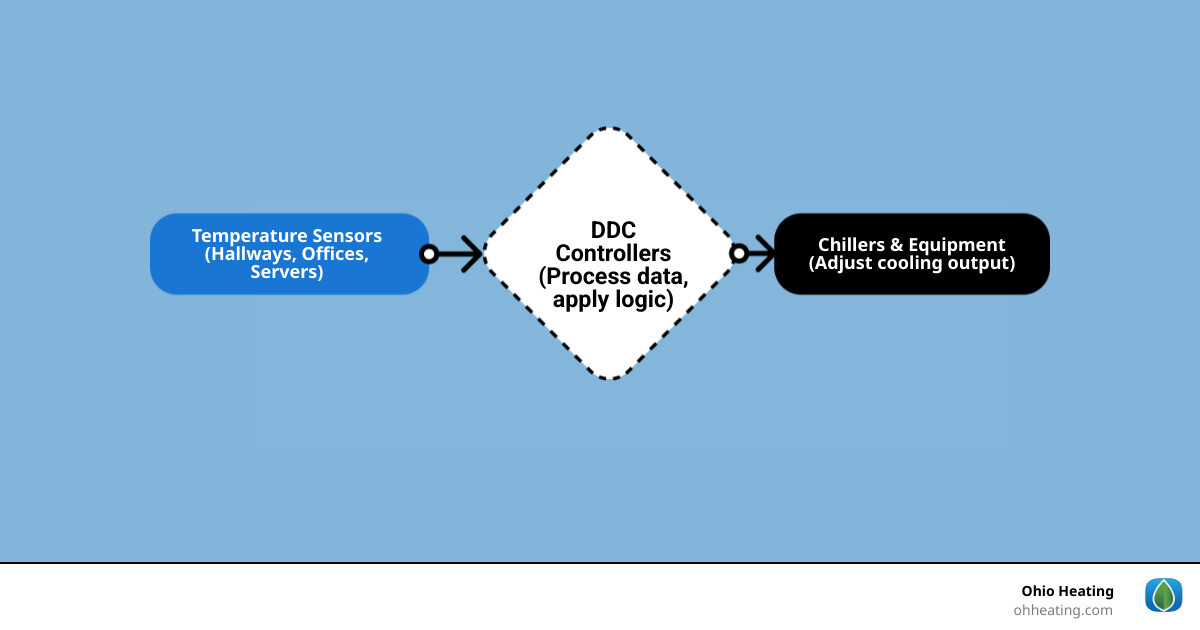
Think of your commercial AC control systems like a human body. You have the “senses” (sensors), the “brain” (controllers), and the “muscles” (actuators). If any one of these parts fails, the whole system starts to stumble.
To help you visualize the difference between the old way of doing things and the digital age, here is a comparison of the components we often see in the field:
| Component | Pneumatic System (Legacy) | DDC System (Modern) |
|---|---|---|
| Power Source | Compressed air | Low-voltage electricity |
| Communication | Air pressure changes | Electronic data packets |
| Accuracy | Moderate (drifts over time) | High (digital precision) |
| Maintenance | High (leaks, compressors) | Low (software updates) |
| Integration | Difficult/Manual | Seamless (BACnet/Modbus) |
If you want to dive deeper into how these parts work together, you can explore our control solutions to see the specific hardware we use to keep Ohio buildings cool.
Input Devices and Sensors
The “eyes and ears” of your system are the sensors. Modern commercial AC control systems use a variety of inputs to make smart decisions:
- Temperature Probes: The most basic input, measuring the air inside ducts or rooms.
- Humidity Sensors: Crucial for comfort in Ohio’s muggy summers; these tell the AC to run longer to pull moisture out of the air.
- CO2 Monitoring: Measures air “freshness.” If CO2 levels rise, the system brings in more outside air.
- Occupancy Detection: Uses motion or infrared to see if a room is empty. Why cool a conference room to 68 degrees if no one is in it?
Maximizing Efficiency with Advanced AC Strategies
Installing the hardware is only half the battle. To really see a return on your investment, you need to implement smart energy management strategies. In a climate like ours, where summer humidity can be brutal, your AC doesn’t just need to work hard—it needs to work smart.
We provide comprehensive commercial AC services in Columbus to ensure these strategies are actually performing as intended. A poorly calibrated system is just an expensive way to waste electricity.
Zoning and Occupancy Scheduling
Zoning is one of the most effective ways to cut costs. By dividing your building into thermal zones, you can provide cooling only where it is needed.
- Setpoint Adjustment: You can set the server room to stay at 65 degrees while the lobby stays at 72.
- Load Shedding: During peak energy demand hours, the system can automatically dim the cooling slightly to avoid high utility surcharges.
- Night Setback: This is the “low-hanging fruit” of energy savings. By letting the building warm up slightly during unoccupied night hours, you reduce the workload on your compressors.
Predictive Maintenance and AI
The future of commercial AC control systems is already here with AI and IoT (Internet of Things) integration. Instead of waiting for a tenant to call and complain that it’s 80 degrees in their office, modern systems use fault detection and diagnostics.
The system can monitor the performance of a cooling coil and notice that it’s taking 10% longer to reach the setpoint than it did last month. It then sends an alert to our team at Ohio Heating, allowing us to fix a small refrigerant leak or a dirty filter before it turns into a total system meltdown. This kind of real-time monitoring and performance analytics transforms maintenance from a chore into a strategic advantage.
Transitioning from Legacy to Smart Cooling Controls
Many iconic buildings in downtown Columbus still rely on pneumatics in Columbus Ohio. While we have a lot of respect for these “tank-like” systems, they are increasingly expensive to operate. Pneumatic compressor maintenance alone can be a full-time job for a facility manager.
However, you don’t always have to rip everything out at once. We often recommend phased upgrades. This involves:
- Installing a digital “head-end” controller.
- Replacing the most critical zone thermostats with digital versions.
- Gradually swapping out pneumatic actuators for electronic ones over several budget cycles.
Benefits of Digital Upgrades
When you move to a digital BAS system in Columbus Ohio, the benefits are immediate:
- Remote Access: No more driving to the building at 2:00 AM because an alarm went off. Check it from your phone.
- Data Logging: Prove that you are meeting your sustainability goals with hard data on energy reduction.
- Precision Cooling: Eliminate the “hot spots” and “cold spots” that lead to employee complaints.
- System Longevity: By running equipment more efficiently (and less often), you extend the life of your expensive chillers and air handlers.
Integration with Other Building Systems
Modern commercial AC control systems don’t live on an island. They use open standard protocols like BACnet or Modbus to talk to other building systems.
- Lighting Coordination: When the occupancy sensor sees the lights go off, it tells the AC to stop cooling that room.
- Security Syncing: When the last employee swipes their badge to leave the building, the entire AC system can shift into “unoccupied” mode.
- Fire Safety: In the event of a fire, the control system can automatically shut down fans to prevent the spread of smoke.
Frequently Asked Questions about Cooling Controls
What are the primary functions of commercial AC controls?
The primary functions are to maintain occupant comfort, ensure indoor air quality, and protect building assets. They do this by regulating temperature, managing humidity, and controlling the flow of fresh air through the facility.
How do control systems improve energy efficiency in large buildings?
They improve efficiency by ensuring that cooling is only delivered when and where it is needed. Through strategies like variable fan speeds, occupancy scheduling, and demand-responsive cooling, a well-tuned control system can reduce energy consumption by up to 30% or more.
Can I upgrade my old pneumatic system without replacing all the equipment?
Yes! This is a very common request. We can install pneumatic thermostats in Columbus Ohio that have digital interfaces, or use transducers to allow a modern DDC “brain” to talk to your existing pneumatic systems in Columbus Ohio. This gives you the benefits of digital control without the massive cost of a full mechanical overhaul.
Conclusion
Your building’s cooling system is one of your largest investments. Leaving its operation to chance—or to an outdated, uncalibrated control system—is a recipe for high costs and headaches. At Ohio Heating, we believe that commercial AC control systems should be invisible: they should just work, keeping your tenants happy and your energy bills low without you ever having to think about it.
From the initial installation of a BAS system to the ongoing customer services required to keep it running at peak performance, our team is here to help businesses across Central Ohio stay cool.
Don’t wait for a summer heatwave to find out your controls aren’t up to the task. Whether you need a simple repair or a full enterprise-level upgrade, we have the expert Ohio control solutions to keep your facility running reliably for years to come. Give us a call today and let’s make sure your building never has a meltdown.