
Makeup Air Unit Basics for Columbus Commercial Kitchens
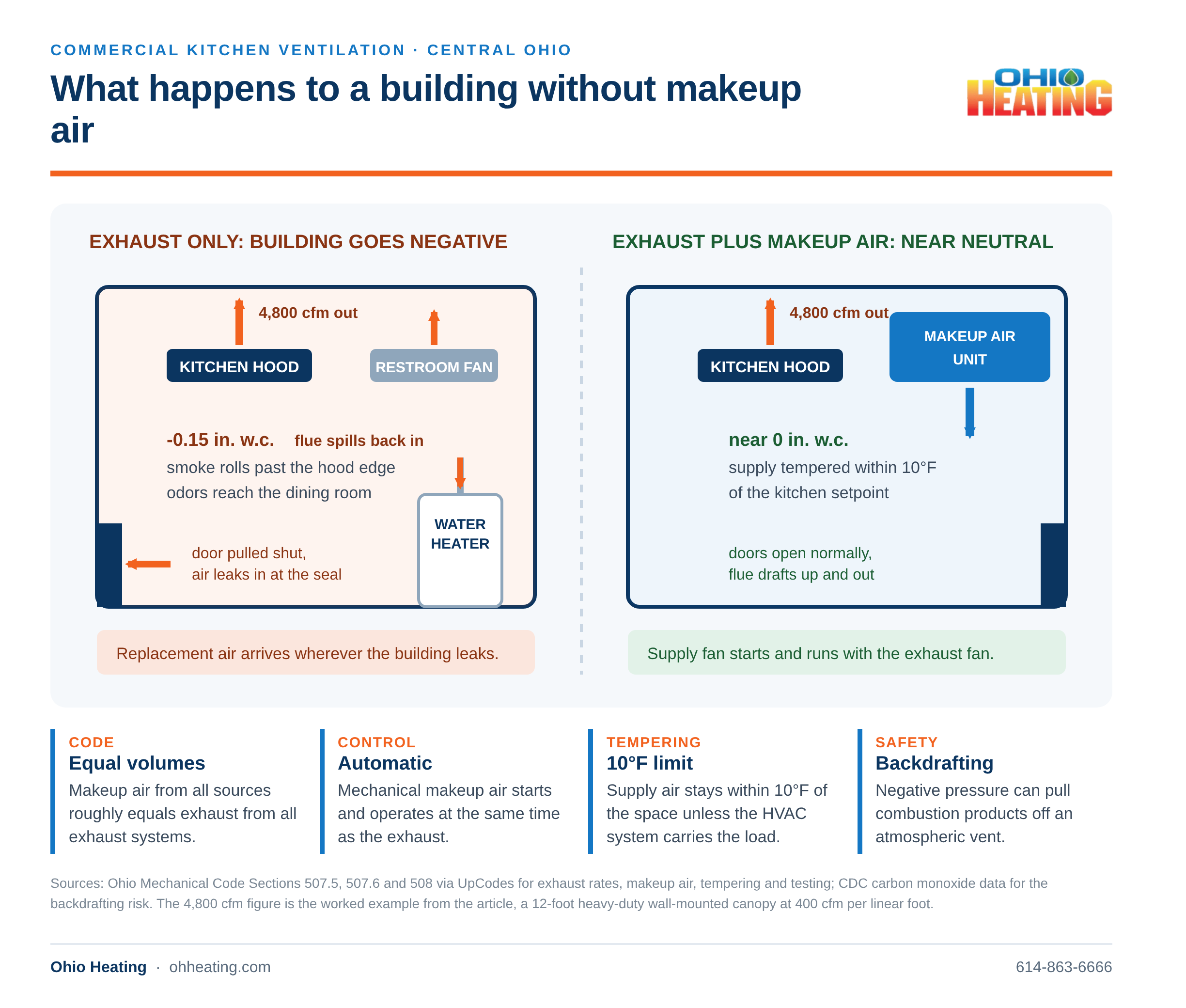
A kitchen manager calls because the front door takes two hands to open during dinner service. The exhaust hood is letting smoke drift into the dining room, and the water heater keeps shutting down. Those complaints appear unrelated until you consider what the building exhausts. A make-up air unit puts back the outside air that hoods, dishwashers, restrooms and process fans pull out. When that unit is missing, undersized, or wired to run separately, the building solves the problem on its own through whatever crack or doorway it can find.
Air balance is not optional in Ohio. Section 508 of the Ohio Mechanical Code covers commercial kitchen makeup air. It sets the terms restaurants and institutional kitchens in Franklin County have to meet.

What Ohio code requires from a makeup air unit
Code language here is short and specific. Makeup air has to be supplied while a commercial kitchen exhaust system serving cooking appliances is running. The amount of air supplied from all sources has to be roughly equal to the amount exhausted by all exhaust systems in the building. Mechanical makeup air systems have to be controlled automatically, so they start and operate at the same time as the exhaust (Ohio Mechanical Code, Section 508).
The code also sets a temperature limit. The gap between the supply air and the air in the kitchen cannot exceed 10°F unless the added heating and cooling loads stay within the capacity of the HVAC system serving the space. Design plans for a facility with commercial kitchen ventilation also have to include a schedule or diagram showing the design for outdoor air balance. This schedule lists all exhaust and replacement air plus net exfiltration. Total replacement airflow equals total exhaust airflow plus that exfiltration (Ohio Mechanical Code 508.1).
Getting the air balance schedule onto the drawings lets the plans examiner check your exhaust and makeup air numbers before anything is built. Without it, a mismatch can show up in the first cold snap. The dining room will end up running cold because the unit is pulling in outside air faster than the system can heat it.
Sizing starts with the hood, not the unit
Exhaust volume drives everything, and the code sets minimum net airflow, in cubic feet per minute or cfm, by hood style and by how hard the appliances under it work. Where heavy, medium and light-duty appliances share one hood, the exhaust rate for the heaviest duty appliance applies to the whole hood (Ohio Mechanical Code Section 507.5).
| Appliance duty | Wall-mounted canopy | Single island canopy | Backshelf or pass-over |
|---|---|---|---|
| Extra-heavy-duty. | 550 cfm per linear foot. | 700 cfm per linear foot. | Not allowed. |
| Heavy-duty. | 400 cfm per linear foot. | 600 cfm per linear foot. | 400 cfm per linear foot. |
| Medium-duty. | 300 cfm per linear foot. | 500 cfm per linear foot. | 300 cfm per linear foot. |
| Light-duty. | 200 cfm per linear foot. | 400 cfm per linear foot. | 250 cfm per linear foot. |
Values come straight from Sections 507.5.1 through 507.5.4 of the Ohio Mechanical Code (Ohio Mechanical Code Section 507.5). Run the arithmetic on a 12-foot wall-mounted canopy over a charbroiler and a fryer, both heavy-duty. That is roughly 4,800 cfm from one hood, before you count the dishwasher hood, the restrooms, or the walk-in condenser.
Net exhaust is what counts. Air supplied directly into a hood cavity gets subtracted from the hood’s total exhaust flow. Compensating hoods use that math to reduce the load on separate air units. Manufacturers of compensating hoods have to label the minimum exhaust flow, the maximum makeup airflow, or both while still showing capture and containment numbers (Ohio Mechanical Code Section 508.2).
How to tell your building is running negative
You rarely get a clean alarm for negative pressure. You get nuisances that staff learn to work around. Exterior doors resist opening or whistle at the seal. Smoke rolls out at the edges of the hood instead of getting captured, cooking odors reach the dining room or upstairs tenants, drafts show up at ground-floor entries, and gas appliances with atmospheric vents spill combustion products rather than drafting up the flue.
Backdrafting is a safety problem rather than a comfort complaint. A water heater or atmospheric boiler that backdrafts puts combustion products into the building. The CDC attributes more than 400 unintentional non-fire carbon monoxide deaths a year in the United States, plus more than 100,000 emergency department visits (CDC carbon monoxide). If your kitchen exhaust runs at full speed while a gas-fired appliance shares the same space, look at the supply air path this month. It should not wait for spring.
The performance test settles arguments
Ohio code requires a performance test before final approval of a ventilation system serving commercial cooking appliances. It verifies exhaust airflow, the make-up airflow required by Section 508, and proper operation. Capture and containment gets its own field test. It runs with appliances under the hood at operating temperature, with all sources of outdoor air providing makeup air for the hood operating, and with all sources of recirculated air for the space operating. Capture is verified visually by observing smoke or steam from actual or simulated cooking (Ohio Mechanical Code Sections 507.6 and 507.6.1).
Ask for those numbers when a kitchen changes. Adding a second fryer, swapping a griddle for a charbroiler, or replacing a hood fan with a larger one changes the exhaust side without touching the supply side. Nobody notices until dinner service starts. Grease removal and cleaning sit on the same schedule. NFPA 96 governs that side of the work (NFPA 96).
Our team designs and services these air systems across Central Ohio. That work includes commercial ventilation systems and rooftop installation and repair when a unit is at the end of its life. Our commercial HVAC maintenance keeps the exhaust and supply sides tested together, not one at a time.
Frequently asked questions
Does each commercial kitchen need its own supply unit? Not in each case. Code requires makeup air supplied by gravity, mechanical means, or both, so smaller kitchens sometimes use transfer air from an adjacent space or a compensating hood. Larger kitchens usually get a direct gas-fired or indirect-fired unit that tempers the incoming air. Larger exhaust volumes usually need dedicated equipment.
Should the makeup air be heated? In Ohio, usually yes. The code caps the temperature difference between supply and conditioned space at 10°F unless the space HVAC system can absorb the extra load, and untempered winter air in Columbus will not meet that on its own.
Why does the unit have to start with the exhaust fan? Because a mechanical supply system on a separate switch gets forgotten. Code requires automatic control so supply and exhaust start and operate simultaneously, which keeps the building near neutral pressure whenever the hood runs.
Can I just crack a door or window instead? That is uncontrolled infiltration. It puts unfiltered, untempered air wherever the leak happens to be, hurts hood capture, and does nothing for proper airflow through the rest of the building.
What paperwork should I keep on file? The design outdoor air balance schedule, the performance test results including capture and containment, and dated records of any change to hood or appliance configuration. Those three make the next inspection or insurance review straightforward.
How often should the system get checked? Tie it to your hood cleaning schedule at minimum, and re-test airflow any time appliances, hoods, or fans change. Belts, filters and dampers on the supply side drift quietly. A unit that passed two years ago may be delivering far less air today.
Doors hard to open during dinner service? Call Ohio Heating at 614-863-6666 or reach us through ohheating.com, and we will measure your building’s air balance before recommending equipment.