
Boiler Leaking Repair: Urgent Fix 2025
When Your Boiler is Leaking: Why Immediate Action Matters
Finding a puddle under your boiler is a serious issue. It signals potential water damage, operational disruptions, and the risk of a complete system failure. A leaking boiler is also a safety hazard that can damage electrical components, promote mold growth, and leave your building without heat.
Effective boiler leaking repair starts with immediate action. Follow this checklist, then call a licensed professional to diagnose and fix the problem before it worsens.
Quick Action Checklist:
- Turn off power – Switch off the boiler and flip the circuit breaker.
- Stop the water – Close the water supply valve to your boiler.
- Contain the leak – Use towels, buckets, or pans to catch dripping water.
- Call a professional – Contact a licensed technician for proper diagnosis and repair.
- Don’t restart – Keep the system off until it’s been inspected and repaired.
This guide walks you through what to do when you find a boiler leak, from initial safety steps to deciding between repair and replacement. Knowing how to respond quickly can save you thousands in damages and prevent a minor problem from becoming a major crisis.
First Response: Immediate Steps for a Leaking Boiler
Finding water under your boiler is alarming, but taking the right steps immediately can prevent a small leak from becoming a disaster. Your safety is the top priority.
First, eliminate electrical hazards. Water and electricity are a dangerous mix. Go to your boiler and turn off the power switch on the unit. Then, go to your home’s circuit breaker panel and flip the breaker for your heating system. This cuts all power and removes the risk of shock.
Next, stop the water flow. Find the water supply shut-off valve on the pipe leading into your boiler and turn it clockwise until it stops. This prevents the leak from worsening while you wait for help.
If you have a gas boiler and smell gas (a rotten egg odor) or hear hissing, turn off the gas supply immediately. The valve is on the pipe leading to the boiler; turn the handle so it’s perpendicular to the pipe. Evacuate the building, don’t use any electronics inside, and call your gas company’s emergency line from a safe location.
Now, contain the water. Use buckets and towels to catch drips and mop up any standing water to prevent floor damage, mold, and slip hazards. Even a slow drip can cause significant damage over time.
With the immediate danger handled, call for professional help. A trained technician is needed to properly diagnose the cause and perform a lasting boiler leaking repair. A simple drip could signal a more serious issue like pressure problems or failing seals. For more guidance, this resource offers additional steps.
Never restart your boiler until a licensed professional has inspected it and completed all necessary repairs. Running a leaking boiler can make the problem much worse and risk total system failure.
Diagnosing the Drip: Common Causes of Boiler Leaks
Once the immediate emergency is handled, understanding why your boiler is leaking is key to an effective boiler leaking repair. Boilers are complex, and several issues can cause a leak.

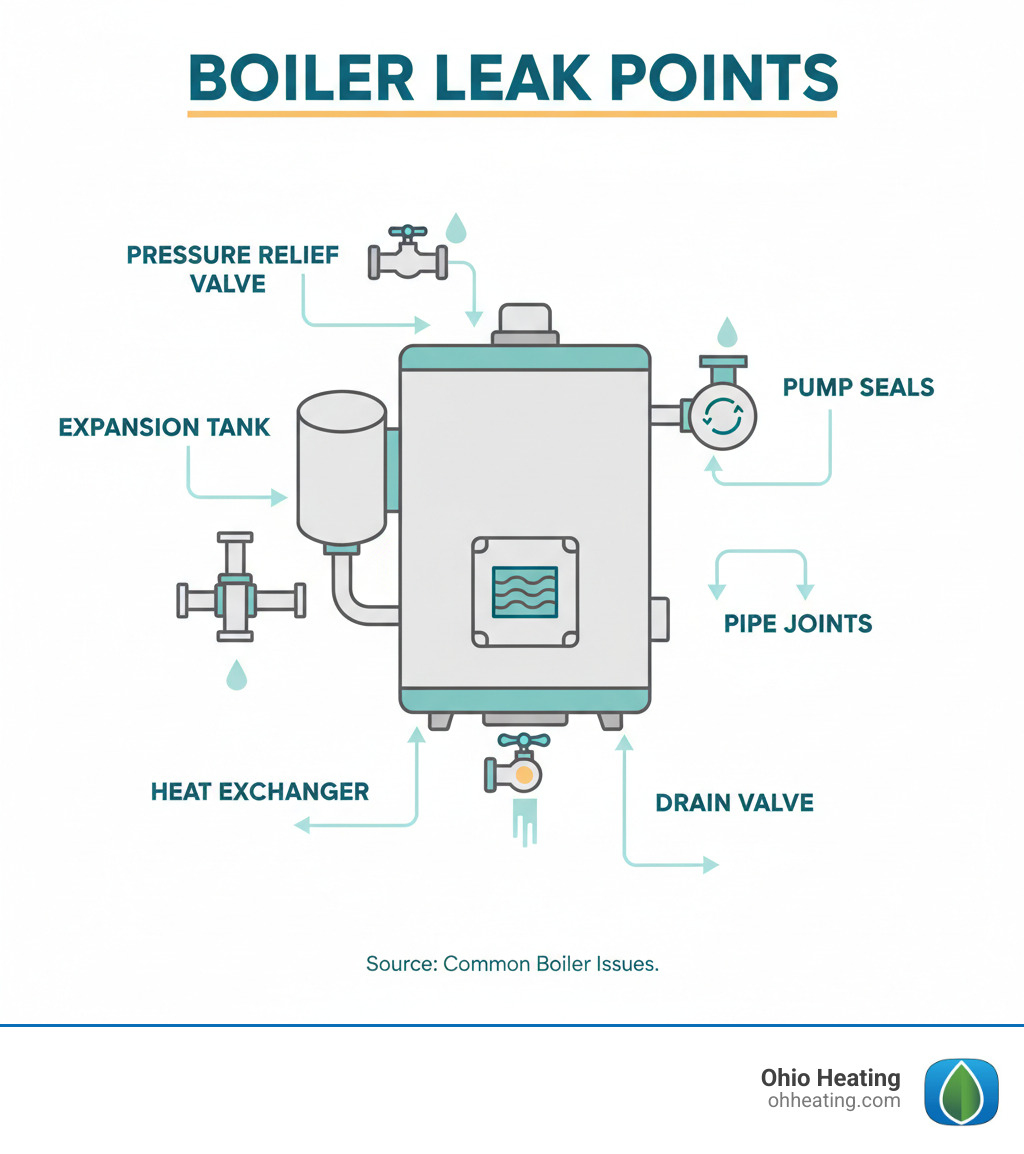
Common causes include high internal pressure, corrosion, faulty seals or loose pipework, damaged components, and even poor installation.
High Boiler Pressure
If water is dripping from an external pipe or valve, high pressure is a likely culprit. Boilers operate within a specific pressure range (typically 1-2 bar). If pressure gets too high, the pressure relief valve (PRV) opens to release it, causing a drip. This indicates an underlying problem, such as an overfilled system or a failed expansion vessel. While you can temporarily lower pressure by bleeding radiators, recurring high pressure requires a professional diagnosis to prevent further damage. For more on this, see our guide on Urgent Boiler Repair: 5 Critical Signs You Can’t Ignore.
Corrosion and Age
Boilers don’t last forever. After 15 years, the constant exposure to water and heat takes a toll. Corrosion is a primary enemy, causing internal rust that leads to pinhole leaks. You might see rust stains on the boiler casing, a clear warning sign.

The most serious issue is a cracked heat exchanger, caused by metal fatigue from constant temperature changes. This usually means the boiler needs to be replaced. If your boiler is over 15-20 years old and showing signs of corrosion, replacement is often more cost-effective than repeated repairs. An aging boiler is also less efficient, increasing your energy bills. Learn more about Signs Your Boiler is Running Inefficiently.
Faulty Seals and Loose Pipework
Sometimes, the cause is simpler. Seals and gaskets around pumps and valves can dry out, crack, and fail over time, causing drips. Similarly, pipe fittings can loosen due to vibration and thermal expansion and contraction. While tightening a fitting might seem easy, over-tightening can make the problem worse. These issues are common but best left to a professional who can identify the exact point of failure. Our team offers expert Leak Detection and Repair Services, but boiler-specific leaks require specialized HVAC knowledge.
Your Guide to Boiler Leaking Repair: DIY vs. Professional Help
When your boiler leaks, you might wonder if you can fix it yourself. While the DIY impulse is understandable, most boiler leaking repair jobs require professional expertise. Boilers combine gas, electricity, and pressurized hot water, making them unsafe for amateur repairs.
DIY Steps for Minor Boiler Leaking Repair
While waiting for a technician, there are a few temporary measures you can take after shutting off the power and water.
- Tightening fittings: If you see a drip from an accessible pipe connection, you can try gently tightening it with a wrench. Overtightening can crack the fitting and worsen the leak.
- Applying epoxy putty: For a tiny pinhole leak on a visible pipe, epoxy putty can be a temporary band-aid. Never apply it to gas lines, the boiler tank, or high-pressure fittings.
- Catching drips: Use buckets and towels to contain the water and protect your property.
Know when to stop. If you can’t find the leak’s source, it’s more than a slow drip, you smell gas, or you feel unsafe, stop immediately and wait for a professional.
When to Call a Pro for Boiler Leaking Repair
Nearly every boiler leak requires professional help. Call a technician in these situations:
- The leak source is unclear: Professionals have diagnostic tools to trace leaks to their hidden source.
- There are major cracks or a significant leak: A steady stream of water indicates a serious failure that needs immediate attention.
- You smell gas: Evacuate immediately, call your gas company’s emergency line, and then call us. Gas leaks are life-threatening and never a DIY job.
- Water is near electrical components: This is an emergency that creates a serious risk of electrocution or fire.
- You have no heat or hot water: This signals a critical component has failed.
- Welded repairs are needed: Certain repairs on pressure vessels require a company with “R stamp” certification, which ensures repairs meet strict safety standards set by the National Board of Boiler and Pressure Vessel Inspectors.
Our NATE-certified technicians have the experience to handle any leak on any boiler brand. We diagnose the problem honestly and get your system running safely again. For professional Boiler Repair and Maintenance in Columbus, OH, we’re here to help 24/7.
Repair or Replace? Making the Right Financial Decision
With a leaking boiler, the big question is whether to fix it or start fresh. This decision involves more than the immediate boiler leaking repair cost; it’s about long-term value, energy efficiency, and future reliability.
Signs Your Boiler Needs Replacement
Some repairs are worthwhile, while others are just delaying the inevitable. It’s likely time for a replacement if your boiler exhibits these signs:
- Age: If your boiler is over 15 years old, a leak can be the first of many problems. Most units last 15-20 years.
- Frequent Breakdowns: If you’re constantly paying for repairs, those costs add up. Investing in a new, reliable system is often smarter.
- Rising Energy Bills: An older boiler can operate at 60-70% efficiency, meaning it works harder and wastes money.
- Significant Corrosion: Widespread rust, especially on the heat exchanger, indicates the metal is failing and cannot be reversed.
- Obsolete Parts: If replacement parts are no longer available, a repair may be impossible.
When you see multiple warning signs, replacement often makes the most financial sense. For more insights, see our guide on Boiler Installation and Replacement for Columbus Homeowners.
The Cost of Leaks vs. The Value of an Upgrade
Let’s look at the numbers. A minor leak repair might cost $100-$300, while a new pump could be over $1,000. But that’s just the upfront cost. An old, inefficient boiler will continue to waste energy and remains at risk for another breakdown.
Replacing your boiler typically costs between $1,845 and $3,500. While this is a larger initial investment, a modern high-efficiency boiler operates at 90% efficiency or higher. This translates to lower utility bills every month, a full warranty, and 15-20 years of reliable heating.
Consider this: a $800 repair on a 17-year-old boiler is a gamble. A new boiler might cost $2,500 but could save you $300 a year on energy bills, paying for itself over time while providing peace of mind. If you’re in Dublin, we can help you make this transition. Learn more about Boiler Installation and Replacement in Dublin, Ohio.
Our job is to give you the facts so you can choose what’s right for your home or business.
How Regular Maintenance Prevents Costly Leaks
Many expensive boiler leaking repair bills could be avoided with regular maintenance. An annual service isn’t just about keeping your boiler running; it’s about catching small problems before they become big ones.
A well-maintained boiler lasts its full 15-20 year lifespan, runs more efficiently, and is less likely to surprise you with an emergency breakdown. Neglected boilers often fail years earlier and develop chronic issues like leaks.
The Annual Boiler Service Checklist
During an annual service, our certified technicians follow a comprehensive checklist to address potential weak points:
- Pressure Level Checks: We ensure your boiler operates in the optimal range (1-2 bar) to prevent stress on seals and connections.
- Corrosion Inspection: We examine all components for rust or deterioration, catching potential leaks before they start.
- Component Cleaning: We clean the burner and heat exchanger to ensure efficient operation and prevent blockages that can lead to cracks and leaks. This may include Burner Service and Replacement | Ohio Heating.
- Safety Valve Testing: We test the pressure relief valve and other safety features to ensure they function correctly in an emergency.
- Efficiency Optimization: We make adjustments to ensure your boiler runs at peak performance, lowering your energy bills.
Regular maintenance also keeps your manufacturer’s warranty valid and gives you peace of mind. For homeowners and businesses in Central Ohio, scheduling annual service is the smartest investment in your heating system. Don’t wait for a puddle to appear. We provide comprehensive Boiler Repair and Maintenance in Westerville, Ohio | Ohio Heating. Schedule your appointment today.
Frequently Asked Questions about Boiler Leaks
Dealing with a boiler leak is stressful. Here are answers to the most common questions we hear from customers across Columbus and Central Ohio.
Is a leaking boiler an emergency?
It can be. A leak is an emergency if water is near electrical components (fire/shock risk), the leak is severe (spraying or rapid dripping), or you smell gas. A gas leak requires immediate evacuation and a call to your gas provider. Even a small, slow leak is urgent, as it can quickly worsen and cause significant water damage. Always shut the system down and call a professional.
Can I still use my boiler if it’s leaking?
No. We strongly advise against it. Operating a leaking boiler can worsen the damage, increase your utility bills, and create a serious safety hazard. It may also void your manufacturer’s warranty. Turn the boiler off completely (power, water, and gas) and call for a professional inspection and repair.
How much does it cost to fix a leaking boiler?
The cost varies depending on the problem.
- Minor repairs, like tightening a fitting or replacing a gasket, may cost between $100 and $300.
- Moderate repairs, such as a new pressure relief valve or pump seal, typically range from $300 to $700.
- Major repairs, like a cracked heat exchanger, can exceed $1,000 to $2,000. At this price point, especially with an older boiler, replacement is often the more economical choice.
We always provide upfront pricing before any work begins, so you can make an informed decision without surprises.
Stay Warm and Dry with Professional Boiler Service
A leaking boiler doesn’t have to be a crisis. The key is to act quickly and safely. Always prioritize safety by turning off the power and water supply before doing anything else. While some temporary measures can contain a leak, a professional boiler leaking repair is almost always necessary for a safe, lasting solution.
Since 1999, Ohio Heating has provided reliable boiler services to homes and businesses across Columbus and Central Ohio. Our NATE-certified technicians diagnose issues accurately and provide honest recommendations for repair or replacement. We understand the importance of a dependable heating system for your comfort and peace of mind.
Your best defense against leaks is regular maintenance. Our annual service catches problems early, extends your boiler’s lifespan, and ensures efficient operation.
Don’t wait for a small drip to become a flood. Whether you need an emergency repair, routine maintenance, or are considering a system upgrade, we’re here to help. For comprehensive boiler sales and service you can trust, reach out to Ohio Heating today.