
Boiler Low Water Cutoff Testing: What Ohio Facility Managers Should Verify Before Winter
A building engineer we work with had pushed the “test” button on his secondary cutoff every Monday for two years, logging it each time. But the control had been mis-wired since installation, so the test proved nothing except that the button worked. That is an unfortunate aspect of these controls- the device that protects you from a dry-fire event can fail in a way the test button will not show.
September is the right time to look at your cutoffs in a Columbus area school, hospital, warehouse or apartment property, before the plant is carrying a full heating load. You should check to see how each cutoff is mounted and how it gets tested, then compare your log against what your inspector will want to see.
What the codes actually require
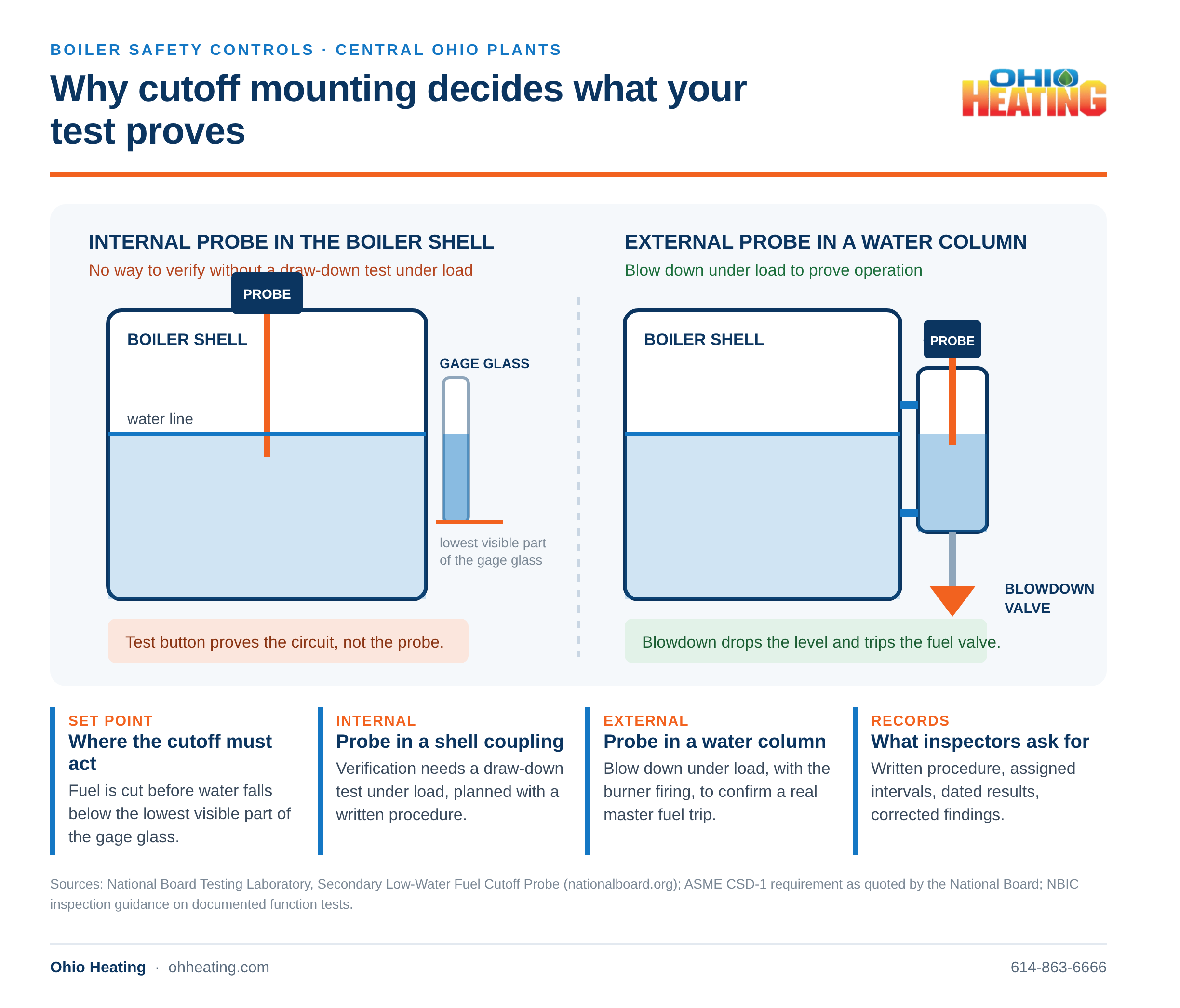
ASME CSD-1, Controls and Safety Devices for Automatically Fired Boilers, and the National Board Inspection Code, Part 1, both require a low-water fuel cutoff. CSD-1 states that each cutoff device “shall be installed to prevent startup and cutoff the boiler fuel or energy supply automatically when the surface of the water falls to a level not lower than the lowest visible part of the gage glass,” and boilers are not to be operated when the water level isn’t visible in the gage glass (National Board Testing Laboratory).
Those codes may require a second cutoff, however they don’t specify is whether that second device is mounted internally or externally. Most manufacturers install a coupling at the top of the boiler shell for a probe holder. With that arrangement, you cannot check the control without a draw-down test under load. If the probe is shorted or wired incorrectly, the “test” button will not prove that it works safely.
The NBIC also expects you to have a written program rather than just good intentions. Inspectors verify that the owner has set up function tests, inspection, and maintenance for every control and safety device. The intervals for these procedures come from either the manufacturer or from the jurisdiction, and results have to be documented. When there is not a set frequency, the work should happen at least once a year (NBIC inspection guidance, PDF).
Testing frequency by boiler type
Frequency depends on the boiler and on how it’s attended. The table below follows testing frequencies published in insurer boiler-risk guidance, which draws on NBIC and ASME practice (Travelers Boiler and Machinery, PDF). A rapid drain test uses the blowdown valve to drop the level fast. A slow drain or evaporation test lowers the level slowly. That one is harder, and it finds probes set below the visible gage.
| Boiler type | Device | Rapid drain test | Slow drain or evaporation test | Open, clean, inspect |
|---|---|---|---|---|
| Hot water heating boiler. | Float or probe LWCO. | Monthly. | Not listed. | Annually. |
| Hot water boiler with forced circulation. | Flow switch. | Monthly operational test. | Not listed. | Not listed. |
| Low pressure steam boiler. | Float or probe LWCO. | Daily. | Annually. | Annually. |
| High pressure steam, automatically fired and unattended. | Float or probe LWCO. | Daily. | Annually. | Annually. |
| High pressure steam with attending operator. | Float or probe LWCO. | Each shift. | Annually. | Annually. |
For steam boilers, CSD-1 recommends a daily test of the cutoff plus a semiannual slow drain test. The slow drain test needs care and usually two people. The primary cutoff has to be jumpered so the burner keeps firing while the level drops. Every jumper has to come back out before the plant returns to service (National Board Testing Laboratory). Schedule it as its own event with a written procedure, as this is not something a technician can just fit in at the end of another service call.
Boiler low water cutoff mounting decides whether your test means anything
Be sure to read the National Board’s practical recommendations next to your own equipment. Mount the secondary cutoff externally in a water column, so you can blow it down under load and verify it. Test all probes yearly under normal operating conditions, and test the primary and secondary cutoffs with the burner running. That last step confirms the test causes a real master fuel trip. Using the same type of control for both duties is risky, because an identical control can fail the same way. Unsafe failures drop when the probe and ground circuits are isolated from building and boiler grounding, either in a single-probe assembly or a two-probe device (National Board Testing Laboratory).
An internally mounted secondary probe does not put you out of compliance, but it does mean your weekly button push is not proof of protection. Plan a draw-down test under load with your service provider. You can also budget an external chamber the next time the boiler is down for pressure testing and inspection work.
Where Ohio’s inspection rules fit
Power boilers and high pressure, high temperature water boilers get a full internal and external inspection under operating conditions each year, unless they are approved for a two-year interval. Low pressure boilers get an external inspection each year under operating conditions. Except for cast-iron boilers, they also get an internal inspection at least every three years. Process boilers run on a three-year cycle unless they are approved for a five-year interval (Ohio Revised Code 4104.11, OAC 1301:3-5-07).
Preparation is your responsibility, and the rule clearly lists out the steps. Shut down and cool the boiler slowly, then clean the fire side. Drain the water and pull the manhole, handhole, washout and water column plugs. Clean and wash out the water side. Secure the feed water and blowoff valves before anyone enters the vessel. An inspector may decline the visit if the boiler was not prepared, and no certificate gets issued or renewed until it passes (OAC 1301:3-5-02). Certificates expire on the calendar-year term stated on them, so the renewal date belongs on the same maintenance calendar as your cutoff tests (OAC 1301:3-5-05).
Combustion controls deserve the same attention. Incomplete combustion and venting faults push carbon monoxide into occupied space, which is a separate risk from a dry-fire event. Our team covers that ground in more detail in our guide to boilers and carbon monoxide, and we handle commercial boiler service across Central Ohio when a plant needs hands on it.
Frequently asked questions
What does the cutoff device actually do? A boiler low-water fuel cutoff shuts off the fuel or energy supply automatically when the water level drops toward the bottom of the visible gage glass. That keeps the boiler from firing against a dry or nearly dry vessel.
How often should we test ours? Steam boilers generally get a daily rapid drain test, hot water heating boilers monthly, and attended high pressure steam plants each shift. Follow your manufacturer’s instructions and any jurisdictional requirement first, and default to at least annual testing when no frequency is specified.
Is pushing the Test button enough? For an externally mounted control that can be blown down under load, a documented test has real value. For an internally mounted probe, the button confirms the circuit responds, and only a draw-down test under load confirms the probe protects the boiler.
Do we need two cutoffs? CSD-1 and NBIC may require a second cutoff depending on the boiler and jurisdiction. Ask your inspector or insurance boiler engineer about your specific vessel rather than assuming one device satisfies the requirement.
What records will an inspector want to see? They want your written test and maintenance procedure, the assigned intervals, and dated results. They also want proof that problems affecting safe operation were fixed.
How does this affect our certificate of operation? Failed preparation or unresolved control problems can delay the inspection, and no certificate is issued or renewed until the boiler passes.
Want your cutoff testing and inspection prep on a schedule your inspector accepts? Call Ohio Heating at 614-863-6666 or reach us at ohheating.com, and we’ll build the program around your plant.