
AC Won’t Turn On: 5 Quick Fixes
When Your AC Won’t Turn On: Understanding the Problem
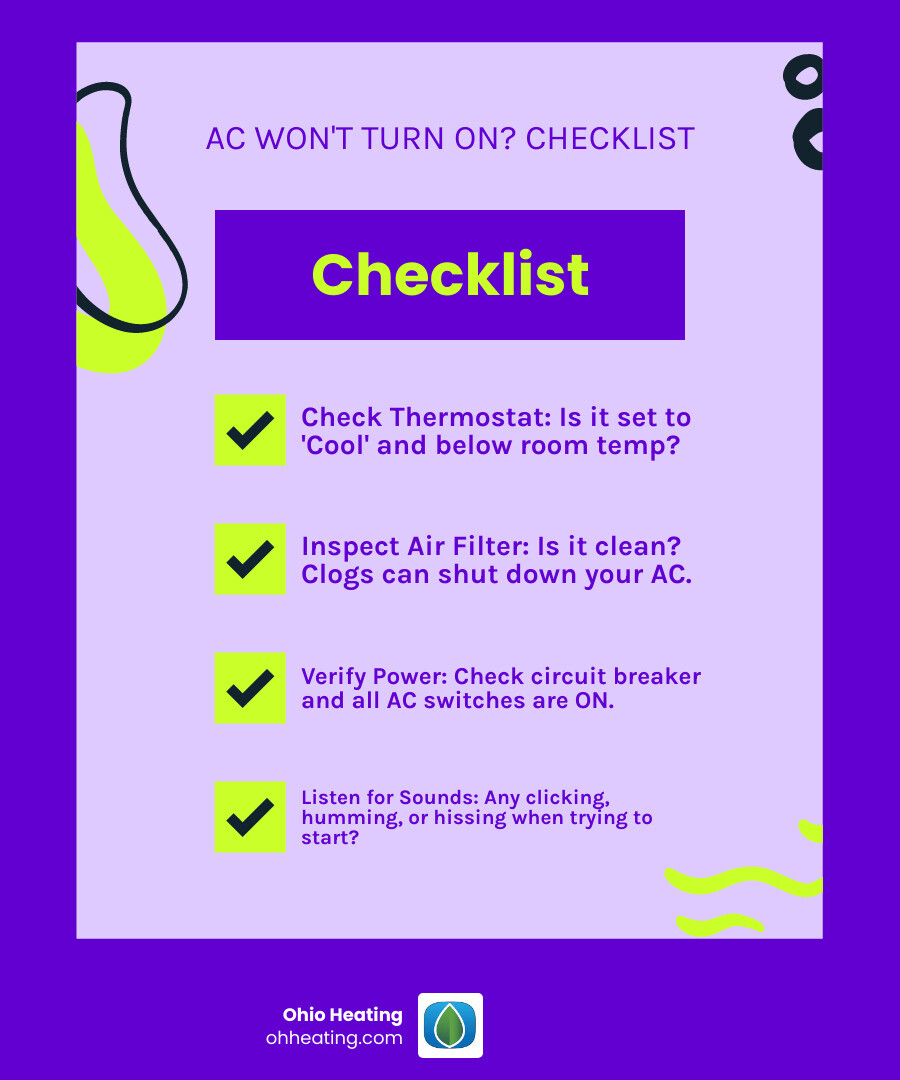
When your AC won’t turn on during a hot spell, it’s a major disruption. Before you panic, there are several quick checks you can perform. Many startup failures have simple fixes you can handle yourself in minutes. Here’s what to check first:
- Thermostat Settings: Ensure it’s set to ‘Cool’ and the temperature is below the current room temperature.
- Circuit Breaker: See if the AC’s breaker has tripped in your electrical panel.
- Air Filter: A clogged filter can trigger a safety shutoff.
- Power Switches: Confirm that both indoor and outdoor unit switches are ‘ON’.
- Reset the Unit: Try turning the system off at the thermostat for 5-10 minutes, then back on.
Industry data shows that dirt and buildup are the number one cause of HVAC breakdowns. A dirty filter alone can stop your system from starting. Knowing whether you have a simple fix or a problem that needs a professional can save you time, money, and prevent further damage.
I’m Jill Frattini, a Service Coordinator at Ohio Heating. I’ve spent years helping property managers and business owners troubleshoot AC issues. I know that quick action on startup problems can prevent costly emergency repairs and keep buildings comfortable.
First Steps: Simple Checks You Can Do in 5 Minutes
When your AC won’t turn on, don’t immediately assume the worst. Many startup problems have simple solutions you can handle in minutes without technical expertise. Before inspecting any components, always turn off power at the thermostat or circuit breaker for safety. For a complete overview of safety protocols, see our guide on How to Prepare for AC Emergencies: Safety Measures to Take.
Is Your Thermostat the Culprit?
Surprisingly often, the thermostat is why an AC won’t turn on. This device controls your entire system, so even a small settings issue can prevent it from starting. Check these three things:
- Mode: Is it set to ‘Cool’? It’s easy to accidentally switch it to ‘Heat’ or ‘Off’.
- Temperature: The set temperature must be at least 5 degrees below the current room temperature to signal the AC to turn on.
- Batteries: If your thermostat has a blank or dim screen, it likely needs new batteries. This simple fix can save you a service call.
If the display is flickering or unresponsive, the thermostat itself may be faulty. For more help, see our Thermostat Troubleshooting Tips.
How to Safely Reset Your AC Unit
Like a computer, your AC sometimes needs a reboot to clear electronic glitches. There are a few ways to do this.
- Reset Button: Some outdoor units have a small, red reset button. Press it for three seconds and wait a few minutes for the system to restart.
- Circuit Breaker: The most common method is to use the circuit breaker. Find the breaker for your AC in your electrical panel (it may be labeled “AC,” “HVAC,” or there might be two—one for the indoor unit and one for the outdoor unit).
If the breaker has tripped (it will be in the middle position), push it fully to “Off,” then back to “On.” Important: Wait 30 minutes before turning your AC back on to allow internal components to reset properly.
- Power Cycle: For window units, unplug the unit from the wall for 10-15 minutes before plugging it back in. This drains residual charge and can resolve stubborn electronic issues.
If these steps don’t work, it’s time to investigate other common causes.
Why Your AC Won’t Turn On: Common Causes & DIY Fixes
If basic resets don’t work, your AC won’t turn on due to one of three likely issues: a power supply problem, an airflow restriction, or a tripped safety switch. Here’s how to identify which one you’re facing. For a comprehensive look at AC repairs, see our guide on How to Repair an Air Conditioner That’s Not Working.
Power Problems: From the Breaker to the Unit
Your AC has several power checkpoints. If a tripped circuit breaker keeps tripping after you reset it, stop. This indicates a serious electrical problem that could cause a fire or damage your unit. Call a professional. Other power issues include:
- Blown Fuses: Some older systems use fuses that must be replaced when they blow. This is a job for a professional.
-
Outdoor Disconnect Switch: Near your outdoor unit is a weatherproof box with a switch or pull-out block. Ensure it’s in the “On” position; it can be accidentally shut off.
-
Indoor Power Switch: Your indoor unit (in the attic, basement, or closet) often has a power switch that looks like a light switch. Make sure it hasn’t been flipped off by mistake.
- Window Unit Power: Ensure the plug is secure in a dedicated outlet—never use an extension cord. If the cord is frayed or damaged, call a pro for replacement. Check for a reset button on the plug itself.
The #1 Cause of Breakdowns: Clogged Air Filters and Coils
More HVAC breakdowns are caused by dirt and buildup than anything else. A clogged filter or dirty coils can definitely be the reason your AC won’t turn on.
- Clogged Air Filter: A dirty filter restricts airflow, which can cause the indoor evaporator coil to freeze into a block of ice. The blower motor may also overheat from straining to push air. Safety switches will then shut the system down to prevent permanent damage. Check your filter monthly and replace it every 1-3 months. For more on filter maintenance, see this article on your air conditioner’s filter.
- Dirty Condenser Coils: The coils on your outdoor unit release heat. If they’re covered in dirt, grass, or leaves, the compressor can overheat and shut down. Keep the area around your unit clear (2-3 feet) and gently rinse the coils with a garden hose (with the power off) a few times a year. This is a key part of our AC Maintenance Plan: Ultimate Guide.
If you see ice on your indoor unit, turn the AC off but leave the fan on to thaw it. If it refreezes after you change the filter, you need a professional.
Water Woes: Clogged Condensate Drain Lines
Your AC removes humidity from the air, which collects in a drain pan and flows out through a condensate line. If this line clogs with algae or debris, water backs up in the pan.
A safety float switch in the pan detects the high water level and shuts down your AC to prevent water damage. This is a common reason an AC won’t turn on.
If you see water pooling near your indoor unit, you likely have a clog. You can try using a wet/dry vacuum on the exterior end of the drain line to suck out the blockage. If you’re not comfortable doing this or it doesn’t work, call a professional to avoid causing further damage.
When to Suspect a Deeper Problem: Signs of Component Failure
If you’ve tried the basic fixes and your AC won’t turn on—or it tries to start but immediately shuts off—you likely have an internal component failure. These problems require professional tools and expertise due to high-voltage electricity and complex parts. Recognizing the signs helps you communicate the issue to a technician. For a broader overview, see our guide on Signs Your Air Conditioning Needs Repair: What to Look For.
Electrical Faults: The Capacitor, Contactor, and Wiring
These high-voltage components should only be handled by a trained professional. A failure in any of them will prevent your AC from starting.
- Capacitor: This part gives the motors a jolt to start. A failing capacitor is a common reason an AC won’t turn on. Signs include a clicking or humming sound from the outdoor unit without the fan or compressor starting. Running an AC with a bad capacitor can burn out the motor, turning a small repair into a major one.
- Contactor: This is an electrical switch that sends power to the outdoor unit. If it’s worn out or corroded, the outdoor unit will remain silent and won’t start.
- Damaged Wiring: Rodents can chew wires, and connections can corrode or loosen over time. If you see frayed or chewed wires, do not touch them. Buzzing or crackling sounds are also a red flag. Turn the system off and call a professional immediately. Our article on What Weird Noises From Your AC Unit Could Mean for Repairs can help identify these sounds.
Refrigerant Leaks and Why They Stop Your AC
Your AC uses a closed loop of refrigerant; it doesn’t get “used up.” If levels are low, you have a leak. This is a problem for a professional, as refrigerants are regulated by the EPA.
When refrigerant is low, a low-pressure safety switch will trip, shutting down the compressor to prevent damage. This is why your AC won’t turn on. Other signs of a leak include hissing sounds or ice on the evaporator coil. DIY recharge kits are not for home AC units and can cause further damage.
Malfunctioning Motors: When the Heart of the System Fails
Your AC has three critical motors. If one fails, the system breaks down.
- Blower Motor (Indoor): Pushes cool air through your vents. If it fails, you’ll hear nothing from your vents, or just a hum, even if the outdoor unit is running.
- Compressor (Outdoor): The heart of the system. A failed compressor is a major, expensive repair. Signs include loud grinding or screeching, or the outdoor unit may be completely silent.
- Outdoor Fan Motor: Pulls air over the condenser coils to release heat. If it fails, the fan won’t spin, causing the compressor to overheat and shut down. The unit may cycle on and off repeatedly.
Calling a Professional: When DIY Isn’t Enough
While many AC issues have simple fixes, some problems require professional training and tools. Your safety is the top priority. If your AC won’t turn on after basic troubleshooting, or if you suspect an electrical or refrigerant issue, it’s time to contact Ohio Heating. If you’re weighing your options, our guide on Find Out Whether to Repair or Replace Your Air Conditioning Unit can help.
Deciding Between DIY Repair and Calling an Expert for an AC that won’t turn on
Knowing when to call for help is key. A wrong move can lead to injury or a more expensive repair.
- Safe for DIY: Checking thermostat settings, replacing batteries, changing air filters, checking power switches, and resetting a circuit breaker (once).
- Call a Professional: Anything involving electrical components (capacitors, wiring), refrigerant leaks, or motor failures. These tasks involve high voltage and regulated materials.
Also, consider your unit’s age. If it’s over 10-15 years old and needs a costly repair, replacement might be more economical. An older unit is less efficient and more prone to breakdowns. For local cost estimates, see What to Expect: Average AC Repair Prices in Columbus Ohio.
How a Technician Diagnoses an AC that won’t turn on
Our technicians follow a systematic process to find the root cause of why your AC won’t turn on. We start by discussing your observations, then perform a series of tests:
- Power Verification: We use a multimeter to check for proper voltage at all points, from the breaker to the unit’s internal wiring.
- Control System Check: We verify the thermostat is communicating with the control board and check for any stored error codes.
- Component Testing: We test individual parts like the capacitor, contactor, and all motors to see if they’ve failed.
- Refrigerant and Safety Circuit Inspection: We check refrigerant pressures for leaks and ensure all safety switches are functioning correctly.
Our goal is to provide a reliable, long-term fix, not just a temporary solution.
What to Tell Your HVAC Technician
The more information you can provide, the faster we can diagnose the problem. When you call, be ready to share:
- Unit’s make and model (if you know it).
- A description of the problem: Did it stop suddenly or fail to start?
- When the problem started.
- Any unusual sounds or smells (clicking, humming, grinding, burning odors).
- Any troubleshooting steps you’ve already taken (changed filter, reset breaker, etc.).
Frequently Asked Questions about AC Startup Problems
Can a dirty air filter really cause my AC to not turn on at all?
Yes, absolutely. A severely clogged filter is a common reason an AC won’t turn on. It restricts airflow, which can cause the indoor coil to freeze or the blower motor to overheat. Your system’s built-in safety switches detect these dangerous conditions and shut the entire unit down to prevent costly damage. Changing the filter and allowing any ice to thaw often resolves the issue.
My thermostat screen is on, but the AC won’t start. What’s wrong?
This frustrating problem means your thermostat is calling for cooling, but the AC unit isn’t responding. The issue could be a communication breakdown or a component failure. Possible causes include:
- A disconnected or damaged thermostat wire.
- A malfunctioning control board in the air handler.
- A failed capacitor, which prevents the motors from starting (you may hear humming or clicking).
- A seized blower motor or compressor.
This scenario requires a professional with diagnostic tools to trace the problem from the thermostat to the AC unit itself.
What’s the difference in troubleshooting a central AC vs. a window unit that won’t turn on?
While the core problems can be similar, troubleshooting a system where the AC won’t turn on differs by type:
- Central AC: These are complex split systems with indoor and outdoor components. Troubleshooting involves checking multiple power sources (often two circuit breakers, plus indoor and outdoor disconnect switches) and understanding how the separate parts interact. Problems can be in the air handler, the condenser, or the lines connecting them.
- Window AC: These are self-contained units. Troubleshooting is simpler. You check one power cord, one outlet, and usually one circuit breaker. Many have a reset button on the plug. While they can still have issues like frozen coils, all components are in one accessible box.
Conclusion
When your AC won’t turn on, it can feel like a crisis, but many causes have simple solutions. By checking your thermostat, air filter, and circuit breaker, you might be able to restore your comfort in minutes. However, the most important rule is safety first. Always turn off the power before inspecting components and call a professional for any electrical, refrigerant, or mechanical repairs.
The best way to prevent that moment when your AC won’t turn on is with regular maintenance. A well-maintained system is more reliable, efficient, and lasts longer, saving you from unexpected breakdowns and high energy bills. Learn more about The Importance of Regular HVAC Maintenance for Homes and Businesses.
Since 1999, Ohio Heating has kept homes and businesses in Columbus and Central Ohio comfortable. If you’ve tried these steps and your AC still won’t cooperate, our expert technicians are ready to help. We can diagnose and fix the problem correctly the first time. Whether you need an emergency fix or want to schedule preventive maintenance, contact us today. For more on our services, see our page on Air Conditioning Repair in Westerville.