
Why Your Central Ohio AC Running Constantly Is a Problem You Shouldn’t Ignore
If your Central Ohio AC is running constantly without ever shutting off, you’re not alone — and it’s not something to brush aside. Here’s a quick look at the most common reasons it happens:
| Cause | Severity | DIY Fix? |
|---|---|---|
| Thermostat set to ON instead of AUTO | Low | Yes |
| Dirty or clogged air filter | Low–Medium | Yes |
| Blocked or closed vents | Low | Yes |
| Dirty condenser or evaporator coils | Medium | Partial |
| Low refrigerant or refrigerant leak | High | No |
| Undersized AC unit | High | No |
| Failing capacitor or fan motor | High | No |
A central AC that never cycles off is working harder than it should. That means higher energy bills, extra wear on the compressor, and a shorter system lifespan. In Central Ohio’s hot, humid summers — where Columbus recorded 35 days above 90°F in 2024 — your system is already under serious strain. A small underlying problem can quietly push it over the edge.
The good news: many causes are simple to fix. Others need a professional. This guide walks you through both.
I’m Jill Frattini, Service Coordinator at Ohio Heating in Columbus, where I’ve spent years working with property managers and homeowners dealing with exactly this kind of Central Ohio AC running constantly issue across our region’s demanding cooling seasons. I’ll walk you through what our technicians see most often — and how to know when it’s time to call us.
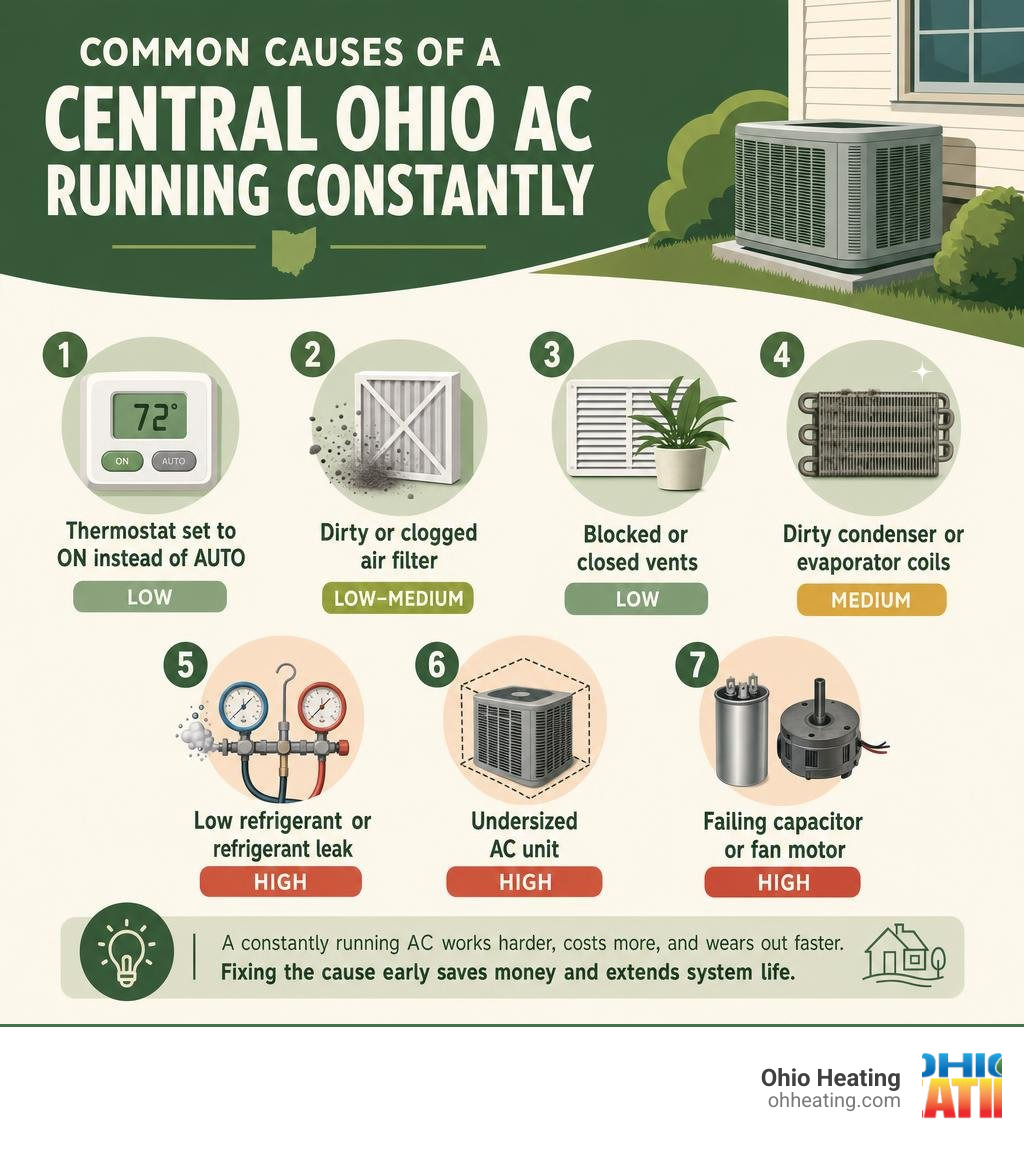
Common Causes of a Central Ohio AC Running Constantly
When summer humidity settles over the Scioto River basin, your air conditioner has to work double-time. It is not just lowering the temperature; it is also pulling gallons of moisture out of the air. When your air conditioner runs continuously without a break, it is usually a sign that something is preventing the system from completing its cooling cycle efficiently.
According to the experts at the Department of Energy, many Common Air Conditioner Problems – Energy.gov stem from poor installation, inadequate maintenance, or restricted airflow. In our experience servicing homes throughout Columbus and Central Ohio, continuous runtime is rarely a mystery. It almost always points to a handful of specific issues.
Thermostat Settings and Calibration
Sometimes the simplest explanation is the right one. If your AC fan is blowing nonstop, check your thermostat. There is a massive difference between setting your system to ON and setting it to AUTO.
When set to ON, the indoor blower fan runs 24/7, even when the outdoor condenser is resting and no active cooling is happening. This can make it feel like your Central Ohio AC is running constantly, even if the compressor is cycling normally. Switching the setting to AUTO ensures the fan only blows when the system is actively cooling.
Additionally, thermostat placement plays a major role in how your system behaves. If your thermostat is installed in direct sunlight, near a drafty window, or close to heat-producing appliances, it will register false, elevated temperatures. It will keep telling your AC to run because it thinks your home is much hotter than it actually is. For more tips on keeping your system running efficiently, check out our Essential AC Tips for Beating the Summer Heat.
Restricted Airflow and Clogged Filters
An air conditioner cannot cool your home if it cannot breathe. Your system relies on a steady loop of warm indoor air passing over cold evaporator coils. If a dirty, dust-caked air filter blocks that airflow, the heat transfer process grinds to a halt.
When airflow is restricted, your AC has to run much longer cycles just to lower the temperature a single degree. Over time, this restriction can cause the evaporator coil to drop below freezing, leading to ice buildup that completely blocks the system.
We recommend checking your air filter monthly, especially during peak cooling months. Upgrading to the right Minimum Efficiency Reporting Value (MERV) rating is also crucial; while high-MERV filters catch more allergens, filters rated too high can restrict airflow in older systems. To learn more about selecting the right filter and maintaining airflow, read The Coolest Guide to Air Conditioner Maintenance.
Dirty Condenser and Evaporator Coils
In Central Ohio, spring and summer bring a beautiful but troublesome natural phenomenon: cottonwood seeds and heavy pollen. These airborne particles act like a blanket when they stick to your outdoor condenser unit.
The outdoor condenser coil is responsible for releasing the heat gathered from inside your home. If it is coated in dirt, grass clippings, and cottonwood fuzz, the heat remains trapped. The system will run continuously because it cannot dump the heat outside.
The same problem can happen indoors on your evaporator coil. A thin layer of dust on either coil acts as an insulator, drastically reducing heat transfer. In fact, a slightly dirty coil or a weak capacitor can reduce your AC’s overall capacity by 15% to 25% in high humidity. Keeping these coils clean is essential for proper heat transfer, as detailed in the guide on Maintaining Your Air Conditioner – Energy.gov.
DIY Troubleshooting and Simple Fixes
Before you pick up the phone to call in our NATE-certified technicians, there are a few safe, straightforward checks you can perform yourself. Taking ten minutes to troubleshoot can save you a service call and get your home back to a comfortable temperature immediately.
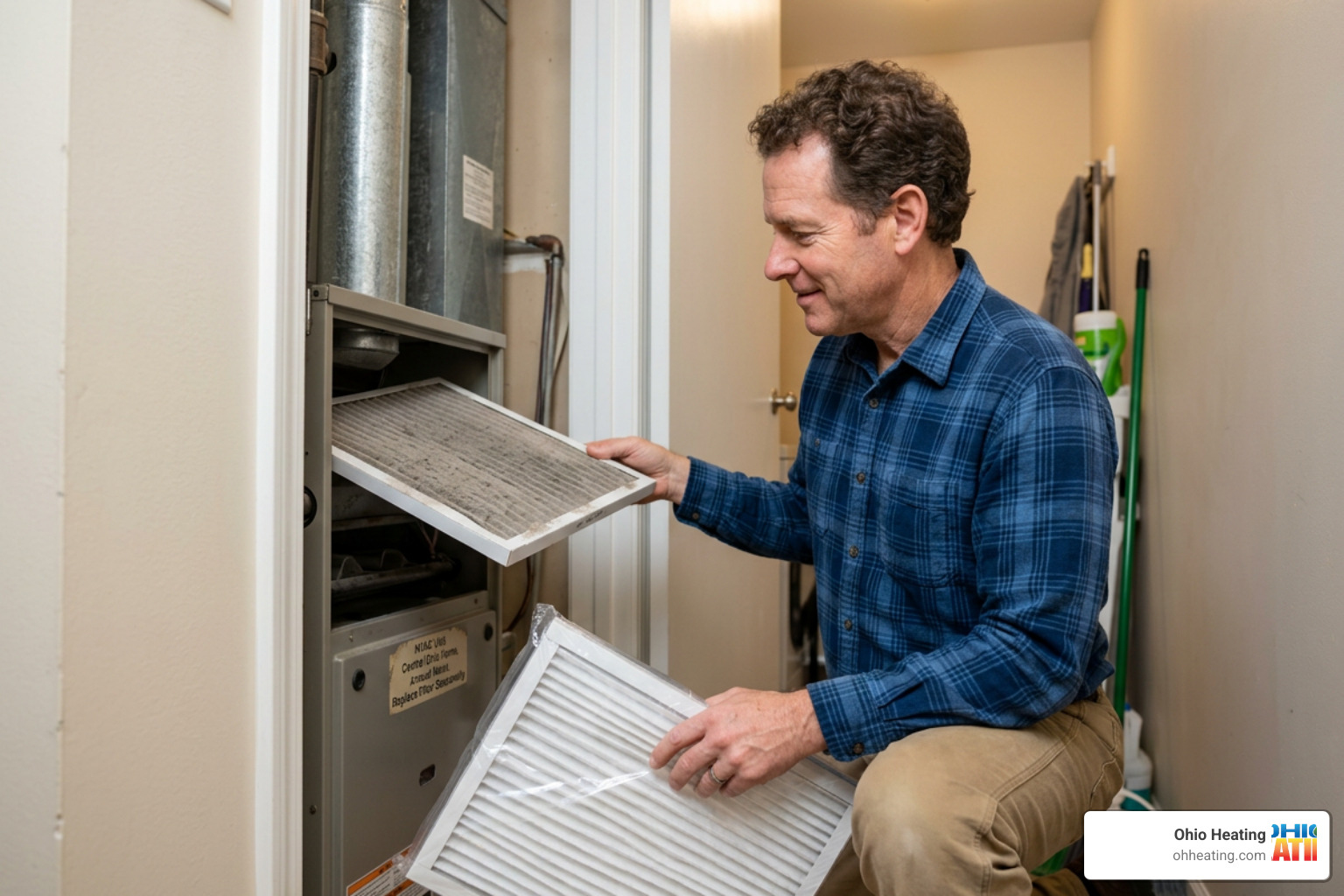
DIY Troubleshooting for a Central Ohio AC Running Constantly
If your system is running indefinitely, follow this quick checklist:
- Verify Thermostat Settings: Ensure the fan is set to AUTO and the system is set to COOL. Double-check that the programmed temperature is realistic — trying to keep your home at 68°F when it is 95°F outside will force almost any system to run nonstop.
- Inspect the Air Filter: Pull out your return air filter. If you cannot see light through it, it is time for a replacement. Standard filters should be changed every 30 to 60 days during heavy summer use.
- Check Supply and Return Vents: Walk through your home and make sure furniture, curtains, or rugs are not blocking any return grilles or supply registers. Closing too many registers (more than 60%) can restrict airflow and increase system pressure, so keep them open.
- Examine the Condensate Drain: Look at the drain line near your indoor unit. If you notice water pooling or if a safety float switch has triggered, a clogged drain could be causing erratic system behavior.
For a comprehensive look at what you should check regularly, explore our AC Maintenance Plan: Ultimate Guide.
When to Clean Your Outdoor Condenser Unit
If your outdoor unit is surrounded by high grass, weeds, or accumulated mulch, it cannot draw in enough air to cool the internal refrigerant.
- Clear the Perimeter: Maintain at least two feet of clear space around your outdoor condenser. Trim back shrubs, clear away weeds, and remove any stray leaves.
- Gently Wash the Coils: Turn off the power to your AC unit at the outdoor disconnect box. Use a standard garden hose with a gentle spray nozzle (never a pressure washer, which will bend the delicate aluminum fins) to wash away dirt, grass clippings, and pollen from the outer coils. Spray from the top down to flush out debris.
If you complete these steps and your Central Ohio AC is running constantly without dropping the indoor temperature, the issue is likely mechanical and requires professional diagnostics.
Signs of Serious AC Issues Requiring Professional Repair
Some air conditioning problems go beyond simple DIY fixes. Attempting to repair electrical components or handling refrigerant without proper certification is dangerous and can void your equipment warranties.
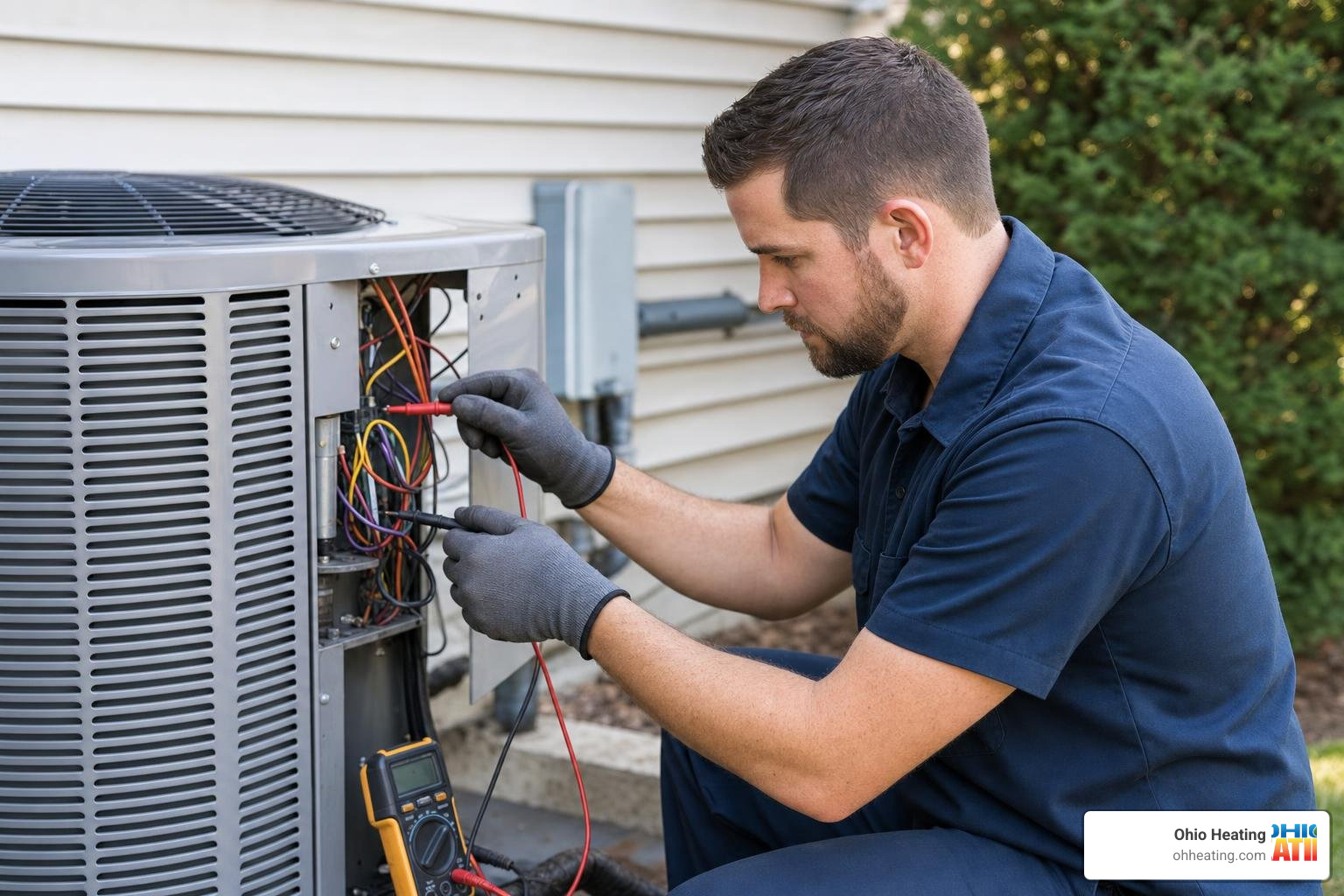
If you notice any of the following symptoms, it is time to call in the professionals. You can read more about what to watch for in our guide on Signs Your Air Conditioning Needs Repair: What to Look For.
Low Refrigerant Levels and Frozen Coils
Refrigerant does not get “used up” like gas in a car. It circulates in a closed loop, absorbing and releasing heat. If your system is low on refrigerant, it means you have a leak.
When refrigerant levels drop, the pressure inside the evaporator coil plunges. This causes the coil to drop below freezing, turning any condensation on the coil into solid ice. Signs of low refrigerant include:
- Warm air blowing from your vents.
- Hissing or bubbling noises near the indoor or outdoor unit.
- Visible ice buildup on the copper refrigerant lines or the indoor evaporator coil.
If you suspect a leak, turn your system off immediately to protect the compressor from permanent damage, and read our advice on what to do when your AC Blowing Warm Air.
Failing Capacitors and Fan Motors
Your outdoor unit relies on a dual run capacitor to provide the electrical boost needed to start and run the compressor and condenser fan motor. These components are highly sensitive to extreme heat.
In Columbus, summer heatwaves can cause outdoor fan motors to overheat. When a motor reaches its thermal limit, its built-in thermal overload protection will shut it down to prevent a fire. If the fan stops but the compressor keeps chugging along, the system will run constantly without actually cooling your home.
If you hear a loud buzzing noise coming from your outdoor unit, or if the fan is stationary while the unit hums, turn the system off to prevent compressor damage and check our troubleshooting steps for when your AC Won’t Turn On.
Sizing and Installation Issues in Central Ohio Homes
Sometimes, a constantly running AC isn’t broken at all — it might simply be the wrong size for your home, or it might be designed to run longer by default. Understanding how modern cooling systems operate can help you determine if your continuous runtime is a defect or a design feature.
Why a New System Might Lead to Your Central Ohio AC Running Constantly
If you recently upgraded your air conditioner, you might be surprised to find it running much longer than your old, noisy system. This is often by design, especially if you invested in a modern two-stage or variable-speed system.
- Single-Stage Systems: These older systems operate like a light switch — they are either 100% on or completely off. They typically cycle on and off every 15 to 30 minutes.
- Variable-Speed Systems: These newer, high-efficiency systems are designed to run almost continuously at lower speeds. By running longer, gentler cycles, they maintain a highly consistent temperature, eliminate hot spots, and remove significantly more humidity from the air.
If you have a variable-speed unit, constant runtime at a very quiet volume is completely normal and highly efficient. However, if your utility bills are skyrocketing or the home isn’t reaching your set temperature, it is worth investigating. To understand the technology and costs associated with modern units, see our guide Don’t Get Quoted $30K: Understanding New AC Unit Costs.
The Importance of Manual J Load Calculations
If an air conditioner is undersized, it will run continuously because it simply does not have the cooling capacity to keep up with the heat load of your home. This is why a professional Manual J Load Calculation is essential before any installation.
Many cut-rate contractors use lazy “rules of thumb” based solely on square footage. However, proper sizing must account for local climate conditions, wall insulation, window orientations, and architectural features like cathedral ceilings.
| Home Size (Sq. Ft.) | Estimated Tons Needed (Standard Ceiling) | Estimated Tons Needed (Cathedral Ceilings / Modular) |
|---|---|---|
| 1,000 | 1.5 – 2.0 Tons | 2.0 – 2.5 Tons |
| 1,500 | 2.5 Tons | 3.0 – 3.5 Tons |
| 2,000 | 3.0 Tons | 3.5 – 4.0 Tons |
| 2,500 | 4.0 Tons | 4.5 – 5.0 Tons |
For instance, a standard 2-ton unit is generally appropriate for a well-insulated 1,000-square-foot home. However, a 1,500-square-foot modular home with cathedral ceilings and western-facing windows will easily require a 3-ton to 3.5-ton unit to stay cool. If your system was improperly sized from day one, you may need to evaluate your options. Learn more by reading Find Out Whether to Repair or Replace Your Air Conditioning Unit.
Frequently Asked Questions About Constant AC Runtime
We hear many of the same questions from homeowners across Columbus when temperatures climb. Here are quick, direct answers to help you make sense of your system’s behavior.
Is it normal for my AC to run all day during a Columbus heatwave?
To an extent, yes. Most standard air conditioning systems are designed to maintain a 20-degree temperature difference between the outdoor air and indoor air.
When Columbus experiences extreme heatwaves where temperatures climb well into the 90s, your AC will run much longer cycles — and may run continuously during the hottest afternoon hours — just to keep your home at 72°F. This is normal behavior, provided the system eventually catches up and cycles off once the sun goes down and outdoor temperatures drop. For more insights on how extreme weather affects your cooling systems, you can also read about general troubleshooting on Why Is My Air Conditioner Running Constantly? – CenterPoint Energy.
Can a dirty air filter cause my AC to run nonstop?
Absolutely. A clogged air filter restricts the volume of warm air passing over your evaporator coil. Because the heat transfer process is severely limited, the system has to work twice as hard and run much longer to cool your home.
In worst-case scenarios, the lack of airflow causes the coil to freeze into a block of ice, which stops all cooling performance while keeping the system running indefinitely as it tries to reach the thermostat setting.
Should I turn off my AC if it runs constantly but doesn’t cool?
Yes, you should turn it off immediately. If your air conditioner is running for hours on end but your home’s temperature is rising, keeping it on will not solve the problem.
Running a malfunctioning system continuously can overheat the compressor — the most expensive component in your outdoor unit — potentially turning a simple, low-cost repair into an expensive system replacement. Additionally, if the constant running is caused by a frozen coil, shutting the system off allows the ice to melt safely. Keep an eye out for water leaks during this time, and check our guide on what to do if your AC Leaking Water Inside.
Conclusion
A constantly running air conditioner is more than a minor annoyance — it is a warning sign that your system is under severe stress. Whether the culprit is a simple dirty filter, a thick layer of spring pollen on your outdoor coils, or a more serious mechanical failure like a refrigerant leak, addressing the issue promptly will save you money on your utility bills and protect your system from premature failure.
For more detailed troubleshooting tips and professional perspectives on constant runtime, you can also consult external resources like Why Is My Air Conditioner Running Constantly? – Aire Serv.
At Ohio Heating, we have been keeping Columbus and Central Ohio homes comfortable and reliable since 1999. Our experienced, NATE-certified technicians are ready to diagnose your system, locate any underlying issues, and restore your peace of mind.
If your AC is running nonstop and DIY troubleshooting hasn’t resolved the issue, don’t wait for your compressor to fail. If you need immediate assistance during a heatwave, check out our guide on how to secure an Emergency AC Fix: How to Get Same-Day Service, or simply schedule professional AC repair today to get your home back to cool comfort.