
Emergency Heating and Air Conditioning Repair Columbus Ohio 24/7
When Your Comfort Can’t Wait: Understanding Emergency HVAC Needs in Columbus
Emergency heating and air conditioning repair columbus ohio is a critical service when your system fails, leaving you without heat in the winter or cooling in the summer. If you’re facing an HVAC emergency, turn off your system at the thermostat and circuit breaker, then call a 24/7 HVAC service immediately.
Key signs of an emergency include:
- No heat or cooling
- Burning smells or gas odors
- Loud grinding noises
- Significant water leaks
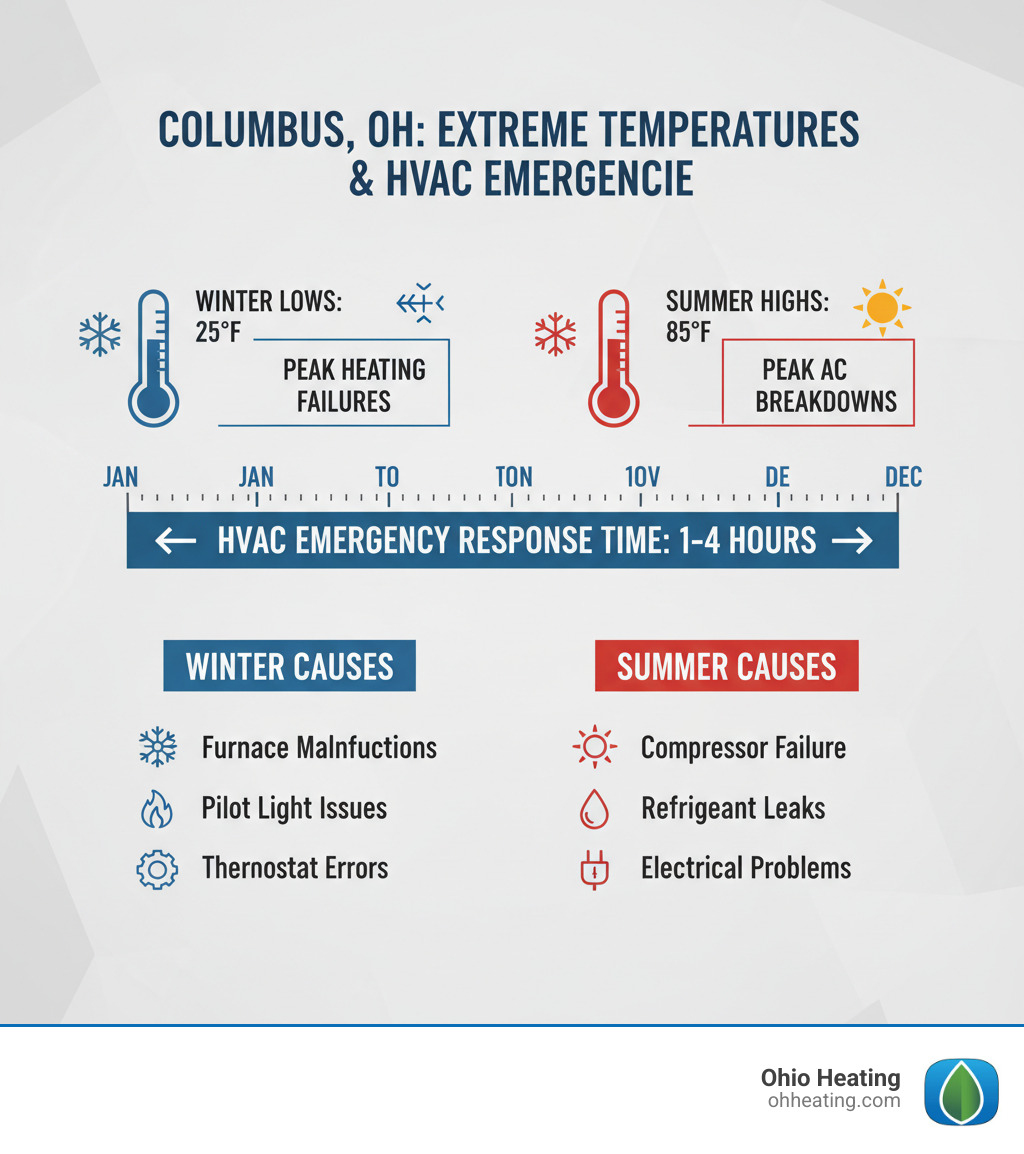
Columbus experiences winter lows around 25°F and summer highs near 85°F. During these extremes, a system failure is more than an inconvenience; it can lead to property damage and operational disruptions for businesses. As one property manager noted, “No heat? No working AC? These moments can feel like the most helpless as a homeowner when your HVAC goes out.”
Most reputable HVAC companies in Columbus offer 24/7 emergency services because failures don’t stick to business hours. With the right provider, you can expect a licensed, NATE-certified technician to arrive with a fully stocked truck, ready to diagnose and fix common issues on the spot, often within 1-4 hours.
What Constitutes an HVAC Emergency?
Not every HVAC issue requires a midnight call, but when your system fails completely or becomes dangerous, you need emergency heating and air conditioning repair columbus ohio. In Columbus, where temperatures can drop to 25°F or climb to 85°F, a broken HVAC system is a serious risk.
A failed furnace in winter can lead to frozen pipes bursting, while a broken AC in summer can cause dangerous indoor heat and humidity, promoting mold growth. These are real risks we’ve helped Columbus homeowners avoid for over two decades.
Signs You Need Emergency HVAC Repair
How do you know if it’s an emergency? Watch for these warning signs:
- Complete heating failure in winter: If your furnace stops working when it’s below freezing, your home will lose heat quickly, endangering your family and your plumbing.
- Total cooling loss during summer: This is critical for homes with elderly family members, young children, or those with health conditions sensitive to heat.
- Loud grinding or squealing noises: Sudden, loud mechanical sounds signal serious trouble. Shut the system down to prevent further, more expensive damage.
- Strong burning or gas smells: A burning odor suggests an electrical problem. A rotten egg smell indicates a gas leak—evacuate your home, call the gas company, and then call for emergency HVAC service.
- Electrical problems: A circuit breaker that repeatedly trips points to a serious electrical fault that could be a fire hazard.
- Water leaks around your unit: Significant water pooling can cause property damage, mold, and electrical hazards.
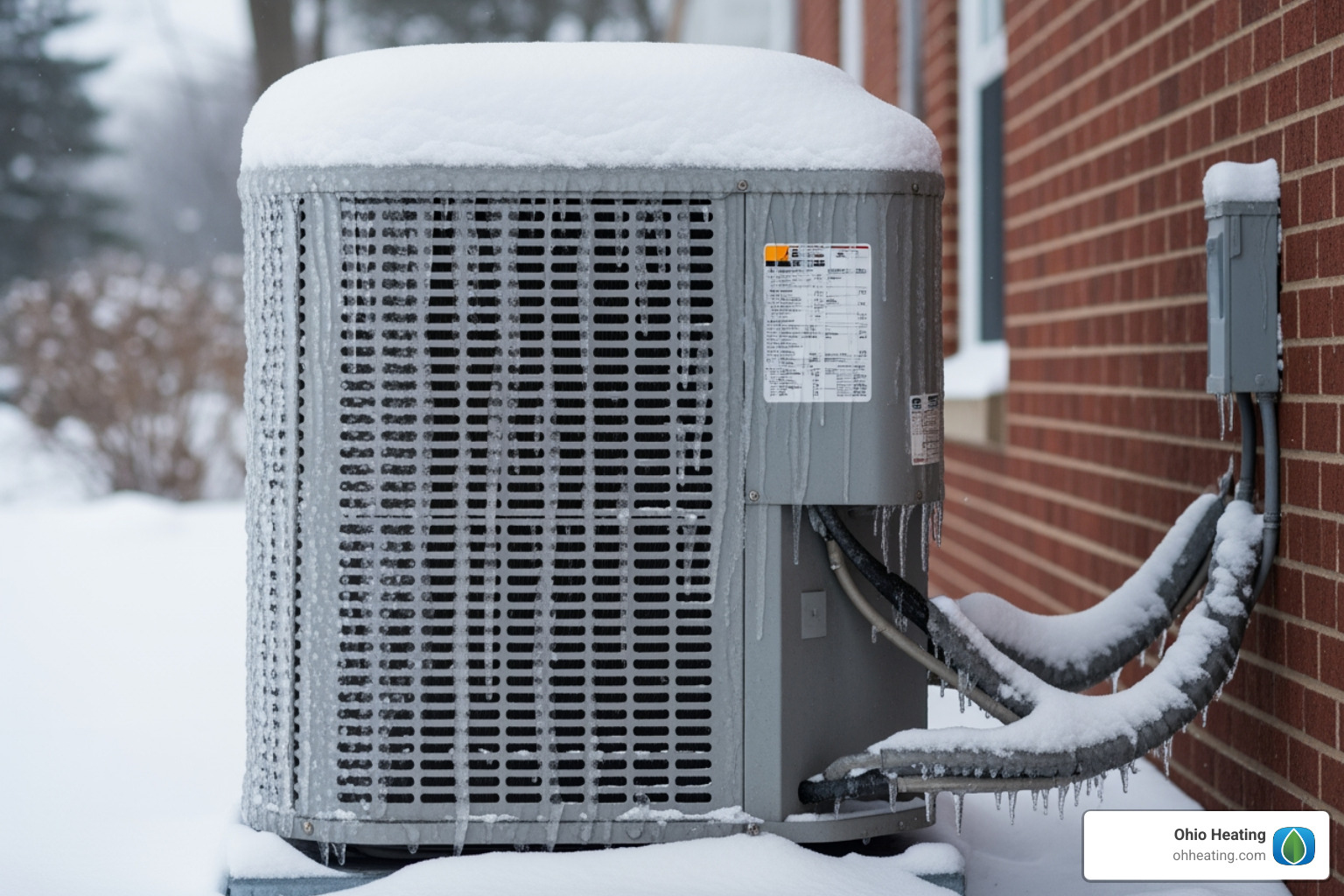
- Ice buildup on your coils: Ice on your indoor or outdoor coils means the system is operating under dangerous conditions and can destroy your compressor.
If you see these signs, call for help. For more on heating issues, see our guide to furnace repair.
Is it a Failing Furnace or Air Conditioner?
Sometimes, a system gives warning signs before it fails completely. Recognizing these can help you avoid a 2 AM emergency call.
- System age: Air conditioners typically last 10-15 years, and furnaces 15-20 years. If your system is nearing these ages, it’s at a higher risk of failure.
- Rising energy bills: A sudden spike in your bills often means your system is losing efficiency and working harder to do its job.
- Frequent cycling: If your system turns on and off repeatedly without reaching the set temperature, it’s a sign that it can’t keep up.
- Uneven temperatures: Hot and cold spots in your home can indicate your system is struggling to distribute air properly.
- Poor air quality: An increase in dust, strange smells, or humidity can mean your system is no longer conditioning the air effectively.
Addressing these early warnings can save you from a future emergency. If you’re worried about your AC, our AC repair information can provide more insight.
Your Immediate Action Plan for an HVAC Breakdown
When your heating or cooling fails, it’s easy to feel overwhelmed. Your safety is the top priority. Before worrying about costs, follow these steps to secure the situation.
![[object Object]](https://images.bannerbear.com/direct/4mGpW3zwpg0ZK0AxQw/requests/000/117/394/312/BjdZ0l7VAYAyE1DDY3Kn1DLqe/6b3a58b016e1d29739274f0bd06c516d2488f65a.jpg "[object Object]")
First Steps to Take When Your System Fails
Before calling for emergency heating and air conditioning repair columbus ohio, take these critical safety steps to protect yourself and your system.
- Turn off your system completely. Go to your thermostat and switch it to “off.” Then, find your electrical panel and flip the circuit breaker for your HVAC unit. This prevents further damage and potential electrical hazards, especially if you’ve seen ice, water, or heard grinding noises.
- Check your air filter. A severely clogged filter can restrict airflow and cause your system to overheat and shut down. If you can’t see light through it, replace it.
- Ensure all vents are open and clear. Blocked supply or return vents can choke your system, forcing it to work too hard. Move any furniture or objects that might be obstructing them.
- Check the circuit breaker. Try resetting the HVAC breaker once. If it trips again immediately, do not keep flipping it. This indicates a serious electrical problem that requires a professional.
What not to do: Do not attempt to disassemble or repair internal components yourself. Modern HVAC systems are complex and dangerous to work on without training. A DIY attempt can lead to injury, void your warranty, and turn a small repair into a costly replacement.
What to Do While Waiting for the Technician
After you’ve called for emergency heating and air conditioning repair columbus ohio, you can use the waiting time to help the technician work more efficiently upon arrival.
- Clear a path to your equipment. Ensure both your indoor and outdoor units are easily accessible. Move any boxes, furniture, or debris that might be in the way.
- Gather system information. If possible, locate the make, model number, and installation date on your unit. This helps the technician prepare.
- Note the symptoms. Write down when the problem started, what you’ve heard or smelled, and any error codes on the thermostat. These clues help speed up the diagnosis.
- Secure your pets. For everyone’s safety and comfort, keep pets in a separate room while the technician is working.
- Take temporary comfort measures. In summer, close blinds and use fans. In winter, layer clothing and use blankets. If using space heaters, do so safely: never leave them unattended and keep them away from flammable materials.
Our typical response time in the Columbus area is one to four hours. The preparation you do now helps us get your system fixed faster. For services in Powell, see More on emergency AC repair.
Navigating the Emergency Heating and Air Conditioning Repair Columbus Ohio Process
When your HVAC system fails, you need a trustworthy provider for emergency heating and air conditioning repair columbus ohio who can respond fast. Since 1999, we’ve helped Columbus homeowners and businesses through these exact situations.

How to Find a Reliable 24/7 HVAC Company
When you need help now, look for these signs of a reliable company:
- True 24/7 Availability: The company should have a live person answering calls and dispatching technicians around the clock, including holidays.
- Positive Online Reviews: Check what other Columbus residents say about their emergency response times and professionalism.
- Licensing and Insurance: These are non-negotiable protections for you and your property.
- NATE Certification: This certification ensures technicians have proven their expertise through rigorous industry testing.
- Local Service Area: Confirm the company serves your specific neighborhood. You can also Check their BBB rating for their commitment to customer satisfaction. We offer emergency services in Westerville and throughout Central Ohio.
What to Expect During an Emergency Service Call
Knowing the process can reduce stress. Here’s our approach:
- Immediate Communication: We’ll provide an estimated arrival window, typically 1-4 hours in the Columbus area.
- Thorough Diagnosis: Our NATE-certified technician will perform a complete system assessment to find the root cause of the problem.
- Clear Explanation & Upfront Pricing: We’ll explain the issue in plain English and provide a detailed quote with all options before any work begins. You approve the cost first.
- Same-Day Repairs: Our trucks are fully stocked with common parts, allowing us to complete most repairs in a single visit.
- Respect for Your Home: We use protective gear and clean up our work area, leaving your home as we found it.
For a full list of our offerings, see More on our HVAC services.
Key Questions to Ask Your HVAC Technician
Empower yourself by asking these important questions:
- “What is the exact problem?” A good technician can explain the failure clearly.
- “Can you provide a detailed cost breakdown?” Ensure you understand all charges for parts, labor, and fees.
- “Is this a permanent fix?” Know if the repair is a complete solution or a temporary measure.
- “What warranties cover this repair?” Ask about guarantees on both parts and labor.
- “How can I prevent this from happening again?” The best technicians offer advice to help you avoid future emergencies.
Understanding the Costs of Emergency HVAC Service
When you need emergency heating and air conditioning repair columbus ohio, cost is a major concern. Understanding the pricing structure can help you manage expectations and avoid surprises.
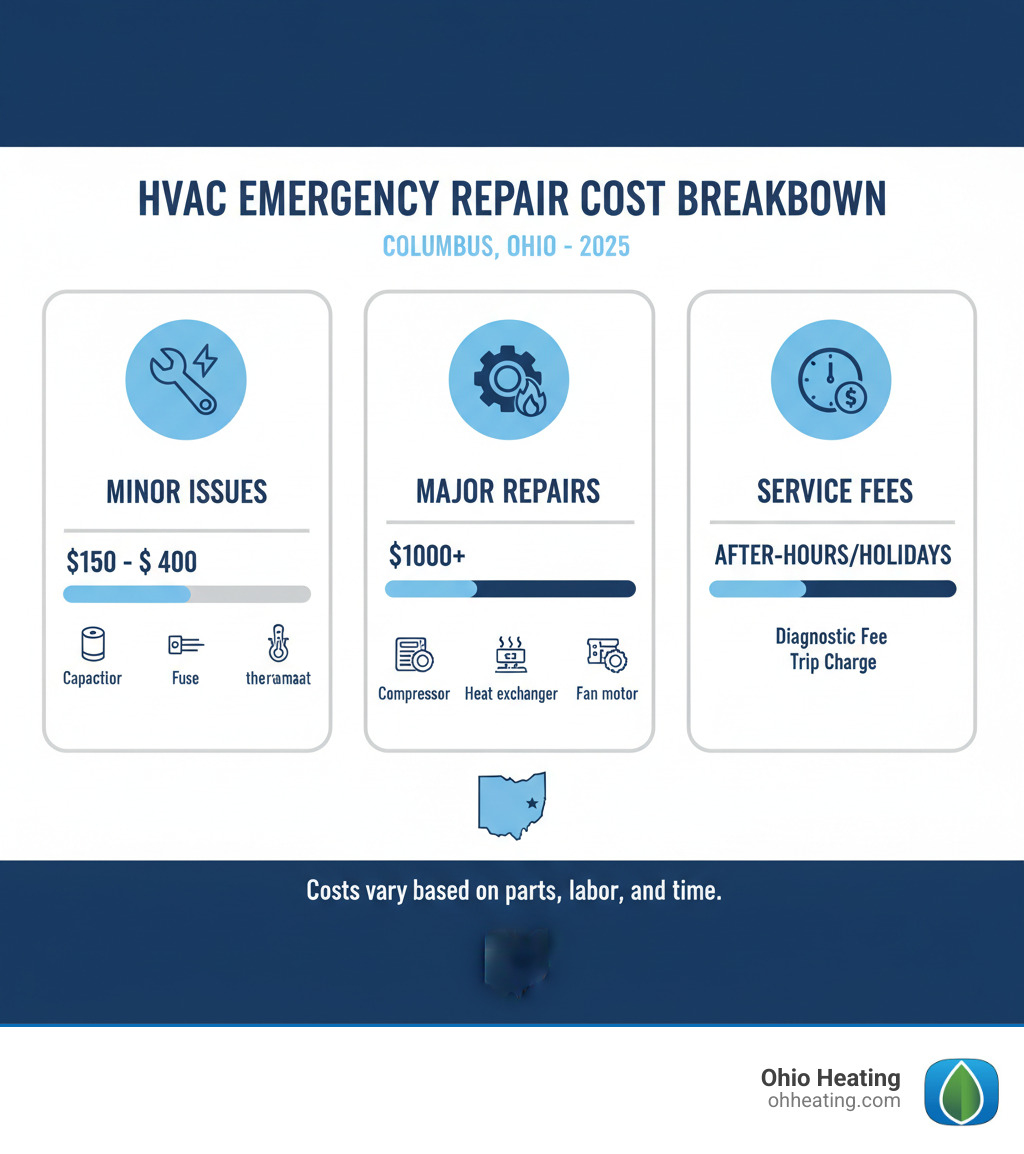
Emergency repairs cost more than scheduled service because they require technicians to be available at all hours. In Columbus, expect to pay anywhere from $150 for minor fixes to over $1,000 for major component replacements. While this is an unplanned expense, it’s often far less than the $5,000 to $12,000+ cost of a full system replacement.
Typical Costs for emergency heating and air conditioning repair columbus ohio
Here’s a general breakdown of what you might pay for emergency heating and air conditioning repair columbus ohio:
- Emergency Service Call Fee: Most companies charge a fee of $80 to $200+ for after-hours diagnostics. This often gets applied to the total repair cost if you proceed with the work.
- Simple Fixes ($150 – $400): This range typically covers replacing a capacitor, thermostat, or clearing a clogged drain line.
- Mid-Range Repairs ($400 – $800): This may include replacing a fan motor or fixing a contactor.
- Major Repairs ($800 – $2,000+): These are for significant failures like a compressor or heat exchanger replacement. At this price point, we’ll discuss the pros and cons of repair versus replacement, especially on older systems.
For more pricing details, see What to Expect: Average AC Repair Prices in Columbus, Ohio.
Factors That Influence the Final Price
The final bill depends on several factors:
- Time of Call: Nights, weekends, and holidays have higher labor rates than standard business hours.
- Repair Complexity: A simple part swap is much faster and cheaper than a repair requiring extensive disassembly.
- Part Costs: A new compressor can cost over $1,500, while a small electrical component might be under $50.
- System Age and Condition: Older, poorly maintained systems may have multiple failing parts, increasing the total cost.
| Repair Type | Furnace (Estimated Range) | Air Conditioner (Estimated Range) |
|---|---|---|
| Thermostat Replacement | $150 – $350 | $150 – $350 |
| Blower Motor Replacement | $400 – $800 | $400 – $800 |
| Ignitor/Pilot Light Repair | $200 – $500 | N/A |
| Capacitor Replacement | N/A | $150 – $400 |
| Refrigerant Leak Repair | N/A | $300 – $1,500+ (includes recharge) |
| Compressor Replacement | N/A | $1,000 – $3,000+ |
| Heat Exchanger Repair/Replace | $800 – $2,500+ | N/A |
| Emergency Call-Out Fee | $80 – $200+ | $80 – $200+ |
These are estimates for the Columbus area. We always provide transparent, upfront pricing before starting any work, so you’ll never be surprised by the final bill.
How to Prevent Future HVAC Emergencies
The best way to handle an HVAC emergency is to prevent it from happening. Most breakdowns are avoidable with proper care, saving you from the stress and expense of an emergency heating and air conditioning repair columbus ohio call.
Just as your car needs regular oil changes, your HVAC system requires routine attention to handle Columbus’s extreme weather, from 25°F winters to 85°F summers.
The Value of Regular HVAC Maintenance
Regular maintenance allows a trained professional to spot a small issue before it becomes a major emergency. We recommend servicing your air conditioner in the spring and your furnace in the fall. During these tune-ups, a technician will inspect, clean, and test your system’s critical components.
The benefits of maintenance are significant:
- Prevents Breakdowns: Catching worn parts early is the number one way to avoid unexpected failures.
- Improves Efficiency: A clean, well-tuned system uses less energy, lowering your monthly bills.
- Extends System Lifespan: Proper care helps your furnace (15-20 years) and AC (10-15 years) reach or exceed their expected lifespan.
- Maintains Your Warranty: Most manufacturer warranties require proof of annual professional maintenance to remain valid.
Investing in maintenance is a smart financial decision that delivers peace of mind and reliable comfort. Learn more about our residential services.
Preparing Your System for Extreme Columbus Weather
Beyond professional tune-ups, you can take steps to prepare your system for seasonal extremes:
- Check Insulation: Proper insulation in your attic and around windows and doors reduces the workload on your HVAC system.
- Seal Ductwork: Leaky ducts can waste up to 30% of your conditioned air. Seal any visible gaps with mastic or metal-backed tape.
- Clear Your Outdoor Unit: Keep at least two feet of clear space around your outdoor AC or heat pump unit, free of leaves, grass, and debris.
- Test Your System Early: Don’t wait for the first heatwave or cold snap. Run your AC for 20 minutes on a warm spring day and your furnace on a cool fall day. This gives you time to schedule a non-emergency repair if something is wrong.
These proactive steps reduce strain on your system and make your home more efficient. For tips related to nearby areas, see More on emergency services in Upper Arlington.
Conclusion
When your furnace fails on a frigid night or your AC quits in a summer heatwave, it’s an emergency that requires immediate action. This guide has outlined the key signs that you need emergency heating and air conditioning repair columbus ohio, from system failures and strange smells to leaks and electrical problems.
We’ve covered the immediate safety steps to take, what to expect during a service call, and how repair costs are determined. Most importantly, we’ve highlighted how regular maintenance is your best defense against unexpected breakdowns. A spring AC tune-up and a fall furnace check-up can prevent the vast majority of expensive, stressful emergencies.
At Ohio Heating, we know that HVAC emergencies don’t follow a 9-to-5 schedule. Since 1999, we have been a trusted partner for homes and businesses across Columbus, providing expert repair and maintenance when it matters most. Our NATE-certified technicians are ready 24/7 with fully stocked trucks to diagnose and fix your problem quickly.
When your comfort and safety are at risk, you need a reliable expert. For 24/7 emergency heating and air conditioning repair columbus ohio from a team that treats your home like their own, contact our team today. We’re here whenever you need us.