
Finding the Perfect Home Comfort Systems for Every Season
What Are Home Comfort Systems and Which One Is Right for You?
Home comfort systems are the heating, cooling, and ventilation equipment that keep your property at a safe, comfortable temperature year-round. Here is a quick comparison of the main types to help you decide:
| System Type | Best For | Key Benefit |
|---|---|---|
| Gas Furnace | Cold climates, existing ductwork | Up to 97% heating efficiency |
| Central Air Conditioner | Homes with ductwork | Reliable whole-home cooling |
| Heat Pump | Mild to moderate climates | Heats and cools in one unit |
| Ductless Mini-Split | No ductwork, zoned spaces | Independent room control |
| Hybrid Heat Pump | Extreme temperature swings | Switches fuel source automatically |
| Boiler | Even, draft-free heat needs | Radiant comfort, no forced air |
Choosing the wrong system does not just affect comfort. It can shorten equipment life by years, raise your energy bills, and cause costly emergency repairs at the worst possible time. Whether you manage a single property or a portfolio of buildings, getting this decision right matters.
Modern HVAC equipment typically lasts 15 to 20 years – but only when it is properly matched to your space and maintained on schedule. The good news is that today’s options are more efficient, more flexible, and more connected than ever before.
My name is Jill Frattini, and as a Service Coordinator at Ohio Heating in Columbus, OH, I have spent years helping property owners and managers navigate home comfort systems across heating, cooling, refrigeration, and boiler services. In this guide, I will walk you through every major option so you can make a confident, informed choice for every season.
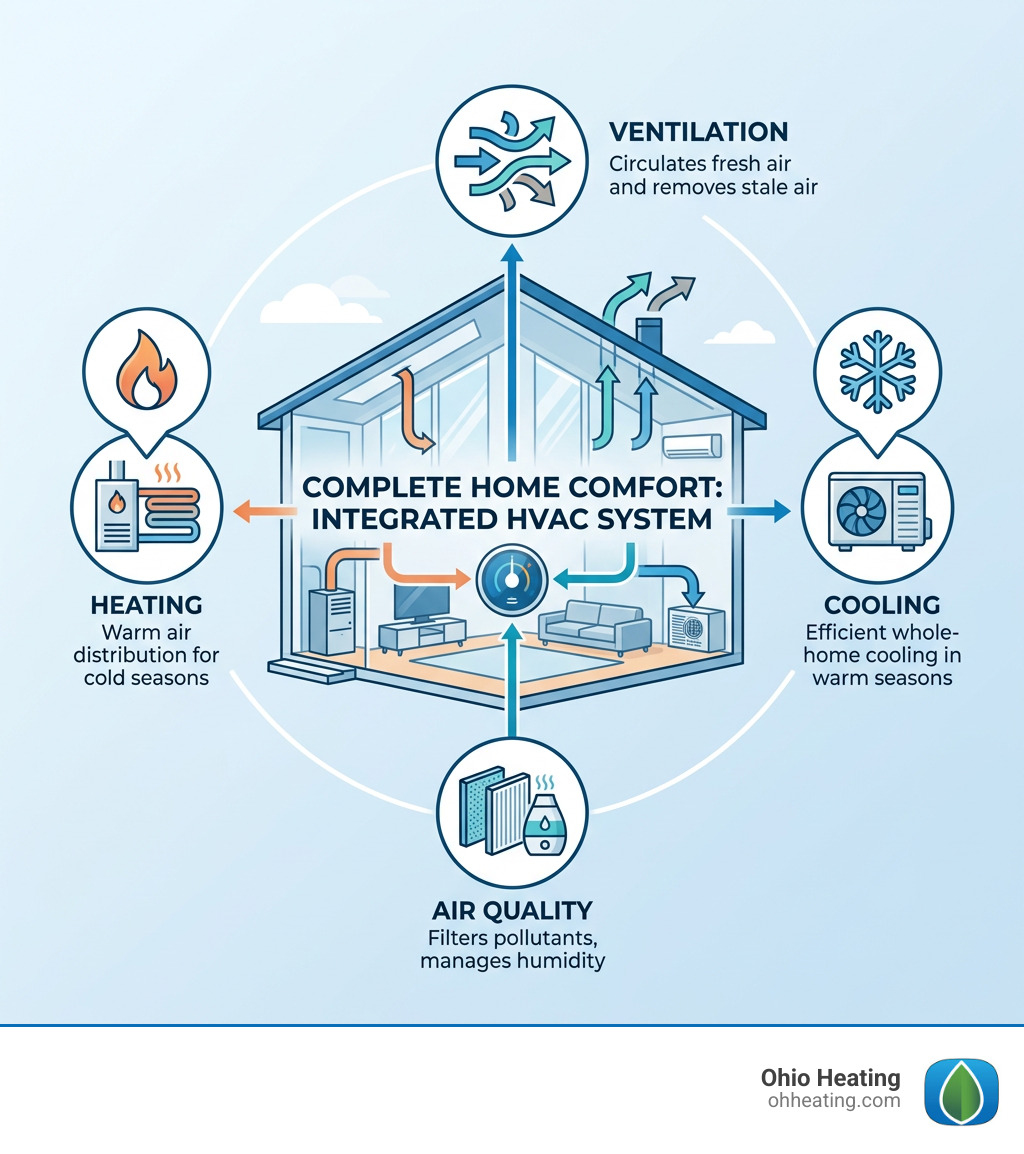
Simple guide to Home comfort systems terms:
Understanding Modern Home Comfort Systems
When we talk about home comfort systems, we are describing a complex, “living” network of machinery designed to regulate your indoor environment. It is not just a metal box in the basement or a plastic unit on the wall; it is an interconnected system of equipment, technology, and processes. In Central Ohio, where we can experience a frozen tundra one week and a humid swamp the next, understanding how these components work together is vital.
Most residential setups in our area are “forced-air” systems. This means a central unit (like a furnace or air handler) uses a powerful blower motor to push conditioned air through a network of ductwork. This air is then distributed to various rooms through supply vents and pulled back to the unit through return vents. This constant circulation allows for consistent temperature control and provides an opportunity to filter and clean the air as it moves.

Modern home comfort systems have evolved significantly. We no longer just “turn on the heat.” We manage microclimates. Leading innovators like the Bosch Home Comfort Group have pioneered smart, sustainable solutions that focus on energy efficiency without sacrificing power. Whether you are looking at Residential HVAC for a new build or upgrading an aging system, the focus today is on “smart” energy consumption—getting the most comfort for every penny spent on utilities.
High-Efficiency Heating Solutions
In Columbus, the furnace is the heart of the home for at least six months of the year. When we look at Furnace and Heating Equipment Sales and Services, the primary goal is often efficiency.
Standard furnaces from decades ago might have operated at 60% or 70% efficiency, meaning 30 cents of every dollar spent on gas literally went up the chimney. Today, high-efficiency gas furnaces can achieve a staggering 95% to 97% efficiency. These units use a second heat exchanger to extract every possible bit of warmth from the combustion gases before they are vented outside through PVC pipes.
For those looking for alternative heating, electric heat pumps are becoming increasingly popular in Ohio. Unlike a furnace that creates heat by burning fuel, a heat pump transfers heat. Even when it feels freezing outside, there is still ambient heat in the air that a heat pump can harvest and move indoors. Many of our neighbors are now opting for “dual fuel” or hybrid systems that pair a high-efficiency furnace with an electric heat pump to get the best of both worlds.
Advanced Cooling and Refrigerant Technology
When the Ohio humidity hits in July, your air conditioner does more than just blow “cold air.” In fact, air conditioners do not “create” cold; they remove heat. Using specialized refrigerant, the system absorbs thermal energy from your indoor air and dumps it outside.
Key to this process is the evaporator coil (inside) and the condenser coil (outside). As the refrigerant changes from a liquid to a gas and back again, it carries heat away from your living spaces. Modern Air Conditioner Repairs and Sales focus heavily on SEER (Seasonal Energy Efficiency Ratio) ratings. Much like miles-per-gallon for a car, a higher SEER rating means more cooling for less electricity.
We also see a shift toward variable-speed compressors. Traditional air conditioners are either “on” or “off,” which can lead to temperature swings. Variable-speed units can run at lower speeds for longer periods, which not only maintains a more consistent temperature but is also much better at removing humidity—a must-have feature for our “muggy” Midwest summers.
Enhancing Air Quality with Specialized Home Comfort Systems
True comfort is about more than just the number on the thermostat. You could have a home that is exactly 72 degrees, but if the air is bone-dry or filled with dust, you won’t feel comfortable. This is where Indoor Air Quality (IAQ) comes into play.
We view IAQ as a critical pillar of home comfort systems. Modern solutions allow us to purify airflow, fine-tune humidity levels, and even bring in fresh outdoor air without losing energy. For a deeper dive into these technologies, you can explore our guide on HVAC Indoor Air Quality 101: Advanced Solutions for Healthier Homes & Businesses.
Whole-House Humidifiers and Dehumidifiers
Central Ohio presents a unique challenge for humidity. In the winter, the cold air holds very little moisture. When we heat that air up, the relative humidity can drop to around 15%. For context, that is drier than the Sahara Desert! This leads to dry skin, static electricity, and can even cause wood floors and furniture to crack.
Installing Whole House Humidifiers allows your HVAC system to add moisture directly into the air stream. Not only does this protect your home and health, but humid air also “holds” heat better, often allowing you to turn the thermostat down a few degrees while feeling just as warm.
Conversely, our summers are notoriously sticky. If your home feels “muggy,” your AC might be oversized or simply unable to keep up with the moisture load. Whole House Dehumidifiers work alongside your cooling system to pull gallons of water out of the air every day, making the air feel crisp and cool rather than damp and heavy.
Advanced Filtration and Whole House Air Cleaners
Every time your home comfort systems cycle air, they have an opportunity to clean it. Standard one-inch filters are designed mostly to protect the machinery from large dust bunnies, but they don’t do much for your lungs.
By upgrading to Whole House Air Cleaners, we can implement HEPA-grade filtration or even UV light technology. These systems are incredibly effective at capturing:
- Pollen and outdoor allergens
- Pet dander and hair
- Mold spores
- Microscopic dust and smoke particles
For families dealing with asthma or allergies, these air cleaners are not a luxury—they are a necessity for a healthy home environment.
Innovative Options for Zoned Home Comfort Systems
One of the biggest complaints we hear is the “forbidden room”—that one bedroom over the garage or the finished attic that is always ten degrees hotter or colder than the rest of the house. Traditional systems often struggle to balance these areas.
However, innovative Ductless Systems offer a solution. Often referred to as mini-splits, these units allow for “zoned” comfort. You can heat or cool specific rooms independently, which is a fantastic way to save energy by not conditioning rooms that aren’t being used. Brands like Comfortmaker HVAC Systems offer versatile options that fit almost any architectural challenge.
Ductless Mini-Split Applications
Ductless systems are the ultimate problem solvers. Since they don’t require bulky ductwork, they are perfect for:
- Attic Conversions: No need to try and squeeze ducts through old walls.
- Garage Workshops: Keep your hobby space comfortable year-round.
- Home Additions: Avoid the cost of resizing your entire central HVAC system.
- Older Homes: Maintain the integrity of historic plaster walls while enjoying modern cooling.
Each indoor unit has its own thermostat, meaning Dad can have his home office at a brisk 68 degrees while the baby’s nursery stays at a cozy 72.
Smart Thermostats and Automation
The brain of your home comfort systems is the thermostat. We have moved far beyond the old mercury dials. Modern Thermostats are Wi-Fi enabled, allowing you to control your home’s climate from your smartphone whether you are on the couch or on vacation in Florida.
Smart thermostats learn your schedule and can automatically lower the heat when you leave for work, saving you money without you having to think about it. Some systems even offer diagnostic alerts, letting you (and us!) know if the system is behaving strangely before it actually breaks down. For those looking to invest in these upgrades, we often see financing options that make high-tech comfort very affordable.
Maximizing Longevity Through Professional Maintenance
An HVAC system is likely one of the most expensive investments in your home. It makes sense to protect it. While modern systems have a life expectancy of 15-20 years, we often see neglected systems fail in as little as 10.
Regular check-ups are the “oil changes” of the HVAC world. For more on why this is non-negotiable, see The Importance of Regular HVAC Maintenance for Homes and Businesses. We offer comprehensive Maintenance Plans & Service Options designed to catch small issues—like a frayed belt or a leaking capacitor—before they turn into a 2 AM emergency call.
The Value of ENERGY STAR® Equipment
When choosing new home comfort systems, look for the blue ENERGY STAR® label. These products are independently certified to save 15% to 25% more energy than standard models. Over the 20-year life of a system, those savings can actually pay for the cost of the unit itself!
| Feature | Standard HVAC | ENERGY STAR® Certified |
|---|---|---|
| Annual Energy Savings | Base level | 15% to 25% Higher |
| Blower Motor | Often Single-speed | Usually Variable-speed |
| Humidity Control | Basic | Advanced/Enhanced |
| Environmental Impact | Higher Carbon Footprint | Lower Emissions |
Frequently Asked Questions about Home Comfort
How long do modern home comfort systems typically last?
In our experience across Columbus and Central Ohio, a well-maintained system typically lasts between 15 and 20 years. However, “well-maintained” is the keyword. Systems that aren’t cleaned or that have clogged filters struggle to breathe, which puts immense strain on the compressor and heat exchanger, potentially cutting that lifespan in half.
What are the benefits of a hybrid heat pump system?
A hybrid (or “dual fuel”) system is perfect for the Ohio climate. It uses an electric heat pump for cooling in the summer and heating during the milder spring and fall days. When the temperature drops below freezing and the heat pump becomes less efficient, the system automatically switches to your high-efficiency gas furnace. This ensures you always use the most cost-effective fuel source for the current weather.
Why is indoor humidity control important for comfort?
Beyond just feeling better, humidity control is vital for your home’s health. In Central Ohio, winter air is so dry it can actually pull moisture out of your body and your home’s structure. Keeping your humidity between 30% and 50% reduces static electricity, prevents respiratory irritation, and stops your wood furniture from shrinking and cracking.
Conclusion
At Ohio Heating, we have been the trusted name for home comfort systems in Columbus and Central Ohio since 1999. We understand that your home is your sanctuary, and our mission is to ensure that sanctuary remains perfectly conditioned, no matter what the Ohio weather throws at us.
Whether you need a quick repair, a seasonal tune-up, or a full system replacement, our team is ready to help. We pride ourselves on providing expert residential and commercial services with a focus on reliability and honesty. We even offer 24-hour emergency support because we know that furnaces never seem to break down at 2 PM on a Tuesday—it’s always the coldest night of the year!
Ready to find your perfect comfort solution? Contact us today for a free estimate on new installations and let us help you breathe easier. Don’t forget to ask about our specialized services like Air Balance in Columbus Ohio to ensure every room in your house is as comfortable as the next.