
Furnace Control Board Replacement: Ultimate 2025 Guide
Why Understanding Furnace Control Board Replacement Matters
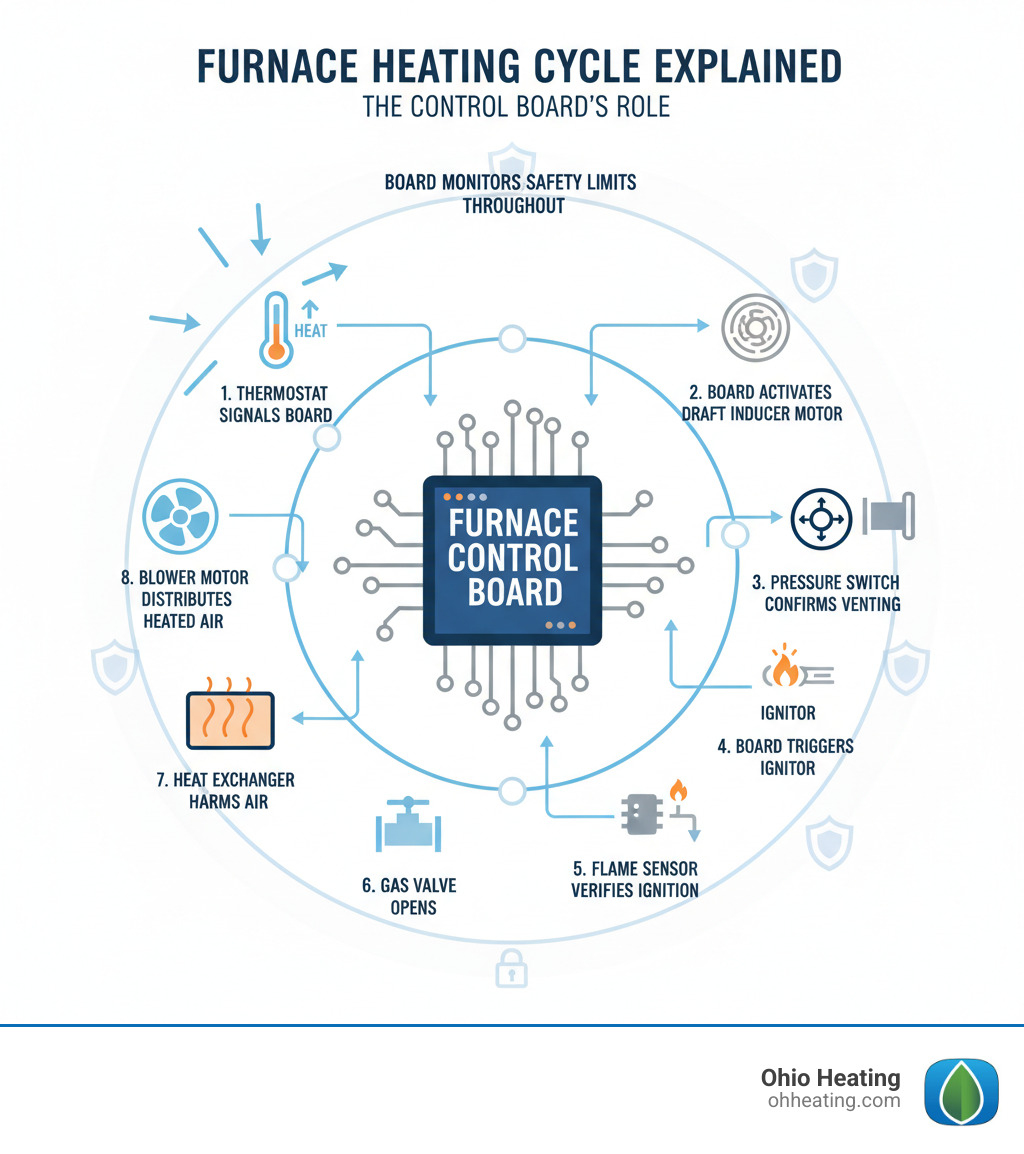
Furnace control board replacement is a critical repair for minimizing downtime and maintaining comfortable environments. The control board is your furnace’s brain, managing everything from ignition to safety checks. When it fails, your furnace may stop responding to the thermostat or short-cycle, making replacement necessary to avoid emergency service calls and extended periods without heat.
Quick Facts About Furnace Control Board Replacement:
- Average Cost: $100-$600 for DIY parts; $550-$1,300 for professional installation
- Typical Lifespan: 15-20 years under ideal conditions, but often fails earlier
- Common Failure Causes: Moisture, power surges, dust buildup, and age
- Warning Signs: No heat, intermittent operation, unusual clicking, or flashing error lights
- DIY Feasibility: Possible for experienced individuals, but gas furnaces require professional attention
Many control board failures show clear warning signs before a complete breakdown. With the right knowledge, you can determine whether to handle the repair yourself or call a professional. This guide will walk you through diagnosing a faulty board, understanding costs, finding the correct part, and deciding on the best course of action.
Diagnosing a Faulty Furnace Control Board
When your furnace acts up, the control board is a common culprit. As the system’s brain, it tells every component what to do. Recognizing the warning signs of a failing board can help you determine if you need a furnace control board replacement.
Common Signs of a Bad Control Board
Look for these hints that your control board is failing:
- No heat or intermittent heating: The furnace ignores the thermostat or cycles on and off erratically because the board isn’t sending proper signals.
- Blower fan issues: The fan runs nonstop or won’t turn on at all, often due to a stuck relay on the board.
- Unusual clicking noises: Excessive or strange clicking patterns can indicate the board is struggling.
- A burning smell: This serious sign often points to an overheating or short-circuiting control board.
- No power to the furnace: If the circuit breaker is fine, the control board itself or its internal fuse may have failed.
- Diagnostic LED error codes: Modern furnaces use flashing lights on the control board to display error codes. Your furnace manual can help you decode these patterns.
What Causes a Control Board to Fail?
Control boards are durable but can fail due to several factors:
- Moisture: Corrosion from damp environments can damage electronic components.
- Power surges: Voltage spikes from lightning or grid fluctuations can instantly fry the board’s sensitive circuitry.
- Overheating: Clogged filters and dust buildup force the furnace to work harder, trapping heat and cooking the board’s components.
- Loose wiring: Vibrations can loosen connections over time, causing shorts or power issues.
- Old age: Internal components like relays and switches wear out, typically after 15-20 years, but sometimes sooner.
- Stuck relays or failed transistors: These common failure points disrupt the furnace’s entire operational sequence.
How to Check Your Furnace Control Board
If you suspect a faulty board, investigate safely with these steps:
- Turn off the power completely. Flip the dedicated circuit breaker and the power switch near the furnace.
- Remove the access panels to expose the control board.
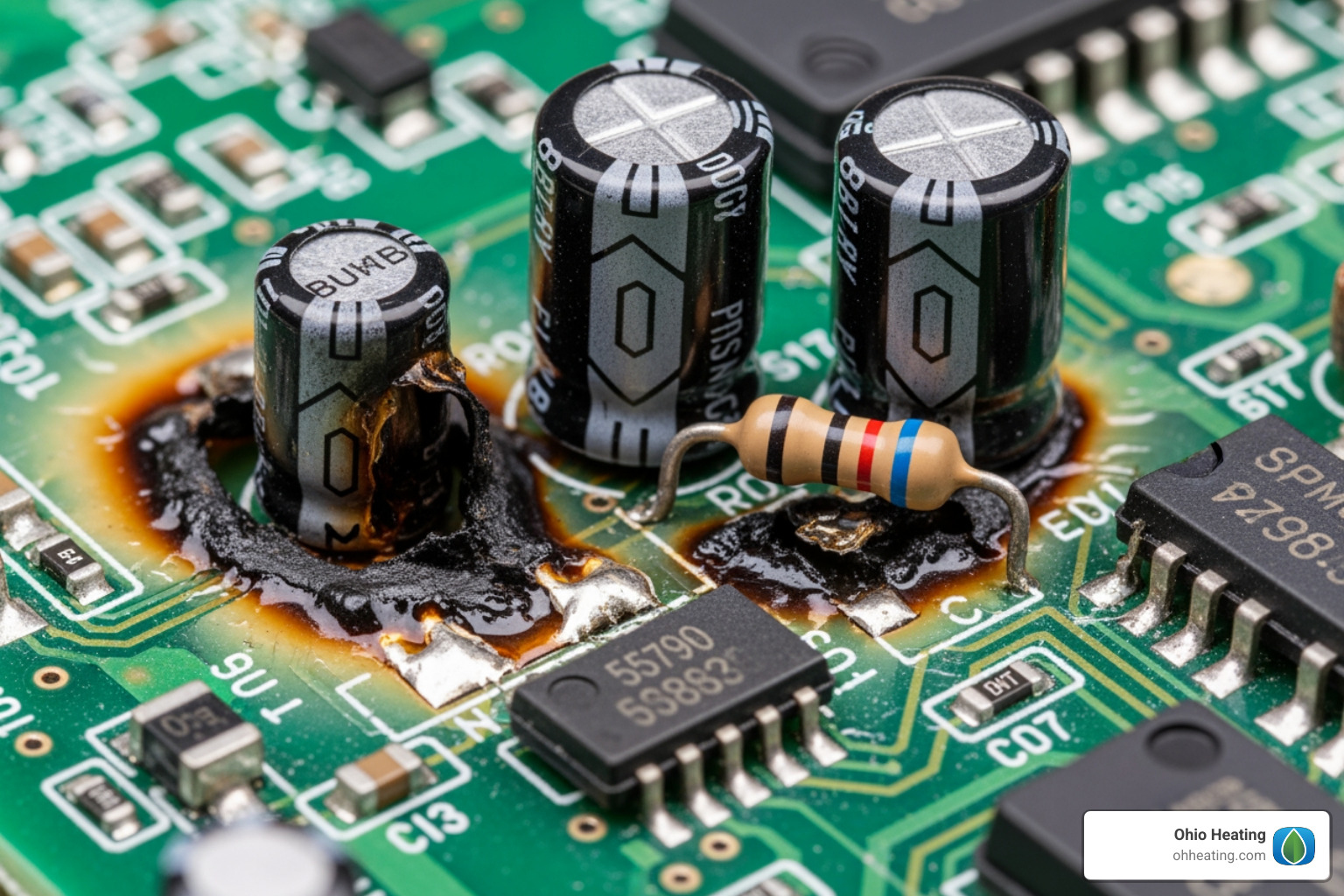
- Do a visual inspection. Look for obvious damage like burn marks, bulging capacitors, or corroded connections. A faint burning smell is also a dead giveaway.
- Check the diagnostic LED lights. Consult your furnace manual to decode any flashing error codes.
- Test the fuses. Many boards have a small automotive-style fuse. A blown fuse may indicate a deeper electrical issue, but replacing it is a simple first step.
- Use a voltage meter for advanced testing. If you’re comfortable with electrical work, check for 120V from the transformer to the board and 24V from the thermostat connections. This requires temporarily overriding the door safety switch. For more details, see our guide on thermostat repair.
Your Step-by-Step Guide to Furnace Control Board Replacement
If you’ve confirmed the control board is the problem and you’re comfortable with basic electrical work, a DIY furnace control board replacement is a manageable project that can save you money. However, this job requires careful attention to detail and strict adherence to safety precautions.
Tools and Preparation
Gather these tools before you begin:
- Screwdriver set (Phillips and flathead)
- Nut driver
- Multimeter
- Needle-nose pliers
- Wire strippers and electrical tape (optional)
- Camera phone (for taking photos of wiring)
- The correct replacement control board for your furnace model.
Before you disconnect anything, take multiple, clear photos of the existing wiring from different angles. These pictures will be an invaluable guide during reassembly.
Key Steps for a DIY Furnace Control Board Replacement
Follow this process carefully for a successful replacement:
- Cut all power. Turn off the furnace circuit breaker and the power switch located on or near the unit. Use your multimeter to confirm the power is off.
- Remove the access panels to expose the control board.
- Photograph all wire connections. This is a critical step. Ensure you can clearly see where each wire connects before you proceed.
- Disconnect the wires. Work methodically, starting with the low-voltage thermostat wires.
- Remove the old board. Unscrew or unclip the old board and gently lift it out.
- Configure the new board (if necessary). Universal boards may require setting dip switches or jumpers to match your furnace’s specifications (e.g., blower speed). Refer to the new board’s instructions and your furnace manual. OEM boards usually don’t require this step.
- Install the new board. Secure it in the same position as the old one, ensuring it’s firmly attached.
- Reconnect the wires. Using your photos as a guide, connect each wire to its correct terminal. Double-check every connection.
- Replace the access panels and ensure they are secure to engage any safety switches.
- Restore power and test. Turn the breaker and power switch back on. Set your thermostat to call for heat and observe the furnace’s startup sequence. If it operates normally, you’re done. If not, re-check your wiring or consider calling for professional furnace repair services.
Understanding the Costs and Parts
When your furnace control board fails, the cost is a primary concern. The final price depends on whether you do it yourself or hire a professional, as well as the type of replacement part you choose.
Understanding the Cost of Furnace Control Board Replacement
The total cost breaks down into parts and labor.
- DIY Cost: If you handle the replacement yourself, you’ll only pay for the part, which typically costs between $100 and $600. The price varies based on the furnace brand and model complexity. Basic boards are at the lower end, while boards for high-end or multi-stage furnaces are more expensive.
- Professional Installation Cost: Hiring a technician will cost between $550 and $1,300, which includes the part, labor, and diagnosis. While more expensive, this ensures the job is done correctly and safely by an experienced professional, and it often comes with a warranty.
The DIY route saves on labor but requires confidence with electrical work. A mistake can lead to more costly damage.
How to Find the Correct Replacement Board
Installing the wrong control board can cause damage or simply not work. Follow these steps to find the right part:
- Find your furnace model number. It’s usually on a sticker or plate inside the furnace cabinet.
- Find the part number on the old board. This is the most direct way to find an exact replacement.
With this information, you can choose between an OEM or a universal board. You can find parts at HVAC supply stores or online retailers like Furnace Part Source or Ferguson.
- OEM (Original Equipment Manufacturer) boards are identical to the original part, ensuring a perfect fit and straightforward installation. They are typically more expensive and can be harder to find for older models.
- Universal replacement boards are designed to work with multiple models and are often more affordable and available. However, they require configuration (setting dip switches or jumpers) to match your furnace’s specific features, such as ignition type and heating stages.
| Feature | OEM Replacement Board | Universal Replacement Board |
|---|---|---|
| Compatibility | Guaranteed exact fit and function for specific models. | Designed to work with a range of models; requires configuration. |
| Installation | Often plug-and-play, matching original wiring. | May require setting dip switches/jumpers; sometimes includes adapter harnesses. |
| Cost | Generally higher. | Often more affordable. |
| Availability | May be harder to find for older or discontinued models. | More readily available, often in stock. |
When choosing a universal board, use cross-reference guides to ensure it supports all your furnace’s features. If you’re unsure, it’s best to get expert help. You can contact Ohio Heating for replacement parts and expert guidance to ensure you get the right part for your system.
When to Call a Professional
While a DIY furnace control board replacement can save money, there are times when calling a professional is the safer and smarter choice. It’s important to be realistic about the risks and your own skill level before starting.
DIY vs. Professional Replacement
Consider these factors before deciding to tackle the job yourself:
- Skill Level: If you’re not comfortable with wiring diagrams and voltage testing, it’s best to call a pro.
- Safety Risks: Incorrect wiring can cause electrical shorts, fire hazards, or damage to other components. With gas furnaces, the risk of a carbon monoxide leak is a serious concern that demands professional handling.
- Time and Tools: A professional repair saves you the time spent on diagnosis, ordering parts, and potential troubleshooting. It also eliminates the need to buy specialized tools like a multimeter.
- Potential for Further Damage: An incorrectly installed board can fry other expensive parts, turning a modest repair into a major expense.
Signs You Need an Expert
We recommend calling Ohio Heating if:
- You’re not 100% sure the control board is the problem. A professional can accurately diagnose the issue, preventing you from replacing the wrong part.
- Electrical work makes you nervous. Our technicians handle these systems daily and do so safely.
- You have a gas furnace. Due to the risk of gas leaks, any work on a gas furnace should be left to a certified professional.
- The furnace still doesn’t work after you replaced the board. There may be a deeper issue or a wiring error that an expert can identify.
- You’re concerned about your warranty. DIY repairs can void your furnace’s warranty. Professional service includes warranties on both parts and labor.
- You don’t have the time. Let us handle the repair so you can focus on your business or other priorities.
Regular maintenance is the best way to prevent control board failure. Annual professional heating system tune-ups allow technicians to clean components, check connections, and catch potential issues early, extending the life of your entire system as recommended by Energy Star’s maintenance checklist.
We’re here when you need us. For any furnace issue, Ohio Heating provides the expertise to keep your property comfortable and safe.
Frequently Asked Questions about Furnace Control Boards
Here are answers to some of the most common questions we receive about furnace control boards.
What is the average lifespan of a furnace control board?
Under ideal conditions, a control board can last the life of the furnace, typically 15 to 20 years. However, real-world factors like moisture, power surges, and dust buildup often cause them to fail sooner. It’s not uncommon to see boards fail in furnaces that are only 5-10 years old. Regular maintenance can help extend its lifespan.
Can a bad control board cause the furnace to run constantly?
Yes. A common sign of a failing furnace control board is a stuck relay, which is an electrical switch on the board. When a relay gets stuck in the “on” position, it can cause the blower motor to run continuously, even when the furnace isn’t heating. This wastes energy and puts unnecessary wear on the motor.
Will a compatible control board work in any furnace?
No, a compatible or universal board is not a one-size-fits-all solution. These boards are designed for a range of models but must be configured for your furnace’s specific requirements, such as its ignition type (hot surface vs. direct spark), heating stages, and voltage. Using the wrong board or configuring it incorrectly can lead to poor performance or damage. Always use a cross-reference guide or consult a professional to ensure compatibility.
Conclusion
Understanding your furnace control board—from diagnosing problems and navigating a DIY replacement to knowing the costs—empowers you to make smart decisions for your property. We’ve covered the key signs of failure, the steps for replacement, and how to find the right parts.
However, knowledge also means recognizing when to call a professional. While DIY replacement can save money, the safety risks associated with electrical work and gas furnaces are significant. A mistake can lead to costly damage or dangerous conditions like electrical fires or carbon monoxide leaks.
For residents and business owners in Columbus, OH, and the surrounding Central Ohio area, Ohio Heating offers a safe and reliable solution. Since 1999, our certified technicians have provided expert diagnosis and repair for all heating system components. We stand behind our work with warranties on parts and labor, ensuring your peace of mind.
Whether you need a furnace control board replacement or other expert furnace and heating equipment services, trust our team to keep your property comfortable and operational. Contact Ohio Heating for professional service you can count on.