
Furnace Repair Milford OH: Expert 24/7 Safe
When Your Columbus-Area Furnace Stops Working: Fast Help Is Available
Furnace repair in Columbus and Central Ohio is a critical service when your heating system fails during Ohio’s harsh winters. A broken furnace is more than an inconvenience; it’s a safety hazard that can lead to frozen pipes and dangerous indoor conditions.
If you need furnace repair in Columbus or Central Ohio right now:
- Emergency Service: Call a licensed HVAC company offering 24/7 emergency repairs.
- Same-Day Service: Many local companies provide same-day furnace repair.
- All Systems Serviced: Gas furnaces, electric furnaces, heat pumps, and oil furnaces.
- Trained Technicians: Look for NATE-certified technicians with extensive annual training.
- Licensed & Insured: Verify the company is properly licensed and insured for your protection.
As a family-owned business serving Ohio since 1999, we understand the anxiety that comes when your heating system stops working. A functioning furnace is essential for your comfort, health, and safety during the winter months.
This guide will help you recognize furnace problems, know what to do when your system fails, and make smart decisions about repair versus replacement. Understanding when to call for professional help can prevent costly disruptions and keep your space warm all winter long.
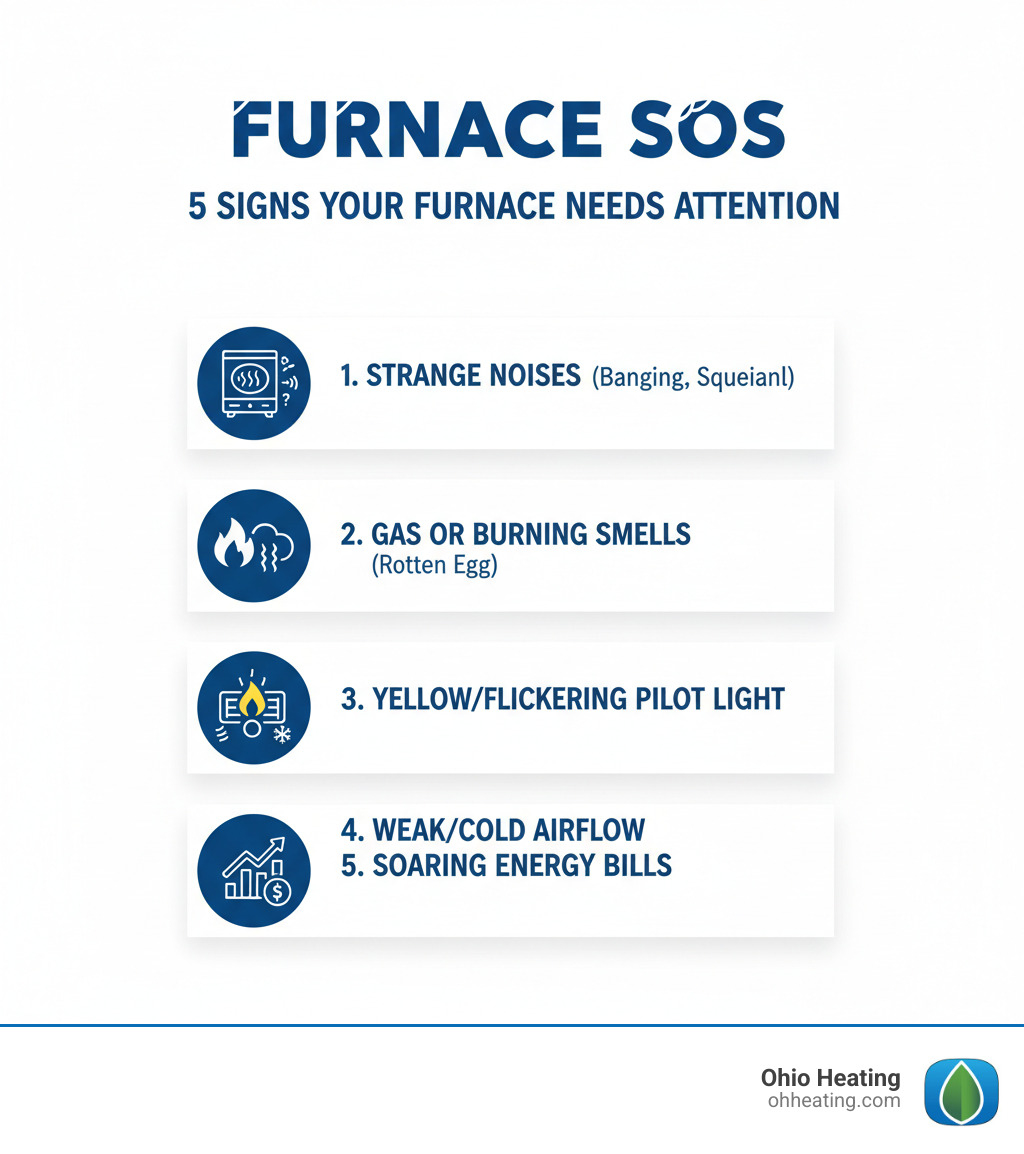
Is Your Furnace Failing? Common Warning Signs
Your furnace often gives warning signs before a complete breakdown. Learning to recognize these signals can save you from an emergency on the coldest night of the year. Heres what to watch for.
Strange Noises: The Soundtrack of a Struggling Furnace
Your furnace should run quietly. Loud or unusual noises warrant attention.
- Banging sounds can point to delayed ignition, where gas builds up before lighting. While it could also be expanding ductwork, it’s worth investigating.
- Squealing or screeching usually means the blower motor is struggling due to worn-out bearings or a loose belt. Left unchecked, this can lead to a total system failure.
- Rattling or clanking might be a loose panel, but it could also signal a cracked heat exchangera serious safety issue. When in doubt, call a professional in Columbus or Central Ohio.
Unusual Smells: What’s That Odor?
A dusty smell when you first turn on the heat for the season is normal. Other odors are red flags.
The most dangerous smell is rotten eggs or sulfur, which indicates a natural gas leak. If you smell this, evacuate your home immediately and call 911 from a safe location. A burning plastic or electrical smell suggests overheating components; turn off the furnace at the breaker and call for service. Musty odors point to moisture or mold in your system or ductwork, which can impact indoor air quality.
Weak Airflow or Uneven Heating: Getting the Cold Shoulder
If your vents are barely pushing out air or some rooms are much colder than others, your system has a problem. Weak airflow is often caused by a clogged air filter, but it could also mean a failing blower motor or blocked ducts. Cold spots and uneven heating can stem from a malfunctioning thermostat, leaky ductwork, or an improperly sized furnace.
Short Cycling: The On-Again, Off-Again Relationship
When a furnace turns on and off in rapid succession without completing a full heating cycle, it’s called short cycling. This wastes energy and puts excessive wear on your system. A dirty filter is a common cause, but it could also be a faulty thermostat or an oversized furnace.
Increased Energy Bills: The Hidden Cost
A sudden jump in your heating bills without a change in usage is a clear sign your furnace is working harder than it should. This often indicates declining efficiency, especially in furnaces over 15 years old.
Yellow Pilot Light: A Dim Warning
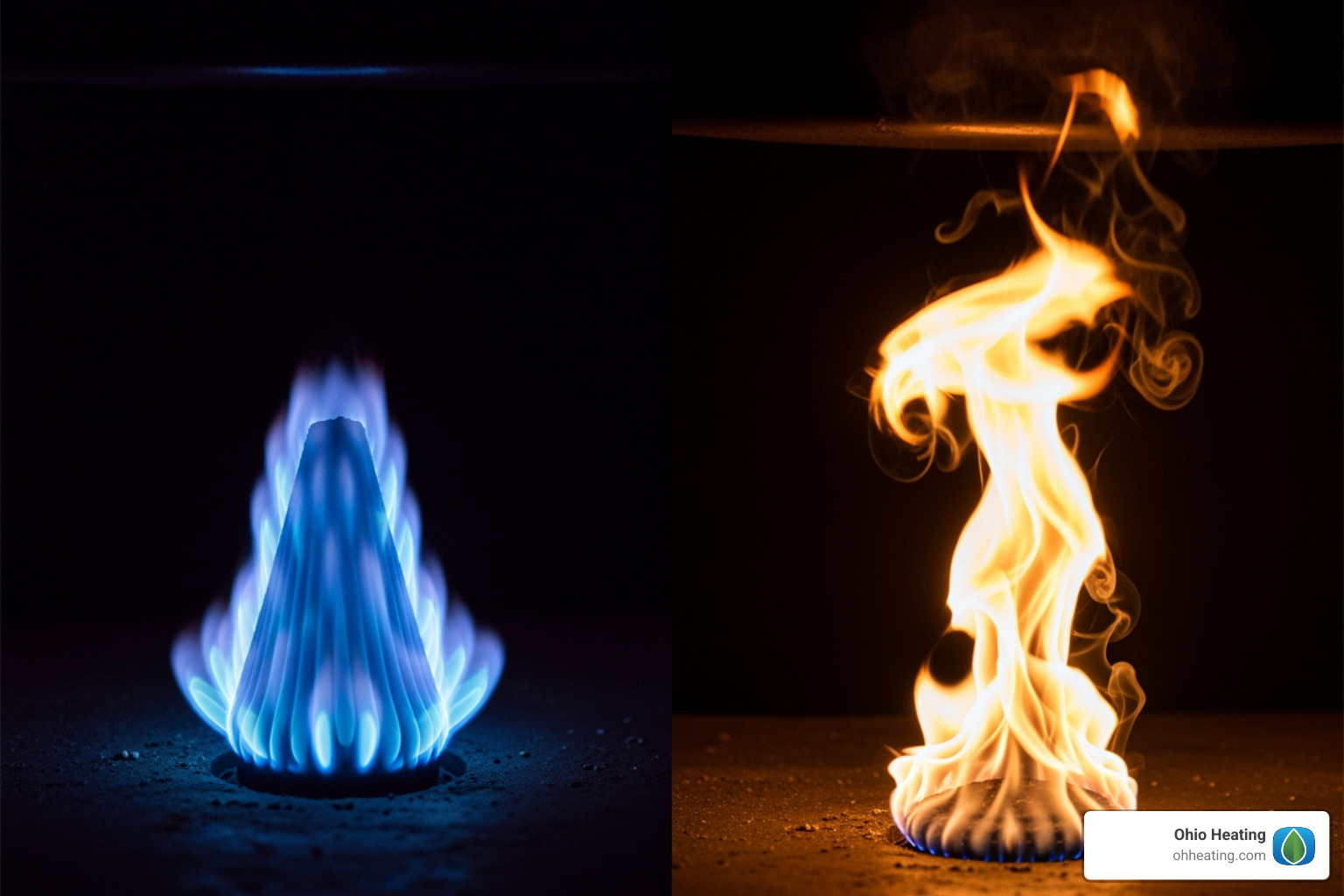
If you have a gas furnace, check the pilot light. A healthy flame is bright blue. A yellow or flickering flame indicates incomplete combustion, which can produce deadly carbon monoxide gas. If you see a yellow flame, turn off your furnace and call for service immediately.
Thermostat Issues: The Brain Drain
Sometimes the problem is the thermostat. If it’s unresponsive, showing errors, or the temperature reading feels wrong, it may be the issue. Check the batteries first, but it could also be a wiring problem or a loss of calibration.
Catching these warning signs early protects your budget, comfort, and safety. When you notice any of these issues, contact a trusted HVAC professional to prevent a minor problem from becoming a major emergency.
What to Do When Your Furnace Quits: A Step-by-Step Guide
When your furnace stops working on a frigid night, it’s easy to feel a sense of panic. Stay calm and methodical. Some issues have simple fixes, while others require a professional. First and foremost, ensure your home is safe.
First, Check for Dangerous Situations
Your family’s safety comes before everything else. Gas leaks are the most serious concern. Natural gas has a distinct rotten egg or sulfur smell added to it for detection. If you smell this or hear a hissing sound near your furnace, act immediately.
If you smell gas:
- Evacuate everyone from the house immediately. Do not use light switches, phones, or any electronics.
- From a safe distance outside, call 911 and your gas company.
- Do not re-enter your home until emergency services declare it safe.
Carbon monoxide is a silent threat. This odorless, colorless gas is deadly. Ensure you have working CO detectors on each level of your home. If an alarm sounds, evacuate immediately and call for help from outside.
Simple DIY Troubleshooting Steps Before You Call for Furnace Repair in Columbus, OH
If there are no immediate dangers, you can try a few simple checks that might solve the problem.
- Check your thermostat. Make sure it’s set to “Heat” and the temperature is set higher than the current room temperature. Also, ensure the fan is set to “Auto.”
- Replace the air filter. A clogged filter is a very common cause of furnace failure, as it restricts airflow and can cause the system to overheat and shut down.
- Check your circuit breaker. Find the breaker for your furnace in your electrical panel. If it has tripped, flip it completely off and then back on again.
- Ensure vents are open and clear. Walk through your home and make sure all supply and return air vents are unblocked by furniture, rugs, or other items.
- Try the reset button. Most furnaces have a reset button. Press it only once and wait to see if the system restarts. Pressing it multiple times can cause other issues.
When to Call for Emergency Service
If these steps don’t work, it’s time to call for professional furnace repair in Columbus, OH. You need an expert if:
- Your DIY efforts fail. The problem is likely with a complex component like the ignition system, blower motor, or heat exchanger.
- You have no heat in freezing weather. This is an emergency that can lead to frozen pipes and significant water damage.
- You have any safety concerns. Any gas smell, CO alarm, or loud, alarming noises from your furnace require an immediate professional response.
At Ohio Heating, we know emergencies don’t wait for business hours. That’s why we offer 24/7 emergency heating repair services throughout Ohio. We’re here for you 365 days a year, because a warm, safe home can’t wait.
More info about emergency HVAC services
The Value of Professional Furnace Repair in Columbus, OH
While a DIY approach can be tempting, modern furnaces are complex systems. An incorrect repair can create a safety hazard or a more expensive problem. Professional furnace repair in Columbus, OH provides an expert diagnosis from a trained technician who can identify the root cause of an issue and spot potential problems before they become emergencies.
Working with a licensed professional ensures the job is done safely and correctly, giving you peace of mind that your family is protected.
What to Look for in a Reputable HVAC Company
Choosing the right HVAC company is crucial for a positive experience. Heres what to look for:
- Licensed and Insured: This protects you from liability and ensures the company meets state and industry standards.
- NATE-Certified Technicians: NATE certification is the industry’s gold standard, requiring technicians to pass rigorous exams. Our technicians receive over 200 hours of training each year to stay current on the latest technology and safety protocols.
- Positive Local Reviews: Feedback from your neighbors provides insight into a company’s reliability and quality of work.
- 24/7 Emergency Repairs: Heating emergencies happen at all hours. A reputable company should be available around the clock.
- Local Expertise: A company with deep roots in Ohio understands our climate and the common issues that affect local homes.
- Family-Owned Business: As a family-owned business since 1999, we prioritize honest recommendations and transparent pricing, treating every customer with respect.
What Furnace Systems Can Be Serviced?
A professional HVAC company should be able to service any type of heating system. We work on all major brands and types of equipment, including:
- Gas Furnaces: The most common system in our area, burning natural gas for heat.
- Electric Furnaces: Use heating elements, ideal for homes without gas lines.
- Heat Pumps: Efficient systems that provide both heating and cooling.
- Oil Furnaces: Found in some older homes, these require specialized service.
- Ductless Mini-Splits: Flexible heating and cooling solutions for spaces without ductwork.
Whether your system is new or old, our technicians have the expertise to get it running right.
Furnace Maintenance vs. Repair: What Central Ohio Homeowners Need to Know
Understanding the difference between furnace maintenance and furnace repair can save you money and prevent a mid-winter breakdown. Think of maintenance as preventative care, like brushing your teeth, while repair is the necessary fix once a problem has already occurred, like getting a filling.
Investing in proactive care impacts your system’s longevity and can even be required to keep your warranty valid.
The Goal of Furnace Maintenance
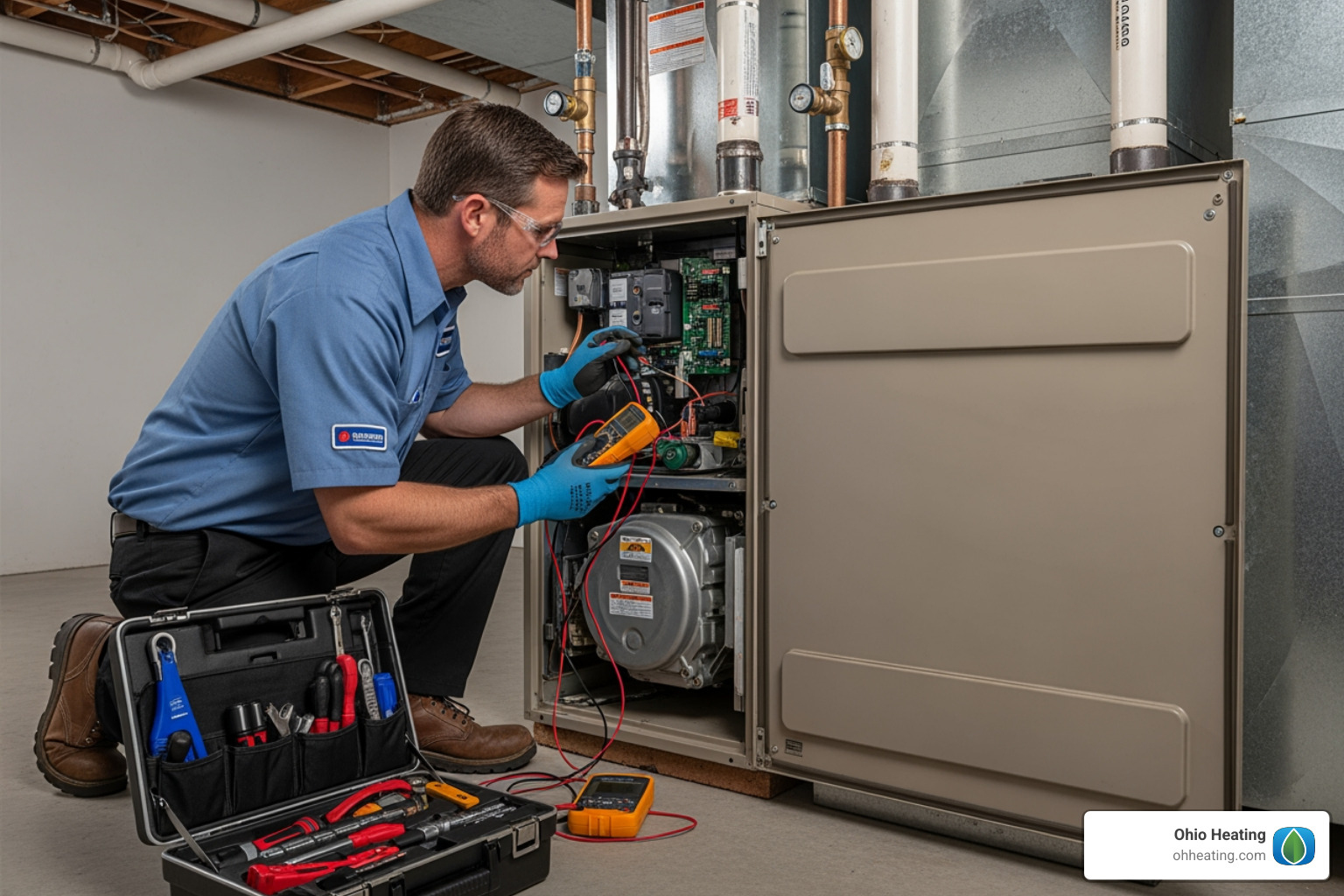
Furnace maintenance is about preventing problems. During an annual tune-up, a technician performs a comprehensive check to keep your system running efficiently and safely. This includes cleaning components, inspecting parts for wear, and testing all safety controls.
Safety inspections are a key part of maintenance, as we check for gas leaks and carbon monoxide risks. The best time for this service is in the fall, before the heating season begins.
Regular maintenance also lowers your energy bills by ensuring your system operates at peak efficiency. Furthermore, many manufacturers require proof of annual maintenance to keep your furnace’s warranty active.
The Goal of Furnace Repair
Unlike proactive maintenance, furnace repair is reactive. It happens when something has already gone wrongyour system is making strange noises, not producing enough heat, or has stopped working entirely.
When you call for furnace repair in Columbus, OH, a technician’s goal is to diagnose the specific issue and implement a fix. This involves not only restoring heat but also ensuring safe operation. The more you invest in maintenance, the less you’ll likely need repairs. However, when a breakdown does occur, prompt professional service is essential to prevent a small issue from turning into a catastrophic failure.
Repair or Replace? Making the Right Financial Decision
When your furnace has problems, you face a tough question: is it better to repair it or invest in a new system? Sometimes a repair is the logical choice, but other times it’s like throwing good money after bad. Here’s how to decide.
Key Factors to Consider for Your Columbus, OH Furnace Repair or Replacement
- Age: Most furnaces last 15 to 20 years. If your unit is approaching or has surpassed this lifespan, replacement is often the more sensible long-term investment.
- Frequency of Repairs: If you’re calling for repairs every season, the costs can add up quickly. At a certain point, that money is better spent on a new, reliable system.
- Cost of the Current Repair: A common rule of thumb is to multiply the furnace’s age by the repair cost. If the total exceeds $5,000, replacement is generally recommended. (e.g., a 12-year-old furnace with a $500 repair: 12 x $500 = $6,000, suggesting replacement).
- Energy Efficiency: Furnaces made over 15 years ago are far less efficient than modern units. A new high-efficiency furnace can significantly lower your monthly energy bills, with savings that help offset the initial cost over time. For more details, you can research energy-efficient heating systems on government resources like Energy.gov.
| Feature | Furnace Repair | Furnace Replacement |
|---|---|---|
| Initial Cost | Lower | Higher |
| Longevity | Extends current system’s life (short-term) | Up to 15-20+ years (long-term) |
| Efficiency | Maintains current efficiency | Significantly improved efficiency, lower energy bills |
| Warranty | Typically for repair part/labor only | Full new system warranty |
| Technology | Sticks with older tech | Access to latest features, smart thermostats, zoning |
| Peace of Mind | Temporary fix, potential for future breakdowns | Reliability, fewer worries for years |
| Resale Value | Minimal impact | Can add value, especially a high-efficiency system |
| Environmental | Keeps old unit operating | Newer units are more eco-friendly |
| When to Choose | Minor, infrequent issues; newer unit; budget constraints | Frequent breakdowns; old unit; high energy bills; major component failure |
Understanding the Costs and Financing
The average furnace repair can cost a few hundred dollars, which is manageable for a one-time fix on a younger furnace. A full replacement is a larger upfront investment, but a new, efficient furnace often pays for itself over time through lower energy bills and the peace of mind of a full warranty.
We understand that this decision can be unexpected and stressful. That’s why we offer financing options to help make sure your home stays warm without breaking your budget. Our team can walk you through your specific situation and provide an honest recommendation that’s right for your home and your finances.
Frequently Asked Questions about Furnace Care
Here are answers to the most common questions we hear from homeowners in Columbus and across Central Ohio.
How often should my furnace be serviced in Columbus, OH?
Your furnace should be serviced at least once a year, ideally in the fall before the heating season begins. An annual tune-up allows a technician to clean components, test safety controls, and catch minor issues before they become major problems.
This yearly appointment is valuable because it extends your furnace’s lifespan, keeps energy bills lower by maximizing efficiency, and often satisfies the requirements of your manufacturer’s warranty. Most importantly, it includes a safety check for risks like carbon monoxide leaks, giving you peace of mind all winter.
What are the signs of a dangerous gas leak from a furnace?
Knowing the signs of a gas leak is critical for your safety. The most obvious sign is a rotten egg or sulfur smell, which is added to natural gas to make it detectable. Other signs include a hissing sound near gas lines or physical symptoms like unexplained dizziness, nausea, or headaches.
If you suspect a gas leak:
- Evacuate your home immediately. Do not use any electronics, light switches, or phones inside.
- From a safe distance, call 911 and your gas company.
- Do not go back inside until emergency responders have given you the all-clear.
Treat any suspicion of a gas leak as a serious emergency.
How long does a typical furnace last?
Most furnaces have a lifespan of 15 to 20 years. Several factors influence where your unit will fall in that range. The quality of the unit itself plays a role, as high-end models are built to last longer than basic builder-grade units.
However, the single biggest factor is maintenance. A furnace that receives an annual professional tune-up will almost always outlast one that is neglected. Proper installation and how hard the furnace has to work to heat your home also impact its longevity. If your furnace is over 15 years old and requires frequent repairs, it’s time to start considering a replacement.
Conclusion: Your Partner for a Warm and Safe Columbus Home
When an Ohio winter arrives, a reliable furnace is not a luxuryit’s a necessity. A breakdown compromises not just your comfort, but also your safety and your home’s integrity. From strange noises to rising energy bills, the warning signs of a failing furnace should never be ignored.
While simple DIY checks are a good first step, professional furnace repair in Columbus, OH requires the skill of a trained expert. A proper repair protects your home from frozen pipes, ensures your family’s safety from gas and carbon monoxide risks, and keeps your heating costs under control.
As a family-owned business serving Ohio since 1999, we understand the stress a furnace failure can cause. That’s why our team is available 24/7, ready to respond when you need us most. Our NATE-certified technicians bring extensive training and a commitment to providing honest, effective solutions.
Don’t wait for a small problem to become a cold-weather crisis. Whether you need routine maintenance, an emergency repair, or advice on a new system, we are here to help keep your Columbus-area home warm and safe all winter long. Contact us for expert furnace services.