
HVAC air balancing: Is it Worth It? 3 Essential Benefits
What is HVAC Air Balancing and Why is it Crucial?
If some rooms in your building are too hot while others are too cold, you likely have an air balance problem. HVAC air balancing is the process of testing and adjusting your heating and cooling system to ensure every room receives the correct amount of conditioned air. This creates even, comfortable temperatures throughout your property.
Proper air balancing is essential for comfort and efficiency. It makes your indoor environment more pleasant and helps your HVAC system run smarter, not harder, which is crucial for lowering energy bills and extending the life of your equipment.
I’m Jill Frattini, a Service Coordinator at Ohio Heating. My years in the HVAC industry have given me deep insight into the practical needs of HVAC air balancing for achieving home and business comfort in Central Ohio.
HVAC air balancing involves fine-tuning your entire heating, ventilation, and air conditioning system. Our goal is to ensure every forced-air system delivers the precise amount of air to each room. While systems should be calibrated upon installation, these settings can shift over time.
Optimizing the whole system—from the main unit to the last vent—is key. This includes maintaining proper airflow across the evaporator coil and through all ductwork. A well-balanced system provides consistent temperatures, a healthier indoor environment by preventing issues like mold, and a longer lifespan for your HVAC equipment. It’s a critical step in maintaining system efficiency and identifying duct issues early. For more on system care, see our guide on The Importance of Regular HVAC Maintenance for Homes and Businesses.
The Benefits of a Properly Balanced System
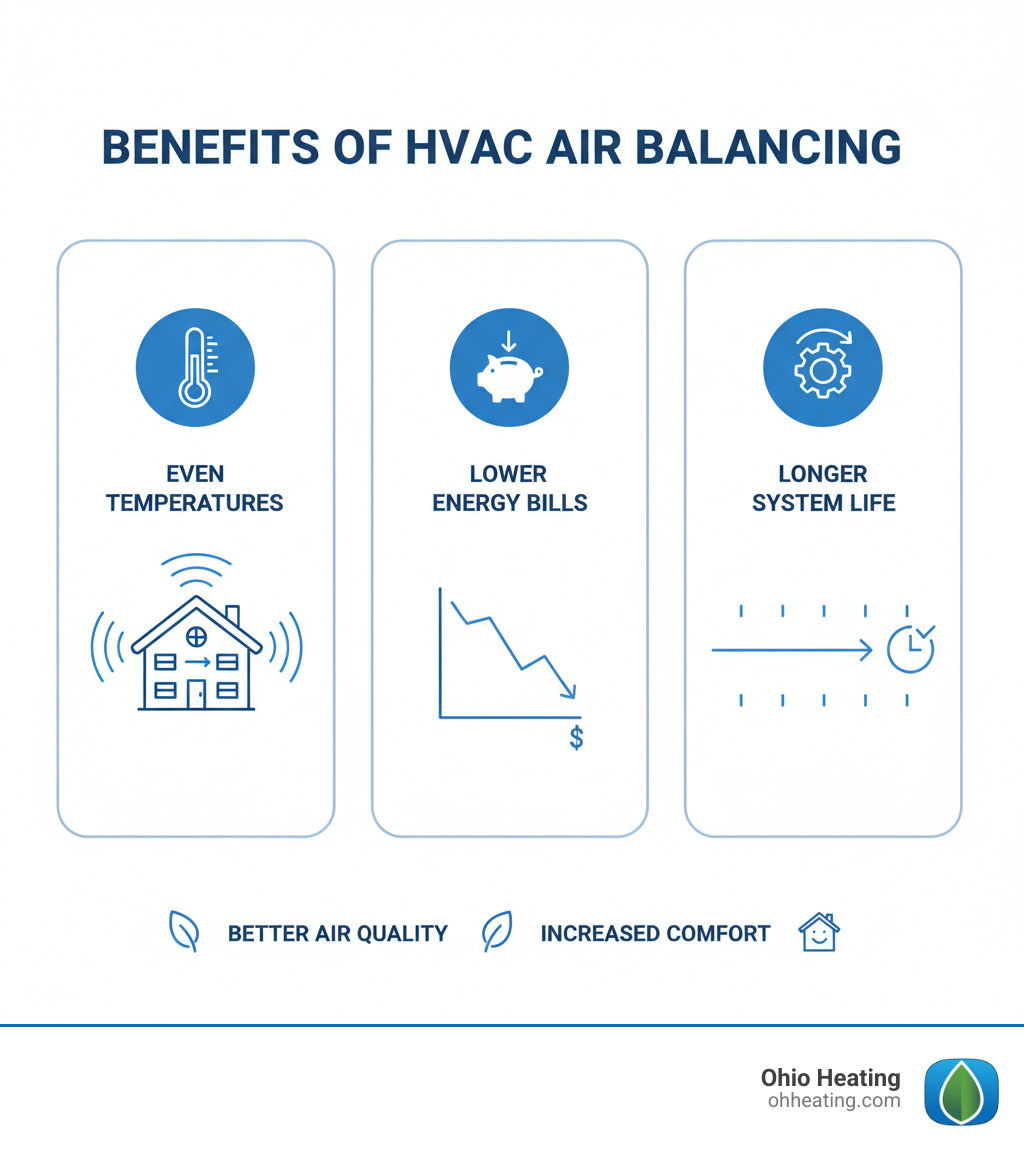
A professionally balanced HVAC system creates a more harmonious and efficient environment. Here’s what you can expect:
- Lower Energy Bills: An efficient system doesn’t have to work as hard, reducing energy consumption and saving you money.
- Extended HVAC Lifespan: Balancing reduces strain on components like the blower motor, helping your equipment last longer and delaying costly replacements.
- Improved Comfort: Say goodbye to hot and cold spots. Balanced airflow ensures consistent, comfortable temperatures in every room.
- Better Indoor Air Quality: Proper ventilation helps reduce allergens, humidity, and stagnant air, creating a fresher, healthier environment.
- Fewer Repairs: An efficient system is less prone to breakdowns, saving you time and money on emergency service calls.
- Reduced System Noise: Balancing can quiet whistling vents or overworked blower motors, contributing to a more peaceful environment.
How Imbalance Affects Your HVAC System
An unbalanced HVAC system struggles to perform, impacting your comfort and your wallet. A primary issue is increased static pressure, which occurs when the blower motor pushes against too much resistance from closed vents or undersized ducts. This high pressure puts immense stress on the blower motor, forcing it to work harder and wear out faster, leading to premature failure.
This overworking also leads to inefficient operation and higher utility bills. It can cause short cycling, where the system turns on and off frequently without completing a full cycle. In cooling mode, poor airflow can even lead to frozen evaporator coils. All these factors contribute to a reduced equipment lifespan, meaning you may need to replace your HVAC unit sooner than expected. Learn more about system issues in our article on Common Issues Causing Commercial HVAC System Failures.
Telltale Signs Your Home Needs Air Balancing
If your home or business in Columbus, Ohio, has a patchwork of different temperatures, your HVAC system is likely out of balance. Recognizing the signs is the first step toward a solution.
The most obvious clue is inconsistent temperatures between rooms. You may notice persistent hot or cold spots, or that certain rooms just never feel comfortable, no matter the thermostat setting. If you feel temperature swings of 2+ degrees from one area to another, your system is struggling to distribute air evenly.
Beyond temperature, pay attention to your system’s performance. Do you notice poor airflow from vents, where some blast air while others are weak? This uneven distribution can also cause whistling or noisy vents, a sign of high air pressure in the ducts.
These issues force your system to work overtime, which often results in unusually high energy bills. If your heating or cooling costs are climbing without a change in your habits, it’s a strong indicator that your system is inefficiently compensating for an air balance problem. If you recognize these symptoms, it’s time to consider an HVAC air balancing assessment.
The Professional HVAC Air Balancing Process
When you call Ohio Heating for professional HVAC air balancing, our certified technicians perform a careful, scientific assessment of your entire system to ensure every component works together perfectly.
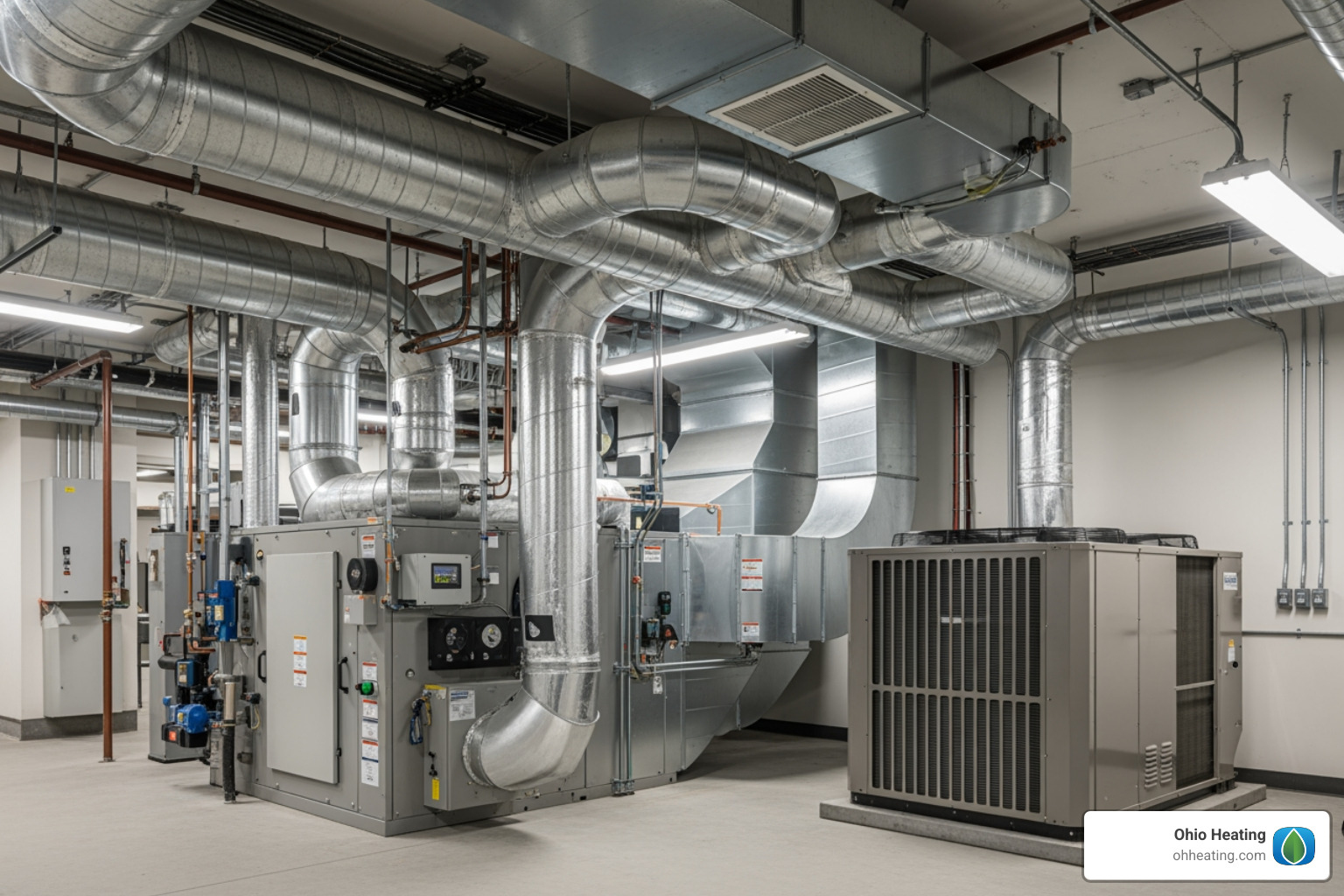
Our thorough process involves a full system diagnostic, precise damper and fan speed adjustments, and, if necessary, ductwork modifications. We don’t guess—we use specialized tools for a quantitative assessment:
- Anemometer: Measures air speed (CFM) to determine total system airflow.
- Manometer: Measures static pressure inside your ducts to identify resistance.
- Airflow Capture Hood (Balometer): Directly measures the CFM coming from each vent for precise readings.
- Thermometers and Psychrometers: Measure temperature and humidity to identify hot/cold spots and assess comfort levels.
By combining our expertise with these advanced tools, we can pinpoint and fix complex airflow problems, ensuring your HVAC system runs at its best.
Step-by-Step: How a Technician Balances Your System
Professional HVAC air balancing is a systematic process to optimize your system’s performance. Here’s how our technicians approach the job:
-
System Inspection and Verification: We start with a thorough inspection of your HVAC unit, blower, and ductwork. We verify that the system is operating under normal conditions, with correct temperature differentials and airflow within design limits.
-
Measure Total and Individual Airflow: Using tools like an airflow capture hood, we measure the total system airflow (CFM). Then, we go to each room and measure the airflow from every supply vent.
-
Compare and Adjust: We compare our measurements to your system’s design specifications to identify which vents receive too much or too little air. We then carefully adjust the dampers inside the ducts, starting with the rooms furthest from their target airflow, to redirect air where it’s needed.
-
Re-Test and Finalize: Balancing is an iterative process. We re-measure and adjust until the airflow from every vent is within +/- 10% of its design target. Once balanced, we secure the dampers in place to prevent them from shifting.
-
Provide a Final Report: We take one last set of measurements and provide you with a detailed report showing the initial findings and final, optimized airflow for your records. For those interested in the technical side, resources like this Fieldpiece STA2 Operator’s Manual offer more detail.
Understanding the Cost of Professional HVAC Air Balancing
The cost of HVAC air balancing depends on your system’s complexity. Key factors include the number of vents to be measured and the accessibility of your ductwork and dampers. In Central Ohio, the average cost per opening (vent) is typically between $75 and $100.
For a typical single-family home, the total cost may range from $750 to $2,000. While this is an upfront investment, consider the return on investment (ROI). A balanced system leads to significant energy savings on monthly utility bills and extends your equipment’s lifespan, helping you avoid thousands in premature replacement costs. Fewer breakdowns also add to your long-term savings.
DIY vs. Professional: What Can You Do Yourself?
Many homeowners wonder if they can perform HVAC air balancing themselves. While you can make some basic adjustments, a truly effective and comprehensive air balance is a job best left to professionals with specialized tools and knowledge.
If you’ve tried basic fixes and still have inconsistent temperatures, high energy bills, or poor airflow, it’s time to call an expert. A professional balance is also recommended for new HVAC systems or after major home renovations to ensure everything is optimized from the start.
DIY Methods for Basic HVAC Air Balancing
If you want to try some basic adjustments first, here are a few DIY methods that may provide some relief:
- Adjust Vent Louvers: Manually direct airflow by opening or partially closing the louvers on your room vents. Slightly close them in comfortable rooms to redirect more air to uncomfortable ones.
- Adjust Manual Dampers: Look for small levers on the ductwork in your basement or attic. These control airflow to different parts of your home. You can experiment by slightly closing dampers to rooms that get too much air, which pushes more air to rooms that need it.
- Label Damper Positions: If you adjust dampers for summer and winter, label their positions to make seasonal changes easier.
- Check for Blockages: Ensure furniture, rugs, or curtains are not blocking supply or return air vents. A clear path for air is crucial.
- Change Air Filters Regularly: A dirty filter is a common cause of restricted airflow. Changing it regularly is one of the easiest ways to maintain system efficiency.
These steps can help with minor issues, but they are not a substitute for professional balancing if a deeper problem exists.
The Dangers of Improperly Closing Vents
It seems logical to close vents in some rooms to force more air into others, but this can cause more harm than good. Closing vents is often a band-aid for a larger problem, not a solution.
The main danger is a sharp increase in static pressure inside your ducts. Your system’s blower is designed for a specific level of resistance. Closing vents creates blockages, forcing the motor to work much harder. This can lead to several problems:
- Blower Motor Damage: The constant strain can cause the motor to overheat and burn out, requiring an expensive replacement.
- Reduced Efficiency: The system uses more energy to fight the increased pressure, driving up your utility bills. As energy.gov notes, if you feel the need to close vents, you likely have an airflow issue that needs a proper fix.
- Duct Leaks: High pressure can worsen existing leaks in your ductwork or create new ones, wasting conditioned air and money.
Closing vents rarely solves the root cause, which could be an improperly sized HVAC system or flawed ductwork. It’s better to view the need to close vents as a sign that your system needs a professional assessment.
Factors That Disrupt Your Home’s Air Balance
An HVAC system’s delicate balance can be disrupted by many factors. In our work across Columbus and Central Ohio, we’ve seen how changes to a home or its HVAC system can quickly lead to comfort problems.
Maintaining proper HVAC air balancing is an ongoing process. The issue often starts with the ductwork design. If ducts were improperly sized or installed with too many sharp turns, achieving balance will always be a challenge. Over time, system age also plays a role, as components like blower motors wear down and lose efficiency.
Home modifications are one of the most common disruptors. A new addition, a finished basement, or even new energy-efficient windows can alter your home’s heating and cooling load. What worked five years ago may not be adequate today. Even changes in insulation can shift the balance. Proper ventilation is key to managing these changes; you can learn more about the principles from our guide on Ventilation Systems.
How Ductwork Design and Condition Affect Balance
The ductwork is the circulatory system for your home’s air, and its design and condition are critical for balance. Many airflow problems start here.
- Improperly Sized Ducts: Ducts that are too small create high static pressure and restrict airflow, while oversized ducts can lead to sluggish, inefficient air delivery.
- Leaky Ductwork: The U.S. Department of Energy estimates that the average home loses a significant amount of conditioned air through leaks in duct seams and joints. This wasted air escapes into walls and attics, making it impossible to properly balance the system.
- Poor Layout: Long, complex duct runs with many sharp bends create resistance that reduces airflow to rooms at the end of the line.
- Lack of Return Vents: A room needs a return vent to pull old air out as new conditioned air is pushed in. Without adequate returns, a room can become pressurized, preventing proper air circulation.
- Blockages: Dust, construction debris, or even toys can accumulate in ducts and severely restrict airflow.
Professional HVAC companies follow design standards from groups like SMACNA and ACCA to ensure ductwork is sized and installed for optimal performance. For more on our services, including proper ductwork design, visit More on Commercial HVAC Services.
The Impact of Home Changes and System Age
Your home and HVAC system change over time, and these changes can disrupt airflow and comfort.
Home additions or renovations, like finishing a basement, fundamentally alter the heating and cooling load. The original system may now be undersized for the larger space, causing it to struggle. Similarly, upgrades like new windows or insulation change your home’s thermal properties, altering the airflow needs of individual rooms.
Aging HVAC equipment also contributes to imbalance. Over the years, blower motors lose power and can no longer move air as effectively. An older system may simply lack the strength to maintain the balanced airflow it had when it was new.
Finally, changes in room usage can affect comfort needs. A guest room that becomes a full-time home office will require more consistent conditioning than it did before. These factors highlight why HVAC air balancing is not always a one-time fix. A professional reassessment after major changes can restore comfort and efficiency.
Conclusion
So, is HVAC air balancing worth it? As a leading HVAC provider in Columbus and Central Ohio, we can say with confidence: yes, it absolutely is.
Your HVAC system is a major investment responsible for your comfort, air quality, and a large portion of your energy bills. An unbalanced system is inefficient and under strain, much like a car with misaligned wheels. It wastes fuel and wears down components faster.
Professional HVAC air balancing transforms your property into a consistently comfortable environment. You’ll eliminate hot and cold spots, and your system will run more quietly and efficiently. The key benefits are clear:
- Improved comfort in every room.
- Lower energy bills from increased efficiency.
- Extended equipment life, protecting your investment.
- Better indoor air quality.
While some DIY adjustments can provide minor relief, true, lasting balance requires the specialized tools and expertise of a professional. Our technicians don’t just move air around; we analyze and optimize your entire system to address the root cause of the problem.
At Ohio Heating, we’ve been ensuring comfort and reliability for homes and businesses since 1999. We’ve seen how proper balancing prevents frustrating temperature swings and costly system failures. Don’t wait for an unbalanced system to cause more strain on your equipment and your wallet.
Schedule your professional Air Balance in Columbus, Ohio today and let us show you what true comfort feels like. Your HVAC system will thank you.