
Certified air balance: Achieve Perfect Flow for 2026
Why Your Building Needs More Than Just “Feeling Comfortable”
Certified air balance is a professional process where trained technicians test, adjust, and balance your HVAC system using specialized instruments to ensure every room receives the right amount of airflow according to engineering specifications.
If you’re looking for certified air balancing services:
- Who performs it: AABC or NEBB certified technicians with specialized training
- What it costs: Typically $75-$150 per opening ($900-$2,000 for a 12-opening system)
- What you get: A detailed report showing airflow measurements, system adjustments, and compliance verification
- Why it matters: Fixes uneven temperatures, reduces energy bills by up to 30%, and ensures proper ventilation
We use the term HVAC quite a bit (Heating, Ventilation, and Air Conditioning), but most people only pay attention when something breaks or when they’re buying a new unit. The ventilation part? That’s usually the most overlooked, yet it’s responsible for about 70% of HVAC problems in buildings.
If some rooms in your building are too hot while others are freezing, or if your energy bills seem unreasonably high despite regular maintenance, you might have an air balance problem. It’s not uncommon to find systems running 30-50% low on airflow, which means your equipment is working harder than it should while delivering less comfort than you’re paying for.
Here’s the challenge: when your HVAC contractor installed your system, they likely sized the equipment correctly and ran the ductwork according to plan. But did anyone verify that the air actually reaches each room in the right amounts? Did they measure to ensure the system performs as the engineer designed it? Without this verification step (certified air balancing), you’re essentially hoping everything works perfectly by chance.
A “comfort balance” is when someone walks around your building, holds their hand up to the vents, and asks if people feel comfortable. A certified air balance is when a trained technician uses precision instruments to measure exact airflow volumes, pressures, and temperatures, then adjusts your system to meet engineered specifications and provides documented proof.
I’m Jill Frattini, a Service Coordinator at Ohio Heating in Columbus, where I’ve spent years coordinating HVAC projects including Certified air balance services for commercial and residential clients. Through my work, I’ve seen how proper air balancing transforms problem buildings into comfortable, efficient spaces.
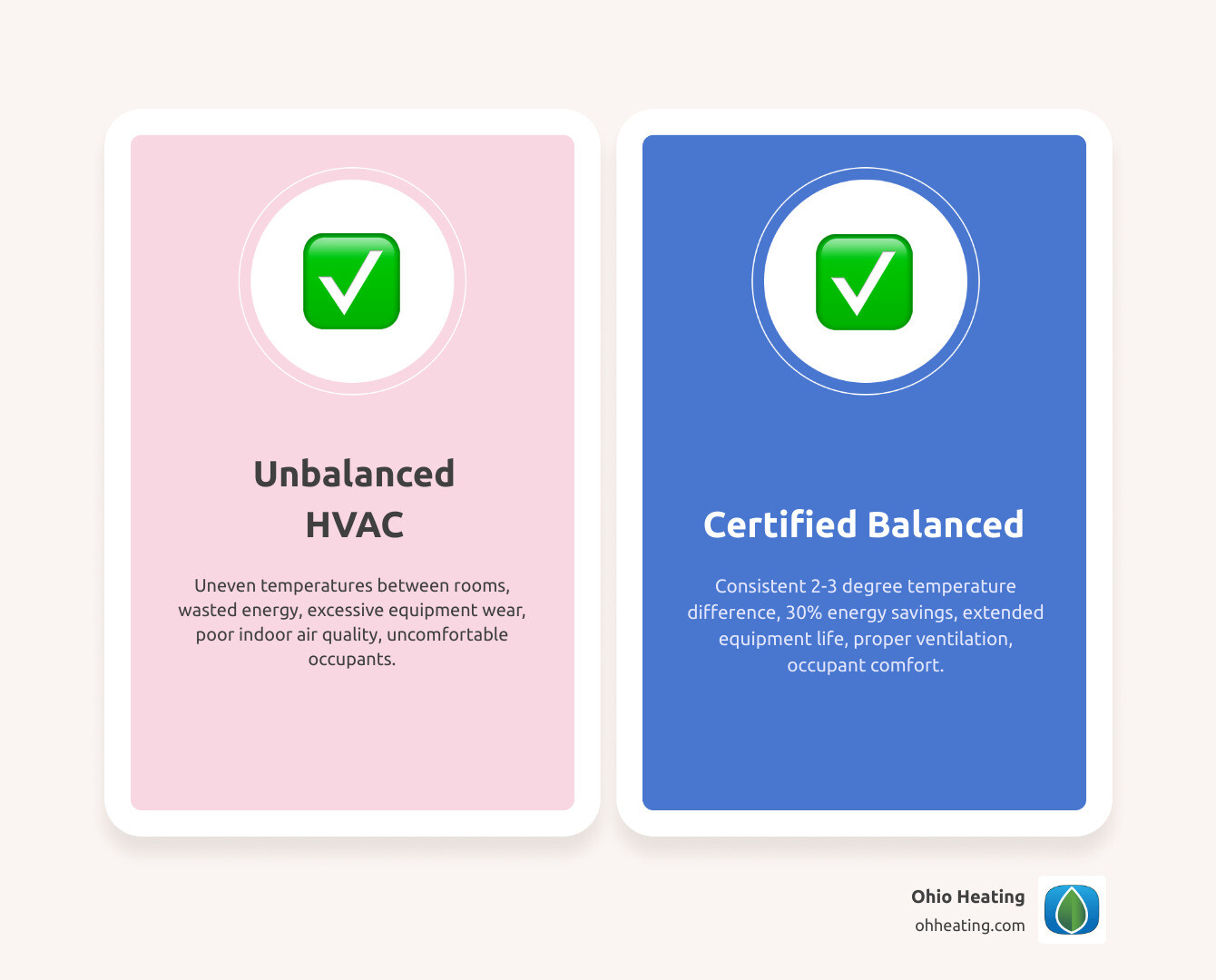
The infographic above illustrates common problems of an unbalanced system (uneven temperatures between rooms, wasted energy, excessive equipment wear, poor indoor air quality, uncomfortable occupants) compared to the benefits of a properly balanced system (consistent 2-3 degree temperature difference, 30% energy savings, extended equipment life, proper ventilation, occupant comfort and productivity).
Certified air balance vocabulary:
What is Certified Air Balance and Why Is It Essential?
At its core, certified air balance is a systematic process of Testing, Adjusting, and Balancing (TAB) your HVAC system. It’s not just about making sure your heating and cooling equipment turns on; it’s about ensuring that your entire system performs precisely as it was designed to. This means verifying that the correct amount of conditioned air (or airflow volume, measured in Cubic Feet per Minute, or CFM) is delivered to every single space within your building, according to the mechanical engineer’s specifications.
Why is this so crucial for your HVAC system? Without proper air balancing, your system can be incredibly inefficient, leading to a host of problems. For instance, it’s not uncommon to find an HVAC system running 30% to 50% low on airflow in certain areas. Imagine your building’s ductwork as a series of highways for air; if some lanes are blocked or too narrow, traffic backs up, and the air never reaches its destination efficiently. This means your system works harder, consumes more energy, and ultimately fails to provide comfort.
In fact, a significant amount of energy is simply lost due to inefficient ductwork. According to the U.S. Department of Energy, roughly one-third of the energy supplied to the ducts is lost before it gets to the living space. That’s like paying for a full tank of gas but only using two-thirds of it! This energy waste directly impacts your utility bills and the lifespan of your HVAC equipment. When your system is constantly struggling to push air through poorly distributed ducts, it puts immense strain on components like blowers and compressors, leading to premature wear and costly breakdowns. A properly balanced system reduces this strain, contributing to the longevity and reliability of your entire HVAC infrastructure. For a deeper dive into how your HVAC system works, you can find more info about HVAC systems.
The practical applications of TAB extend to both new construction and existing buildings. In new builds, it ensures that the HVAC system is commissioned correctly from day one, meeting design specifications and optimizing performance. For existing buildings, it’s a powerful tool to address persistent issues like uneven temperatures, high energy bills, and poor indoor air quality that may have developed over time due to system degradation, changes in building usage, or initial improper setup.
Comfort Check vs. Certified Air Balance: What’s the Difference?
When we talk about air balance, it’s important to distinguish between a “comfort check” and a certified air balance. They are vastly different in their approach, accuracy, and outcomes.
A “comfort balance,” often seen as a quick assessment, is largely subjective. It involves a technician or even a building manager walking around, feeling the airflow from registers, and asking occupants if they “feel comfortable.” It might involve some basic adjustments based on immediate feedback, like closing a damper slightly if a room feels too cold. While this might provide temporary relief in one area, it often creates problems elsewhere in the system, like “robbing” airflow from other rooms or increasing static pressure. It’s a bit like trying to fix a complex machine by just “eyeballing” it – you might get lucky, but you’re probably missing a lot.
In contrast, a certified air balance is an objective, rigorous, and scientific process. It relies on specialized instruments and verifiable data, not just feelings. Certified technicians carefully measure airflow, pressure, and temperature at every supply and return opening, as well as throughout the ductwork. They compare these measurements against the mechanical engineer’s precise design specifications for each space. The goal is to achieve proportional airflow distribution, ensuring that every room receives the exact CFM it needs. This process adheres to strict industry standards set by reputable organizations, guaranteeing accuracy and reliability. The result is a system that performs optimally, documented with a detailed report that provides tangible proof of compliance and performance. It’s the difference between a casual observation and a precise engineering verification.
The Anatomy of the TAB Process: Testing, Adjusting, and Balancing
The Testing, Adjusting, and Balancing (TAB) process is a methodical and iterative approach to fine-tuning an HVAC system. It’s like a symphony conductor making sure every instrument plays its part perfectly in harmony.
Testing: Gathering the Data
The first step in TAB is comprehensive testing. Our certified technicians use a suite of specialized, calibrated instruments to gather precise data on your system’s performance. This isn’t guesswork; it’s about hard numbers. Key measurements include:
- Airflow volume (CFM): We measure the amount of air moving through each duct, grille, and diffuser. This is often done using a highly accurate air balancing hood placed over each opening.
- Static pressure: This measures the resistance to airflow within the ductwork. High static pressure can indicate blockages, undersized ducts, or dirty filters, forcing your fan to work harder. We use manometers for this.
- Temperature: We take temperature readings at various points to ensure conditioned air is being delivered effectively and that the system is heating or cooling to design specifications.
- Fan RPM (Revolutions Per Minute): This helps us determine if the fan is operating at its intended speed and if it’s capable of delivering the required airflow.
Other tools like anemometers (for measuring air velocity) are also part of our arsenal. All this data is carefully recorded and compared against the original design specifications provided by the mechanical engineer.
Adjusting: Making the Corrections
Once we have a complete picture of your system’s performance, the adjusting phase begins. This is where our technicians make precise modifications to various system components to bring them into alignment with the design. This involves:
- Dampers: These are crucial components within the ductwork that control airflow. We adjust opposed blade dampers (OBDs) located behind grilles and other balancing dampers in branch ducts to increase or decrease airflow to specific areas.
- Fan speeds: Sometimes, adjusting the fan’s speed can help achieve the desired system-wide airflow.
- Valves: In hydronic systems (which handle water flow for heating/cooling coils), valves are adjusted to ensure proper water distribution.
- Grilles and diffusers: While these deliver air to the space, initial adjustments are usually made further upstream in the ductwork.
This is an iterative process. Changing one damper’s setting will inevitably affect the airflow in other parts of the system. Our technicians constantly re-measure and re-adjust until all areas are brought into balance. It requires skill, patience, and a deep understanding of air dynamics.
Balancing: Achieving Harmony
The final stage is balancing, where the goal is to achieve proportional airflow distribution throughout the entire HVAC system, matching the engineer’s design specifications. This means ensuring that each room, zone, or area receives its designated CFM. We aim for a state where the system operates as a cohesive unit, delivering consistent comfort and efficiency everywhere.
Once achieved, the final settings of all dampers and devices are “locked down” to prevent accidental changes. The result is an optimally performing system, documented in a comprehensive report detailing all measurements, adjustments, and final settings. This report is a valuable record for future maintenance and troubleshooting.
The Experts and Standards Behind Professional Air Balancing
Achieving a truly balanced HVAC system is a team effort involving several key players. It begins with the Mechanical Engineer, who designs the entire HVAC system and provides detailed specifications, including CFM requirements for each opening. Next, the HVAC contractor is responsible for the proper installation of the equipment and ductwork according to those designs. Finally, the Certified TAB Technician steps in for the critical verification process. Our Commercial HVAC Services team works closely with all these professionals to ensure seamless project execution.
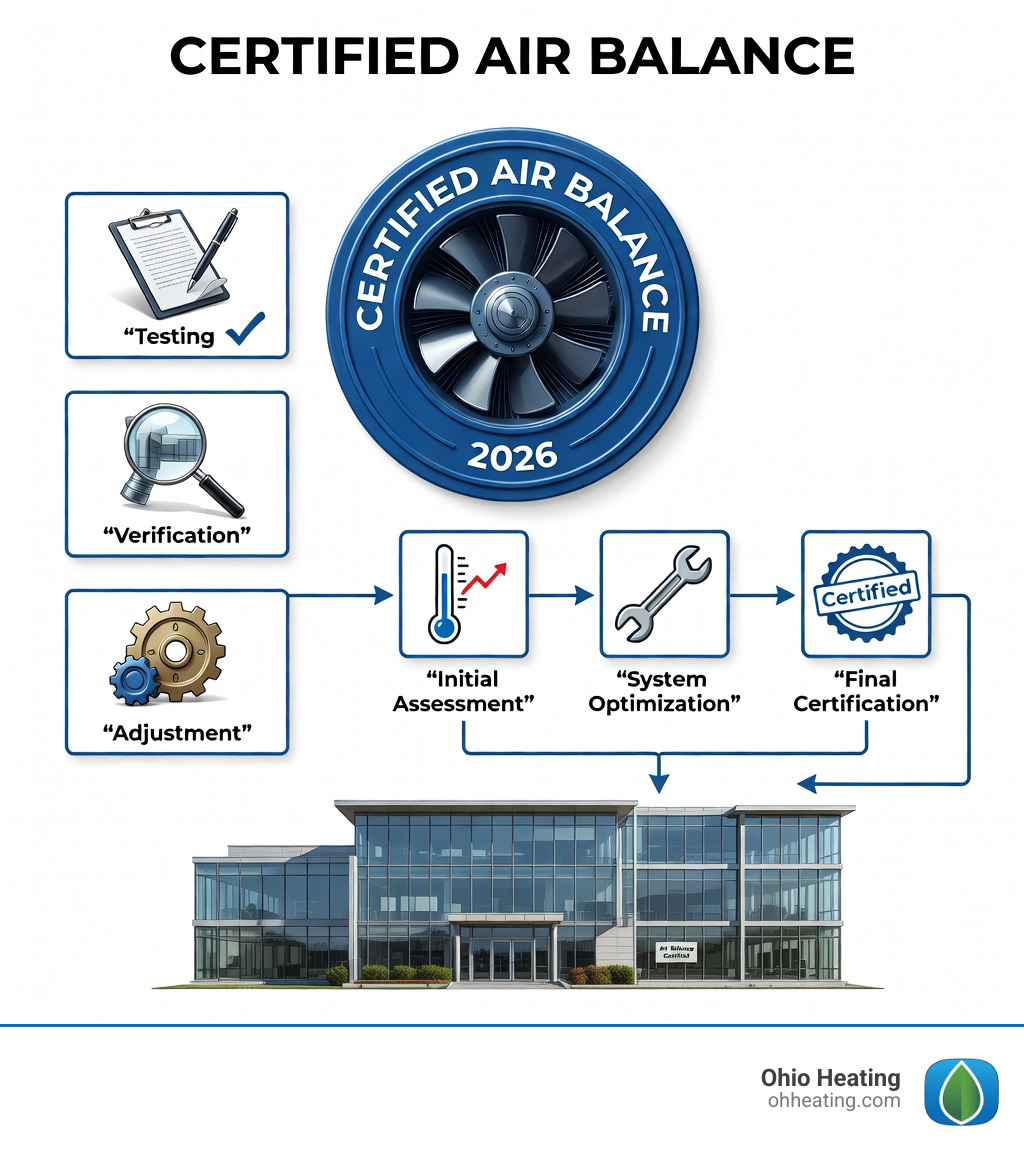
Certifying Bodies: AABC and NEBB
To ensure the highest level of expertise and independence in air balancing, reputable certifying bodies establish rigorous standards and qualifications. The two primary organizations in North America are the Associated Air Balance Council (AABC) and the National Environmental Balancing Bureau (NEBB).
-
Associated Air Balance Council (AABC): The AABC is dedicated to the advancement of independent, third-party testing, adjusting, and balancing (TAB). Their mission is to certify highly qualified, independent test and balance agencies and individuals. AABC offers two levels of individual certification: the Test & Balance Engineer (TBE) and the Certified Test & Balance Technician (TBT). These certifications ensure professionals adhere to a strict code of ethics and performance guarantees.
-
National Environmental Balancing Bureau (NEBB): NEBB also provides certification for firms and professionals in TAB, among other disciplines. NEBB’s certification program objectives include establishing industry standards, setting minimum educational requirements, developing training programs, and certifying competent firms and individuals. For a firm to become NEBB-certified in TAB, it must have operated for at least 12 months with full-time employees, possess a reputation for integrity, be affiliated with a local NEBB chapter, own all required TAB instruments, and designate a NEBB Certified Professional responsible for the TAB work. NEBB TAB certified professionals are responsible for developing work plans, preparing reports, recommending corrective actions, establishing safety plans, maintaining instruments, understanding control strategies, and signing off on final reports. Individual certification involves extensive study covering six key domains, culminating in a 5-hour closed-book exam.
The independence of these certified professionals is paramount. Certified balance contractors cannot be affiliated with mechanical contractors, design engineers, or equipment manufacturers. This ensures unbiased verification of system performance.
The Value of a Certified Air Balance Report
A certified air balance isn’t just a service; it culminates in a comprehensive report that is an invaluable asset for building owners and managers. This report details:
- Design vs. Actual Readings: It clearly shows the intended CFM and other parameters for each opening versus the actual measurements taken by the technician.
- Final Settings: All adjustments made to dampers, fan speeds, and other components are documented.
- Recommendations: The report may include recommendations for further improvements or maintenance.
The purpose of this report is multifaceted: it provides a definitive baseline of your system’s performance, proves compliance with design specifications and often local building codes, and serves as a critical document for future troubleshooting or system upgrades. It’s your verifiable proof that your HVAC system is performing exactly as intended.
The Payoff: Open uping Efficiency, Comfort, and Safety
Investing in certified air balance offers significant returns, changing your building into a more efficient, comfortable, and safer environment.
Energy Efficiency and Optimal Building Performance
One of the most immediate and tangible benefits is improved energy efficiency. When your HVAC system is properly balanced, every component works in harmony, and air is delivered precisely where it’s needed. This eliminates the need for your system to overwork, reducing energy consumption and lowering your utility bills. We’ve seen buildings in Columbus, OH, realize substantial savings, sometimes cutting energy costs by up to 30%. This directly contributes to optimal building performance and sustainability goals. For more insights into managing your building’s energy, visit our page on Building and Energy Management.
Beyond energy savings, certified air balance ensures occupant comfort. In an unbalanced system, you often experience “hot and cold spots”—some rooms are too warm, others too chilly, leading to constant complaints and thermostat wars. With a properly balanced system, airflow is evenly distributed, eliminating drafts and maintaining consistent temperatures throughout the building. The best systems, achieved through expert balancing, can maintain a 2- or 3-degree temperature difference from any room compared to any other room. This is a significant improvement over older standards that sometimes accepted a 10-degree difference between floors!
Improved Indoor Air Quality and Safety
Proper air balancing plays a critical role in maintaining indoor air quality (IAQ) and safety, which is especially important in today’s world. When airflow is correctly managed, your ventilation system can effectively remove pollutants, allergens, and stale air, replacing it with fresh, conditioned air. This is crucial because the air inside your home can be more polluted than the air outside, even in Central Ohio.
Correct building pressurization, achieved through balancing, also prevents outdoor pollutants from infiltrating and, critically, prevents the dangerous spillage of combustion gases from furnaces or water heaters. Carbon monoxide, a byproduct of combustion, is odorless and colorless, making it incredibly dangerous. Ensuring your system is properly vented and balanced helps mitigate the dangers of carbon monoxide and other harmful combustion byproducts. This keeps your occupants safe and healthy, reducing the risk of illness and improving overall well-being.
What Does a Professional Air Balance Cost?
We understand that cost is always a consideration. The cost of obtaining an AABC Certified Air Balance, or any certified air balance, can vary depending on several factors: the size and complexity of your building, the intricacy of your HVAC system, and primarily, the number of supply, return, and exhaust openings that need to be tested and adjusted.
Generally, the cost to do an AABC Certified Air Balance ranges from $75-$150 per opening. To give you a practical example, consider a typical commercial space or a larger residential property with five supply openings, five return openings, one exhaust fan, and one outside air (OSA) intake. This totals 12 openings that need to be carefully verified. Depending on the complexity and location of these openings, you can expect to pay anywhere from $900-$2,000 for a thorough, certified balance. While this might seem like an upfront investment, when you consider the long-term savings in energy costs, extended equipment life, and improved occupant comfort and health, it quickly becomes a sound financial decision.
Conclusion: Achieve Perfect Airflow in Your Building
At Ohio Heating, we believe that a truly comfortable and efficient building starts with perfectly balanced airflow. Certified air balance is not just a technical service; it’s an investment in the comfort, health, and operational efficiency of your property. From ensuring consistent temperatures and improving indoor air quality to significantly reducing your energy bills and extending the life of your HVAC equipment, the benefits are clear and far-reaching.
Don’t let uneven temperatures, high energy costs, or concerns about indoor air quality compromise your building’s performance. Our team of local experts in Columbus, OH, is equipped with the knowledge, experience, and certified professionalism to bring your HVAC system into perfect harmony.
Schedule your certified air balance in Columbus, Ohio today!