
Why Air Conditioning Matters More Than Ever
Air conditioning is one of the most important systems in any home or commercial building — keeping occupants comfortable, protecting equipment, and even saving lives during extreme heat.
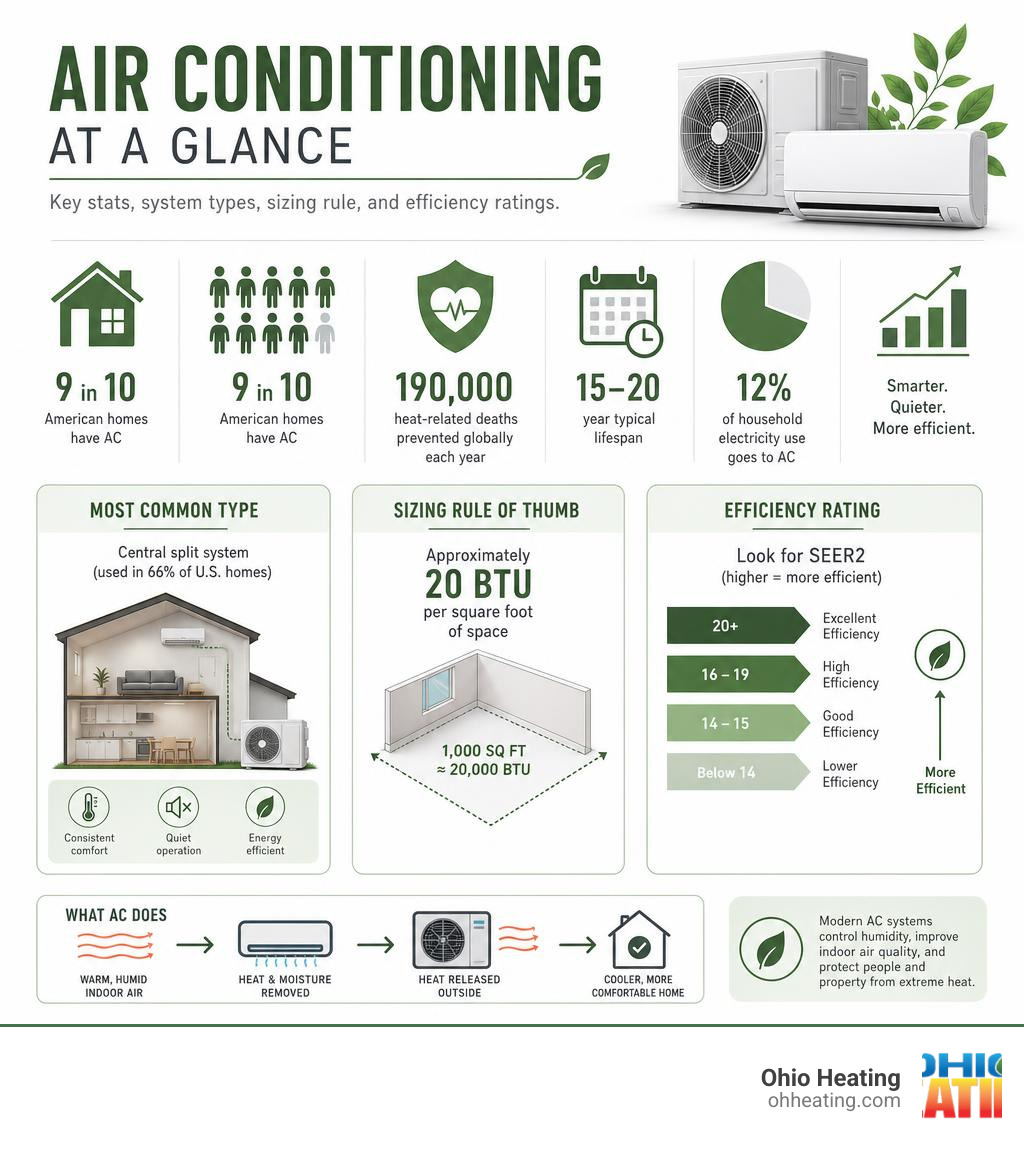
Here’s a quick overview of what you need to know:
| Topic | Quick Answer |
|---|---|
| What it does | Removes heat and humidity from indoor air |
| Most common type | Central split system (used in 66% of U.S. homes) |
| Right size | Approximately 20 BTU per square foot of space |
| Efficiency rating to look for | SEER2 (higher = more efficient; 16+ is a solid target) |
| Typical lifespan | 15–20 years with proper maintenance |
| Average U.S. energy cost | AC accounts for about 12% of household electricity use |
Nearly 9 in 10 American homes now have some form of air conditioning — and for good reason. Beyond comfort, modern AC systems control humidity, improve indoor air quality, and protect both people and property from the dangers of extreme heat. Globally, air conditioning is estimated to prevent around 190,000 heat-related deaths every year.
The technology has come a long way since Willis Carrier installed the first modern electrical air conditioning system in a Brooklyn printing plant in 1902 — not to keep workers cool, but to stop paper from warping in the summer humidity. Today, systems are smarter, quieter, and far more energy-efficient than anything Carrier could have imagined.
Whether you manage a single property or an entire portfolio, understanding how your cooling system works — and how to keep it running — directly affects your bottom line.
I’m Jill Frattini, Service Coordinator at Ohio Heating in Columbus, OH, with several years of hands-on experience coordinating air conditioning repairs, installations, and maintenance across Central Ohio. I’ll walk you through everything you need to make smart, confident decisions about your cooling system.
What is Air Conditioning and How Does It Work?
To understand how an air conditioner keeps your house feeling like an oasis during a muggy Ohio July, it helps to realize one fundamental truth: an air conditioner doesn’t actually “create” cold air. Instead, it acts as a heat magnet, pulling warmth and moisture out of your indoor spaces and dumping them outside.
This cooling wizardry relies on the vapor-compression cycle, a continuous loop of heat transfer that operates on the exact same scientific principles as your kitchen refrigerator. The process is divided into four main stages, managed by four essential components:
- The Evaporator Coil (Located Indoors): Cold, liquid refrigerant flows through this copper coil. As warm indoor air is blown across the coil by your blower fan, the refrigerant absorbs the heat. Because heat naturally moves toward cold, the indoor air drops in temperature. At the same time, moisture in the air condenses on the cold coil (like water droplets on a cold glass of iced tea), which effectively dehumidifies your home.
- The Compressor (Located Outdoors): Once the refrigerant absorbs indoor heat, it vaporizes into a warm gas and travels outside to the compressor. The compressor squeezes the gaseous refrigerant, raising its pressure and temperature even higher, preparing it to dump its heat.
- The Condenser Coil (Located Outdoors): The high-pressure, hot gas enters the condenser coil. A large outdoor fan blows ambient air across this coil, forcing the heat to escape into the outdoor air. As it cools down, the refrigerant condenses back into a high-pressure liquid.
- The Expansion Valve: Before heading back inside, the liquid refrigerant passes through an expansion valve. This valve reduces the pressure of the liquid, causing its temperature to plummet. It is now a freezing-cold liquid, ready to head back to the indoor evaporator coil and start the cycle all over again.
By continuously cycling refrigerant through these phases, your system lowers both the temperature and the relative humidity of your living spaces. In fact, dehumidifying the air first is incredibly important. Dehumidifying indoor spaces can reduce subsequent cooling costs by up to 90% because dry air feels significantly cooler to the human skin than damp air at the exact same temperature.
To learn more about the deep science and history behind this technology, you can explore the Air conditioning article or read the broader Air conditioning – Wikipedia entry.
Types of Cooling Systems for Your Home
No two homes in Columbus are built exactly alike. A historic home in German Village has different layout and ductwork constraints than a modern, open-concept build in Dublin. Choosing the right system selection depends heavily on your home layout, budget, and required cooling capacity.
Central Air Conditioning Systems
For comprehensive, whole-house comfort, ducted cooling remains the gold standard. A central split system utilizes your home’s existing ductwork to distribute cooled air evenly to every room.
These systems consist of an outdoor condenser unit and an indoor evaporator coil (usually paired with your indoor air handler). Because they cool the entire house through a centralized thermostat, they are exceptionally convenient and highly effective at maintaining a consistent temperature. However, they do require pre-existing ductwork in good condition. If your current system is aging or frequently breaking down, you can read our guide on how to Find Out Whether to Repair or Replace Your Air Conditioning Unit to help you weigh your options.
Ductless Mini-Split Air Conditioning
If your home doesn’t have ductwork—or if you have built a new home addition, finished a basement, or have specific rooms that always seem too warm—ductless mini-splits are an incredible alternative.
These systems provide localized, zoned cooling. An outdoor unit connects to one or more indoor air handlers mounted directly on your walls or ceilings. Because there are no ducts, there is zero energy loss from leaky ductwork, making mini-splits incredibly energy-efficient. They allow you to set different temperatures for different zones of your home, saving money by only cooling the rooms you are actively using. High-quality systems, such as those inspired by global inverter split designs like the TX Series 3.5kW Reverse Split Air Conditioning | Rinnai Australia, showcase just how quiet, powerful, and precise modern ductless technology can be.
Portable and Window Units
For temporary solutions or highly localized cooling in a single room, portable and window air conditioners offer quick, easy installation without the need for a major renovation.
A window unit sits directly in a window frame, containing all the cooling components in one compact box. Portable units sit on the floor and vent hot air through a flexible hose running to a window. While they are less efficient than central or mini-split systems, they are great for renters or specific situations. For example, a compact unit like the 7,500 BTU 115V Window Air Conditioner can quickly cool down a small studio, home office, or guest space with minimal fuss.
Sizing and Energy Efficiency Ratings
Buying an air conditioner is not like buying a toaster; you cannot simply grab the biggest one on the shelf and call it a day. Proper system performance, energy savings, and manageable operating costs rely entirely on matching the unit to your home’s physical characteristics.
Determining the Right AC Size
If your air conditioner is too small, it will run constantly, struggling to cool your home, driving up your electric bills, and wearing itself out prematurely. If it is too large, it will suffer from “short-cycling”—turning on, cooling the air rapidly, and shutting off before it has a chance to dehumidify the space. This leaves your home feeling cold and clammy, like a damp cave.
To find the perfect fit, HVAC professionals don’t rely on guesswork. We calculate the cooling capacity needed using BTUs (British Thermal Units). While a general rule of thumb is that you need about 20 BTUs per square foot of living space, a true professional will perform a Manual J Load Calculation. This detailed assessment takes into account:
- Total square footage and ceiling heights
- The number, size, and orientation of windows
- Local climate patterns in Central Ohio
- Insulation levels in your walls and attic
- Home shading and roof materials
Getting this math right is the single most important step in any new installation.
Understanding SEER2 and Energy Efficiency
Once you know the correct size, you need to look at efficiency. In the HVAC world, cooling efficiency is measured by SEER2 (Seasonal Energy Efficiency Ratio 2). Introduced as the mandatory industry standard in January 2023, SEER2 represents the total cooling output of an AC unit over a typical cooling season divided by the total electric energy input.
Think of SEER2 like miles-per-gallon (MPG) for your car: the higher the number, the less electricity the unit uses to cool your home.
- Standard efficiency: 13.4 to 15 SEER2
- High efficiency: 16 to 18 SEER2
- Ultra-high efficiency: 19+ SEER2 (often utilizing advanced inverter technology)
Investing in an Energy Star certified system with a higher SEER2 rating can yield massive electricity savings over the 15-to-20-year lifespan of your equipment. To explore the best options for your budget, read our detailed breakdown to Discover Energy Efficient AC Options for Columbus Homeowners.
Compressor Technologies and System Costs
The heart of any air conditioning system is its compressor. The type of compressor technology you choose directly impacts your daily comfort, temperature consistency, and the upfront cost of your system.
Single-Stage vs. Two-Stage vs. Variable-Speed Compressors
Compressor technology generally falls into three distinct tiers:
| Compressor Type | How It Operates | Temperature Consistency | Humidity Control | Efficiency Level |
|---|---|---|---|---|
| Single-Stage | Only runs at 100% capacity (“On” or “Off”). | Moderate (swings up/down) | Standard | Standard (Up to 15 SEER2) |
| Two-Stage | Runs at ~65% capacity on mild days; kicks up to 100% on hot days. | High | Excellent | High (Up to 17.5 SEER2) |
| Variable-Speed | Modulates continuously from 25% to 100% capacity in tiny increments. | Perfect (always consistent) | Best in class | Ultra-High (Up to 21+ SEER2) |
Variable-speed systems utilize advanced inverter technology to run almost continuously at lower speeds. This constant, gentle operation eliminates temperature swings, keeps indoor air incredibly fresh, and maximizes dehumidification while using a fraction of the electricity of a single-stage system.
Average Costs of a New AC Unit
A new central air conditioner is a significant investment. Total installation costs are determined by the equipment tier (SEER2 rating and compressor type), the size of your home, and labor expenses.
In Central Ohio, a standard replacement can vary widely based on these factors. While it is easy to feel overwhelmed by quotes, it is crucial to understand what goes into these prices so you don’t overpay. For a transparent, honest look at what you should expect to spend, check out our guide: Don’t Get Quoted 30k: Understanding New AC Unit Costs.
To get an even deeper look at local pricing dynamics, check out Air Conditioning Installation Costs Columbus Ohio Insights.
Lifespan, Maintenance, and Smart Features
With proper care, a high-quality cooling system should keep your home comfortable for 15 to 20 years. However, achieving that system longevity requires a mix of smart usage, preventative care, and professional upkeep.
Factors Affecting AC Lifespan
How long your AC lasts depends on several critical variables:
- Installation Quality: A system that was poorly sized or improperly installed will work twice as hard, leading to early component failure.
- Usage Patterns: Running your system at extremely low temperatures without break accelerates wear and tear.
- Environmental Factors: Outdoor units exposed to heavy cottonwood debris, lawn clipping buildup, or corrosive elements can degrade faster.
- Maintenance Consistency: Neglected systems lose about 5% efficiency every year they go without a tune-up.
Essential AC Maintenance and Troubleshooting
The single most important maintenance task a homeowner can perform is replacing the air filter regularly. A clogged filter chokes off airflow, forcing your system to work harder, spike your energy bills, and potentially cause the evaporator coil to freeze over.
Beyond changing your filter every 30 to 90 days, regular coil cleaning and professional tune-ups are essential to prevent costly breakdowns. We recommend scheduling a professional inspection every spring. To help you stay on top of these tasks, check out The Coolest Guide to Air Conditioner Maintenance.
If you want to take a proactive approach to protecting your system, read up on Preventative AC Maintenance and explore these Strategies to Boost Efficiency Through Proper AC Maintenance. For long-term peace of mind and priority service, consider signing up for a local program like an AC Maintenance Plan Near Me or read our AC Maintenance Plan Ultimate Guide.
Smart Thermostats and Connected Cooling
Modern cooling isn’t just efficient; it’s incredibly smart. Upgrading to a Wi-Fi-enabled smart thermostat allows you to control your home’s climate from your smartphone, set automated smart scheduling, and track your energy usage in real-time.
Advanced systems even feature remote diagnostics (such as InteliSense™ technology), which can alert your HVAC technician to a performance issue before you even notice your home getting warm.
Environmental Impact and Eco-Friendly Refrigerants
As of 2022, global air conditioning accounted for roughly 7% of global electricity consumption and 3% of global greenhouse gas emissions. As a result, the industry has undergone massive shifts toward eco-friendly designs.
Older refrigerants like R-22 (Freon) and R-410A are being phased out in favor of low-GWP (Global Warming Potential) alternatives, such as R-32 and A2L class refrigerants. These modern refrigerants transfer heat more efficiently, allowing systems to use less charge and significantly lowering the carbon footprint of your home’s cooling.
Frequently Asked Questions
Why is my AC blowing warm air?
If your vents are blowing warm air, start by checking your thermostat to ensure it is set to “Cool” and the fan is set to “Auto” rather than “On” (which blows air continuously even when the cooling cycle is off).
If the settings are correct, you may be dealing with a dirty air filter blocking airflow, a tripped outdoor circuit breaker, or a more serious issue like an AC Blowing Warm Air caused by a refrigerant leak. If you suspect a leak, you will need a professional AC Refrigerant Leak Fix. In worst-case scenarios, a failing compressor might require an AC Compressor Replacement or a specialized Residential AC Compressor Repair: What You Need to Know.
How often should I schedule professional AC maintenance?
You should schedule a professional AC Tuneup at least once a year, ideally in the spring before the heavy cooling season begins. This preventative care allows technicians to clean the coils, check refrigerant levels, test electrical connections, and catch minor wear-and-tear issues before they turn into major mid-summer breakdowns.
If your system is already acting up, you can learn How to Repair an Air Conditioner That’s Not Working Appliances to understand what steps a professional will take to get it back up and running.
What should I do if my AC is leaking water inside?
An indoor water leak is typically caused by a clogged condensate drain line. As your AC pulls moisture out of the air, the water flows into a drain pan and out through a PVC pipe. Over time, algae, dust, and mold can clog this pipe, causing water to back up and overflow indoors.
If you notice your AC Leaking Water Inside, shut the system off immediately to prevent water damage to your drywall and floors, and call a professional to clear the line. For more indicators of system trouble, read our guide on Signs Your Air Conditioning Needs Repair: What to Look For. If your system completely shuts down, check out AC Won’t Turn On or seek an Emergency AC Fix: How to Get Same-Day Service. To plan your budget, you can also review What to Expect: Average AC Repair Prices in Columbus, Ohio.
Conclusion
A reliable, highly efficient air conditioning system is essential for enjoying hot summer days in Central Ohio without worrying about soaring utility bills or sudden breakdowns. From understanding the underlying vapor-compression cycle to selecting the perfect compressor technology, taking an active interest in your home’s cooling pays massive dividends in comfort, efficiency, and equipment longevity.
Since 1999, our team at Ohio Heating has been proud to serve homeowners and businesses across Columbus, OH, and the surrounding communities. As proud members of the Air Conditioning Contractors of Central Ohio (ACCCO) , we are dedicated to providing honest, top-tier installation, repair, and preventative maintenance services.
Whether you need a quick system tune-up, an emergency repair, or a complete system replacement, we are here to ensure your indoor spaces remain perfectly cool and comfortable all summer long.
Ready to optimize your home’s cooling? Contact us today to schedule your next service or explore our Ohio Heating Air Conditioner Repairs and Sales page to find the perfect cooling solution for your home! You can also check out local reviews and find us listed among top-rated cooling and HVAC services in Columbus, OH to see why your neighbors trust us with their comfort.