
Whole House Humidifier in Columbus: Getting Winter Humidity Right
By the middle of January, you know the feeling. You get zapped by the door handle, the trim around the doors has hairline cracks in it, and you wake up with a sore throat every morning. The house feels chilly even though the thermostat has not moved.
Cold air just cannot hold much moisture, and your furnace makes it worse by heating that dry air up. A normal January in Columbus runs a high of 37.1°F and a low of 22.0°F (NOAA/NWS Columbus climate normals, 1991–2020), so you are living with that same dry air for months at a stretch.
A whole house humidifier fixes it, but not by cranking the dial as high as it goes. You add the right amount for the weather and then back it off as it gets colder outside. Push too much moisture into a cold house and you swap dry skin for water running down the windows, and eventually for mold and rotted sills.
What a whole house humidifier in Columbus should be set to
EPA says to keep indoor relative humidity under 60 percent. The ideal range is 30 to 50 percent (EPA, Mold Course Chapter 2). That is the year-round target.
In an Ohio winter, though, that ceiling keeps moving on you. The colder it gets outside, the colder the glass in your windows gets, and cold glass starts pulling moisture out of the room long before the rest of the house does. EPA publishes ASHRAE’s maximum indoor levels by outdoor temperature, and this is the table to set your humidistat by.
| Outdoor temperature | Maximum indoor relative humidity |
|---|---|
| +20°F | 35% |
| +10°F | 30% |
| 0°F | 25% |
| −10°F | 20% |
| −20°F | 15% |
Source: EPA, “What are the main ways to control moisture in your home?”
Now read that against our weather. A typical January night here sits near 22°F. So roughly 35 percent is your practical ceiling. On the few nights we near zero, the dial should go down, not up.
Most homeowners set it once and leave it. That is the most common mistake we see.
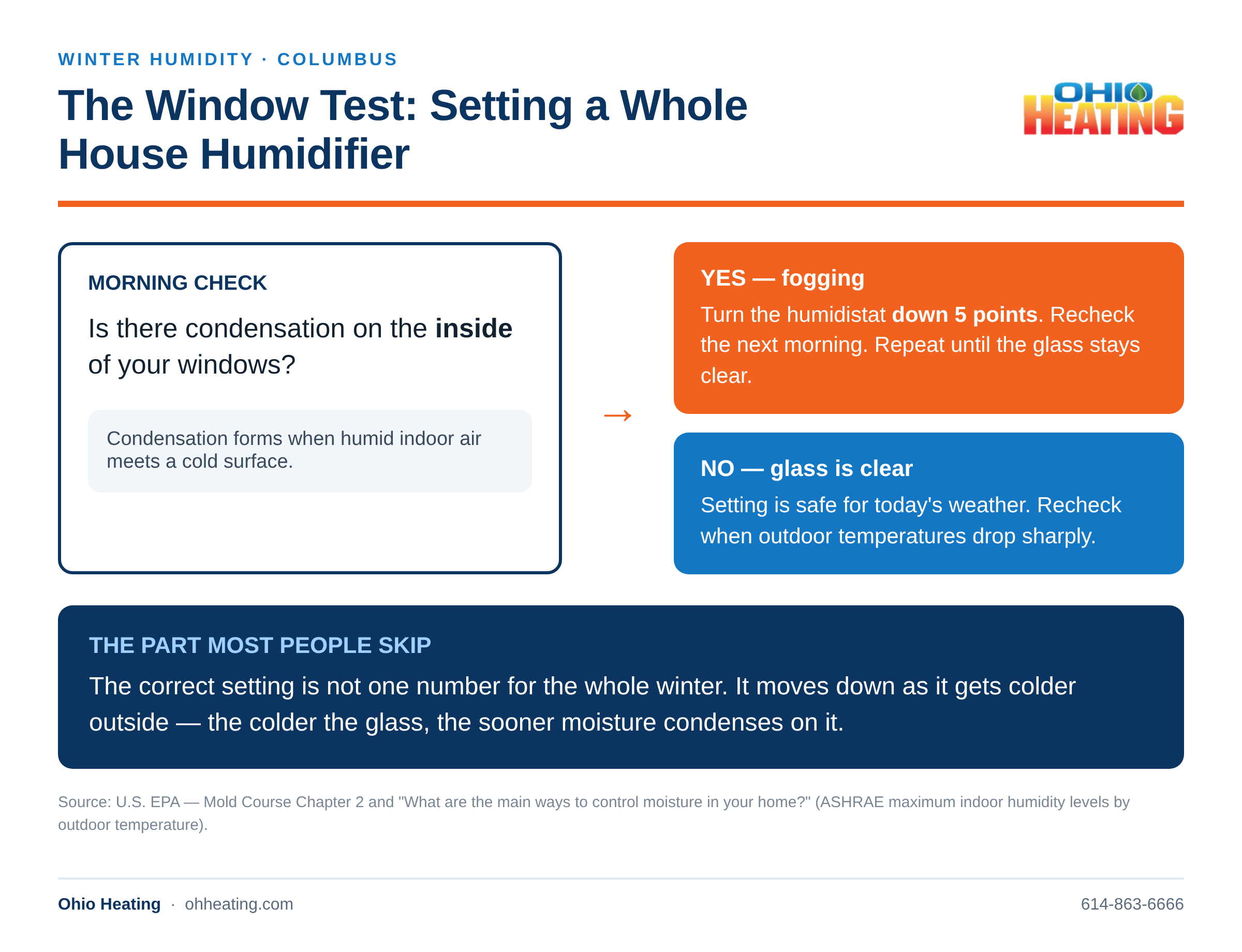
Your windows tell you before any meter does- fog on the bottom of the glass each morning means the setting is too high for the weather. Wipe it, then drop the humidistat five points. Look again the next morning.
Bypass, fan-powered, or steam
There are three common types. They are not interchangeable. The right one depends on your ducts, your water, and how much moisture the house needs.
| Type | How it works | When it runs | Best fit |
|---|---|---|---|
| Bypass | Water flows over a pad. A bypass duct sends warm air through it. | Only while the furnace heats. | Modest homes with room for the bypass duct. |
| Fan-powered | Same pad, but a small fan pushes air through it. | While heating, and on its own in some setups. | Tight mechanical rooms, or higher demand. |
| Steam | Boils water and injects steam into the supply duct. | On demand, whether or not the burner fires. | Large or leaky homes, and heat pumps. |
What matters here is how the unit works, not whose name is on it. Bypass and fan-powered models add moisture by evaporation, so what they can put into the house rises and falls with how warm and how dry the air moving past them happens to be. A steam unit makes its own moisture instead, which means the temperature of your supply air is beside the point.
That is why steam suits a home heated by a heat pump. Heat pump supply air is cooler than a gas furnace’s. Weighing a humidifier installation against other upgrades? Our guide to indoor air quality in Columbus shows where a whole-home humidifier sits next to filtration and ventilation.
The maintenance nobody does
When a humidifier quits, it rarely makes a scene about it. There are two ways it usually goes.
The first is the pad. Water around Columbus is hard, and over a season or two the minerals blind the pad so completely that air passes straight through and picks up almost nothing. Everything sounds right from the basement. The unit hums, the valve opens, and the house is still dry.
The second is the drain or the valve. A valve stuck open quietly runs water down the drain all winter, and a blocked drain does the opposite by dumping it onto the furnace. That second one is how a humidifier ends up rusting out the cabinet of the equipment it was supposed to be helping.
Whoever services your heating and cooling equipment should be looking at both. Our forced air furnace maintenance page covers what a fall visit includes, and humidifier service belongs in that same trip, before the heating season gets going.
One caution comes straight from EPA. Humidifiers are not recommended in buildings without proper vapor barriers, because of possible moisture damage (EPA). In an older Columbus home with thin wall insulation or a damp crawlspace, the added moisture can end up inside the wall. Answer that question before you buy equipment, not after.

Why the right humidity level can improve comfort
There is a payoff past skin and sinuses. Moist air feels warmer at the same thermostat setting. A humidified house reads as comfortable. A bone-dry one at the same setting does not.
It also protects what dry air damages. Hardwood floors gap. Trim splits. Guitars and pianos drift out of tune.
None of that works if air does not move evenly. A humidifier feeding a duct system that starves the second floor will humidify the wrong rooms. If some rooms have long run colder and drier, the problem is distribution. Start with HVAC air balancing.
Ready to sort out dry winter air before the furnace runs all day? Ask us to check your humidifier and your airflow on the same visit.
Frequently asked questions
What humidity should I keep my Columbus house at in winter? Aim for 30 to 50 percent as a general target (EPA). Then drop it as it gets colder outside. That is about 35% at 20°F, 30% at 10°F, and 25% at 0°F (EPA/ASHRAE table).
Why are my windows fogging after a humidifier installation? The setting is too high for the weather. Condensation forms when humid indoor air meets a cold surface (EPA). Lower the humidistat and check again the next morning.
Do I need a humidifier if I have a heat pump? Often, yes. A steam unit is usually the better match. It makes moisture on its own instead of relying on warm supply air.
How often does the pad need to be changed? Follow the maker’s schedule for your model. On most evaporative units it is a once-a-season part. Hard water shortens pad life.
Can a humidifier cause mold? It can if you run it too high. EPA advises keeping relative humidity under 60% (EPA). EPA also warns against humidifying buildings without proper vapor barriers.
Is a portable room humidifier good enough? It helps one room. It will not fix whole-house dryness. Portable units also need frequent refilling and cleaning.