
The Straight Pipe on Boiler Gas Lines
Why Your Boiler Gas Line Is the Foundation of a Reliable Heating System
A boiler gas line is the pipe system that delivers natural gas or propane from your utility meter to your boiler’s burner. Get it right, and your building stays warm and efficient. Get it wrong, and you face lockouts, pressure problems, or worse — a safety hazard.
Here’s what you need to know at a glance:
| Topic | Quick Answer |
|---|---|
| What it does | Carries gas from meter to boiler burner at the right pressure and flow rate |
| Common materials | Black iron (schedule 40), CSST, copper (limited use) |
| Typical pipe size | 1″ to 2.5″ depending on BTU load and pipe length |
| Key pressure standard | Max 0.3 in. w.c. pressure drop across the gas line |
| Average installation cost | $265–$850, or roughly $20 per linear foot |
| Who should install it | A licensed HVAC or gas piping professional |
Most heating problems aren’t caused by the boiler itself. They start upstream — at the gas line. An undersized pipe starves the burner of fuel. A poorly routed line creates pressure drops. And an aging system that was never designed for today’s high-efficiency boilers can quietly undermine everything downstream.
This guide walks you through every critical aspect of boiler gas lines — from materials and sizing to safety components and troubleshooting — so you can make informed decisions and keep your system running reliably.
I’m Jill Frattini, Service Coordinator at Ohio Heating in Columbus, OH, with years of experience coordinating boiler service, installations, and repairs — including hands-on work with boiler gas line assessments and upgrades across residential and commercial properties. Whether you’re managing a single building or a full property portfolio, understanding your gas line is the first step toward protecting your investment.
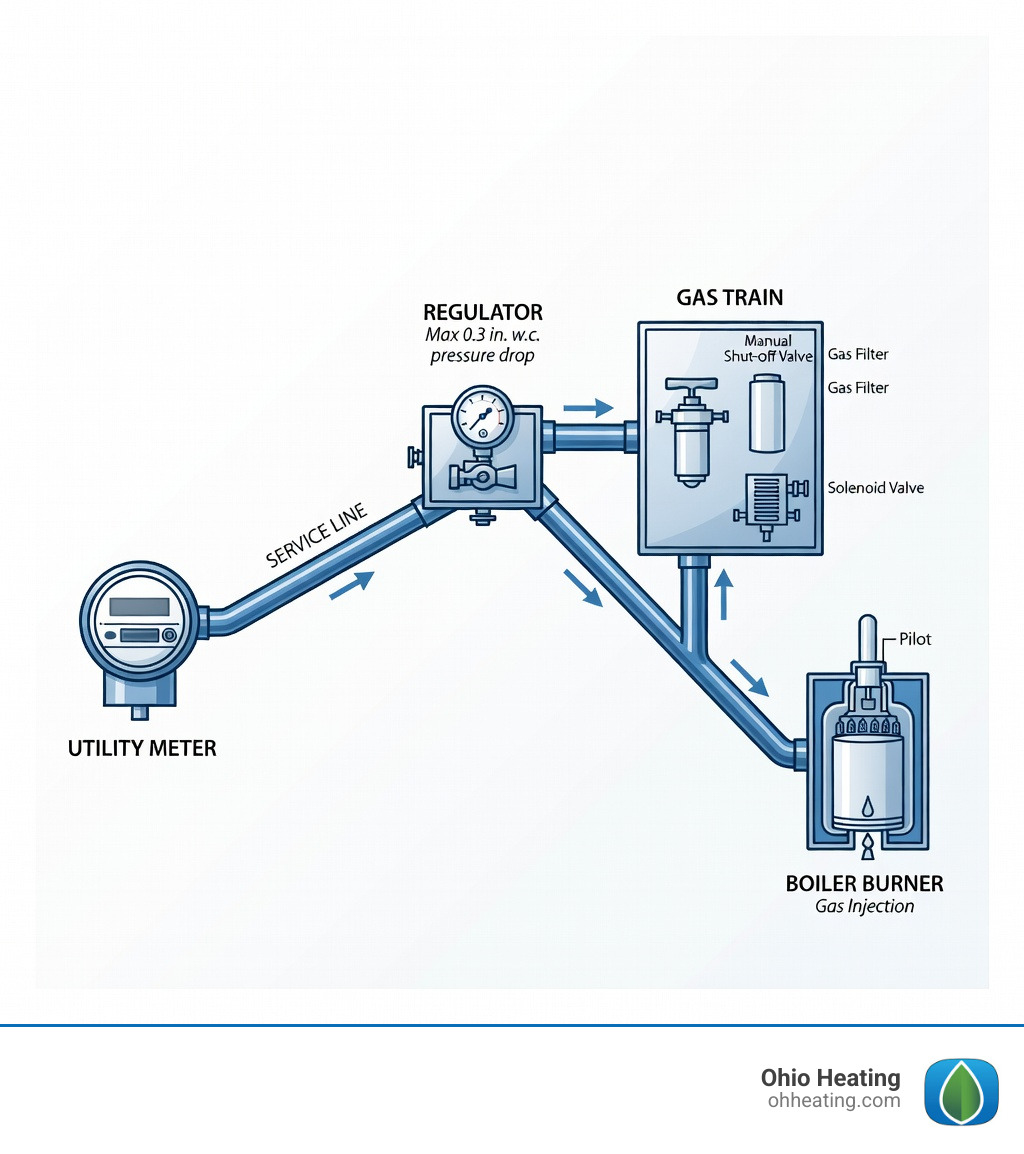
Key Boiler gas line vocabulary:
Understanding the Boiler gas line and Gas Train
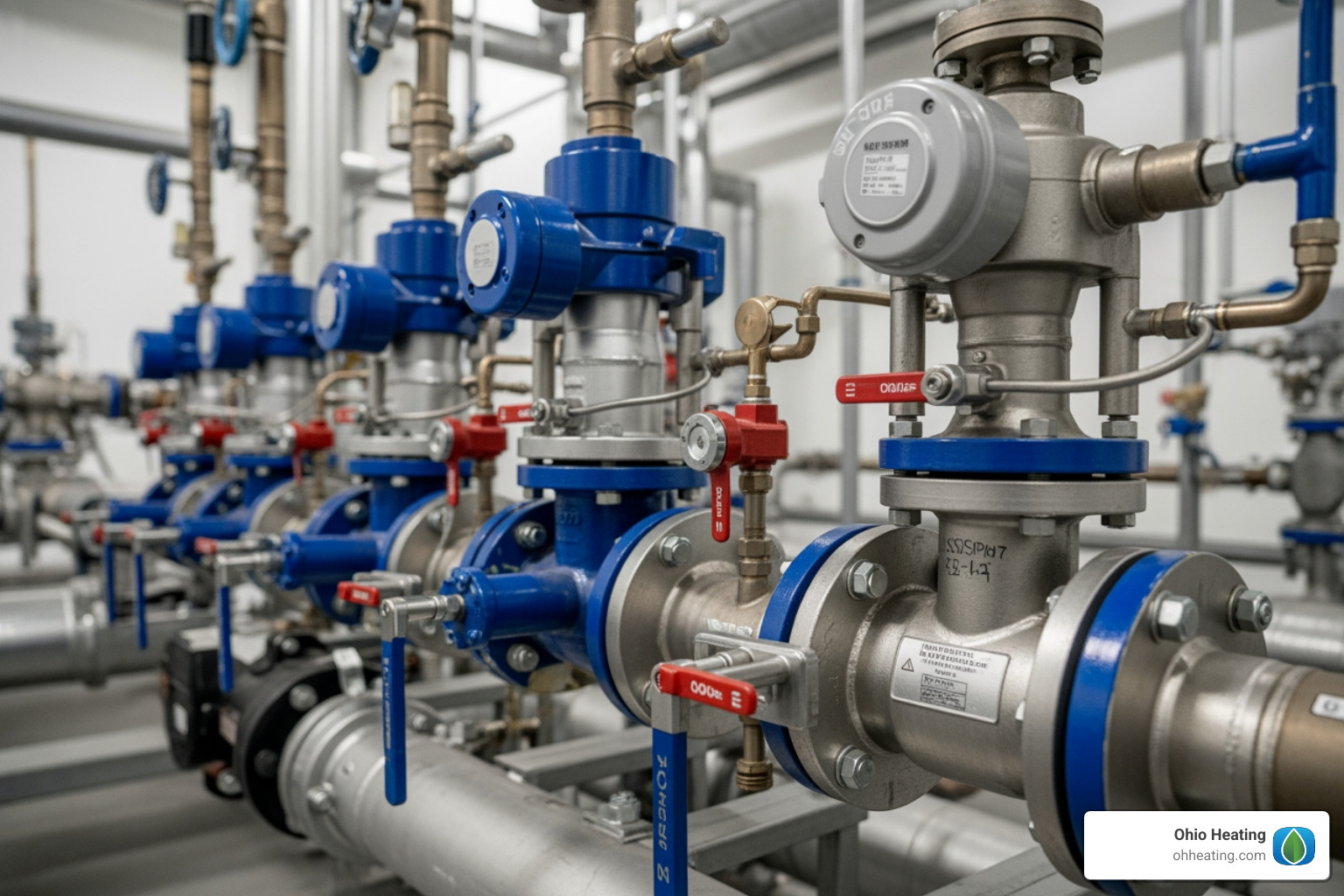
In professional heating, we don’t just talk about “the pipe.” We talk about the gas train. The gas train is the specific sequence of valves, regulators, and safety devices that manage the flow of fuel from the main boiler gas line into the burner.
If the gas line is the “highway,” the gas train is the “toll booth and traffic controller.” It ensures that gas only enters the boiler when it is safe to do so and at the exact pressure required for efficient combustion. For commercial systems, these setups must follow strict standards like ASME CSD1 (Controls and Safety Devices for Automatically Fired Boilers), which dictates which safety devices are required based on the boiler’s BTU rating.
One of the most critical safety aspects we monitor is the risk of leaks. Proper gas train maintenance is essential to prevent the buildup of dangerous fumes. You can find more info about boiler carbon monoxide safety to understand why these mechanical safeguards are non-negotiable for your home or business.
Components of a Standard Gas Train
A robust gas train includes several key players:
- Sediment Trap (Dirt Leg): Usually the first component, this is a vertical pipe extension that uses gravity to catch moisture, pipe scale, or debris before they reach sensitive valves.
- Strainer: Often recommended by ASME CSD1, this fine mesh screen catches smaller particles that could clog the burner.
- Manual Shut-off Valves: These allow us to isolate the boiler for service. In a standard setup, you’ll have an upstream valve and a downstream valve.
- Gas Pressure Regulator: This drops the high pressure from the utility line down to the “working pressure” the boiler needs.
- Safety-Shutoff Valves (SSVs): These are automatic electric valves that snap shut if the system detects a problem.
- Pressure Switches: High and low gas pressure switches are typically required when a burner’s rating exceeds 2,500,000 Btuh. They shut the system down if the gas pressure goes outside of safe operating limits.
- Firing Valve / Butterfly Valve: This controls the actual rate of gas flow to the burner to modulate the heat output.
- Pilot Connection: This must be attached on the upstream side of the main manual valve to allow for safe testing of the ignition system.
When these components age or fail, it leads to inefficient heating or total system failure. If you suspect your burner isn’t firing correctly, more info about burner service can help you decide if it’s time for a professional inspection.
How Gas Delivery Works
Gas delivery relies on a pressure differential. Natural gas naturally moves from areas of high pressure (the utility main) to areas of lower pressure (your boiler).
The journey begins at the service line, which connects the utility main in the street to your gas meter. The utility company is generally responsible for everything up to the meter. Once the gas passes through the meter and enters the houseline, it becomes the property owner’s responsibility.
From the meter, the gas travels through:
- Branch Lines: These are the pipes that split off from the main line to serve different areas of the building.
- Drop Lines: These are the vertical pipes that descend from a branch line to connect directly to an appliance like your boiler.
Materials and Installation Best Practices
Choosing the right material for your boiler gas line isn’t just about cost; it’s about chemistry and physics. Different materials react differently to the sulfur compounds in gas or the humidity in a Columbus basement.
| Material | Best Use | Pros | Cons |
|---|---|---|---|
| Black Iron | Main interior lines | Extremely durable, heat resistant | Can rust if not maintained |
| CSST (Flexible) | Hard-to-reach runs | Easy to install, fewer joints | Must be properly bonded; high cost |
| Copper | Limited residential | Flexible | Strict code limits; 20-year lifespan |
| PVC / HDPE | Underground only | Corrosion proof | Cannot be used indoors |
Nationally, the average cost to run a gas line is about $550, with most residential projects falling between $265 and $850. This typically works out to roughly $20 per linear foot. However, complex commercial installations or lines that must run under driveways can easily exceed $1,000. For those looking at new heating systems, more info about residential boilers provides a broader look at how these piping costs fit into a total installation budget.
Approved Materials for a Boiler gas line
In Central Ohio, the gold standard for indoor gas piping is Black Steel (Schedule 40). It is incredibly strong and creates airtight seals when threaded correctly with pipe dope.
Corrugated Stainless Steel Tubing (CSST) is another popular choice, especially for retrofits. It features 304 stainless steel tubing often protected by a gray PVC coating to resist UV and chemicals. However, CSST must be installed by a qualified professional and properly bonded to the home’s grounding system to prevent damage from electrical surges.
For outdoor or rooftop units, galvanized steel is often used because the zinc coating provides an extra layer of protection against the elements. If you are interested in the science behind how these systems maximize fuel, you can read scientific research on gas-fired boilers provided by the Department of Energy.
Prohibited Materials and Fittings
Safety codes are very specific about what cannot be used in a boiler gas line:
- Plastic Piping (PVC/CPVC) Indoors: Plastic is excellent for underground lines because it won’t rot, but it is strictly prohibited inside buildings because it can melt or release toxic fumes during a fire.
- Unbonded CSST: As mentioned, if CSST isn’t grounded, it’s a fire hazard during lightning storms.
- Cast Iron Fittings: These are too brittle for gas pressure.
- Close Nipples: These are short pieces of pipe threaded all the way to the center. They are often thin and prone to breaking during installation.
- Aluminum Tubing: This is generally avoided because it can corrode easily when in contact with other metals or certain gas additives.
Sizing, Pressure, and Capacity Requirements
One of the most common mistakes in DIY or cut-rate installations is “guessing” the pipe size. If a pipe is too small, the boiler will be “starved” for fuel. This often manifests as the boiler working fine during mild weather but failing or “locking out” on the coldest night of the year when it tries to run at full capacity.
Calculating Capacity for Your Boiler gas line
To size a line correctly, we use the Longest Pipe Method. We identify the appliance furthest from the meter and measure that total distance. Then, we calculate the Equivalent Length by adding the length of straight pipe plus a “penalty” for every fitting. For example, a standard elbow or tee is often calculated as being equivalent to 5 feet of straight pipe in terms of friction and pressure drop.
Key technical targets include:
- BTU Rating: We must know the total load of all appliances on the line, not just the boiler.
- Pressure Drop: For most residential systems, we aim for a pressure drop of no more than 0.3 in. w.c. (inches of water column) across the piping.
- Static vs. Dynamic Pressure: Static pressure is the pressure when the boiler is off (target is usually around 7 in. w.c. for natural gas). Dynamic pressure is the pressure while the boiler is running. If the pressure drops more than 1 in. w.c. when the flame kicks on, your pipe is likely undersized.
To ensure your system is up to code, we recommend more info about pressure testing and inspections to verify that your lines can handle the load.
Natural Gas vs. Propane Requirements
While both fuels provide heat, they have different “personalities.” Natural gas has a specific gravity of about 0.60, while propane is heavier and has a much higher heating value (more BTUs per cubic foot).
Because propane is more energy-dense, it often requires smaller pipes but higher-pressure regulators. Propane systems also require large storage tanks (typically 500 gallons for residential use) and specific conversion kits if you are switching a boiler from natural gas. For those looking to save on monthly bills, more info about energy efficient boilers explains how both fuel types can be optimized with modern technology.
Troubleshooting and Maintenance
A boiler gas line usually gives off warning signs before it fails completely. Being able to spot these can save you from an expensive emergency.
Signs of Gas Line Problems
- The “Rotten Egg” Smell: Utilities add a chemical called mercaptan to natural gas. If you smell this, evacuate immediately and call for help.
- Hissing Sounds: This usually indicates a high-pressure leak at a joint or regulator.
- Boiler Lockouts / Flame Failure: If your boiler tries to start but fails, it might be experiencing “gas starvation.” On modern units, look for fault codes like Ideal L2, which often points to insufficient gas pressure.
- Soot Buildup: Yellow flames or soot around the burner indicate improper combustion, often caused by the wrong gas-to-air ratio.
- High Energy Bills: A leak doesn’t always smell strong; a slow leak can lead to a steady climb in your monthly costs.
If you encounter any of these, don’t wait. Check out more info about urgent boiler repair for the next steps to take.
Regular maintenance is the best way to prevent these issues. This includes checking for corrosion on black iron pipes and ensuring that regulators aren’t plugged by debris or insects (a common issue in Central Ohio). More info about regular boiler servicing highlights how a yearly check-up can extend the life of your entire system.
Frequently Asked Questions about Boiler Gas Lines
How much does it cost to install a boiler gas line?
In the Columbus area, a standard residential installation typically costs between $265 and $850. Factors that increase the price include the length of the run, the number of appliances being connected, and whether the pipe needs to pass through finished walls or underground.
Are flexible gas connectors suitable for boilers?
Yes, but with limitations. Flexible connectors (like those made of PVC-coated stainless steel) are excellent for the final connection to the boiler because they absorb vibration. However, they should not be used to replace the main run of the gas line, and they must be CSA-approved for high-BTU appliances.
When is a gas pressure regulator necessary?
A regulator is necessary whenever the utility supply pressure is higher than what the boiler’s gas valve can handle. In many modern systems, especially those using “2 PSI” high-pressure lines, a dedicated regulator must be installed roughly 10 feet away from the boiler to ensure a stable flow.
Conclusion
At Ohio Heating, we’ve been the trusted HVAC experts for Columbus and Central Ohio since 1999. We understand that a boiler gas line is more than just a pipe—it’s the lifeline of your building’s comfort. Whether you’re dealing with a complex commercial gas train or a residential boiler upgrade, our team ensures every installation is sized correctly, meets ASME and local codes, and operates with maximum safety.
Don’t leave your heating to chance. From pressure testing to full system replacements, we provide the reliability you need to avoid costly downtime and keep the cold at bay. View our Boiler Sales and Service page to see how we can help you today.