
Clear the Air with These Top Ceiling Kitchen Fans
Why a Ceiling Kitchen Exhaust Fan Belongs in Every Modern Kitchen
A ceiling kitchen exhaust fan is one of the most effective tools for keeping your kitchen air clean, your space comfortable, and your cooling system from working overtime. Here’s a quick look at what they do and why they matter:
| Feature | What It Means for You |
|---|---|
| Removes cooking smoke | Clears the air fast during and after cooking |
| Captures grease particles | Protects surfaces and reduces fire risk |
| Eliminates odors | Keeps kitchens fresh without masking smells |
| Extracts heat and humidity | Reduces the load on your AC system |
| Fits open-concept layouts | Ventilates without blocking sightlines |
Cooking generates heat, steam, grease, and gases. Without proper ventilation, all of that stays in your space. For property managers and business owners, that means uncomfortable occupants, strained HVAC equipment, and higher energy bills.
The good news? The right ceiling-mounted exhaust hood handles the problem at the source — before it ever reaches your AC system.
I’m Jill Frattini, Service Coordinator at Ohio Heating in Columbus, OH, and I’ve seen how poor kitchen ventilation puts unnecessary strain on commercial cooling systems. In this guide, I’ll walk you through the best ceiling kitchen exhaust fan options available in April 2026 so you can make a smart, informed choice.
Why Kitchen Ventilation Supports Your Home Cooling System
When we think about air conditioning, we usually think about thermostats and outdoor compressors. However, your kitchen is a major “heat factory” that can sabotage your AC’s efficiency. Every time you boil water or sear a steak, you are releasing sensible heat (temperature rise) and latent heat (humidity) into your home.
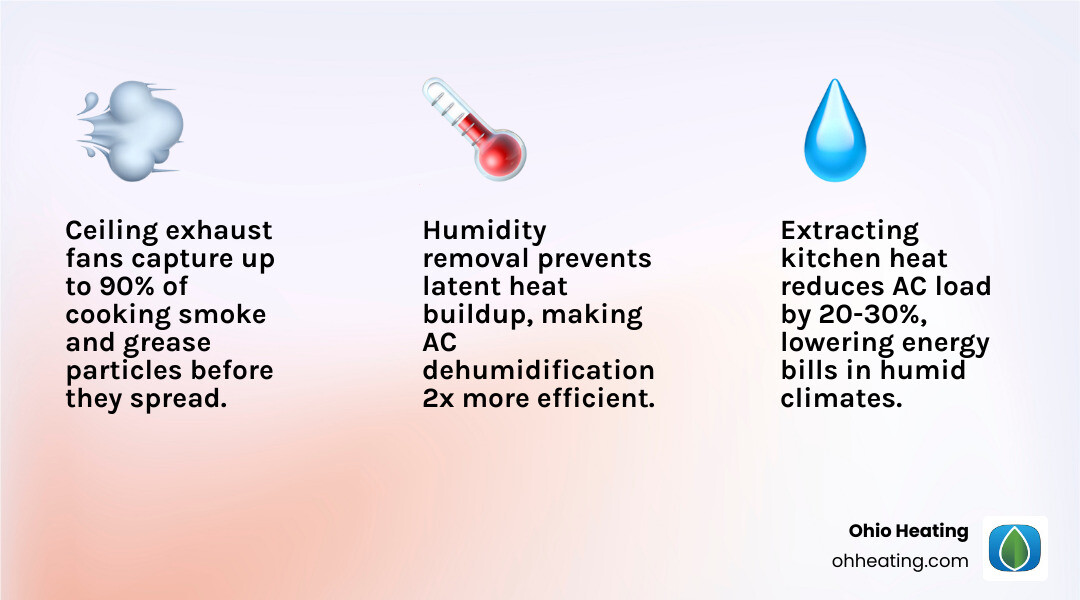
In Central Ohio, where summer humidity can already be a bear, adding more moisture to the air makes your AC work twice as hard. A high-quality ceiling kitchen exhaust fan acts as the first line of defense for your cooling system. By capturing steam and hot air at the ceiling level and ducting it outside, you prevent that heat from migrating to the rest of the house. This reduces the “latent load” on your evaporator coil, allowing your AC to focus on cooling the air rather than just dehumidifying it.
For smaller spaces or light-duty needs, models like the Broan QTXE 110 CFM Ventilation Fan offer whisper-quiet moisture removal. While often used in bathrooms, these ENERGY STAR certified units are excellent for supplemental ventilation in butler’s pantries or small kitchen nooks to keep humidity levels in check. For comprehensive solutions, our team at Ohio Heating specializes in Ventilation Systems that integrate seamlessly with your overall HVAC strategy.

Selecting the Best Ceiling Kitchen Exhaust Fan for Modern Homes
Choosing a ceiling kitchen exhaust fan in 2026 is about balancing raw power with aesthetic subtlety. Unlike wall-mount or under-cabinet hoods that can feel bulky, ceiling hoods are designed to preserve sightlines—perfect for those beautiful open-concept kitchens in Columbus.
When selecting a model, you need to consider the “Big Three”: CFM (Cubic Feet per Minute), Sones (noise level), and Installation Depth.
| Model Example | Max CFM | Noise Level (Sones) | Key Feature |
|---|---|---|---|
| Viking Pureline Pro | 600 | 1.0 – 6.0 | Smart App Control |
| XO Ceiling Hood | 600 | 1.5 – 6.5 | Remote Control Included |
| Victory Ultra Slim | 800+ | 2.0 – 7.0 | Low Profile Flush Mount |
| Broan QTXE | 110 | 0.7 | Energy Star / Quietest |
A standout for 2026 is the Viking 48″W. Ceiling Hood Pureline Pro. It offers a professional-grade 600 CFM blower while remaining virtually invisible, tucked away in the ceiling. This is ideal for island cooktops where a traditional chimney would block the view of your living area.
High-Performance Ceiling Kitchen Exhaust Fan Models
If you do a lot of high-heat cooking—think stir-frying or indoor grilling—you need serious “oomph.” High-performance models typically range from 600 to 1000 CFM. At Ohio Heating, we often recommend looking for “Perimeter Aspiration.” This technology draws air through narrow slots around the edges of the hood, increasing air pressure and capture efficiency even if the fan is mounted higher up.
Modern units also feature high-efficiency LED lighting with adjustable color temperatures. This ensures your cooking surface is bright without clashing with the rest of your kitchen’s ambiance. For business owners managing multi-family properties or light commercial kitchens, checking out our Commercial HVAC Tips can provide extra insight into maintaining these high-output systems.
Choosing the Right Ceiling Kitchen Exhaust Fan for Your Layout
Layout dictates everything. You have two primary styles:
- Flush-Mount: The unit sits entirely inside the ceiling joists. Only a flat panel is visible. This is the ultimate minimalist look.
- Suspended/Island Design: The hood hangs slightly lower. While it takes up more visual space, it is often more effective at capturing smoke because it is closer to the source.
For those in the Columbus area looking to maintain a clean, architectural flow, the flush-mount is the winner. It keeps the kitchen feeling airy and connected to the dining space. If you’re planning a major renovation, consulting with Commercial HVAC experts during the framing stage is vital to ensure your ceiling joists can accommodate the ducting requirements.
Essential Features: CFM, Sones, and Smart Controls
In 2026, a ceiling kitchen exhaust fan is more than just a motor in a box. It’s a smart appliance.
- Sone Levels: A “sone” is a measure of perceived loudness. A rating of 0.4 to 1.5 sones is essentially a whisper. When you get up to 6.0 or 8.0 sones, it sounds like a heavy rainstorm. Look for models with “Hush Systems” or sound-absorbing insulation.
- Baffle Filters: These are the stainless steel filters you see in pro kitchens. They are superior to mesh filters because they force grease-laden air to change direction quickly, causing grease to drop into a tray. Most are dishwasher-safe for easy cleanup.
- Smart Connectivity: Many Viking and Wolf models now feature Bluetooth or Wi-Fi. You can control the fan speed from your smartphone or an ADA-compliant remote control—a lifesaver if your hood is mounted 8 feet up!
- Code Compliance: In Ohio, residential codes (like Chapter 15 Exhaust Systems: Ohio Residential Code) require specific venting practices. For example, if your fan exceeds 400 CFM, you might need a “make-up air” system to prevent negative pressure in your home, which could otherwise pull exhaust gases back down your water heater vent.
Installation and Maintenance for Peak Performance
We cannot stress this enough: installation is the difference between a fresh kitchen and a smoky one.
Ducted vs. Recirculating
- Ducted: This is the gold standard. It physically moves the air outside. For a ceiling kitchen exhaust fan, this usually requires 6-inch or 8-inch rigid metal ducting.
- Recirculating (Ductless): These use charcoal filters to “scrub” the air and blow it back into the room. They are easier to install but much less effective at removing heat and humidity. In our humid Ohio summers, we always recommend ducted systems to help your AC stay efficient.
Mounting Height Most ceiling hoods are designed to be installed between 72 and 96 inches from the floor. If you go too high, the “capture zone” weakens, and steam will drift into your living room before the fan can grab it.
Maintenance To keep your system running like a dream:
- Clean Filters Monthly: If grease builds up, the motor has to work harder, which uses more energy and increases noise.
- Inspect the Exterior Vent: Ensure no bird nests or debris are blocking the flapper outside.
- Professional Calibration: Every few years, have a technician check the ductwork for leaks. Our team provides more info about ventilation services to help keep your home’s air moving correctly.
Frequently Asked Questions about Kitchen Ventilation
How many CFM do I need for a professional gas range?
A good rule of thumb is 100 CFM for every 10,000 BTUs of your range’s total output. For a standard 30-inch electric cooktop, 300-400 CFM is usually plenty. For a high-end 48-inch gas range, you’ll likely want 600 to 1,000 CFM to handle the intense heat and combustion byproducts.
Can a ceiling exhaust fan help lower my summer AC bills?
Yes! By removing the “latent heat” (steam and humidity) from cooking, your AC doesn’t have to run as long to reach your target comfort level. It’s much cheaper to run a small exhaust fan motor for 20 minutes than it is to run a 3-ton AC compressor to remove that same moisture.
How often should I clean the grease filters in a ceiling-mounted hood?
For average home cooking, once a month is perfect. If you do a lot of frying or use a wok frequently, check them every two weeks. Most modern stainless steel baffle filters can go right into the dishwasher on a high-heat cycle.
Conclusion
At Ohio Heating, we’ve been the trusted choice for Columbus, OH, residents and businesses since 1999. We understand that a ceiling kitchen exhaust fan isn’t just a luxury—it’s a vital component of your home’s environmental control system. By properly venting heat, grease, and moisture, you protect your indoor air quality and ensure your cooling system operates with maximum reliability.
Whether you are looking for a sleek flush-mount model for your minimalist kitchen or a high-capacity system for a commercial space, we have the expertise to get the job done right. Don’t let cooking heat win the battle against your AC this summer.
Schedule your ventilation system consultation today and let us help you clear the air!