
Everything You Need to Know About Your Industrial Walk In Freezer
When we talk about an industrial walk-in freezer, we are discussing a high-performance cooling system that goes far beyond the standard “box” you might find in the back of a local diner. While both provide cold storage, the engineering requirements for an industrial-scale facility are significantly more rigorous. As a leader in AC and refrigeration services, we know that a standard commercial unit is designed for manual loading, whereas an industrial unit is a structural component of a logistics chain, built to withstand the literal weight of your business.
The primary differences lie in the construction and the mechanical load. Industrial units often feature walls reaching up to 25 feet high to accommodate tall storage racks, and they utilize heavy-duty materials that can handle the constant vibration and impact of heavy machinery. While a commercial freezer might use standard 4-inch panels, an industrial-scale system often requires enhanced insulation and specialized floor reinforcement to prevent the ground beneath the unit from freezing and heaving—a common and costly mistake in large-scale setups.
| Feature | Standard Commercial Walk-In | Industrial-Scale Walk-In Freezer |
|---|---|---|
| Typical Size | 6′ x 6′ to 10′ x 20′ | 20′ x 40′ up to 1,600+ sq. ft. |
| Ceiling Height | 7′ to 8′ | Up to 25′ or more |
| Floor Capacity | 200–300 lbs. per sq. ft. | 800+ lbs. per sq. ft. (Forklift Rated) |
| Loading Method | Hand-carried / Small carts | Pallet jacks / Forklifts |
| Door Type | Standard swing door | Oversized sliding or roll-up doors |
Sizing and Capacity for an industrial walk-in freezer
One of the most frequent questions we get at Ohio Cooling is: “How big of a freezer do I actually need?” To answer this, we use a standard industry metric: 1 cubic foot of storage space accommodates approximately 28 lbs. of food.
However, when sizing an industrial walk-in freezer, you cannot simply calculate the raw volume of your inventory. You must account for “dead space” required for proper airflow. If you pack a freezer to the ceiling without leaving room for the cold air to circulate, you’ll end up with “hot spots” (which, in a freezer, just means “not cold enough” spots) that can lead to spoilage.
We also recommend planning for at least 20-25% future growth. It is much more cost-effective to install a slightly larger unit now than to realize two years later that you need to knock out a wall. For large warehouses, aisles should be at least 40 inches wide to accommodate carts, or wider if you are utilizing pallet jacks. For more details on sizing for large facilities, check out Industrial Walk-In Coolers & Freezers for Warehouses.
Temperature Ranges for an industrial walk-in freezer
Temperature precision is the heartbeat of food safety and pharmaceutical integrity. While federal guidelines generally require food to be kept below 40°F, an industrial walk-in freezer is typically set much lower.
- Standard Frozen Storage: 0°F to -10°F is the “sweet spot” for most frozen food products.
- Deep Freeze/Flash Freezing: For high-end meats, seafood, or specific chemical processes, temperatures may need to reach -20°F or lower.
- Pharmaceutical Storage: Many vaccines and biologics require incredibly tight tolerances, often necessitating redundant refrigeration systems to ensure the temperature never fluctuates more than a degree or two.
Maintaining these temperatures isn’t just about the cooling power; it’s about the recovery time. In an industrial setting where large doors are opening frequently, the system must be powerful enough to “recover” that lost cold air almost instantly. You can learn more about how we manage these complex requirements on our Walk-in Refrigeration page.
Essential Components and Refrigeration Systems
An industrial walk-in freezer is a complex machine with several moving parts that must work in perfect harmony. The main players are the compressor (the heart), the evaporator coils (the lungs), and the condenser (the heat exhaust).
In an industrial setup, these components are significantly more robust than those found in smaller units. For instance, the ArcticKing Industrial Walk-In Freezer specifications highlight the use of high-efficiency, commercial-grade refrigerants and powerful three-phase motors designed to run 24/7 without breaking a sweat.
Remote vs. Self-Contained Systems
Choosing between a remote and a self-contained system is one of the most important design decisions you’ll make.
- Self-Contained Systems: These are “plug-and-play” units where the evaporator and condenser are all in one housing. They are easier to install but release heat and noise directly into the surrounding room. For a massive warehouse, this is usually inefficient because your building’s AC will have to fight the heat coming off the freezer’s condenser.
- Remote Systems: In this configuration, the condensing unit is located outside the building or on the roof. This is the gold standard for an industrial walk-in freezer. It keeps the heat and noise outside, leads to better energy efficiency, and allows for much larger, more powerful compressors that wouldn’t fit inside a standard ceiling height.
Advanced Control Systems
Modern industrial units don’t just have a dial on the wall. They utilize electronic monitoring systems that can be linked to your smartphone or desktop. These systems track:
- Defrost Cycles: To prevent ice buildup on the coils without letting the interior temperature rise too high.
- Digital Thermometers: Providing real-time accuracy within a fraction of a degree.
- Alarms: Notifying you immediately if the door is left open or if the power fails.
Ignoring these systems can lead to disaster. We often see clients who miss the 5 Warning Signs Your Walk-in Cooler Needs Repaired, such as ice buildup or unusual cycling, which could have been caught early by a smart control panel.
Design and Construction for Heavy-Duty Use
The “shell” of your industrial walk-in freezer is what keeps the cold in and the Ohio humidity out. Most industrial panels are made of foamed-in-place polyurethane. This material is preferred because of its high R-value (thermal resistance).
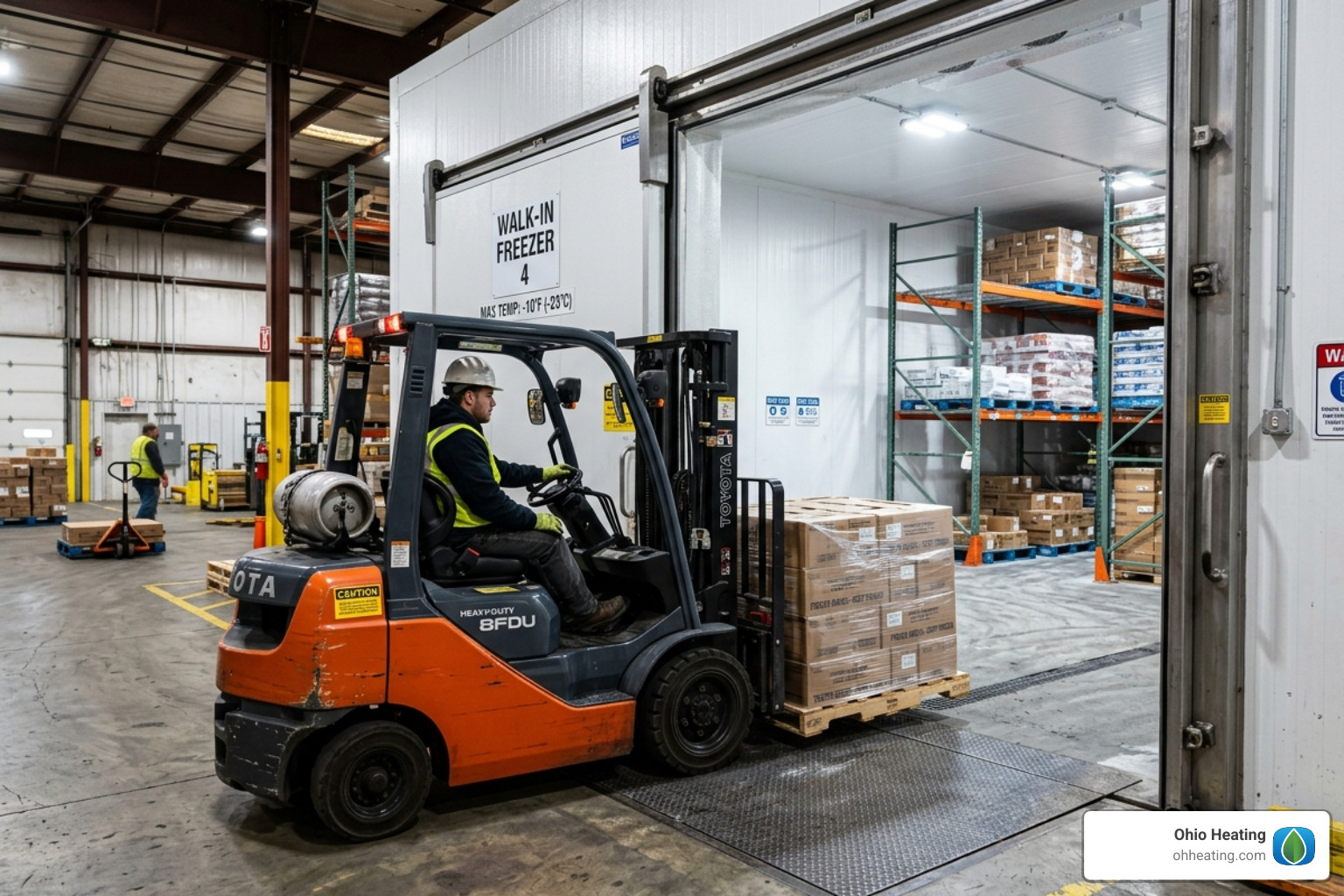
One fascinating statistic from the industry involves fiberglass construction. Some high-end fiberglass exteriors conduct only 0.04 BTUs of heat, which is significantly more efficient than traditional aluminum or steel. When you are cooling thousands of square feet, that small difference in thermal conductivity adds up to thousands of dollars in energy savings every year.
Structural Integrity and Flooring
If you plan on using a forklift, you cannot use a standard walk-in floor. A typical freezer floor might support 200 lbs. per square foot, but an industrial floor must support 800 lbs. per square foot or more.
These floors are often reinforced with heavy-duty plywood and a “diamond tread” aluminum or stainless steel overlay to provide a non-slip surface. Furthermore, the transition into the freezer must be seamless. We install “thermal anti-frost systems” under the floor at the doorway to prevent condensation from freezing and creating a dangerous ice slick for your forklift drivers.
Industrial Door Configurations
The door is the weakest point of any freezer. In an industrial setting, we move away from standard hinges toward:
- Sliding Doors: These are easier to seal and don’t take up “swing space” in the warehouse.
- Roll-Up Doors: Ideal for high-traffic areas where speed is essential to keep the cold air in.
- Strip Curtains: These PVC strips act as a secondary barrier, keeping about 80-90% of the cold air inside even when the main door is open.
- Pressure Relief Valves: Because the air inside a freezer is so cold and dense, opening and closing a large door can create a vacuum. These valves equalize the pressure so your staff (and your walls) don’t get stuck.
Installation, Energy Efficiency, and Regulatory Compliance
Installing an industrial walk-in freezer is a complex task that requires expert AC and cooling services. It requires a coordinated effort between structural engineers, electricians, and AC specialists. In Columbus, we have to ensure every installation meets the Energy Independence and Security Act (EISA) standards.
Electrical and Power Requirements
Industrial freezers are power-hungry. Most require 230V to 460V three-phase power. This isn’t something you can just plug into a wall outlet; it requires professional hardwiring and often a dedicated electrical sub-panel. Our team at Ohio Cooling handles the complex Walk-in Freezer Install and Service in Columbus, ensuring that the voltage drops are calculated correctly so your compressor doesn’t burn out prematurely.
Maximizing Energy Efficiency
Energy is likely your largest ongoing expense. To keep costs down, we focus on:
- Airtight Seals: Using high-quality gaskets and cam-lock panels that pull together to create a seamless joint.
- LED Lighting: Traditional bulbs give off heat; LEDs stay cool and last longer in sub-zero temperatures.
- R-Value Compliance: Federal law requires specific R-values (usually R-32 for freezers) to ensure the insulation is thick enough to prevent heat transfer.
Regular maintenance is the best way to keep these systems efficient. As we explain in our article on Why Timely Walk-in Freezer Repair Saves Money, a small leak in a seal or a dusty condenser coil can cause your energy bill to spike by 20% or more.
Maintenance, Costs, and Investment Strategies
Investing in an industrial walk-in freezer is a long-term play. Most high-quality panels come with a 15 to 20-year warranty, while compressors typically carry a 5 to 10-year warranty. However, these warranties are often contingent on proving that the unit was professionally maintained.
Understanding Total Cost of Ownership
The “sticker price” of an industrial freezer can range from $20,000 for a medium-sized unit to well over $100,000 for a massive warehouse installation. But the purchase price is only part of the story.
- Section 179 Tax Incentive: This is a huge win for business owners. Under Section 179, you may be able to deduct the full purchase price of qualifying equipment (like a walk-in freezer) from your gross income in the year it was purchased, rather than depreciating it over many years.
- Financing: Many manufacturers offer monthly payment plans to help offset the initial capital expenditure.
Customization for Specific Industries
No two businesses are alike. We provide custom solutions for:
- 3PL Providers: Needing flexible shelving and high-clearance ceilings for third-party logistics.
- Food Processing: Requiring wash-down-rated interiors and stainless steel finishes for sanitation.
- Pharmaceutical Labs: Needing redundant “backup” refrigeration systems to protect multi-million dollar inventories.
Frequently Asked Questions about Industrial Walk-In Freezers
How much food can an industrial walk-in freezer hold?
Using the industry standard of 28 lbs. per cubic foot, a 1,000-cubic-foot freezer can theoretically hold 28,000 lbs. of product. However, for industrial safety and airflow, you should usually plan to utilize only about 70-80% of that total volume.
What are the federal R-value requirements for industrial freezers?
Under EISA regulations, walk-in freezers must generally have an R-value of at least R-32. This usually requires at least 4 to 5 inches of high-density polyurethane insulation.
Do I need a remote refrigeration system for my warehouse?
Almost certainly, yes. While self-contained units are fine for small restaurants, the heat output from an industrial-sized compressor is too much for most indoor AC systems to handle efficiently. Remote systems are quieter, more efficient, and last longer.
Conclusion
An industrial walk-in freezer is more than just a cold room; it is the foundation of your inventory management and quality control. From choosing the right R-value panels to ensuring your floor can handle a five-ton forklift, every detail matters.
At Ohio Cooling, we’ve been the trusted partner for Columbus and Central Ohio businesses since 1999. We don’t just “install boxes”—we engineer reliability. Whether you are looking for a new installation, a complex repair, or a preventative maintenance plan to protect your investment, we are here to help.
Ready to upgrade your cold storage? More info about industrial refrigeration services is just a click away, or give us a call to speak with one of our experts today!