
Why Your Building Needs a Planned Commercial HVAC Maintenance Strategy
Why Every Commercial Building Needs a Planned AC Maintenance Strategy
A commercial HVAC maintenance plan is a scheduled service agreement that keeps your building’s cooling systems running efficiently, reliably, and within compliance — before problems happen.
Here’s what a commercial AC maintenance plan typically includes:
| Component | What It Means |
|---|---|
| Scheduled inspections | Regular checkups (2-4x per year) to catch issues early |
| Filter and coil cleaning | Keeps airflow clean and energy use low |
| Refrigerant checks | Ensures proper levels and EPA compliance |
| Electrical system review | Prevents failures from loose connections or worn parts |
| Priority service access | Faster response when something does go wrong |
| Performance reporting | Documentation of system health over time |
Most commercial buildings benefit from quarterly inspections at minimum, with biannual service as the baseline for smaller or lower-use systems.
The payoff is real. The U.S. Department of Energy estimates that following operations and maintenance best practices can reduce energy bills by 5% to 20% annually — without major capital investment. And when you consider that a neglected 20-ton rooftop AC unit can fail after just 9 years (versus 14+ years with proper care), the math becomes hard to ignore.
For property managers and business owners, an unplanned AC failure isn’t just inconvenient. It means disrupted operations, uncomfortable occupants, and emergency repair bills that dwarf the cost of prevention.
I’m Jill Frattini, Service Coordinator at Ohio Heating in Columbus, OH, and I’ve spent years helping commercial clients build the right commercial HVAC maintenance plan for their buildings, budgets, and cooling demands. In this guide, I’ll walk you through everything you need to know to protect your investment and keep your systems performing at their best.
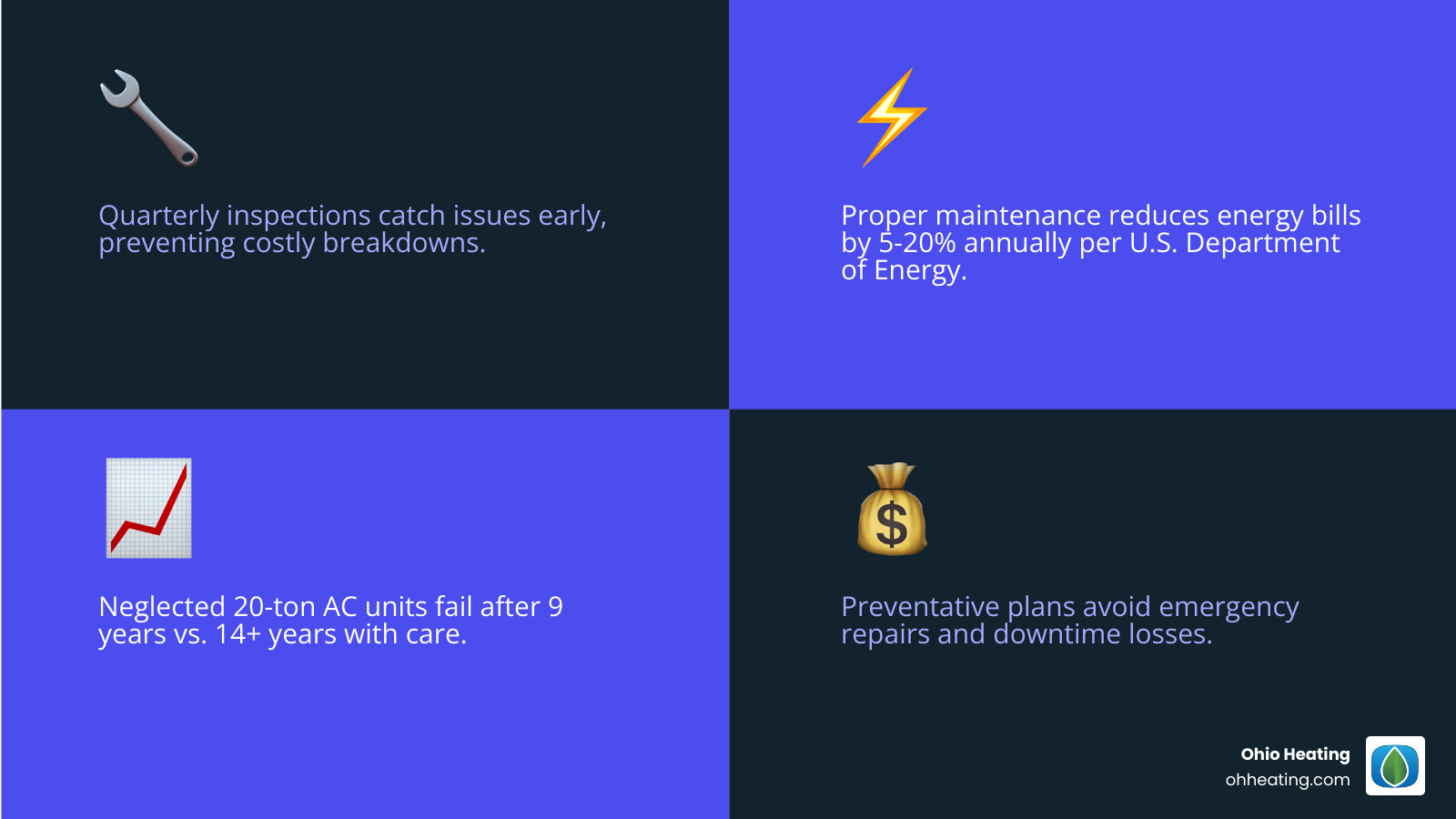
Commercial hvac maintenance plan terms simplified:
Understanding the Commercial HVAC Maintenance Plan
Think of a commercial HVAC maintenance plan as a “yearly physical” for your building’s cooling infrastructure. In the high-demand environment of Columbus, where humidity can soar and cooling systems work overtime from April through September, these plans aren’t just a luxury; they are a necessity for asset protection.
At Ohio Heating, we view these plans as a partnership. We aren’t just showing up to change a filter; we are auditing the health of your cooling systems to ensure they can handle the peak loads of a Central Ohio summer. By moving from a “break-fix” mentality to a proactive strategy, we help you avoid the “hot and bothered” phone calls from tenants when the mercury hits 90 degrees.
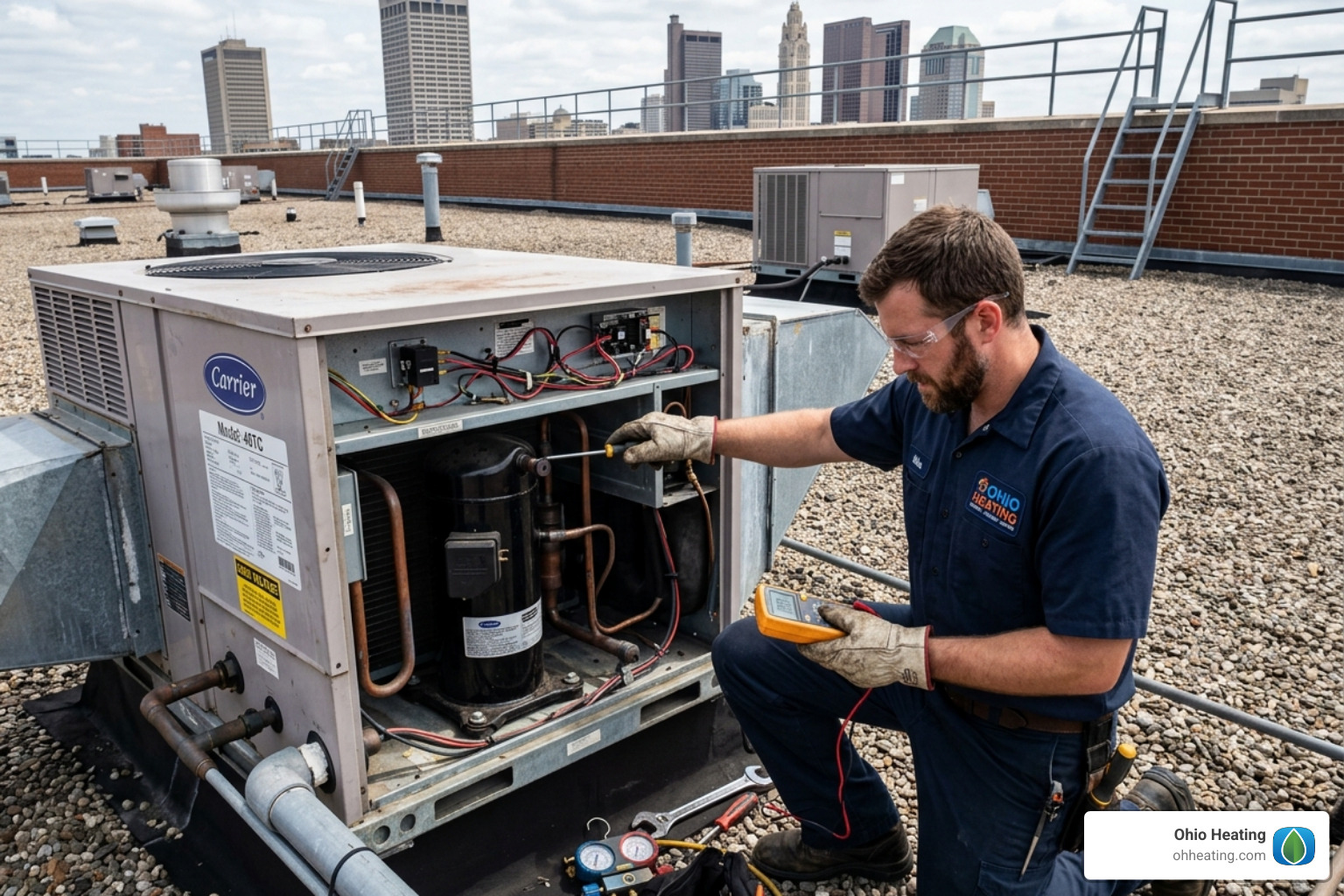
Core Components of a commercial hvac maintenance plan
When you look at More info about commercial HVAC services, you’ll see that a professional plan is multifaceted. It generally consists of three core pillars:
- Inspection Maintenance: This is the baseline. It involves thorough visual and mechanical checkups to ensure the system is running properly. We look for signs of wear, unusual vibrations, and early indicators of component failure.
- Labor Coverage: Many plans include the labor for routine tasks, ensuring you don’t get hit with unexpected hourly charges for standard upkeep.
- Comprehensive Coverage: The “all-inclusive” option. These plans often cover labor, parts, and even refrigerants. It provides the ultimate budget predictability because your cooling costs are essentially “locked in” for the year.
Tiered Service Options for Cooling Systems
Every building in Columbus has different needs. A small retail shop in Short North has different cooling requirements than a multi-story office complex in Dublin. That’s why we offer tiered options:
- First-Year Plans: These are designed specifically to protect your manufacturer’s warranty. Most manufacturers require documented maintenance to honor warranty claims on new rooftop units or chillers.
- Operational Inspections: These focus on efficiency. We calibrate thermostats, check airflow, and ensure the building automation system (BAS) is communicating correctly with your AC units.
- Annual Tune-Ups: These involve deep cleaning of condenser and evaporator coils and seasonal startups.
- Priority Service: Perhaps the most valuable perk. If your AC goes down during a July heatwave, plan members move to the front of the line.
The Financial Impact of a commercial hvac maintenance plan
It’s easy to see maintenance as an expense, but in reality, it’s one of the highest-ROI investments a facility manager can make. Organizations following O&M best practices consistently save between 5% and 20% on their annual energy bills. For a large commercial facility, that 20% can represent tens of thousands of dollars.
When your cooling system is dirty or poorly calibrated, it has to work harder and run longer to achieve the same temperature. This “efficiency drag” is a silent profit killer.
| Cost Factor | Proactive Maintenance | Reactive Repair (Break-Fix) |
|---|---|---|
| Annual Fee | Predictable, flat rate | $0 upfront |
| Emergency Repairs | Minimized (up to 75% reduction) | Frequent and expensive |
| Repair Costs | Discounted labor/parts | Full price + emergency premiums |
| Energy Bills | Optimized (5-20% lower) | Inflated due to system strain |
| Downtime | Scheduled during off-hours | Unplanned and disruptive |
If you find yourself frequently calling for Commercial HVAC Repair & Replacement, it’s a clear sign that your current maintenance strategy is failing.
Extending Equipment Lifespan and Durability
The lifespan of a commercial cooling unit is directly tied to how it’s treated. A poorly maintained 20-ton rooftop AC unit typically fails after just 9 years. However, with a consistent commercial hvac maintenance plan, that same unit can easily reach its expected 14-year lifespan or beyond.
By extending the life of your equipment by 5 or 6 years, you are deferring a capital expenditure that could cost $15,000 to $50,000+ per unit. You can find more details on this in our guide on 10 Easy Commercial HVAC Maintenance Strategies to Boost System Durability.
Avoiding the High Cost of Cooling Neglect
Neglect is expensive. Unscheduled repairs typically cost 25% more than planned maintenance visits. But the “hidden” costs are even higher. Think about:
- Lost Productivity: Employees can’t work effectively in an 85-degree office.
- Inventory Damage: In warehouses or retail spaces, high temperatures can ruin products.
- Refrigerant Leaks: Neglected systems are prone to leaks. With current EPA regulations and the rising cost of refrigerants, a major leak can be a budgetary disaster.
Our Commercial HVAC Maintenance Services are designed to catch these small leaks and worn belts before they turn into “Stage 4” mechanical failures.
Essential Checklist for Commercial Cooling Systems
A proper checklist is the backbone of any commercial hvac maintenance plan. At Ohio Heating, our technicians follow a rigorous protocol to ensure no bolt is left unturned.
The Professional AC Maintenance Checklist:
- Air Filters: We don’t just inspect them; we replace them. Clean filters are the first line of defense for airflow and indoor air quality.
- Condenser Coils: In Columbus, cottonwood seeds and dust can clog coils quickly. We chemically clean these to ensure heat transfer remains efficient.
- Evaporator Coils: Checking for biological growth and ensuring the “cold” side of the system is unobstructed.
- Refrigerant Levels: We test for proper charge and use leak detection tools to ensure compliance with EPA Section 608.
- Electrical Connections: Tightening terminals and checking for pitted contactors to prevent electrical fires or motor burnouts.
- Drain Lines: Cleaning condensate pans and flushing lines to prevent water damage and “office rain.”
For a deeper dive into industry standards, you can view the Commercial Comfort Standards which outline the technical requirements for commercial systems.
Seasonal Scheduling for Peak Performance
In Central Ohio, timing is everything. We recommend a “Spring Startup” visit in late March or April. This ensures your system is ready for the first humid day of the year. Quarterly checks are then performed to monitor performance through the high-heat months.
For local business owners, our Columbus AC Prep: Year-Round Seasonal Maintenance Guides provide a localized timeline for when to schedule your visits.
Daily and Monthly AC Monitoring Tasks
While our technicians handle the heavy lifting, facility managers can help by performing simple monthly visual inspections.
- Listen: Are there new grinding or squealing sounds coming from the rooftop?
- Look: Are there signs of oil or water pooling around the units?
- Feel: Is the airflow consistent across all zones?
- Check: Is the thermostat calibrated, or are tenants using space heaters because the AC is overcooling?
Compliance and Digital Management in 2026
As of April 2026, the regulatory landscape for commercial cooling has never been more complex. Between ASHRAE 180 standards and evolving EPA mandates, documentation is just as important as the mechanical work itself.
This is where Building and Energy Management comes into play. We utilize modern digital tools and CMMS (Computerized Maintenance Management System) software to track every service call, every part replaced, and every ounce of refrigerant added. This data allows for predictive diagnostics—we can often see a failure coming based on the data trends before the machine actually stops.
Selecting the Right commercial hvac maintenance plan Provider
When choosing a partner for your building, look for three things:
- Factory-Trained Technicians: You want experts who understand the specific nuances of brands like Daikin, Trane, or Carrier.
- Local Accountability: A provider in Columbus, OH, will understand the local climate and utility costs better than a national clearinghouse.
- 24/7 Priority: Ensure your contract guarantees a response time during emergencies.
Check out our Commercial HVAC Overview to see how we structure our local support teams.
Regulatory Standards for Refrigerant Management
The EPA is very strict about refrigerant leaks in commercial systems. For systems containing more than 50 pounds of refrigerant, the EPA requires leak repair within 30 days if they exceed specific leak rate thresholds (10% for comfort cooling).
Our maintenance plans include detailed refrigerant tracking. If we find a leak, we document the repair and provide the necessary paperwork to keep you in compliance with Section 608. Failing an EPA audit can lead to massive fines—maintenance is your best insurance policy against these risks.
Frequently Asked Questions about Commercial AC Maintenance
How much does a commercial maintenance plan cost?
Annual contracts typically range from $1,000 to $10,000+ per year. The price is influenced by:
- Building Size: Larger square footage requires more time.
- Number of Units: A building with 20 rooftop units costs more to service than one with two large chillers.
- System Complexity: VRF systems or chilled water loops require more specialized labor than standard split systems.
- Inclusion Level: Does the plan cover parts and labor, or is it inspection-only?
How often should commercial AC units be serviced?
For most Columbus businesses, we recommend quarterly service. High-use environments like restaurants (due to grease) or manufacturing plants (due to dust) may require monthly filter changes. At a absolute minimum, you should have a professional tune-up twice a year—once before the cooling season and once at the end of it.
What are the consequences of neglecting AC maintenance?
The most immediate consequence is a 45% increase in downtime and a 75% increase in unexpected breakdowns. Beyond that, you face:
- Premature Failure: Your system dies at age 9 instead of age 15.
- Safety Risks: Loose electrical connections can lead to fires.
- Poor Air Quality: Dirty coils and filters can lead to “Sick Building Syndrome,” impacting employee health.
- Voided Warranties: Most manufacturers will not pay for parts if you cannot prove the system was maintained.
Conclusion
At Ohio Heating, we’ve been serving the Columbus and Central Ohio community since 1999. We know that a commercial hvac maintenance plan isn’t just about turning wrenches—it’s about providing you with peace of mind. Our goal is to ensure that your building remains a productive, comfortable environment while you enjoy the long-term ROI of lower energy bills and extended equipment life.
Don’t wait for the first 90-degree day to find out your AC isn’t up to the task. Investing in a planned strategy today is the smartest way to protect your building’s most valuable mechanical asset.
Ready to protect your investment? Enroll in a Commercial AC Maintenance Plan with Ohio Heating today and let us handle the heavy lifting.