
Why Chiller Pump Replacement Service Matters for Commercial and Industrial Cooling
Chiller pump replacement service is a critical maintenance investment for any commercial or industrial facility that depends on a chilled water cooling system to stay operational.
Quick answer — what chiller pump replacement service typically involves:
- System assessment — A technician inspects the existing pump, motor, seals, and bearings to determine the extent of failure or wear.
- Pump selection — The right replacement pump is chosen based on flow rate, head pressure, and motor horsepower requirements.
- Removal and installation — The failed pump is safely removed and the new unit is installed with precision.
- Laser alignment and calibration — The pump is aligned, balanced, and tested to confirm proper operation.
- Performance verification — Flow rates and system pressures are checked to ensure the cooling system is back to full capacity.
When a chiller pump fails, the entire cooling loop can come to a halt — putting equipment, occupants, and operations at risk. Commercial HVAC systems account for roughly 34% of a building’s total energy use, according to the U.S. Department of Energy, and the pump is at the heart of keeping that system running efficiently. Delaying a replacement can escalate a manageable repair into a full system failure, with costs climbing well beyond what timely service would have required.
I’m Jill Frattini, Service Coordinator at Ohio Heating in Columbus, OH, where I’ve spent years scheduling and overseeing chiller pump replacement service and other commercial cooling solutions for facilities across central Ohio. I’ll walk you through everything you need to know to make a confident, informed decision for your building.
Understanding the Role of Chiller Pumps in Commercial Cooling
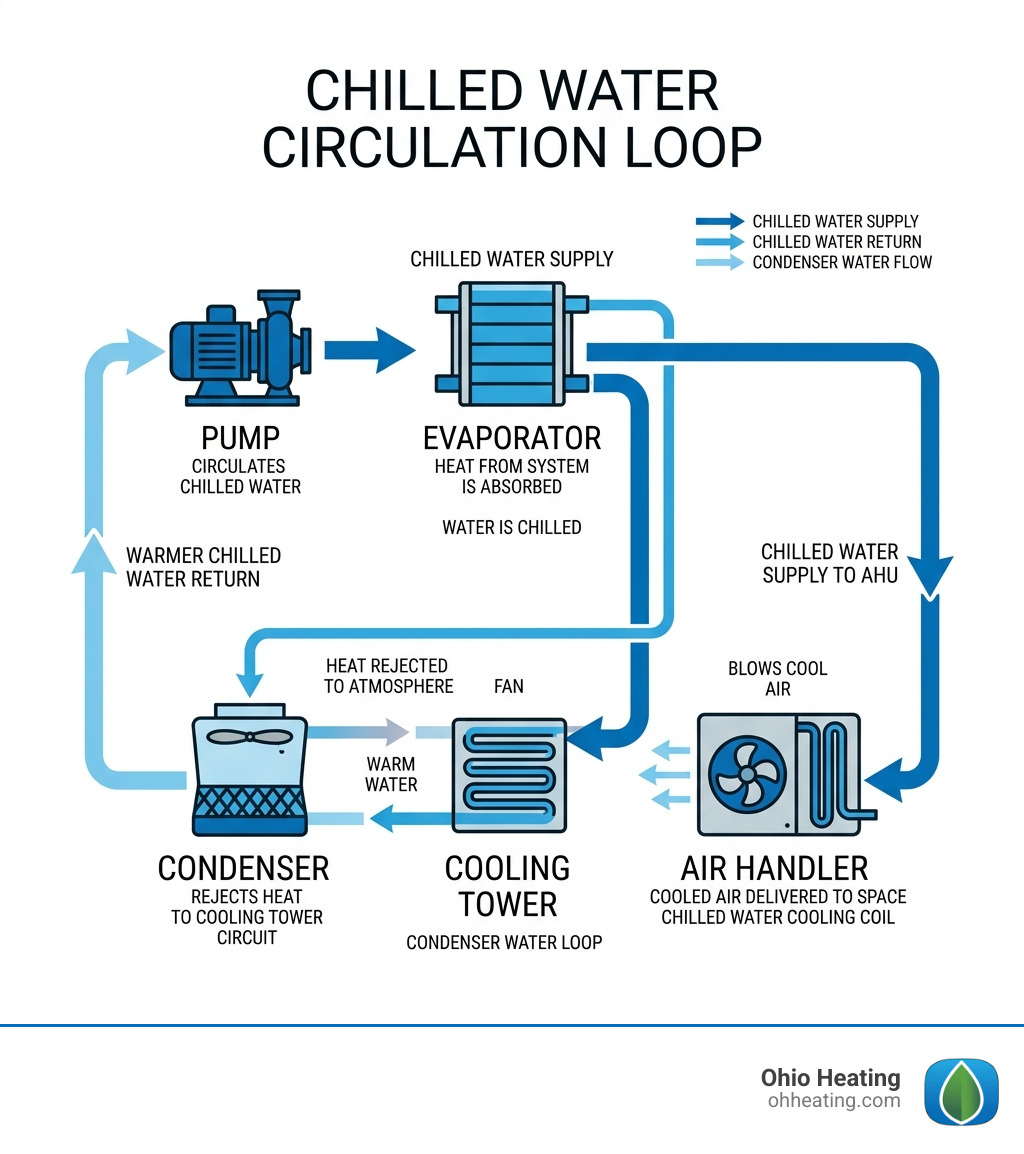
In industrial cooling, the chiller gets all the glory, but the chiller pump is the unsung hero that actually does the heavy lifting. Think of the chiller as the “refrigerator” and the pump as the “circulatory system.” Without a healthy pump, that beautifully chilled water just sits there, getting warmer while your building’s temperature climbs.
Chiller pumps are responsible for moving chilled water through a building’s cooling system to provide cold air exactly where it’s needed. In a typical setup, the pump drives water through the chiller’s evaporator, where heat is removed. This chilled water then travels to units like a chilled water air handler in Columbus Ohio, which uses the cold water to cool the air being blown into your offices or factory floor.
There are usually two main types of pumps we deal with in these systems:
- Chilled Water Pumps: These move the cold water from the chiller to the air handlers.
- Condenser Water Pumps: These are used in water-cooled systems to move water between the chiller and the cooling tower to reject heat.
Proper flow is everything. If the pump isn’t maintaining the correct system pressure, the heat transfer process breaks down. This is why commercial and industrial cooling towers and chillers are so dependent on the health of their pumps. If the flow is too slow, the chiller might freeze up; if it’s too fast, you lose efficiency. It’s a delicate balance that requires professional calibration.
When to Schedule a Chiller Pump Replacement Service
Knowing when to call for a chiller pump replacement service can save you from an emergency “system down” phone call at 2:00 AM. While some pumps can be brought back to life with a new seal or a bearing change, there comes a point where the cost of constant repairs outweighs the price of a new, high-efficiency unit.
In our experience here in Central Ohio, industrial pumps generally have a lifespan of about 10 to 16 years. Because these pumps often run 24/7 during the humid Ohio summers, they endure significant wear and tear.
One of the most common “death rattles” of a chiller pump is cavitation. If you hear a sound like marbles being shaken in a metal can, that’s cavitation. It happens when vapor bubbles form and implode against the impeller, literally eating away the metal. Other signs include excessive vibration, which can shake a pump right off its mountings, and reduced flow rates that leave your upper floors feeling like a sauna.
Identifying Critical Warning Signs
Before you face a total shutdown, keep an eye (and ear) out for these red flags:
- Seal Leaks: A small puddle today is a flood tomorrow. Leaking seals can also damage the motor bearings if water sprays into the housing.
- Unusual Noises: Squealing (bearings), grinding (impeller issues), or the aforementioned “marbles” sound (cavitation).
- Motor Overheating: If the pump motor is too hot to touch, it’s likely overworking due to internal friction or electrical issues.
- Frequent Cycling: If your pump is constantly starting and stopping, it puts immense strain on the motor and starters.
Repair vs. Replacement: Making the Right Choice
At Ohio Heating, we always try to extend the life of your equipment through smart repairs. However, the math often favors replacement as the unit ages.
| Feature | Minor Repair | Full Replacement |
|---|---|---|
| Average Cost | ~$3,500 | ~$5,700+ |
| Lifespan Added | 1–3 years | 10–15 years |
| Efficiency | Remains the same | Increases (Newer Tech) |
| Reliability | Moderate | High |
If your pump is over 12 years old and needs a major repair like a motor rewind or a full impeller replacement, we usually recommend a chiller pump replacement service. Modern pumps are significantly more efficient, often paying for themselves in energy savings within a few years.
The Professional Chiller Pump Replacement Process
Replacing an industrial pump isn’t as simple as “unplugging the old one and plugging in the new one.” These are complex machines that require precision handling. When we perform a chiller pump replacement service, we follow a rigorous process to ensure the new unit integrates perfectly with your existing chiller and cooling tower.
First, we conduct a full system assessment. We don’t just look at the broken pump; we look at the why. Was the pump undersized? Were there issues in the secondary cooling loops or overall chilled water distribution? We perform a load calculation to ensure the new pump is perfectly matched to your building’s cooling requirements.
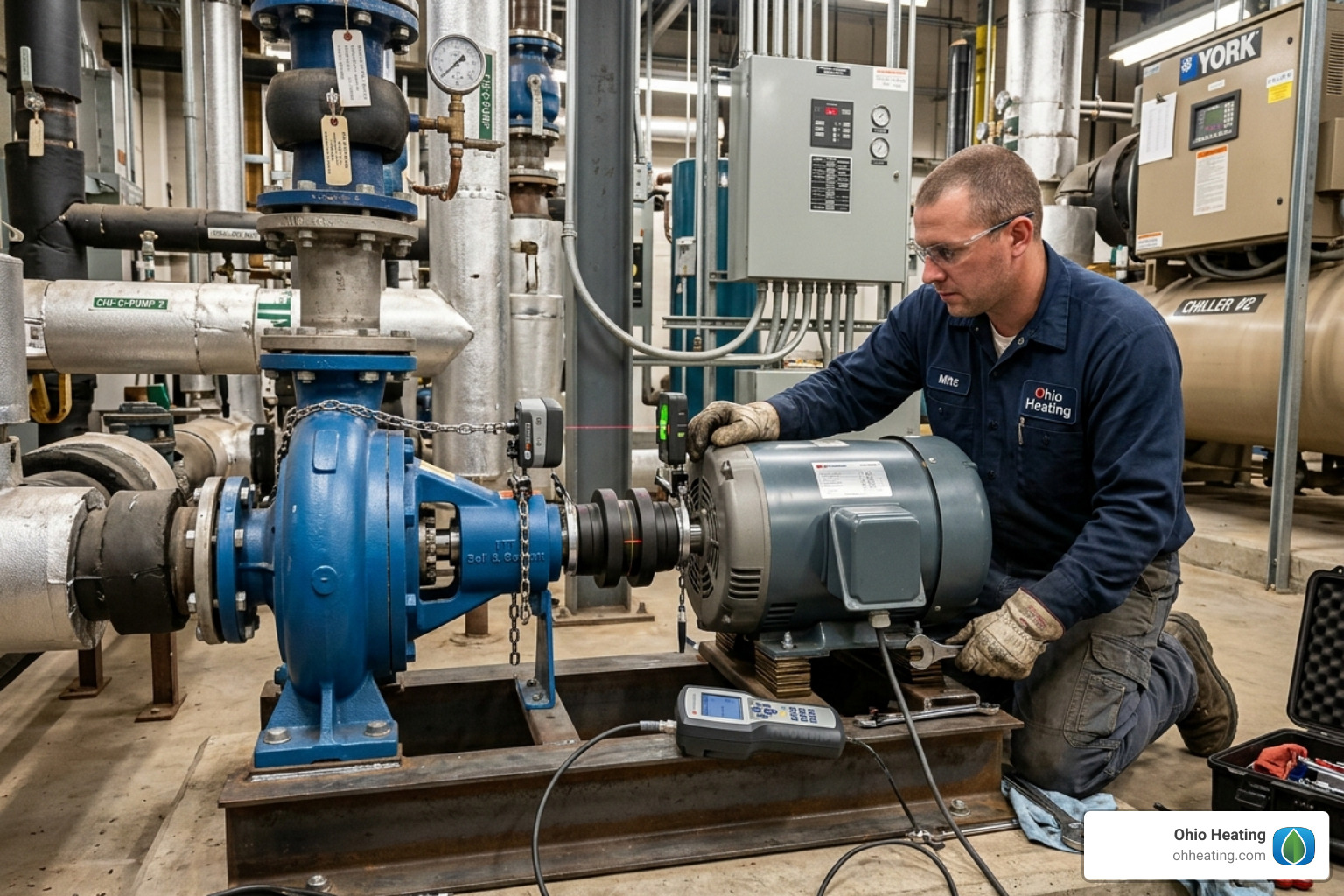
Once the new pump is selected-whether it’s a Bell & Gossett, Armstrong, or Taco unit-the installation begins. This involves more than just bolting it down.
Key Factors in Selecting a Chiller Pump Replacement Service
When we help you choose a new pump, we look at several technical specifications:
- Flow Rate (GPM): How much water needs to move per minute to keep the chiller happy.
- Head Pressure: The amount of “push” needed to get water to the highest point in your building.
- Motor Horsepower: We service pump motors up to 100 HP, ensuring they have the muscle for industrial loads.
- Variable Frequency Drives (VFD): We often recommend adding an ABB frequency drive. This allows the pump to slow down when cooling demand is low, saving you a fortune on electricity.
Post-Installation Testing and Calibration
The job isn’t done when the last bolt is tightened. Precision calibration is what separates a “good” installation from a “great” one.
- Laser Alignment: We use laser tools to align the pump shaft with the motor shaft. If they are off by even a fraction of a millimeter, the bearings will fail prematurely.
- Vibration Analysis: We check for smooth operation to prevent future mechanical fatigue.
- Flow Verification: We measure the actual GPM to ensure it meets the chiller manufacturer’s specs.
- Performance Benchmarking: We record the new pump’s “baseline” performance, which helps us spot issues during future maintenance visits.
Maximizing Efficiency with Expert Chiller Pump Replacement Service
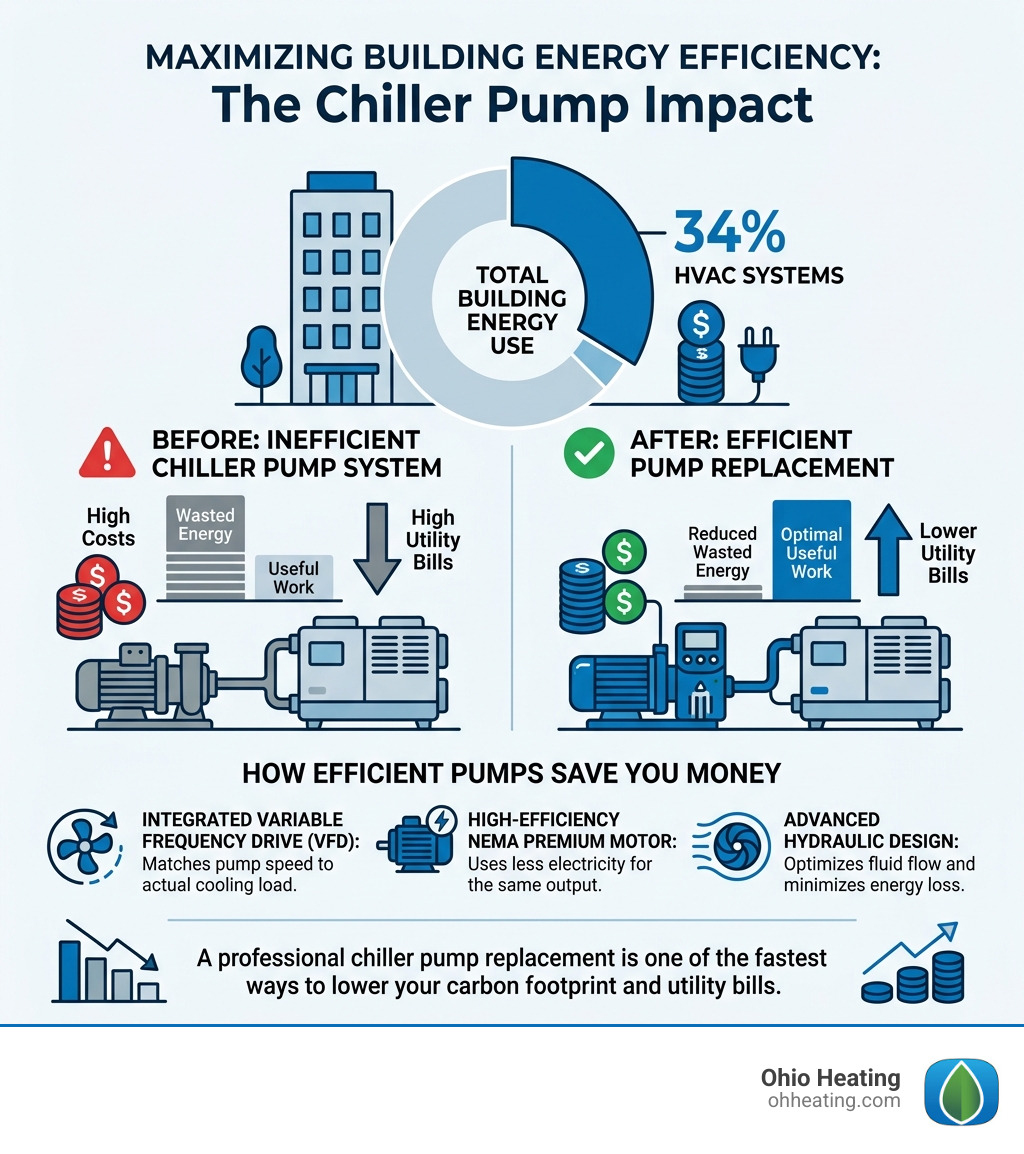
Did you know that commercial HVAC systems consume about 34% of a building’s total energy? In many older Columbus buildings, a significant portion of that energy is wasted by inefficient, oversized, or worn-out pumps. Investing in a professional chiller pump replacement service is one of the fastest ways to lower your carbon footprint and your utility bills.
Modern pump technology has come a long way since 1999. Newer impellers are designed with advanced fluid dynamics, and high-efficiency motors (NEMA Premium) use less electricity to produce the same amount of work. When you combine a new pump with a VFD, the energy savings can be staggering. Instead of running at 100% power all day, the pump adjusts to the actual cooling load of the building.
Long-term Benefits of a Professional Chiller Pump Replacement Service
- Reduced Downtime: No more emergency repairs during a July heatwave.
- Lower Utility Bills: Improved motor efficiency and VFD integration.
- Extended System Life: A properly sized pump prevents the chiller compressor from overworking, extending the life of your most expensive equipment.
- Improved Cooling Capacity: Ensure every corner of your facility stays at the desired setpoint.
We also emphasize the importance of preventative maintenance. Services like regular seal inspections, bearing lubrication, and annual laser alignment checks can extend the life of your new pump well beyond that 16-year mark. We’ve seen facilities where proactive care prevented a $10,000 emergency and turned it into a simple $500 maintenance task.
Frequently Asked Questions about Chiller Pump Replacement Service
How long does a typical chiller pump replacement take?
For most standard commercial systems, a chiller pump replacement service can be completed in a single day, provided the equipment is on-site. Larger, more complex industrial pumps (up to 100 HP) might take 24 to 48 hours to ensure proper curing of mounting adhesives and meticulous laser alignment. We always aim to schedule these replacements during low-occupancy hours to minimize the impact on your operations.
Can a more efficient pump reduce my building’s energy costs?
Absolutely. Upgrading an old, constant-speed pump to a new model with a Variable Frequency Drive (VFD) can reduce the pump’s energy consumption by 30% to 50%. Since HVAC accounts for over a third of your building’s energy, this change significantly impacts your bottom line.
What is the average lifespan of an industrial chiller pump in 2026?
With the technology available in April 2026, you can expect a high-quality industrial pump to last between 10 and 16 years. However, this depends heavily on maintenance. Pumps that receive annual inspections and laser alignment checks often last closer to 20 years, while neglected pumps can fail in as little as 7 or 8 years.
Conclusion
Your industrial cooling system is only as strong as its weakest link, and more often than not, that link is a tired, vibrating, or leaking pump. At Ohio Heating, we’ve been a trusted name in Columbus and Central Ohio for commercial AC service since 1999. We understand that in an industrial setting, downtime isn’t just an inconvenience-it’s a loss of revenue.
Whether you’re noticing a strange noise from your mechanical room or your energy bills are creeping higher than they should be, our NATE-certified technicians are ready to help. We don’t just swap parts; we provide a comprehensive chiller pump replacement service that ensures your entire cooling loop is optimized for the long haul.
Don’t wait for a total system failure to address your pump issues. Schedule your commercial refrigeration and chiller service with us today and keep your facility running cool and efficient all year long. Give us a call at Ohio Heating-we’re here to support your cooling performance and operational reliability!