
Commercial Kitchen Ventilation in Columbus: Cleaning Frequency and Makeup Air
Commercial kitchen ventilation is the system a restaurant depends on hardest and thinks about least, and as long as it’s doing its job nobody in the building really thinks about it.
The complaints that follow a failure rarely blame the hood. Smoke drifts into the dining room, the back door takes a shoulder to open, pilot lights keep dropping out, and the line works through heat that won’t clear. Eventually a fire inspector arrives with a clipboard, and the conversation gets expensive from there.
Almost all of it traces back to two questions: how often the system actually gets cleaned, and whether the air being pulled out of the building is getting replaced.
Commercial kitchen ventilation cleaning frequency is set by cooking type
NFPA 96 sets a minimum inspection and cleaning frequencies required for a kitchen ventilation system. The frequency follows the type and volume of cooking. Fire marshals and authorities who have jurisdiction use the below frequency table to judge whether a system was properly maintained or not.
| Cooking operation | Inspection and cleaning frequency |
|---|---|
| Solid fuel cooking, such as wood, charcoal, or mesquite. | Monthly. |
| High-volume work, including 24-hour cooking and charbroiling. | Quarterly. |
| Moderate-volume operations. | Semiannually. |
| Low-volume operations, such as churches, day camps, and seasonal businesses. | Annually. |
Source: NFPA 96 grease buildup inspection requirements, as published on UpCodes. The inspection has to be done by a qualified person approved by the authority having jurisdiction (UpCodes).
Since the frequency of cleaning required follows the real cooking happening in your restaurant, the requirements will change as your kitchen set-up grows. Add a char-broiler or move to 24-hour service and your obligation changes right then, not at the next renewal or inspection.
“Cleaned” means the whole system, too. Exhaust hoods, filters, the full duct run, and the fan. A kitchen ventilation hood that gleams above a greasy duct is exactly the setup that turns a flare-up into a structure fire.
Makeup air is the piece that gets forgotten
Exhaust systems remove air from the building, but that air has to come from somewhere.
Under Ohio’s mechanical code rules, kitchen systems for commercial cooking equipment are built under the commercial kitchen exhaust sections. Makeup air is part of that framework (Ohio Administrative Code 4101:2-5-01, Exhaust Systems).
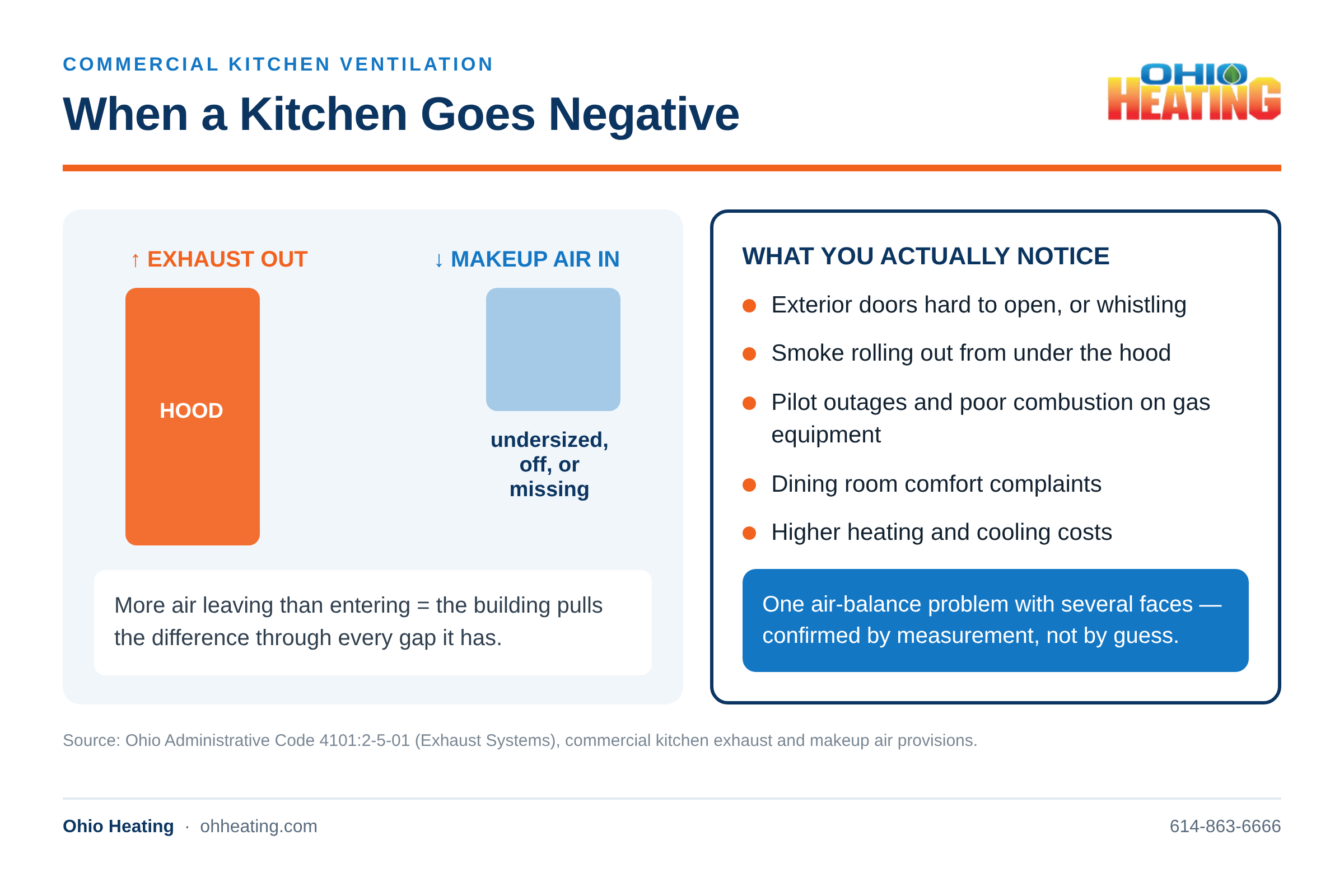
When that air supply is missing, undersized, or shut off, the kitchen goes negative. The symptoms are predictable:
- Exterior doors that are hard to open, or that whistle.
- Smoke and odor rolling out from under the hood instead of up into it.
- Pilot outages and poor combustion on gas equipment.
- Dining room comfort complaints, as conditioned air gets dragged toward the kitchen.
- Higher heating and cooling bills, since the building pulls unconditioned air through every gap it has.
Owners tackle these one problem at a time, but the real cause is one air-balance problem. Confirming it requires measurements, not guesswork. That is what a building air balance evaluates and documents.
Winter is when air units earn their money
An untempered unit dumps outdoor air straight into the kitchen. In August that is tolerable. In January it is not. Columbus normal lows sit near 22°F (NOAA/NWS Columbus climate normals, 1991–2020).
Cold aisles follow, as do unhappy staff members. Then comes the common fix: somebody turns the unit down or off. But the exhaust fans keep running, and he building goes further negative. Every symptom above gets worse, and in the coldest part of the year.
So the heater section deserves the same pre-season attention as the building’s furnaces and boilers. Late summer is the time to verify it fires, modulates, and holds temperature. A failure now is as simple as a call to make an an appointment. A failure in January is a service call during a busy dinner service.

What a real commercial kitchen ventilation service visit covers
A visit worth paying for goes past the filters.
- Filters. Correct type, correctly seated, no gaps at the ends. Gaps let grease bypass straight into the duct.
- Grease containment. Cups and troughs emptied and clean, not overflowing onto the cookline.
- Exhaust fans. Belt tension and condition, bearings, hinge kit operation, and a clean fan base.
- Ductwork. Access panels opened, used, and re-secured. The run inspected, not assumed.
- The air supply unit. Filters, dampers, heater operation, and airflow verified.
- Balance. Supply and exhaust compared under real operating conditions.
- Documentation. A dated service record, because that is what an inspector asks for.
Step seven is one restaurants regret skipping. Doing the work is not the same as proving the work was done. In an inspection or an insurance claim, this documentation is the proof.
These systems do not exist in isolation. They share a roof, a gas supply, and often a technician with the rest of the building. That is why most Columbus operators fold them into a single commercial HVAC maintenance program instead of juggling three vendors. If refrigeration is on the same list, see keeping commercial refrigeration systems cool.
Want the whole system checked and documented before the fire inspector shows up? Ask us to schedule the pre-season visit.
Frequently asked questions
How often does a commercial kitchen hood have to be cleaned? It goes by cooking type. Monthly for solid fuel cooking. Quarterly for high-volume work, including 24-hour cooking and charbroiling. Semiannually for moderate-volume operations. Annually for low-volume operations such as churches and seasonal businesses (NFPA 96 grease buildup inspection requirements, via UpCodes).
Who is allowed to perform the inspection? A qualified person approved by the authority having jurisdiction (UpCodes).
What is makeup air, and why does my kitchen need it? It is the outdoor air brought in to replace what the hood removes. Without it the kitchen goes negative. That causes hard-to-open doors, smoke rollout, pilot outages, and dining room complaints. Ohio’s exhaust rules address it as part of commercial kitchen construction (OAC 4101:2-5-01).
Why is my kitchen door hard to open? That is a classic negative pressure symptom. The building removes more air than it brings in. Confirm it with a measurement rather than adjusting by guess.
Does adding a charbroiler change my cleaning schedule? Yes. Frequency follows the type and volume of cooking. Adding charbroiling or 24-hour cooking moves the system into a higher-frequency category (UpCodes).
Should the supply unit be serviced before winter? Yes. An untempered or failed heater section in a Columbus winter, with normal January lows near 22°F (NOAA/NWS), usually leads someone to shut it off. That makes every negative pressure problem worse.