
Cracked Heat Exchanger Symptoms Columbus Homeowners Should Take Seriously
You won’t get one clear warning that a heat exchanger has cracked. The furnace will still light, the house still warms up, and the only hint that something’s wrong might be a headache that fades about an hour after you leave for work. That’s why cracked heat exchanger symptoms are worth knowing before the first cold week, when a Columbus furnace goes from idle to running most of the day. The heat exchanger is the metal shell that keeps burner combustion separate from the air blowing through your vents, and a split in that metal lets flue gas cross into the air you breathe.
Central Ohio furnaces sit idle from April through September, then run hard the first cold week. Metal that has expanded and contracted for fifteen winters is most likely to fail right at the beginning of the cold season, which is why September is the month to check everything. If you’re already scheduling seasonal work, our furnace and heating equipment service page covers what a full inspection includes.
Why a cracked heat exchanger is more than a comfort problem
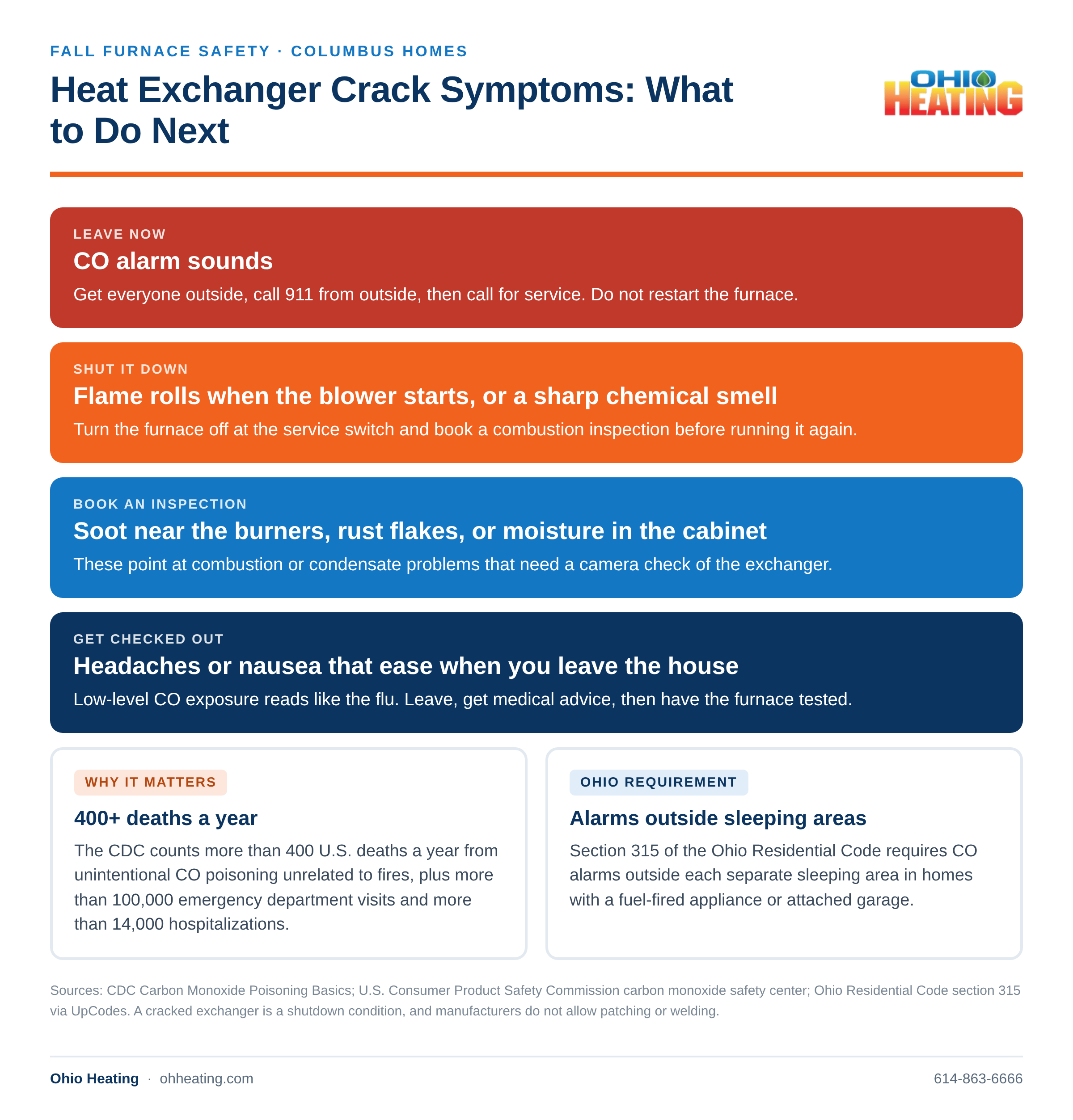
Carbon monoxide is the reason this repair takes priority. It’s colorless and odorless. The CDC reports that more than 400 Americans die each year from unintentional CO poisoning unrelated to fires. Another 100,000 people visit an emergency department annually, and more than 14,000 are hospitalized. The Consumer Product Safety Commission counts more than 200 of those deaths as consumer-product related each year.
Symptoms of CO exposure include headaches, nausea, dizziness, weakness, chest pain, and confusion, and the CDC notes they’re often described as flu-like. That’s the trap. In October a family reads the same signs as a seasonal bug, and nobody connects them to the furnace that just started running again.
The cracked heat exchanger symptoms you can actually observe
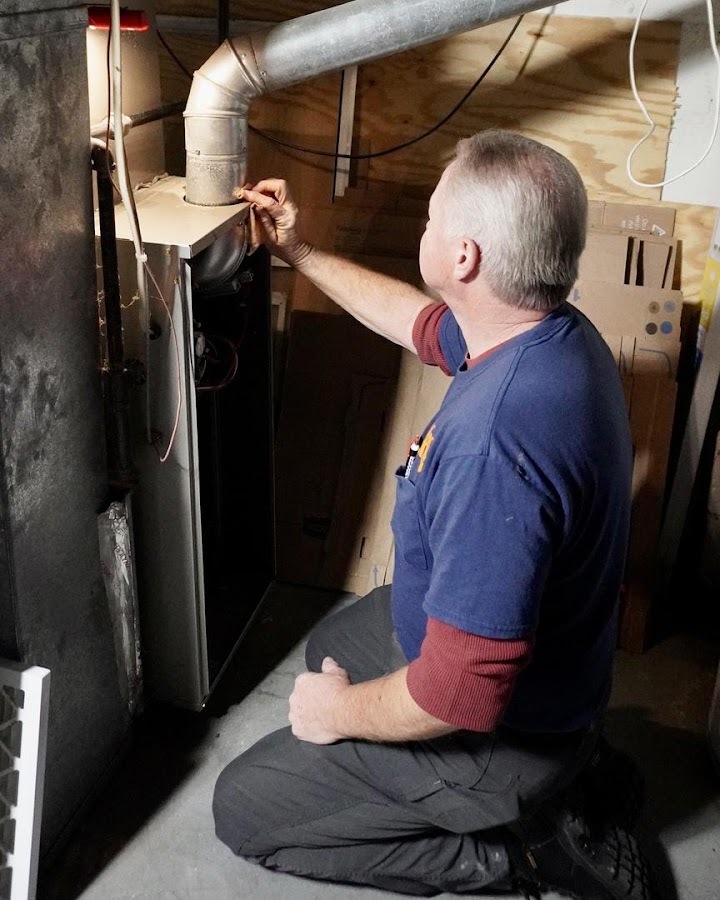
You can’t see most of a heat exchanger without pulling the furnace apart, so pay attention to furnace behavior instead. The signs below are the ones homeowners typically report just before our technician confirms there is a crack.
| What you notice | What it can mean | What to do |
|---|---|---|
| CO alarm sounds or chirps in a new pattern. | Combustion gases are reaching living space. | Get everyone outside, call 911, then call for service. |
| Burner flame flickers or rolls when the blower starts. | Air is moving through a breach in the exchanger. | Shut the furnace off at the switch and schedule an inspection. |
| Soot or dark streaking near the burner compartment. | Incomplete combustion, often paired with a restriction. | Have the burners, flue, and exchanger inspected together. |
| Sharp chemical or formaldehyde smell during heating. | Flue gas entering supply air. | Ventilate the house and shut the system down. |
| Headaches or nausea that ease when you leave home. | Possible low-level CO exposure. | Leave, seek medical advice, then have the furnace tested. |
| Rust flakes or moisture inside the cabinet | Condensate corroding the exchanger from the inside | Ask for a camera inspection of the exchanger |
None of these confirm there is a crack on their own. A flickering flame can also come from a blocked flue or a return leak, and rust can come from a failed condensate line on a high-efficiency unit. The point is that each issue on the list deserves a real inspection by a technician rather than a wait-and-see week.
How a technician confirms the crack
A visual check of the furnace is only part of the inspection. Techs also pull the burners, run a borescope along the exchanger cells, and look for splits at the welds and the bends where stress concentrates. Cold-metal cracks can close up once the furnace heats, so the inspection needs to happen on a running system as well as a cold one.
The rest of the inspection includes combustion testing. A technician measures CO in the flue and in the supply air stream, watches how the reading changes when the blower kicks on, and checks draft at the vent. A supply-air CO reading that climbs when the blower starts points at the exchanger rather than the burner. If you want the wider view of what airborne contaminants do in a tight house, our indoor air quality page explains how filtration and ventilation fit together.
Ohio code backs up the detection side. Section 315 of the Ohio Residential Code requires carbon monoxide alarms outside each separate sleeping area in dwellings that contain a fuel-fired appliance or an attached garage. Alarms are the backstop, though, not a substitute for an annual combustion check.
Repair or replace once a crack is confirmed
A cracked exchanger is a shutdown condition. Manufacturers don’t patch or weld them, and any technician who offers to seal one is offering something the equipment listing simply doesn’t allow. Your real choice is either a new exchanger or a new furnace.
Age is usually the determining factor. Exchanger parts on furnaces under about ten years old are often still covered by the manufacturer’s parts warranty, leaving you to think about just labor and downtime. Past fifteen years, the labor to swap an exchanger runs close enough to the cost of a replacement that most homeowners put the money toward a system with a current efficiency rating. ENERGY STAR lists 95 percent AFUE as the qualifying threshold for gas furnaces in the U.S. South and 97 percent in the U.S. North, which gives you a benchmark when you compare quotes.
Whatever you decide, get the model and serial number off the rating plate first. Warranty status, exchanger design, and parts availability all key off that number, and it saves a second trip.
What to do this month
Book the inspection before the first hard freeze, because that’s when call volume spikes and same-day appointments dry up. Test every CO alarm in the house and replace any unit past the manufacturer’s listed lifespan. Clear the area around the furnace so a technician can pull the burner assembly without moving storage boxes.
If your furnace is over fifteen years old and has been getting an annual tune-up, keep at it. If it hasn’t been inspected in three or four seasons, treat this fall’s visit as a safety check rather than routine maintenance.
Frequently asked questions
Q: Can I run my furnace with a cracked heat exchanger if I open a window? A: No. Opening a window doesn’t control where flue gas goes inside the ductwork, and the system should stay off until it’s repaired or replaced.
Q: Will a carbon monoxide alarm catch a small crack? A: Not reliably. Residential alarms are built to warn about dangerous concentrations, so a small intermittent leak can stay below the alarm threshold while still exposing your family.
Q: How long does a heat exchanger usually last? A: Most residential exchangers run fifteen to twenty-five years depending on cycling, filter maintenance, and how well the system was sized. Short cycling shortens that life because it multiplies the heating and cooling stress on the metal.
Q: Does a cracked exchanger raise my gas bill? A: Sometimes, though it’s a weak signal. Efficiency losses from a crack are small next to the safety risk, so don’t wait for a bill to tell you something’s wrong.
Q: Is a cracked exchanger covered by my warranty? A: The part often is, if the furnace is within the manufacturer’s stated parts coverage and was registered. Labor is usually separate, so ask for both answers in writing before work starts.
Q: What if the technician can’t find a crack but symptoms continue? A: Ask for combustion analysis results in writing and have the flue, water heater, and any other fuel-fired appliance checked. CO in a home doesn’t have to come from the furnace.
If you’ve spotted any of these cracked heat exchanger symptoms in your Columbus home, shut the system down and have it inspected before you run it again. Ohio Heating’s technicians handle combustion testing and exchanger inspections across Franklin County and the surrounding communities, and you can reach us at 614-863-6666 or through the furnace repair in Columbus page to get on the schedule.