
Furnace Short Cycling: Six Causes and How to Tell Them Apart
Furnace short cycling is when your furnace fires, runs for a few minutes, shuts off, and starts again well before the house reaches the set temperature. It burns extra fuel on each startup and wears the ignition components out early. Rooms end up heating unevenly, because the blower shuts down before it can move heat properly through the whole house.
There are multiple common issues that look identical from the thermostat alone. They’re easy to distinguish by timing the heating cycle and paying attention to what happens right before the burner drops out.
What Counts as Furnace Short Cycling
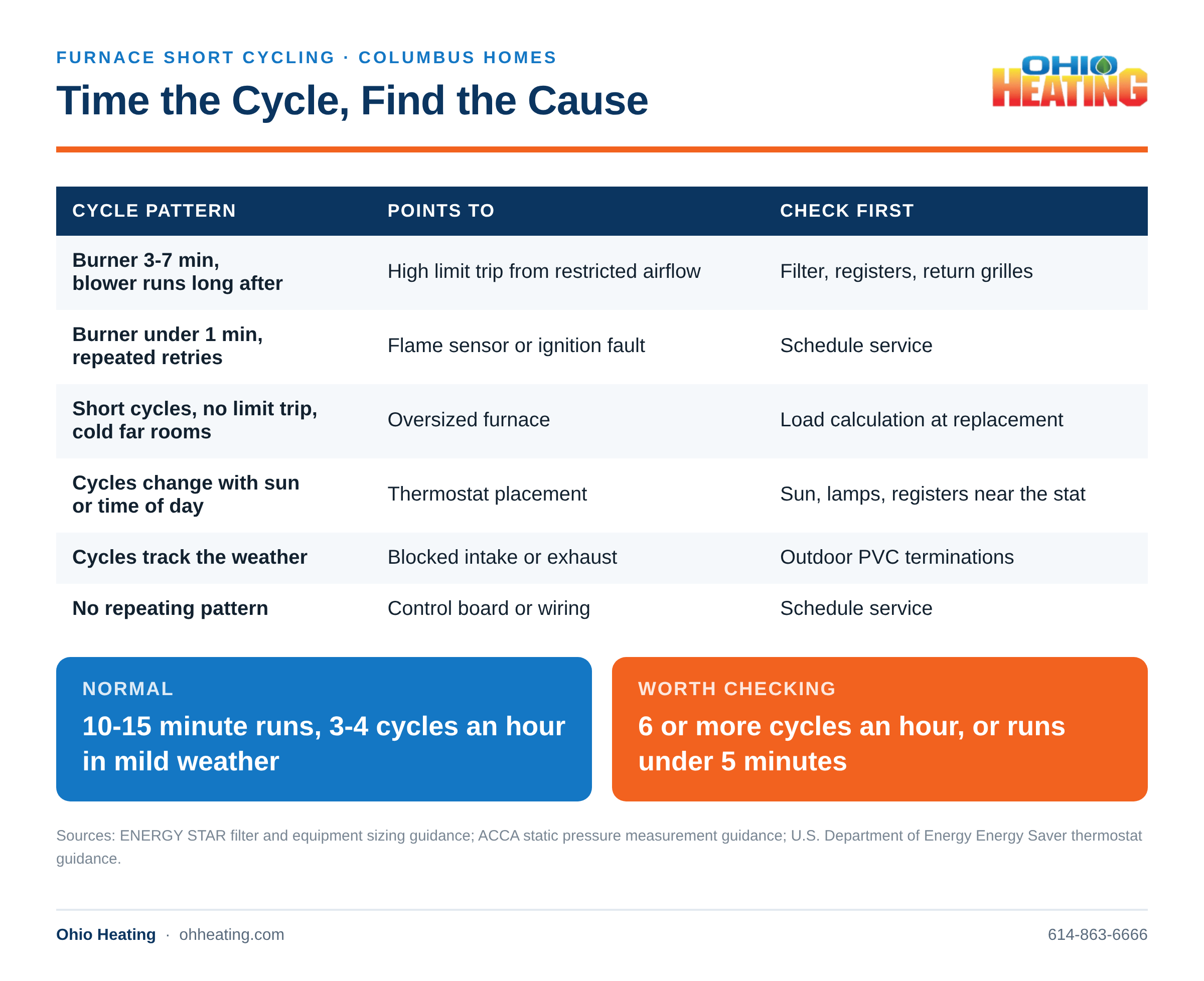
A gas furnace in a Columbus home normally runs a 10 to 15 minute heating cycle in mild weather, and a much longer one during a cold snap. Three or four cycles an hour on a 30°F day is normal, while six to eight cycles an hour (cycles that end after three to five minutes) is short cycling.
Time it with your phone before you call anyone. Note how long the burner stays lit, how long the blower runs after the burner drops out, and how long the system sits idle before it fires again. Those three numbers will help to diagnose the cause faster than any other information you can gather.
Airflow, Sizing, and Thermostat Causes
Restricted airflow tripping the high limit
This is the most common cause and the easiest to check. Your furnace has a high limit switch that shuts the burners off when the air inside the cabinet gets too hot. When airflow drops, cabinet temperature climbs, and the burners stop while the blower keeps running to cool things down. The burner runs three to seven minutes, cuts out, and the blower keeps running afterward for a long stretch. Then the cycle repeats.
Start with the filter, since dirty filters cause more service calls than anything else. ENERGY STAR recommends checking air filters monthly during heavy-use months and changing it at least every three months, since a dirty filter slows airflow and makes the system work harder (ENERGY STAR). Then open every supply register and clear furniture off return grilles, so the blower can pull the dirty air it needs from the house.
If those are clean and it still cycles, the duct system itself is the next suspect. ACCA’s quality installation and duct design standards call for measuring total external static pressure and comparing it to the maximum rating on the equipment nameplate (ACCA). A reading well above the nameplate rating means the ducts are choking the blower, and no filter change will fix that.
The gas furnace is oversized
An oversized furnace heats the space near the thermostat quickly, satisfies the call for warm air, and then the furnace turns off before the rest of the house catches up. That’s short cycling gas furnace behavior you can’t fix with parts alone. ENERGY STAR notes that oversized equipment tends to have a shorter life because short cycling inflicts wear and tear (ENERGY STAR).
This signature is different from an airflow problem. Heating cycles are short, the high limit doesn’t trip, the blower shuts off on its normal timing, and the house feels warm near the thermostat but cool at the far end. Rooms furthest from the equipment stay cold no matter what you set.
This is a sizing issue, and is fixed at replacement time by using a load calculation, not with a rule of thumb based on square footage or on whatever was there before. A two-stage or modulating furnace also helps, because it can run long, low-output cycles instead of full-output bursts.
Thermostat issues and placement
Thermostat issues start with their location. A thermostat in direct sun, above a supply register, on an exterior wall, or near a lamp reads a temperature the rest of the house doesn’t share. It satisfies before the house is warm and calls again as soon as the local air cools.
Deep setbacks can look like short cycling too. Turning the thermostat back 7°F to 10°F for eight hours a day can save as much as 10 percent a year on heating and cooling, which is worth doing (Department of Energy). The recovery period afterward is long by design, so a system struggling through recovery gets blamed for cycling problems it doesn’t actually have. You should judge the cycle length during steady conditions instead.
Ignition, Venting, and Control Causes
Flame sensor and ignition faults
When the flame sensor gets dirty, it stops reading the flame and the control board assumes that the burner went out. Then the gas valve shuts, the control board tries again, and you get the same loop of ignition: a few seconds of flame, then shutdown. These cycles are much shorter than a limit trip, often under a minute, and you’ll usually hear several attempts in a row before the furnace locks out. This one needs us out there, since the sensor has to be cleaned or replaced, and we measure the flame signal afterward to make sure it’s back in range.
Blocked venting and pressure switches
A condensing furnace uses a pressure switch to confirm that it has proper draft before the burners light. If the intake or exhaust is blocked, the condensate line sags, or the drain trap clogs, that switch opens partway through the cycle and shuts the burners down. Head outside and look at the PVC pipes coming out of your wall, because nests, ice, mulch, and drifted snow all plug them up.
Venting problems cause most furnace-related carbon monoxide risk, so this is worth checking even if the furnace seems to be running fine. The Consumer Product Safety Commission recommends a CO alarm on every level of your home and outside sleeping areas, tested monthly with fresh batteries once a year (CPSC).
Control board and wiring problems
A failing control board, a loose thermostat wire, or a corroded connection can lower the call for heat at random. The pattern is inconsistent, which is what distinguishes it from the issues described above. Airflow and sizing problems repeat the same way every cycle, while a wiring fault comes and goes. Our furnace control board replacement guide covers what that repair involves.

Cycle Pattern Diagnostic Table
| Cycle pattern | What it points to | First thing to check |
|---|---|---|
| Burner 3-7 min, blower runs long after | High limit trip from restricted airflow | Filter, registers, return grilles. |
| Burner under 1 min, repeated retries | Flame sensor or ignition fault | Schedule service. |
| Short cycles, no limit trip, cold far rooms | Oversized furnace | Load calculation at replacement. |
| Cycles vary with sun or time of day | Thermostat placement | Thermostat location and nearby heat sources. |
| Cycles stop and start with weather | Blocked intake or exhaust vent | Outdoor PVC terminations. |
| No repeating pattern at all | Control board or wiring | Schedule service. |
How to Fix Short Cycling Yourself, and When to Stop
Change the clogged air filter, open the registers, clear the returns, and check the outdoor vent terminations. That covers what’s safe to do yourself, and it resolves a good share of cases.
Past that point you need specialized instruments. Static pressure, temperature rise, flame signal, and combustion readings all require special tools and training, and the components involved include gas and line voltage. Our furnace repair team serves Columbus and the surrounding communities, and a fall visit costs less disruption than a furnace failure in January. If your thermostat turns out to be the culprit, thermostat installation and repair is usually a same-visit fix.
Frequently Asked Questions
How often should a furnace cycle per hour? Three to four cycles an hour in mild weather is typical, with longer runs during cold snaps. Six or more short cycles an hour is worth investigating.
Can a dirty filter cause a furnace to short cycle? Yes, and dirty filters are the most common reason a furnace keeps short cycling. Restricted airflow raises cabinet temperature, and the high limit switch shuts the burners off before the thermostat is satisfied.
Is short cycling dangerous? The cycling itself mostly costs money and equipment life. The underlying cause can matter more, particularly when a blocked vent is involved, so working CO alarms are important while you sort it out.
Does short cycling mean I need a new furnace? Usually not. Airflow restrictions, thermostat placement, and ignition faults are all repairs. Oversizing is the one cause that only gets corrected at replacement.
Why does the blower keep running after the burner shuts off? Normal off-delay runs a minute or two to pull remaining heat out of the heat exchanger. A much longer run after an early shutdown suggests the high limit tripped.
Will a smart thermostat fix short cycling? It can help with cycle timing and setback recovery. It will not fix restricted airflow, an oversized furnace, or a dirty flame sensor.
Get the Cycling Diagnosed Before Winter
Sorting this out now protects the equipment you already own, saves fuel all winter, and keeps you off the emergency schedule in January. Call Ohio Heating at 614-863-6666 to schedule a furnace diagnostic.