
When the Heat Is On, Your AC Can’t Afford to Fail
Getting an ac tune up hot weather service isn’t just routine maintenance — it’s the difference between a building that stays comfortable and one that becomes a liability on the hottest days of the year.
Here’s what you need to know right now:
- A professional AC tune-up takes 35 minutes to 1 hour and should ideally be scheduled before peak summer heat arrives
- Without annual service, your system loses up to 5% efficiency every year — and dirty coils alone can slash cooling power by 20–30%
- A well-maintained system lasts 15–20 years; a neglected one may fail in 8–10 years
- Tune-up costs typically run $75–$200 — emergency repairs during a heat wave can cost 50–100% more
- The best time to schedule: spring or early summer, before HVAC companies are booked solid with emergency calls
Ohio summers don’t ease in gently. One week it’s mild, the next you’re dealing with back-to-back 90-degree days and a building full of people wondering why the air isn’t keeping up. That’s exactly when an unmaintained system decides to quit — and exactly when every HVAC company has a three-day wait.
I’m Jill Frattini, Service Coordinator at Ohio Heating in Columbus, OH, and I’ve spent years coordinating AC tune-up hot weather calls, scheduling technicians, and watching which systems hold up under summer pressure and which ones don’t. In this guide, I’ll walk you through everything you need to keep your cooling system reliable when temperatures spike.
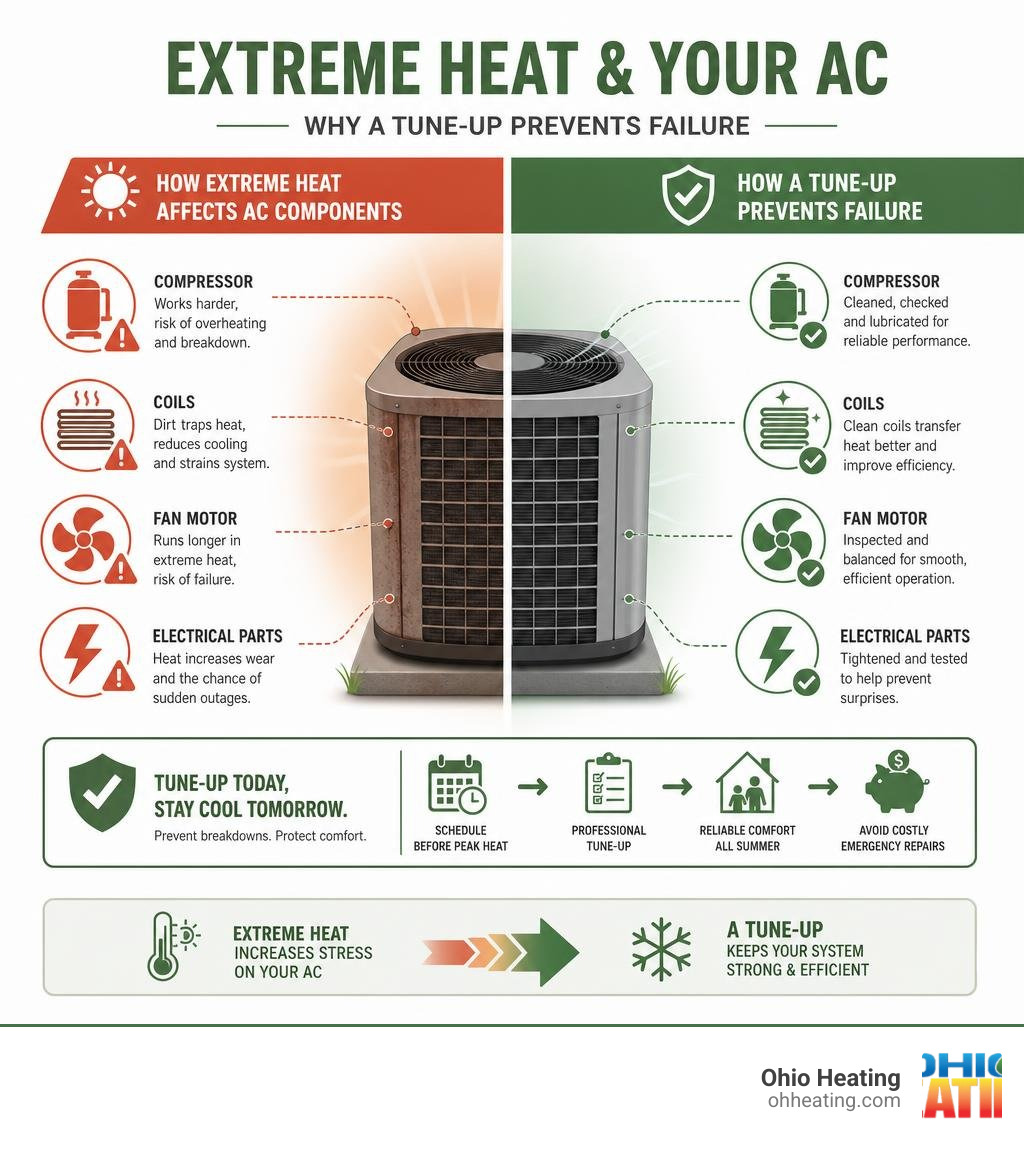
Why You Need an AC Tune Up Hot Weather Service
When the humidity in Central Ohio climbs and the afternoon sun beats down on your roof, your air conditioner is the only line of defense between your family and the sweltering outdoor heat. Yet, many homeowners treat their cooling systems with an “out of sight, out of mind” attitude until the day the vents start blowing warm air.
Scheduling an ac tune up hot weather service is a proactive strategy to protect your comfort, your wallet, and your peace of mind. Without regular professional attention, your air conditioner experiences quiet, progressive wear and tear. Over time, this leads to a steep decline in cooling efficiency, a shortened system lifespan, and skyrocketing energy bills.
Think of your AC like a car. You wouldn’t drive a vehicle across the country without checking the oil, testing the brakes, and ensuring the coolant is topped off. Similarly, running your AC continuously through a Columbus summer without a tune-up is a recipe for disaster. To understand the financial risks of skipping this crucial step, read about The Real Cost of Skipping Your Annual AC Tune-Up.
How an AC Tune Up Hot Weather Visit Prevents Mid-Summer Breakdowns
The hottest days of July generate peak demand on our local power grid—and on your cooling equipment. When outdoor temperatures climb into the 90s, your air conditioner must run longer, harder cycles to maintain your indoor thermostat settings. This sustained operating pressure exposes every hidden weakness in your system.
The most common point of failure during a summer heat wave is the run capacitor. The capacitor acts like a short-term battery, delivering the electrical boost your compressor and fan motors need to start and run. High operating temperatures and non-stop run cycles degrade capacitors rapidly. If a technician tests your capacitor in the spring and notices its electrical storage capacity (measured in microfarads) has dropped below safe limits, we can replace it for a fraction of the cost of an emergency after-hours call.
When a weak capacitor is left unaddressed, it forces the compressor motor to draw excessive electrical current. This leads to severe compressor strain, motor overheating, and eventually, a total system failure. By catching these marginal components early, a professional tune-up prevents unexpected cooling system failures during extreme heat waves when you need your AC the most.
Maximizing Efficiency and Lowering Energy Bills
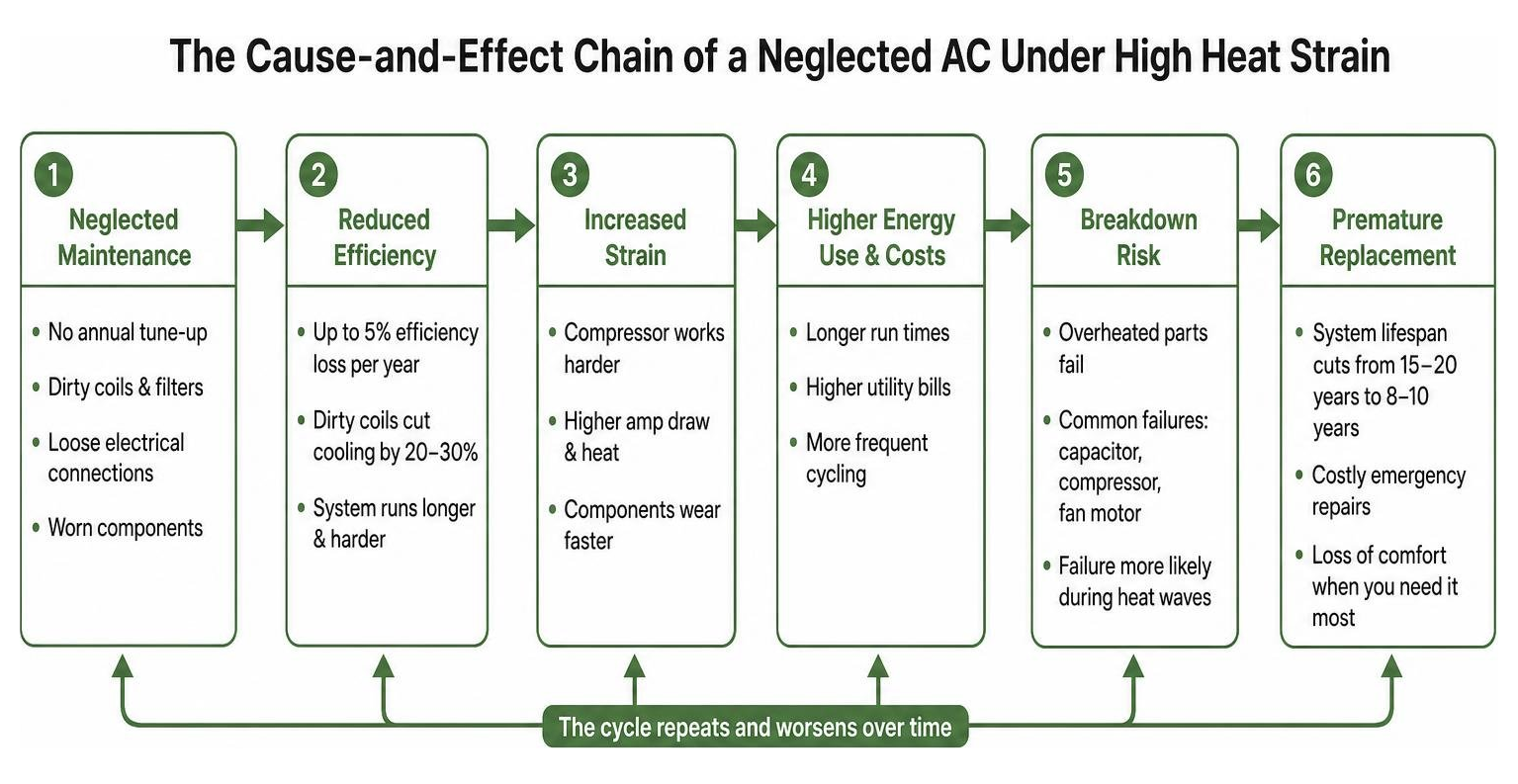
Did you know that your air conditioner loses up to 5% of its operating efficiency each year it goes without professional service? This means you pay more on your monthly utility bills for less actual cooling power.
The primary driver of this efficiency loss is dirt accumulation. During the off-season, wind, rain, and pollen deposit a layer of grime over your outdoor condenser coils. When these coils are dirty, they cannot efficiently release the heat your system has pulled from inside your home. This forces the compressor to run longer cycles to achieve the same indoor temperature. In fact, dirty coils can reduce AC efficiency by 20% to 30%, which is equivalent to losing nearly a third of your system’s total cooling capacity.
Professional cleaning restores free airflow and heat transfer, directly reducing your monthly power bills. To explore more ways to keep your system running optimally, check out our Strategies to Boost Efficiency Through Proper AC Maintenance.
What is Included in a Professional AC Tune-Up?
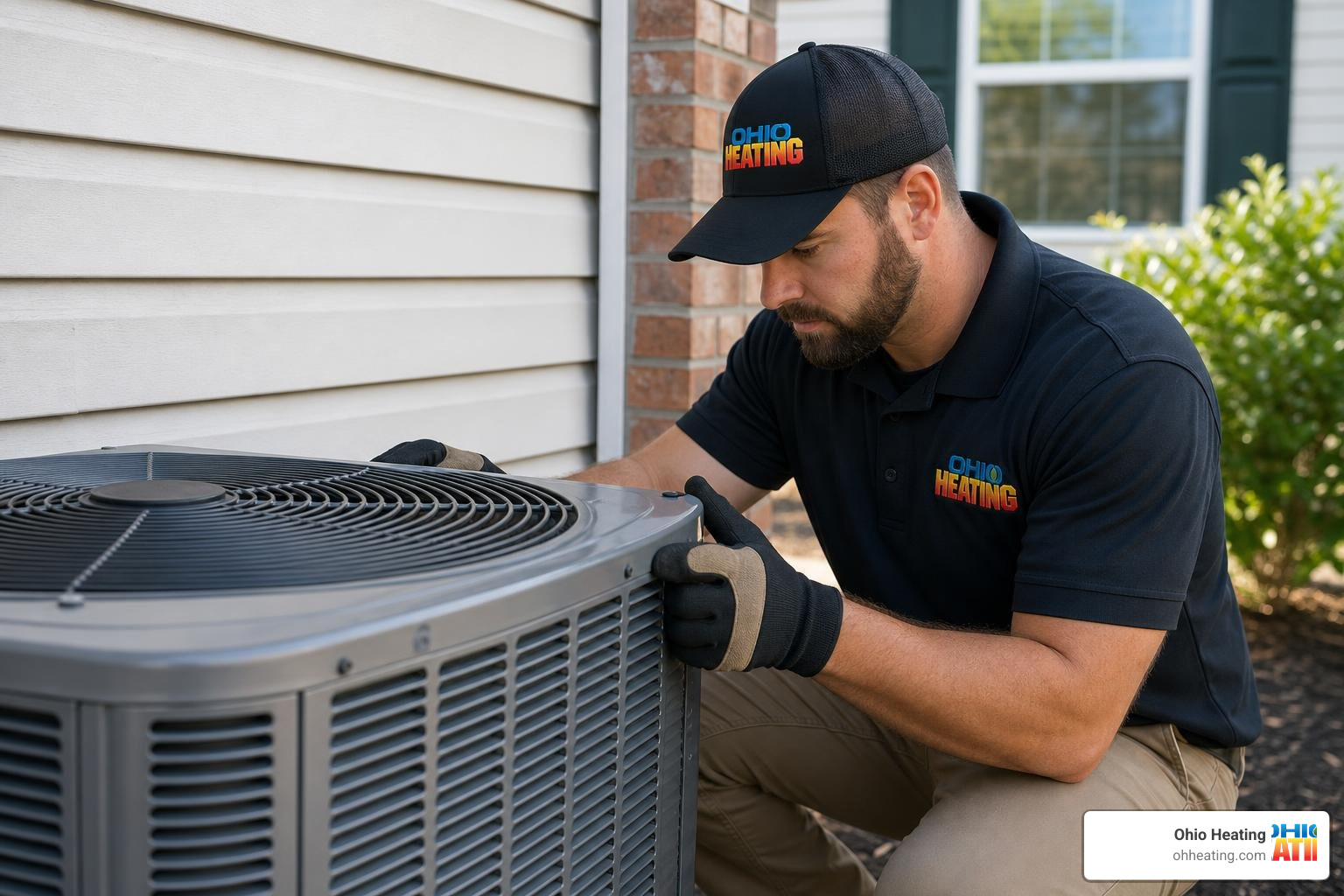
A legitimate, professional AC tune-up is not a quick visual inspection. It is a highly technical, hands-on process that requires specialized tools, diagnostic instruments, and certified expertise. At Ohio Heating, our technicians perform a comprehensive 17-point inspection to ensure every mechanical and electrical part of your air conditioner is functioning perfectly.
During this service, we evaluate electrical connections, measure refrigerant levels, and perform deep coil cleanings. These steps ensure that the physical heat transfer process occurs safely and efficiently.
To see the complete list of everything we evaluate during a standard visit, check out our Ultimate Checklist for AC Maintenance.
The Core Maintenance Checklist
A thorough cooling system tune-up focuses heavily on the components responsible for moving air and transferring heat. Here are the core steps required to prepare your cooling system for summer peak performance:
- Condenser Coil Cleaning: We gently wash the outdoor condenser coils to remove dirt, grass clippings, and pollen, ensuring maximum heat rejection.
- Evaporator Coil Inspection: We check the indoor evaporator coil for dust buildup or biological growth, which can restrict airflow and cause the system to freeze up.
- Condensate Drain Line Clearing: A central AC system can pull 5 to 20 gallons of water out of your indoor air on a humid July day in Columbus. We flush and clear the condensate drain line to prevent algae clogs, water damage, and system shut-offs.
- Thermostat Calibration: We verify that your thermostat is reading indoor temperatures accurately and communicating correctly with your AC unit.
Electrical and Mechanical Component Testing
Beyond cleaning, our technicians perform precise electrical and mechanical diagnostics. We measure the electrical draw of the compressor and fan motors, test all run capacitors and contactors for wear, and inspect the safety controls of the system.
We also measure superheat and subcooling. These are technical calculations based on refrigerant temperatures and pressures. Measuring these values is the only accurate way to verify that your system has the exact refrigerant charge required by the manufacturer. An incorrect charge—whether too high or too low—will degrade system performance and eventually destroy the compressor.
Signs Your Cooling System Needs Immediate Attention
Sometimes, your air conditioner will give you subtle warning signs that it is struggling before it shuts down completely. Recognizing these signs early can save you from a hot, sleepless night and a costly emergency repair bill.
- Warm Air from Vents: If the air coming out of your registers feels lukewarm, your system may have a refrigerant leak, a failed compressor, or a severely clogged outdoor coil.
- Weak Airflow: If you can barely feel air moving through your vents, you could be dealing with a failing blower motor, a completely clogged air filter, or leaky ductwork.
- Short Cycling: This occurs when your AC turns on and off rapidly every few minutes. Short cycling places immense wear on your compressor and prevents your home from dehumidifying properly.
- Unusual Noises: Squealing, grinding, rattling, or clicking sounds indicate loose components, failing motor bearings, or electrical contactor issues.
- Water Leaks: Pooling water around your indoor unit indicates a clogged condensate drain line or a frozen evaporator coil that is melting.
If your system is exhibiting any of these behaviors, it is no longer operating at peak performance. Read our Air Conditioner Can’t Keep Up 2026: Troubleshooting Guide to learn how to diagnose these issues before they turn into complete system failures.
When to Schedule an AC Tune Up Hot Weather Service
If you notice your monthly utility bills rising unexpectedly, or if you experience uneven cooling where some rooms feel like a sauna while others are freezing, it is time to schedule a professional visit.
Another common sign of trouble is a thermostat mismatch—where your thermostat is set to 72 degrees, but the actual indoor temperature refuses to drop below 78 degrees. If your system is actively failing during a heat wave, do not wait. You can learn how to get rapid assistance by reading about our Emergency AC Fix: How to Get Same-Day Service.
DIY AC Maintenance vs. Professional Service
While we always recommend leaving the technical diagnostics to the professionals, there are several simple maintenance tasks that homeowners can—and should—perform themselves to keep their systems running smoothly between professional visits.
To help you understand where DIY boundaries lie, we have compiled this comparative table:
| Maintenance Task | Can Be Done DIY? | Why It Matters / Safety Risks |
|---|---|---|
| Filter Replacement | Yes | Keeps airflow unrestricted; should be checked every 30 days during peak summer. |
| Clearing Outdoor Debris | Yes | Maintain a 2-foot clear perimeter around the condenser unit for proper heat rejection. |
| Cleaning Condenser Coils | No | Requires specialized, non-acidic coil cleaners and precise water pressure. Pressure washers will bend delicate aluminum fins. |
| Electrical Diagnostic Testing | No | Involves high-voltage electrical components (240V) that carry severe shock hazards. |
| Refrigerant Handling | No | Requires EPA certification. Handling refrigerant without proper licensing is illegal and highly dangerous. |
By combining consistent DIY habits with annual professional service, you create the ultimate protection plan for your home’s cooling system. For a comprehensive look at how to protect your investment, explore our guide on Preventative AC Maintenance.
Repair vs. Replacement: Making the Right Call in 2026
If your air conditioner is struggling to keep up with the summer heat, you may find yourself wondering whether you should continue repairing it or invest in a complete system replacement.
One classic industry benchmark is the $5,000 Rule. To use this rule, multiply the age of your air conditioning unit by the estimated cost of the repair. If the total exceeds $5,000, replacement is generally the more financially sound decision. For example, if your 12-year-old system needs a $500 repair ($6,000 total), investing that money toward a modern, high-efficiency system is usually wiser than patching up an aging unit that is nearing the end of its natural lifespan.
Another critical factor to consider in 2026 is the phase-out of R-22 refrigerant (Freon). If your system was manufactured before 2010, it likely uses R-22. Because this chemical is no longer produced or imported, repairing a refrigerant leak on an older system has become incredibly expensive. Upgrading to a modern system utilizing environmentally friendly refrigerants and boasting higher SEER (Seasonal Energy Efficiency Ratio) ratings will dramatically lower your monthly operating costs and provide superior indoor comfort.
If you are trying to decide which route is best for your home, read more about AC Tune Up Near You to understand your options.
Frequently Asked Questions about Summer AC Maintenance
How long does a professional AC tune-up typically take?
A thorough, professional AC tune-up typically takes 35 minutes to an hour. The exact duration depends on the location of your equipment (such as an easily accessible outdoor unit versus a tight crawlspace or attic) and what the technician finds during the initial inspection. If we discover a weak capacitor or a minor electrical issue, resolving it during the visit may add a few minutes to the service, but it saves you from a future multi-hour emergency repair.
How often should I schedule AC maintenance in hot climates?
You should have your air conditioner professionally serviced at least once per year, ideally in the spring or early summer before the heavy cooling season begins. For older systems (over 10 years old) or homes in high-dust areas, a mid-season check in late July or August can provide extra insurance against late-summer breakdowns.
To learn more about how regular visits keep your system running smoothly year-round, check out our AC Maintenance Plan Ultimate Guide.
Why is my AC running constantly but not cooling my home?
If your air conditioner is running non-stop but your home still feels warm, it is often due to the 20-Degree Rule. Most residential cooling systems are designed to lower the indoor air temperature by a maximum of 20 degrees compared to the outdoor temperature. When Columbus experiences extreme heat waves with temperatures climbing into the mid-90s, your AC may struggle to keep your home at 70 degrees—and that is actually normal behavior.
However, if your system is running constantly on a typical 85-degree day and failing to cool, the cause is usually a dirty air filter restricting airflow, heavily fouled condenser coils, or a low refrigerant charge. To learn more about troubleshooting these performance issues, read Chill Out: Your Ultimate Guide to Air Conditioning Service Columbus Ohio.
Conclusion
When summer temperatures rise, you need to know that your air conditioner is ready to handle the load. Investing in an ac tune up hot weather service is the most effective way to prevent unexpected breakdowns, lower your energy bills, and extend the lifespan of your cooling system.
Since 1999, Ohio Heating has been the trusted choice for residential cooling services throughout Columbus, OH, and the surrounding Central Ohio communities. Our team of certified technicians is dedicated to ensuring your comfort and operational reliability, protecting your home from extreme temperatures and costly downtime.
Don’t wait for the next heat wave to find out if your air conditioner can keep up. Schedule your professional AC Tuneup today, or secure year-round peace of mind by joining our AC Maintenance Plan Near Me program. We are here to keep you cool when it sizzles!