
Furnace Repair or Replace, Ohio? Use This Decision Table First
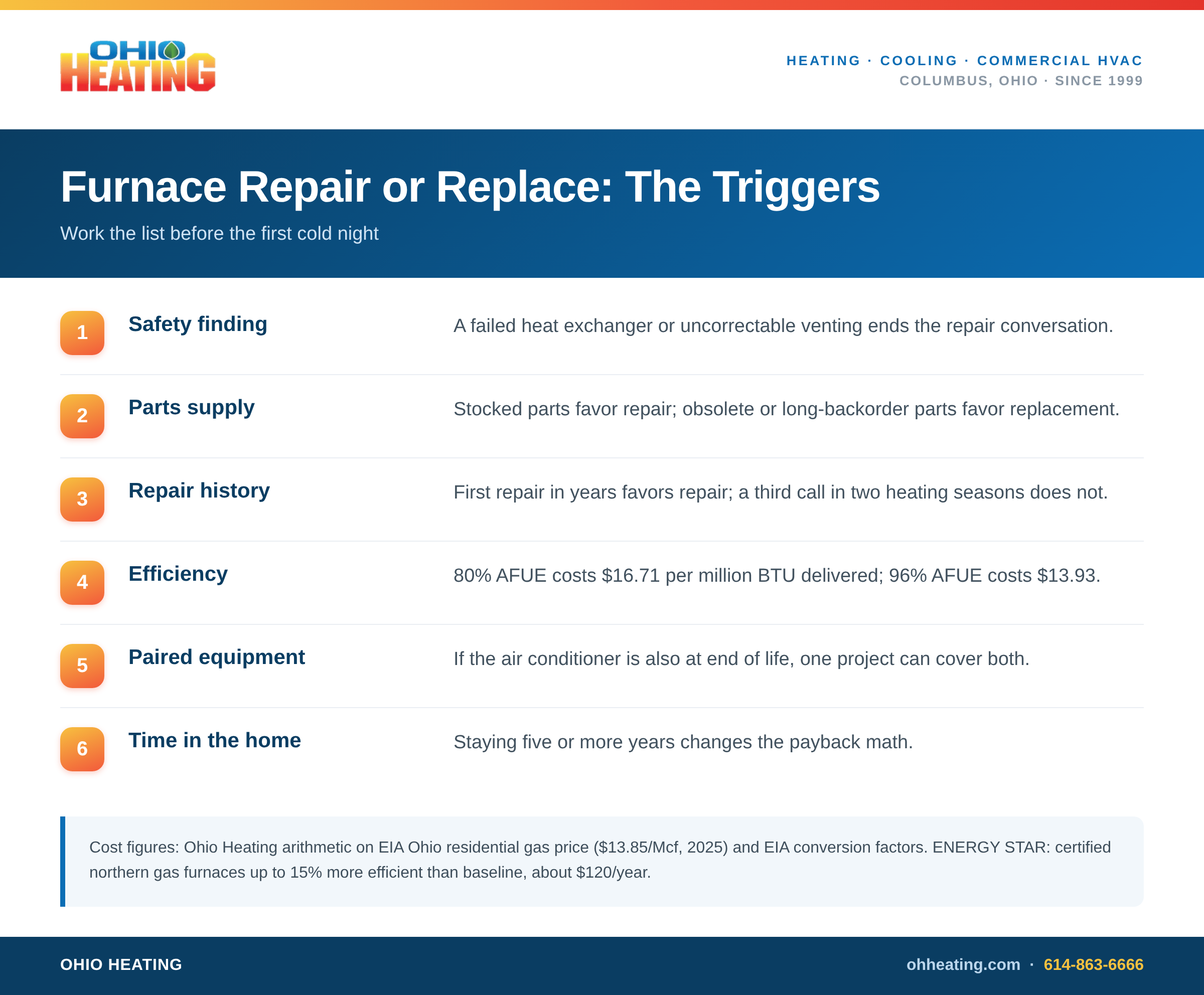
Nobody makes a good call about a furnace at 6 a.m. in January, standing in a cold kitchen while somebody quotes you a number. August is when this decision is easy. The furnace repair or replace Ohio homeowners agonize over in the middle of winter is mostly a matter of working through a short list of triggers, and you can do that right now, with the heat off and nothing on fire.
Most of the time, repair is the right answer. People assume otherwise because the internet is full of replacement pitches. Replacement earns its keep in three situations: a safety finding, parts you cannot get anymore, and efficiency math that has quietly moved. That last one is worth a second look. Ohio’s residential natural gas price averaged $13.85 per thousand cubic feet in 2025, up from $9.53 in 2020, per the U.S. Energy Information Administration. What you burn matters more now than it did the last time you thought about this.
What Furnace Repair Technicians Look at First
Every fall, from Columbus out to northeast Ohio, homeowners ask some version of the same question: is this thing worth fixing? A good technician will not answer it until after the diagnosis, and that order is not a stalling tactic. Price the job before you know what is actually wrong and you are guessing with somebody else’s money.
A real diagnosis looks at the whole HVAC system, not just the part that quit. Heating, cooling, and airflow all run through the same ductwork, so repair costs for any type of failure read differently once the tech knows whether that ductwork is choking the blower. Furnace repairs on a system that cannot breathe tend to come back: fix the part, and you are looking at the same failure, or one just like it, a season or two later.
Furnace replacement only belongs in the conversation once repairs stop addressing the actual cause. That is a judgment call rather than a formula, which is exactly why it should show up in writing, with the readings that led to it attached.
Start With Safety, Not Age
Before you weigh anything else, there are two findings that settle the question by themselves.
The first is a failed heat exchanger. A cracked or burned-through exchanger can put combustion products into the same air your blower pushes through the house. That is a replacement conversation, not something to patch and hope about.
The second is a venting problem that cannot be corrected. Draft and combustion testing exist precisely to catch this. If the venting cannot be brought back into compliance, no repair on the furnace itself changes the answer. Ohio’s residential requirements, including alarms and appliance provisions, are codified in the Residential Code of Ohio.
If a technician clears you on both, then you have a real choice to make. That is where the table below comes in, and where pricing a repair against replacement finally makes sense.
The Furnace Repair or Replace- Ohio Decision Table
| Trigger | Points toward repair | Points toward replacement |
|---|---|---|
| Safety finding | No cracks, draft tests clean | Failed heat exchanger or uncorrectable venting |
| Parts availability | Parts stocked locally | Parts obsolete or on long backorder |
| Repair scope | Igniter, flame sensor, capacitor, pressure switch, control board | Blower and control board and heat exchanger in one visit |
| Repair frequency | First repair in years | Third service call in two heating seasons |
| Efficiency | 90% AFUE or higher | 80% AFUE or unknown, with rising gas bills |
| Comfort | Even temperatures once airflow is fixed | Rooms that were not right from day one, even after duct work |
| Air conditioner age | AC is newer and healthy | AC is at end of life too, so one project covers both |
| Plans for the house | Selling within a year | Staying five or more years |
The efficiency row is where the money sits. ENERGY STAR reports certified gas furnaces in the northern U.S. are up to 15 percent more efficient than baseline models, saving about $120 a year in energy costs. Certified oil furnaces run up to 4 percent more efficient, worth roughly $70 a year (ENERGY STAR).
How to Read the Table
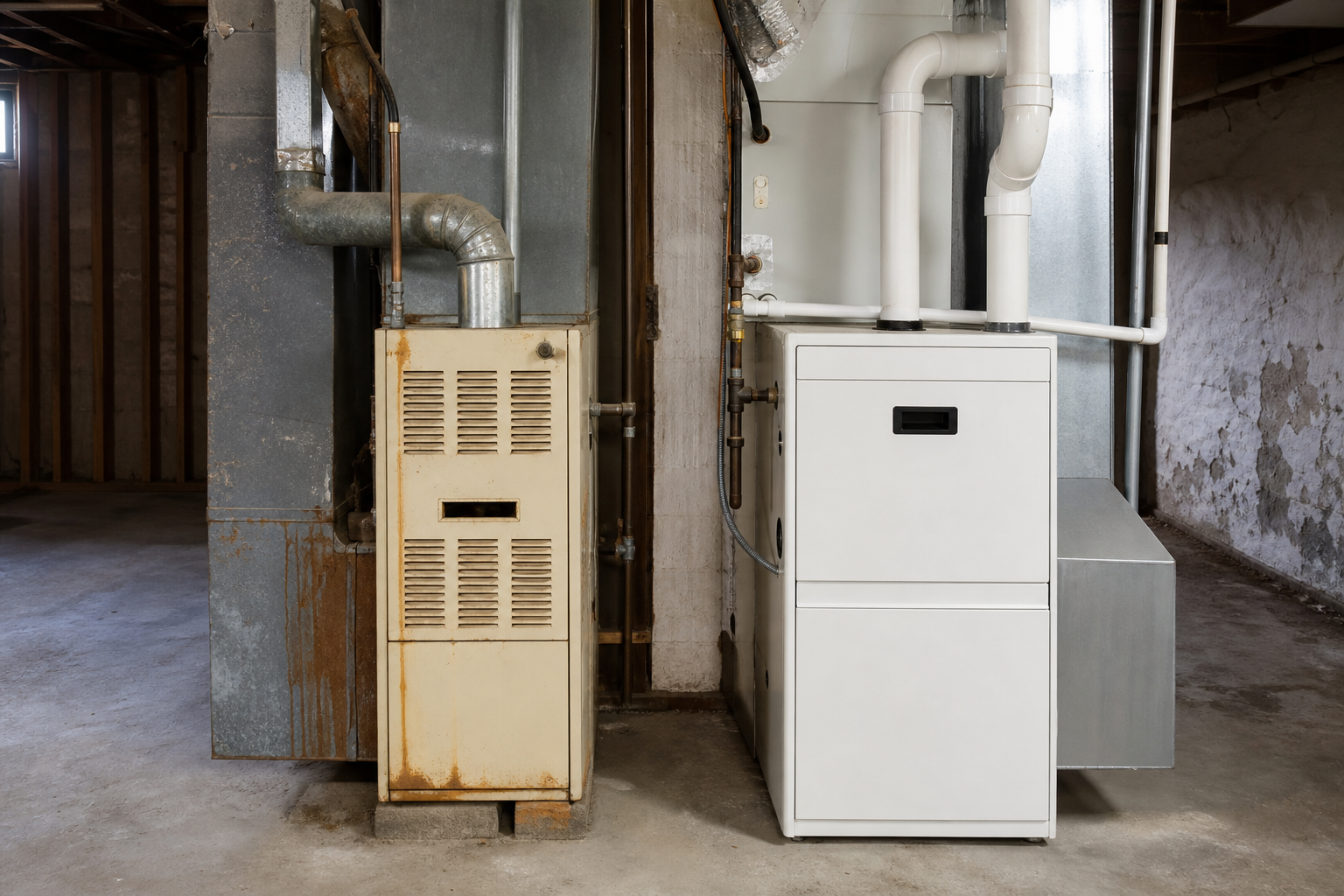
Tally up which way the rows lean. Anything in the safety row settles it on its own. Short of that, once you are stacking up three or more replacement triggers, the repair is usually just buying you time.
Then put three questions to the technician while they are still standing there. What failed, and why did it fail? A capacitor giving out in year 14 is just wear. A blower motor that has died twice in two years is telling you about something else, and that something else is usually airflow. Is this a part that will be back? Components have service lives, and a tech who works on your model every week can tell you where yours sits on that curve. And what did the diagnosis turn up everywhere else? Ductwork, how the filter actually fits, whether the return is sized right – all of that belongs in the answer, not just the part that quit.
The Efficiency Math, In Plain Units
Here is the arithmetic that turns AFUE into dollars per unit of heat. Using the EIA Ohio gas price above and EIA’s energy conversion calculators, where one cubic foot of natural gas averages 1,036 BTU, gas fuel costs about $13.37 per million BTU before efficiency.
| Furnace rating | Cost per million BTU delivered |
|---|---|
| 80% AFUE | $16.71 |
| 92% AFUE | $14.53 |
| 96% AFUE | $13.93 |
Those figures are our arithmetic on the linked EIA data, not a quote. Local utility charges, weather, and how a home actually uses heat move the real number. Even so, the ranking is clear. Moving from 80% to 96% cuts about 17 percent off fuel cost per unit of heat delivered.
A caution on downsizing the question to price alone. Efficiency gains disappear when equipment is oversized or the duct cannot carry the air. Sizing follows the ACCA technical manuals: Manual J for the load, Manual S for equipment, Manual D for the duct. Ventilation minimums follow ASHRAE 62.2 for homes (ASHRAE).
What to Have Ready When You Call
Have the make, model, and serial number. They are on the rating plate inside the cabinet door. Have the age of the air conditioner too, since pairing matters. Note the symptom pattern: time of day, outdoor temperature, and which rooms suffer.
Also note the filter size and the last change date. The EPA advises replacing filters on the manufacturer’s schedule to keep them working (EPA). A restricted filter mimics several expensive failures, and ruling it out is free.
FAQ
How long does a gas furnace last? Service life depends on maintenance, run hours, and installation quality. Follow the manufacturer’s maintenance schedule; Bryant, for example, hosts model documents in its homeowner resources.
Is it worth repairing a 20-year-old furnace? Sometimes. A stocked part, a clean heat exchanger, and a first-time repair argue for the fix. Obsolete parts, repeat calls, or a safety finding argue for replacement.
Should I replace the furnace and air conditioner together? Consider it when both are near end of life, or when you are moving to a heat pump or dual-fuel setup, because the indoor and outdoor equipment have to match.
Will a new furnace lower my gas bill? It lowers fuel used per unit of heat delivered. Going from 80% to 96% AFUE cuts about 17 percent, using the EIA prices and conversion factors linked above.
What is AFUE? Annual Fuel Utilization Efficiency. It is the share of fuel energy the furnace turns into usable heat over a season. ENERGY STAR certification levels are listed on its furnaces page.
Does a cracked heat exchanger have to be replaced? A cracked heat exchanger is a safety finding. Options are heat exchanger replacement, where parts exist and economics allow, or replacing the furnace.
Work the table before the first cold night, not during it. A clear decision protects your family from a mid-winter breakdown and helps you save on fuel every month the system runs. To get a diagnosis and a written recommendation, contact Ohio Heating to schedule a visit.