
Rooftop Unit Maintenance Schedule Columbus Facility Managers Can Hand to a Vendor
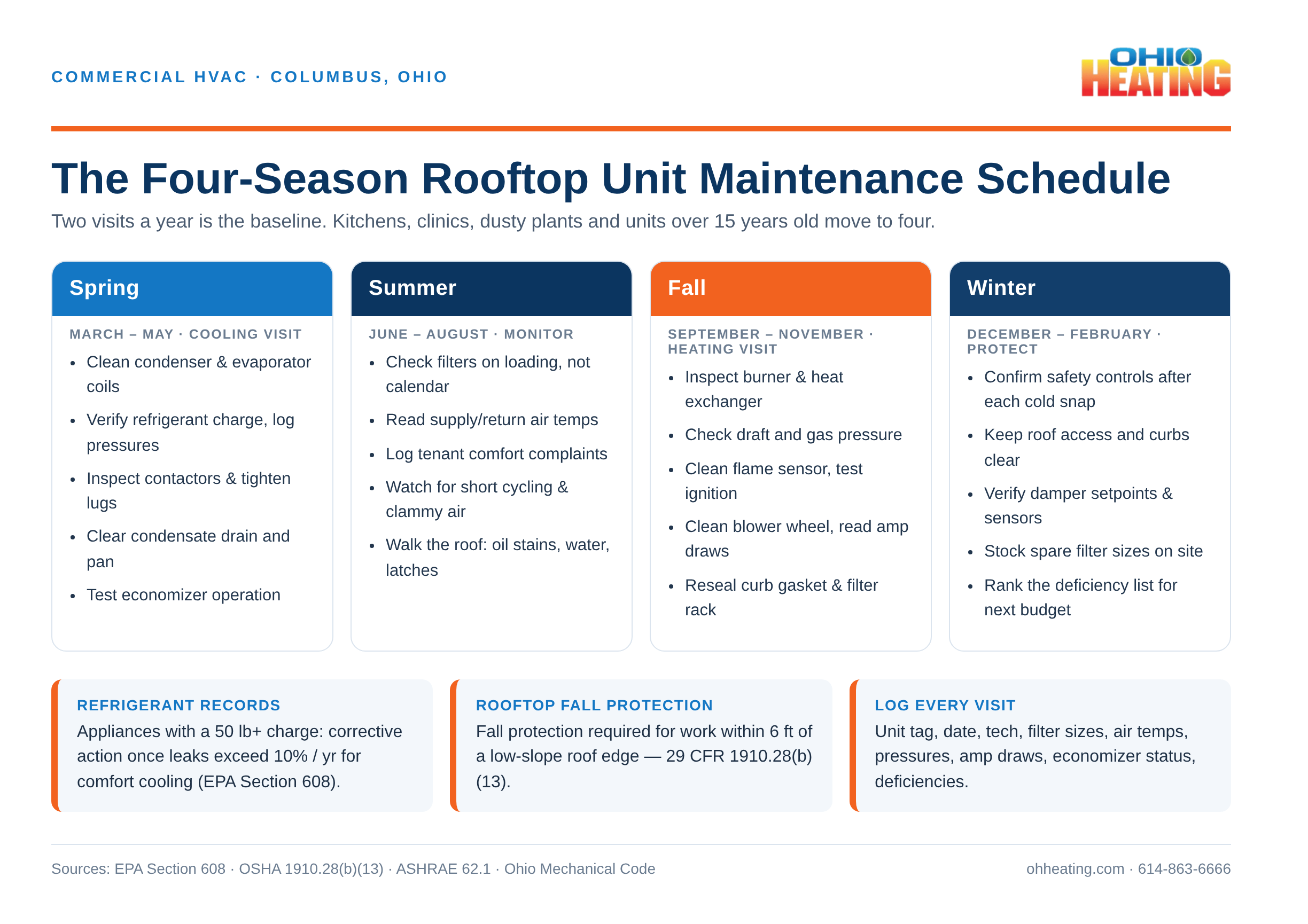
When a rooftop unit quits in the middle of July, the cause is rarely a surprise part failure. Usually it traces back to maintenance nobody scheduled, assigned, or wrote down. The fix is a rooftop unit maintenance schedule Columbus facility managers can hand straight to a vendor. It says how often each unit gets serviced, what the technician does on every visit, and what gets recorded before anyone leaves the roof.
Columbus area properties need a rooftop package unit to do two jobs well: heat hard in winter and dry the air in summer. NOAA’s 1991–2020 climate normals for John Glenn Columbus International Airport show 5,233 heating degree days and 1,068 cooling degree days a year, with a 28.2-inch annual snowfall normal. That is a full heating season and a humid cooling season.
Rooftop Unit Maintenance Schedule Basics in Columbus
Start with plain terms. An HVAC rooftop unit, or RTU, is a packaged system. Heating, cooling, and the blower all sit in one cabinet on the roof curb. Commercial HVAC service for these units is mostly access and airflow. The work is simple, keeping it on a plan is the hard part.
A preventive maintenance plan has three parts. The first is a visit count. The second is a maintenance checklist per visit. The third is a log.
Most commercial RTUs should be professionally serviced at least twice a year. Add visits when the space is dirty, busy, or humid. Older HVAC units require extra visits too. RTU maintenance done twice a year on a clean office is enough, the same schedule on a restaurant roof is not.
How Many Visits per Year
Two visits is the common baseline: one before cooling season, one before heating season. Buildings with kitchen exhaust, high occupancy, dust, or process loads move to quarterly.
| Building type | Visits per year | Driver |
|---|---|---|
| Office, low occupancy | 2 | Seasonal changeover |
| Retail with heavy door traffic | 2 to 4 | Filter loading, economizer wear |
| Restaurant or food service | 4 | Grease, makeup air, kitchen exhaust |
| Medical or dental | 4 | Ventilation and filtration requirements |
| Light manufacturing or warehouse | 4 | Dust and process heat |
| Any unit over 15 years old | 4 | Component wear and refrigerant risk |
HVAC maintenance practice for commercial systems is codified in the ASHRAE/ACCA standards library; ASHRAE publishes its standards catalog and addenda here, and ACCA hosts the companion technical manuals that cover load, equipment selection, and duct design.
The Rooftop Unit Maintenance Schedule, Task by Task
| Interval | Task focus |
|---|---|
| Monthly, in-house | Look and listen. Oil stains, latches, noise, water on the curb |
| Monthly to quarterly | Air filters. Change on loading, not on the calendar |
| Spring visit | Cooling side. Coil cleaning, charge check, contactors, drain pan, economizer test |
| Fall visit | Heating side. Burner, heat exchanger, draft, gas pressure, flame sensor, blower wheel |
| Both visits | Electrical and controls. Amp draw, tight lugs, thermostat, curb gasket, filter rack |
| Annually | Documentation. Economizer function, damper setpoints, sensor checks, leak records |
Ventilation minimums for commercial buildings come from ASHRAE Standard 62.1 (ASHRAE). Kitchen exhaust systems follow NFPA 96 (NFPA). Ohio’s mechanical requirements sit in the Ohio Mechanical Code.
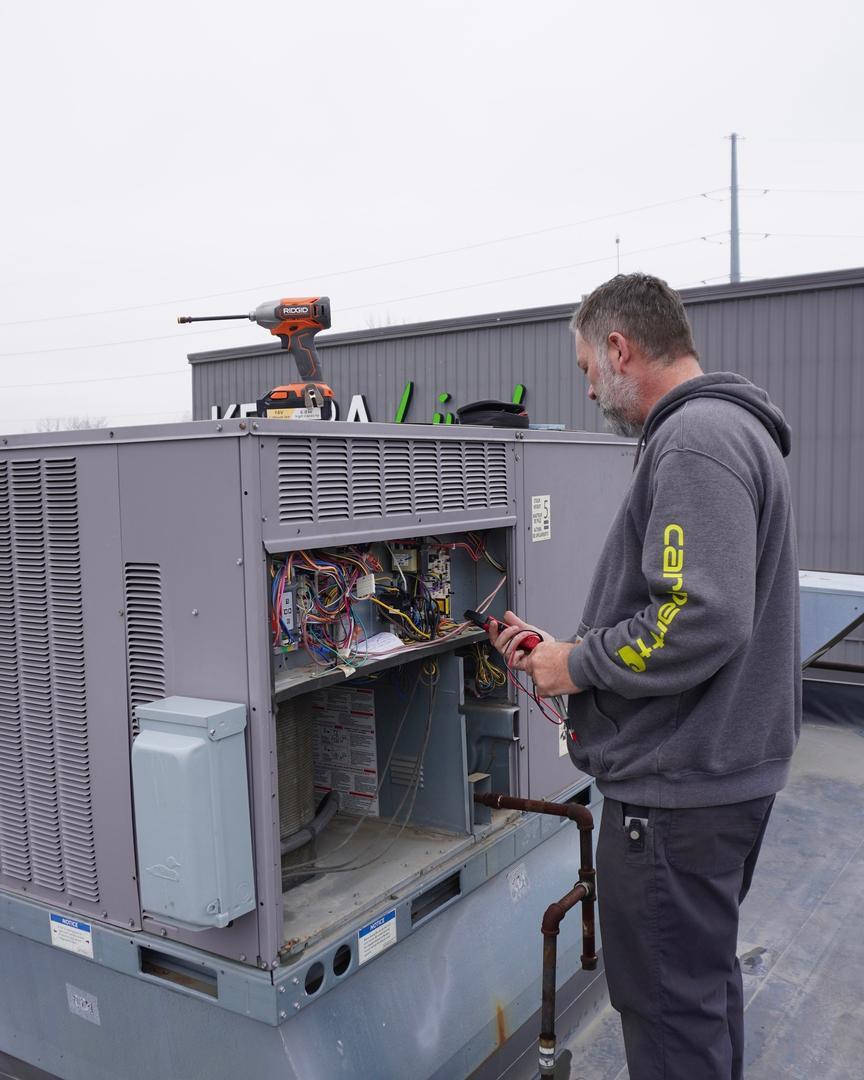
Budget and Downtime Notes
A plan also protects the budget. Planned visits happen on a weekday morning. Failures happen on the hottest Friday of the year. That difference shows up in overtime, rental equipment, and lost sales.
Ask the vendor for a deficiency list with each visit and rank items by risk. Fix the safety items first and schedule the rest against the next budget cycle. Tightening electrical connections is cheap. Replacing a burned compressor is not.
Keep spare filters on site as well. Sizes vary by unit, and a missing filter size turns a 20-minute stop into a second trip.
Two Compliance Items That Belong in the Schedule
Refrigerant leaks. Under EPA’s Section 608 rules, owners or operators must take corrective action when an appliance with a full charge of 50 or more pounds is found leaking above the trigger rate. The trigger is 10 percent per 12 months for comfort cooling, 20 percent for commercial refrigeration, and 30 percent for industrial process refrigeration (EPA). Charge records from each visit are what prove the rate.
Rooftop fall protection. OSHA’s rule at 29 CFR 1910.28(b)(13) requires guardrails, safety nets, travel restraint, or personal fall arrest for work performed less than 6 feet from a low-slope roof edge. Between 6 and 15 feet, the same systems apply, with a designated area allowed for work that is both infrequent and temporary. At 15 feet or more, employers must protect workers or enforce a work rule keeping them back from the edge (OSHA). Ask any vendor how they comply. Ask before they go up.
Comfort Complaints Are Part of the Schedule Too
Tenant complaints are data. Do not treat them as noise. Log them next to the unit tag and the date.
OSHA’s guidance on office temperature recommends a range of 68 to 76°F and 20 to 60 percent relative humidity (OSHA interpretation). Compare complaints against that range before anyone talks about new equipment. Cool-but-clammy usually points at short cycling or an oversized unit, not a lack of capacity.
What to Log on Every Rooftop Unit Visit
A maintenance schedule without records is a handshake. Records settle vendor disputes, shorten the next diagnosis, and support parts claims. Each visit should leave behind:
- Unit tag and roof location.
- Date and technician name.
- Filter sizes and count installed.
- Supply and return air temperatures.
- Refrigerant pressures and any charge added.
- Motor amp draws.
- Economizer status.
- Safety control test results.
- Deficiencies, with a recommended action.
Keep the log per unit, not per building, one page per curb. Roof numbering saves an hour on every future call. Paint or tag the curb, then use the same tag in the log, the drawings, and the work order.
FAQ
How often should a commercial rooftop unit be serviced? Twice a year at minimum, split into a spring cooling visit and a fall heating visit. Restaurants, medical suites, and dusty industrial spaces are typically quarterly.
What is included in rooftop unit maintenance? Coil cleaning, filter changes, refrigerant charge verification, electrical inspection and amp readings, condensate drain cleaning, economizer testing, burner and heat exchanger inspection, and safety control checks.
How often should filters be changed on a rooftop unit? On loading, not on the calendar. Monthly checks tell you the interval for that unit and that space.
Are refrigerant leak records required? For appliances with a 50-pound or larger charge, EPA leak repair requirements apply once the leak rate exceeds the trigger for the appliance type (EPA).
Who is responsible for fall protection during rooftop service? The employer of the workers on the roof, under 29 CFR 1910.28. Facility managers should confirm the vendor’s plan before work starts.
What temperature should an office be kept at? OSHA recommends 68 to 76°F with 20 to 60 percent relative humidity in office settings (OSHA).
Heating season fills up every commercial service calendar in the city, so this is the month to get the plan on paper. Decide the visit count, the task list, and the log format now, while a vendor still has room to work with you. A rooftop unit maintenance schedule Columbus buildings actually follow keeps tenants comfortable, keeps your compliance paperwork in order, and costs a fraction of the emergency calls it heads off. Ohio Heating’s HVAC preventative maintenance plan covers commercial rooftop equipment throughout Columbus. Call 614-863-6666 and we will walk your roof with you.