
HVAC Economizer Checks Every Columbus Facility Manager Should Run This Fall
An HVAC economizer gives you cooling at the cost of running a fan. It’s also the part of a rooftop unit most likely to be broken without anyone noticing. September and October are when the economizer mode is the most valuable in Columbus. Outside air sits in the 50s and 60s, while your servers, lights, and people still put heat into the space.
Nothing on your dashboard turns red when a damper sticks. The building stays comfortable, the compressors just run more. But the bill will show the extra cost from the economizer not functioning properly.
What an HVAC Economizer Does, and How Economizer Mode Should Behave
The economizer is a set of motorized dampers and a controller. Together they decide how much outside air to pull in. When outdoor air is cool and dry enough to carry part of the load, the dampers open past the minimum ventilation position. The unit then cools the building with fresh air instead of using the compressor. That cuts energy use on a mild day. When conditions outside are too warm, the dampers return to minimum and the mechanical cooling system takes over.
So the economizer cuts compressor runtime. It doesn’t replace the cooling system. Your HVAC system still needs its refrigeration circuit for July.
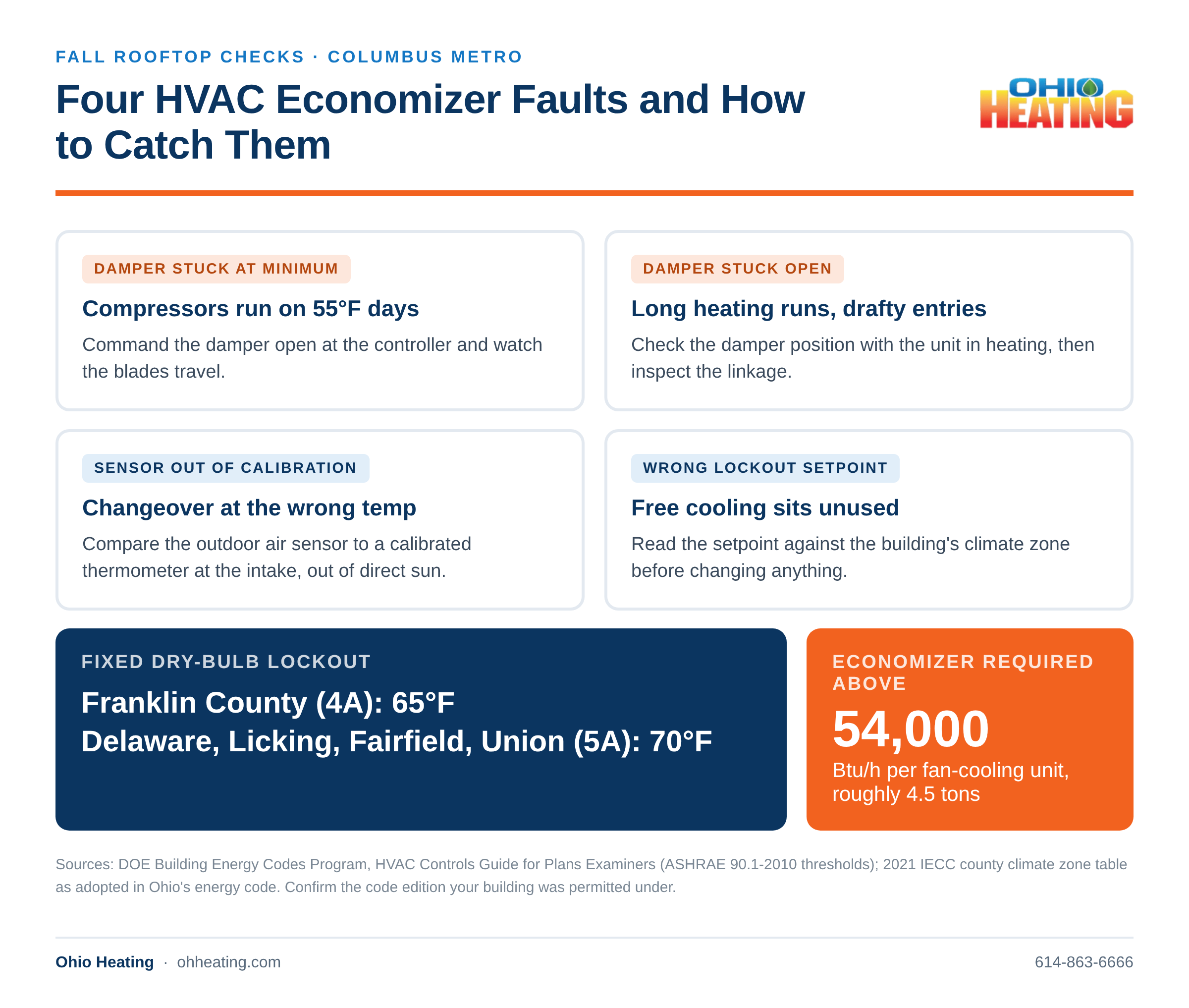
That behavior is a code requirement on most equipment, not an upgrade. The Department of Energy’s Building Energy Codes guide for plans examiners lists the thresholds. ASHRAE 90.1-2010 requires economizers on fan-cooling units above 54,000 Btu/h in all climate zones except 1A and 1B. The control has to modulate from minimum ventilation up to 100 percent outdoor air (DOE Building Energy Codes Program). That threshold is roughly 4.5 tons. It covers most single-zone rooftop units on a Columbus retail, office, or light industrial building.
The Zone Line That Runs Through the Columbus Metro
The high-limit setpoint is the outside air temperature at which the economizer locks out. With fixed dry-bulb control, that setpoint number varies by climate zone. The same DOE guide puts the shutoff at 70°F in zones 5A, 6A, and 7A, while most other zones use 65°F, including 4A.
The zone line runs right through the metro area. The 2021 IECC county table used in Ohio’s energy code places Franklin County in climate zone 4A, while Delaware, Licking, Fairfield, and Union counties are placed in 5A (Ohio Energy Code 2021, Table R301.1). If you manage a portfolio across the metro area, two buildings only 15 miles apart can have different lockout setpoints. Check which code edition your permit was issued under before you change anything, because the thresholds moved between editions.
Faults You’ll Find, and What They Cost
Field studies have been finding broken HVAC economizers for years. Pacific Northwest National Laboratory reported that a significant fraction of economizer controls on rooftop units do not work as intended, which is part of why California mandated automated fault detection on new units sold there after July 2014 (PNNL-23790).
The upside of fixing them is significant. In a PNNL field test, 66 rooftop units across eight buildings were retrofitted with an advanced controller that included enhanced air-side economizer control, multi-speed fan control, and demand controlled ventilation. Normalized annual RTU energy use dropped between 22 and 90 percent, averaging 57 percent across all units (PNNL-22656). Those savings come from controls being put in place, not from new equipment being purchased.
| Fault | What you’d notice | Field check | Typical fix |
|---|---|---|---|
| Damper stuck at minimum | Compressors run on 55°F days. | Command the damper open at the controller and watch the blade. | Free or replace the actuator. |
| Damper stuck open | Heating runs long on cold mornings, entry doors feel drafty. | Check damper position with the unit in heating. | Replace the actuator, verify the linkage. |
| Outdoor air sensor out of calibration | Economizer changes over at the wrong temperature. | Compare sensor reading to a calibrated thermometer at the intake. | Recalibrate or replace the sensor. |
| Wrong changeover setpoint | Free cooling is available and unused. | Read the setpoint against your county’s climate zone. | Reset to the code value for that zone. |
| Linkage disconnected | Controller says open, dampers stay shut. | Watch the blades while the actuator strokes. | Reconnect and adjust the linkage. |
| Blocked or seized intake hood | Reduced outdoor air, nuisance faults. | Visual inspection at the hood and screen. | Clear debris and replace damaged screens. |

A Fall Inspection Routine That Takes Under an Hour Per Unit
Start at the roof with the unit running. Command the economizer to fully open from the control system and confirm the blades actually move. A controller reporting a position it can’t deliver is the most common finding. The actuator fails, and the software keeps reporting the commanded position.
Next, check the outdoor air sensor against a calibrated thermometer held at the intake, out of direct sun. A sensor reading five degrees high in a 4A building keeps the compressors online all through a mild October. That single fault can add more energy consumption than any other item on this list.
Then read the changeover setpoint and the minimum damper position. Write both down for each unit. Good records make next year’s inspection quick. They also tell you if someone changed a setpoint during a service call.
Finish with the mixed air temperature while the unit runs in economizer mode. Say outside air is 55°F and mixed air barely moves off return temperature. The dampers aren’t delivering what the controller thinks they are. Our rooftop installation and repair team runs this sequence during commercial maintenance visits. The building automation controls we support can trend damper position and mixed air. A stuck damper then shows up as data instead of a surprise down the line.
When Economizer Problems Are Really Airflow Problems
An economizer can only move the air your HVAC system is capable of moving. If the return path is undersized or the relief is blocked, opening the dampers pressurizes the building instead of cooling it. Doors get hard to open, and customers begin to complain.
Testing airflow can settle the question. A measured building air balance tells you what the supply, return, and relief paths are actually doing.
Frequently Asked Questions
What does an HVAC economizer do? An economizer in HVAC equipment introduces outdoor air for cooling when it’s mild out. The compressors run less, and the unit reduces energy use.
How do I know if my economizer is broken? Watch the dampers move while you command them from the controller. Compare mixed air temperature to outside air and return air on a mild day. If the blades don’t travel or mixed air doesn’t drop, it’s broken.
What outdoor temperature should the economizer lock out at? For fixed dry-bulb control, the DOE code guide lists 70°F for zones 5A, 6A, and 7A. Most other zones, 4A included, use 65°F. Check the edition your building was permitted under.
Which Columbus-area counties are in which climate zone? Under the 2021 IECC table adopted in Ohio’s energy code, Franklin County is 4A, and Delaware, Licking, Fairfield, and Union counties are 5A.
How often should HVAC economizers be inspected? Twice a year fits most buildings, once before the fall free-cooling season and once in spring. Units on kitchens, labs, or dusty processes need more frequent checks.
Is an economizer required on my rooftop unit? Under ASHRAE 90.1-2010, fan-cooling units above 54,000 Btu/h need one in every zone but 1A and 1B. The standard lists exceptions. Your permit drawings show what was required at install.
Book the Fall Economizer Check
A working economizer protects your compressors. It also saves fuel through each mild week between now and December. Call Ohio Heating at 614-863-6666 to schedule a commercial rooftop and economizer inspection.