
Furnace Tune-Up Checklist Columbus Homeowners Can Run Before the First Cold Snap
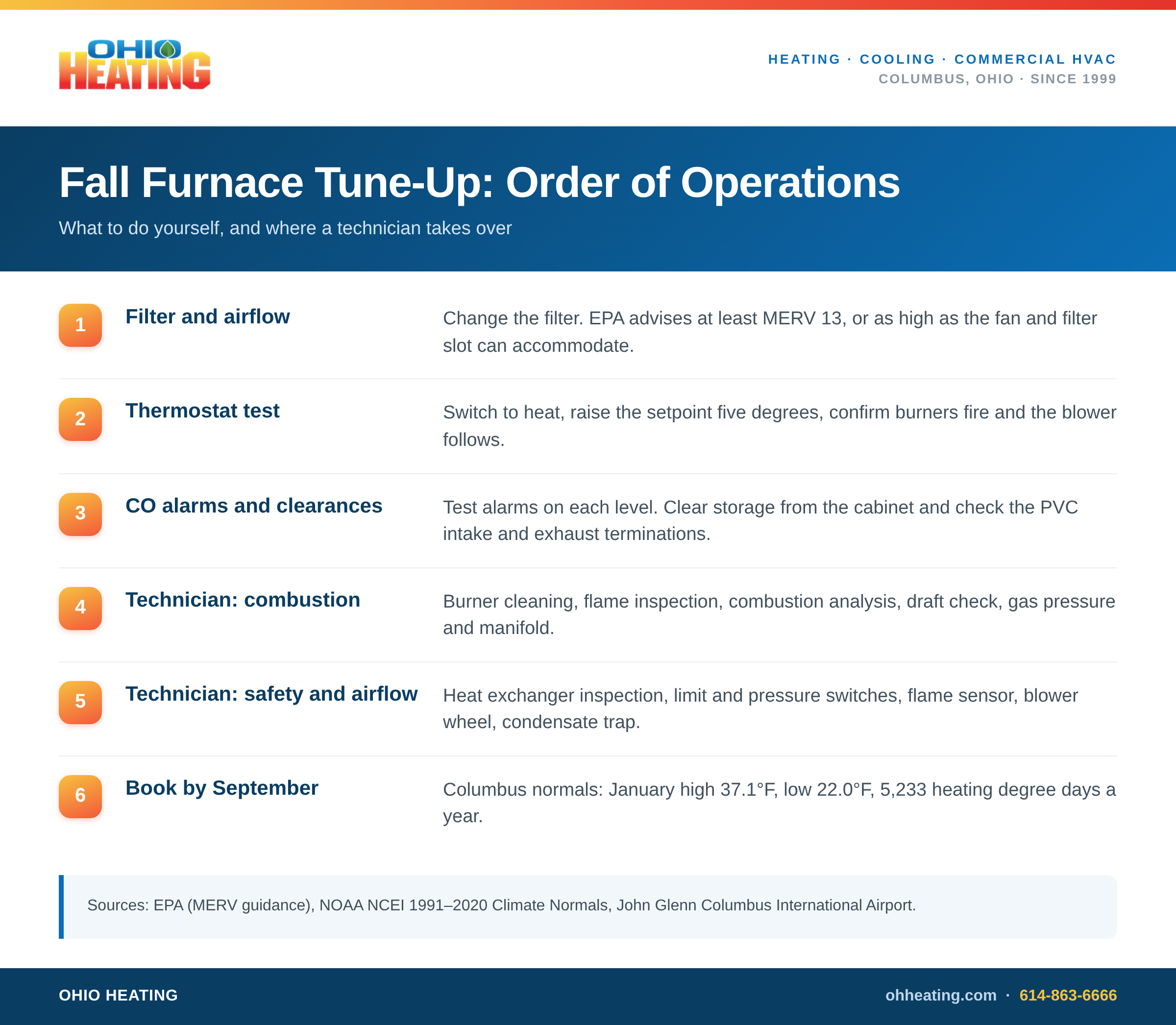
Central Ohio does not ease into heating season. Columbus, Ohio has a normal January high of 37.1°F and a normal low of 22.0°F. The city averages 5,233 heating degree days a year. Those figures come from the NOAA 1991–2020 U.S. Climate Normals for John Glenn Columbus International Airport. This is a heating climate. The first hard night tends to arrive before anyone has tested the heat. A furnace tune-up checklist central Ohio homes can use in late summer finds the bad igniter in daylight.
Split the work in two. There is a homeowner half, and there is a licensed-technician half. Both matter.
Two more notes before the checklist. First, write down the model and serial number of your furnace. That one step speeds up parts lookup later. Second, keep the annual furnace paperwork. A dated record of each visit helps a new tech read the history of the unit fast.
Ohio Heating works on both residential and commercial systems across Columbus and the surrounding suburbs. The residential fall list below applies to a standard forced-air gas furnace. Boilers and heat pumps follow different steps.
One more habit pays off in January. Learn where your furnace shutoff switch and gas valve are located. Show a second person in the house as well. A tech on the phone can walk you through a reset in a minute if you know what you are looking at.
The Homeowner Half of the Checklist
Five items need no tools.
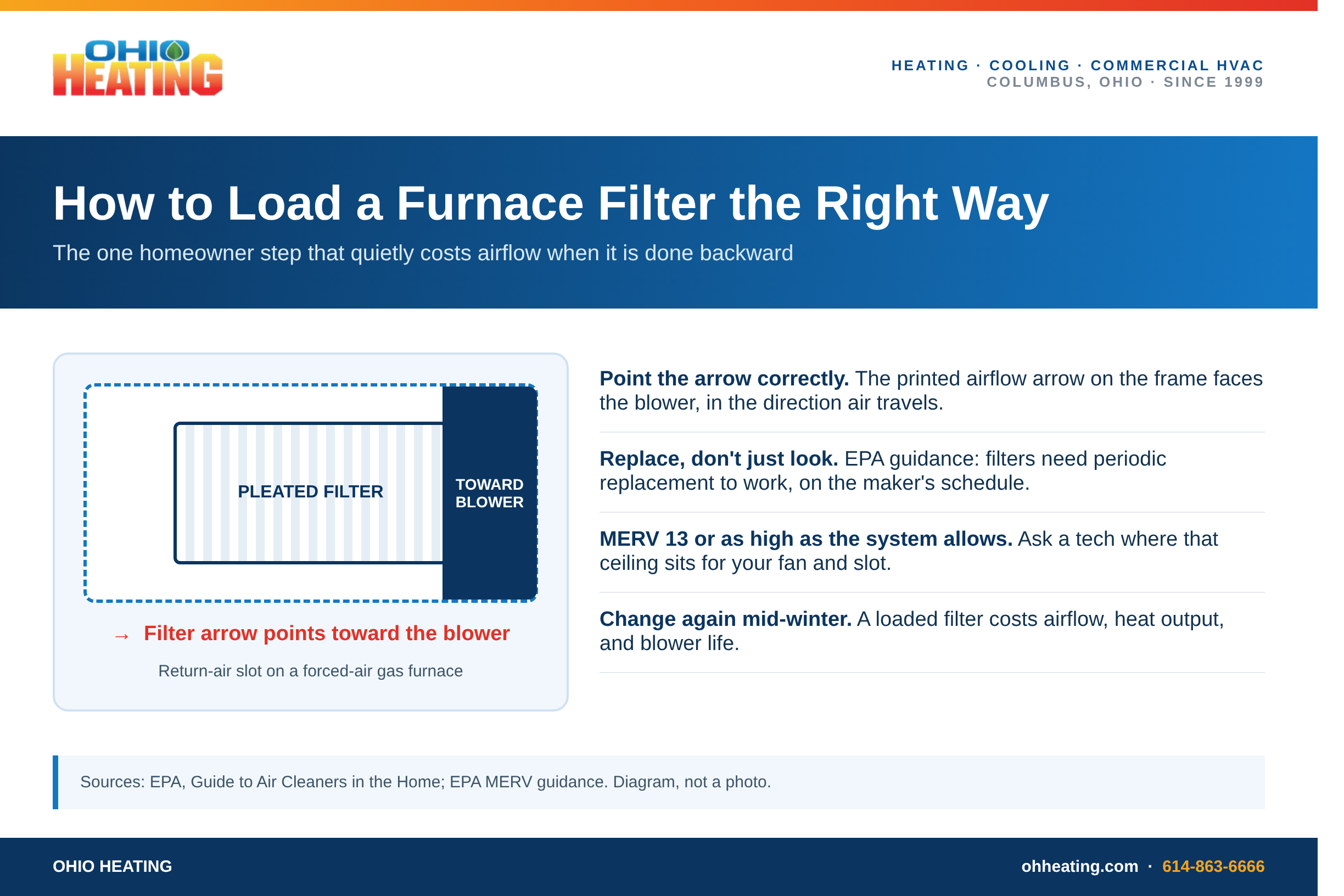
Change the air filter. The EPA’s Guide to Air Cleaners in the Home says filters need periodic replacement to work, and that you should follow the maker’s guidance. A loaded filter chokes airflow. That cuts heat output and strains the blower.
Clear the space around the furnace. Boxes against the cabinet block service access. They can also block combustion air.
Test the thermostat. Switch to heat. Raise the setpoint five degrees. Confirm the burners fire and the blower follows. Thermostat calibration issues show up here first.
Test the carbon monoxide alarms. A gas furnace is a combustion appliance, so alarms belong on each level. Ohio’s rules for homes sit in the Residential Code of Ohio. Placement and test steps follow the alarm maker’s instructions.
Check the flue and the intake. On a 90%-plus furnace, two PVC pipes end on an outside wall. Nests, mulch, and snow all block them.
What a Technician Checks on a Furnace Tune-Up
The pro visit is a combustion and safety inspection. It is not a filter swap. Each step below needs instruments.
| Checklist item | Why it is on the list | What a failure looks like |
|---|---|---|
| Heat exchanger inspection | A crack can spill combustion gas into supply air | Soot, flame roll-out, rust |
| Burner cleaning and flame check | Dirt distorts the flame and shifts combustion | Yellow or lifting flames |
| Combustion analysis and draft | Confirms the unit vents and burns to spec | High flue CO, weak draft |
| Gas pressure and manifold | Over-firing and under-firing cut equipment life | Short cycling, limit trips |
| Electrical connections and amps | Loose lugs and tired motors show up in readings | Scorched terminals |
| Blower assembly and wheel | Dirt on the wheel cuts airflow system-wide | Low temperature rise, noise |
| Limit, pressure switch, flame sensor | These parts shut the unit down safely | Nuisance lockouts |
| Condensate drain and trap | A blocked trap trips the pressure switch | Standing water, no ignition |
Service intervals are set by the maker of your equipment, not by a blog. Bryant, for example, posts owner guides and model documents in its homeowner resources library. Find the manual for your model and follow it.
The Airflow Half Nobody Books Until January
Many “the heat is not keeping up” calls in Columbus are airflow calls. Duct leaks, crushed flex, closed dampers, and small returns all read as a cold room. The ACCA technical manuals are the trade references here. Manual J sizes the load. Manual S picks the equipment. Manual D designs the duct. That is why a good tech measures temperature rise instead of guessing.
Fresh air counts too. ASHRAE Standards 62.1 and 62.2 set minimum ventilation rates for buildings and homes (ASHRAE). Sealing a house tight without ventilation trades one problem for another.
When the Visit Turns Into a Replacement Talk
Sometimes the honest answer is new equipment. A failed heat exchanger is one case, no parts supply is another.
Fuel cost is the second trigger. ENERGY STAR reports that certified gas furnaces in the northern U.S. run up to 15 percent more efficient than baseline models and save about $120 a year. Certified oil furnaces run up to 4 percent better, for about $70 a year (ENERGY STAR). Ohio’s residential gas price averaged $13.85 per thousand cubic feet in 2025. In 2020 it was $9.53 (U.S. EIA).
Booking Order for a Central Ohio Fall
| Timing | Task | Reason |
|---|---|---|
| Mid-August | Filter, thermostat test, CO alarm test | No scheduling needed |
| Late August to September | Book the pro visit | Open slots before the rush |
| First 40°F night | Run a full heat cycle | Confirms the work held |
| Mid-winter | Second filter change | A loaded filter costs airflow |

FAQ
How often does a gas furnace need service? Once a year, before heating season, and on the schedule in the maker’s manual. Manufacturers publish that schedule; Bryant, for one, hosts model guidance in its homeowner resources.
What is the difference between furnace maintenance and a tune-up? In practice they name the same annual visit. Furnace maintenance is the broad term. The tune-up is the cleaning, testing, and adjustment done during it.
Can I do this myself? You can do the filter, the thermostat test, the alarm test, and the vent check. Combustion analysis, gas pressure, and heat exchanger work need tools and training.
What MERV filter should I use? The EPA suggests at least MERV 13, or as high as your fan and filter slot can handle. It also suggests asking an HVAC tech where that ceiling sits (EPA).
Why is carbon monoxide testing part of the job? Because the furnace burns fuel. Draft and combustion tests confirm flue gas leaves the house. Alarms are the backstop.
When should I book in Columbus? Late August through September. NOAA puts the Columbus January normal low at 22.0°F, and calls climb with the first cold nights (NOAA).