
Heat Pump vs Gas Furnace Columbus: Which One Actually Costs Less to Run
The heat pump vs. gas furnace Columbus debate usually gets settled with opinions. It can be settled with arithmetic instead. Both machines deliver heat. Heat is measured in BTU, so price the BTU.
Two inputs drive the answer here. Ohio’s residential gas price averaged $13.85 per thousand cubic feet in 2025, according to the U.S. Energy Information Administration. Ohio’s average residential electricity price was 18.40 cents per kilowatt-hour year-to-date through May 2026, per EIA’s Electric Power Monthly, Table 5.6.B. A year earlier that figure was 16.10 cents.
How the Comparison Is Built
Fuel is sold in different units, so both sides get converted to the same one: one million BTU of heat delivered into the house.
EIA’s energy conversion calculators give the two factors. One kilowatt-hour equals 3,412 BTU. One cubic foot of natural gas averages 1,036 BTU for gas delivered to U.S. consumers in 2026. So one thousand cubic feet holds about 1.036 million BTU, and one million BTU takes about 293 kilowatt-hours of electricity.
Then apply efficiency. A gas furnace is rated in AFUE, so divide fuel cost by that rating. A heat pump moves heat rather than burning it, so divide by its coefficient of performance. HSPF2 divided by 3.412 gives a seasonal COP.
Heat Pump vs Gas Furnace: The Cost of Delivered Heat in Columbus
The table below is our arithmetic on the EIA prices and conversion factors linked above. It is not a quote, and it excludes equipment cost, maintenance, and utility fees.
| System and efficiency | Cost per million BTU delivered |
|---|---|
| Gas furnace, 80% AFUE | $16.71 |
| Gas furnace, 92% AFUE | $14.53 |
| Gas furnace, 96% AFUE | $13.93 |
| Heat pump, seasonal COP 2.29 (7.8 HSPF2) | $23.59 |
| Heat pump, seasonal COP 2.37 (8.1 HSPF2) | $22.72 |
| Heat pump, steady COP 3.0 (mild weather) | $17.98 |
| Heat pump, COP 1.75 (ENERGY STAR floor at 5°F) | $30.82 |
| Electric resistance backup, COP 1.0 | $53.93 |
The HSPF2 and COP figures above are the ENERGY STAR criteria for air-source equipment. Certified split systems must hit 7.8 HSPF2, 15.2 SEER2, and 11.0 EER2. Cold-climate ducted split systems must hit 8.1 HSPF2. Cold-climate models also have to show a COP of at least 1.75 at 5°F, and at least 70 percent of their 47°F heating capacity at 5°F (ENERGY STAR heat pump criteria).
What That Means for a Columbus Winter
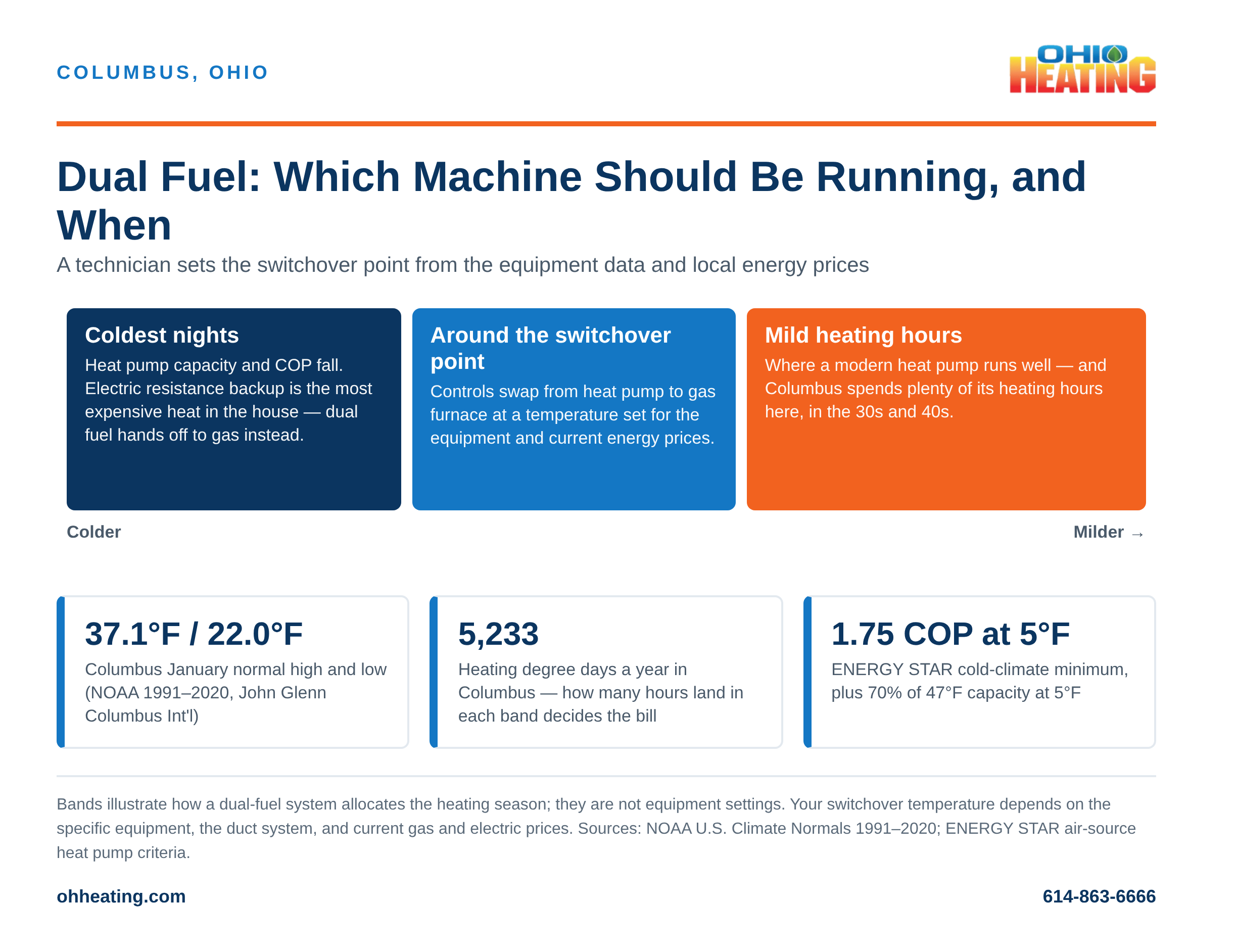
At current Ohio prices, gas heat is cheaper per BTU than a heat pump for most of the heating season. The gap narrows in mild weather and widens on the coldest nights, because a heat pump’s COP falls as outdoor temperature drops.
Columbus weather decides how many hours land in each bucket. That is the whole ballgame. NOAA’s 1991–2020 climate normals for John Glenn Columbus International Airport put the January normal high at 37.1°F and the normal low at 22.0°F, with 5,233 heating degree days a year. Plenty of central Ohio heating hours sit in the 30s and 40s, where a modern heat pump runs well. The coldest stretch is where an electric-only system leans on resistance backup, and that backup is the most expensive row in the table.
Where the Heat Pump Still Wins
Operating cost per BTU is one factor, not the decision.
| Situation | Better fit | Why |
|---|---|---|
| Home already has a gas line and ductwork | Gas furnace, or a dual-fuel pair | Lowest cost per BTU at current Ohio prices |
| No gas service at the property | Heat pump | Beats electric resistance heat on cost per BTU |
| Currently heating with electric baseboard | Heat pump | Baseboard runs at COP 1.0 |
| Air conditioning also needs replacing | Heat pump | One outdoor unit covers heating and cooling |
| Frequent single-digit nights and low tolerance for risk | Dual fuel | Heat pump in mild weather, gas below the switchover point |
| Room additions or zones with no duct | Ductless heat pump | Non-ducted cold-climate units are rated at 8.5 HSPF2 |
Two habits help before any of this. Get a utility bill history for the house – twelve months of gas and electric use tells a tech more than a square-footage rule of thumb. Then ask what the switchover plan is. A quote with no answer on backup heat is an incomplete quote.
Dual fuel deserves the attention it gets in Ohio. The heat pump handles mild hours, the gas furnace takes over below a switchover temperature that a technician sets from the equipment data and local energy prices.
Getting the Sizing Right Either Way
Equipment choice fails if sizing fails. Load calculations, equipment selection, and duct design follow the ACCA technical manuals: Manual J, Manual S, and Manual D. Ventilation minimums come from ASHRAE Standards 62.1 and 62.2 (ASHRAE).
Also check the duct system before choosing either machine. A heat pump delivers warm air at a lower supply temperature than a furnace, so it needs the airflow it was designed for. Leaky or undersized duct shows up faster on a heat pump than on an 80% furnace.
FAQ
Is a heat pump cheaper to run than a gas furnace in Columbus? At the Ohio energy prices linked above, no. A 92% AFUE gas furnace works out to about $14.53 per million BTU, while a heat pump at a 2.29 seasonal COP works out to about $23.59.
Do heat pumps work in Ohio winters? Yes. Cold-climate certified units must show a COP of 1.75 or better at 5°F and hold at least 70 percent of their 47°F capacity at that temperature (ENERGY STAR).
What is dual fuel? A heat pump paired with a gas furnace. Controls run the heat pump in mild weather and switch to gas when the outdoor temperature drops below the switchover setting.
Why did my electric bill jump after switching to a heat pump? Often the backup heat is running more than expected. Electric resistance backup costs about $53.93 per million BTU at 18.40 cents per kilowatt-hour, based on the EIA price above.
Does a heat pump replace my air conditioner too? Yes. An air-source heat pump is a reversible system, so it cools in summer and heats in winter.
Which is quieter or more comfortable? A heat pump runs longer cycles at a lower supply air temperature, which many people find steadier. A furnace delivers hotter air in shorter bursts.
Price the BTU before choosing the box. Then check the duct, the gas service, and the load calculation. A right-sized system will protect your comfort on the coldest nights and save money each month it runs. To compare a heat pump and a gas furnace for your Columbus home, contact Ohio Heating to schedule an assessment.