
How to Upgrade Your HVAC and Save Money
Why Energy Efficient HVAC Is Worth Your Attention Right Now
Energy efficient HVAC refers to heating, ventilation, and air conditioning systems that deliver the same comfort using less energy — lowering your utility bills without sacrificing indoor air quality or temperature control.
Here’s a quick summary of what you need to know:
| Topic | Key Takeaway |
|---|---|
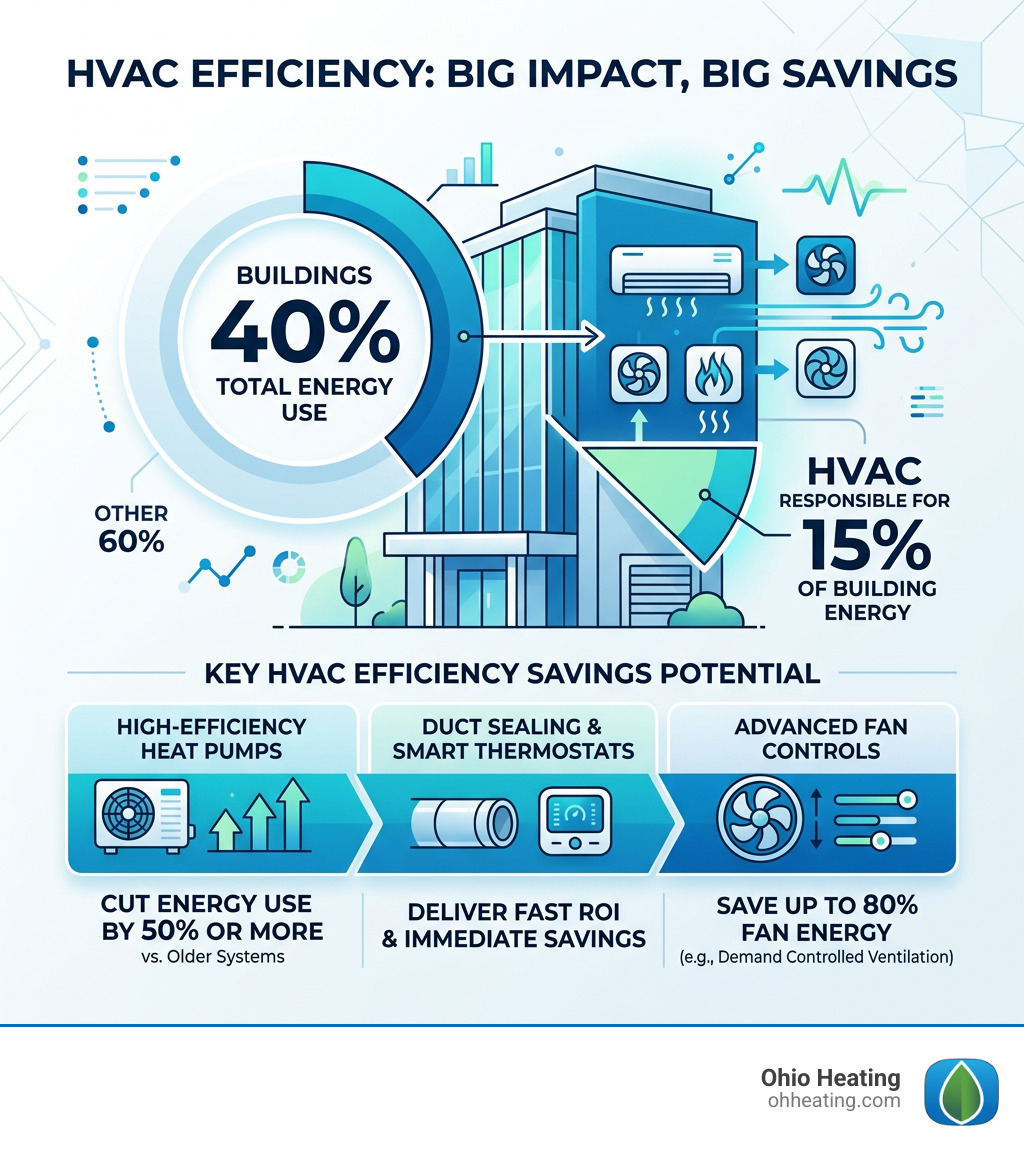
| Energy impact | HVAC accounts for roughly 15% of total building energy use |
| Savings potential | Heat pumps can cut energy use by 50% or more vs. older systems |
| Quick wins | Duct sealing, filter changes, and smart thermostats deliver fast ROI |
| Advanced options | Demand controlled ventilation and heat recovery can save up to 80% of fan energy |
| Standards to know | SEER2, EER2, HSPF2 are the current U.S. efficiency benchmarks (as of 2023) |
Buildings consume around 40% of all energy in the western world. HVAC is one of the biggest slices of that pie. For property managers and business owners, that means your heating and cooling system is one of the highest-leverage places to cut operating costs — and protect the comfort and safety of everyone inside.
The stakes are real. An inefficient system doesn’t just cost more to run. It wears out faster, strains your budget during peak seasons, and can leave occupants uncomfortable exactly when you need reliability most.
This guide walks you through everything: how efficiency ratings work, which upgrades deliver the biggest returns, and how newer technologies are changing what’s possible.
I’m Jill Frattini, a Service Coordinator at Ohio Heating in Columbus, OH, with years of hands-on experience helping property managers and homeowners get more out of their energy efficient HVAC systems. I’ll be sharing practical guidance throughout this article based on what actually works in the field.
Learn more about Energy efficient HVAC:
Understanding Energy Efficient HVAC Systems
When we talk about an Energy efficient HVAC system, we are looking at how much “work” the unit does compared to how much electricity or fuel it gulps down. Think of it like a car’s miles-per-gallon (MPG) rating. A high-efficiency system provides the same cooling or heating as a standard one but does it with a much smaller “fuel tank.”
In the HVAC world, we use a specific alphabet soup of ratings to measure this performance. If you are shopping for a new unit in Columbus, you’ll see these labels prominently displayed on the equipment.

Key Standards and Regulations
As of January 1, 2023, the U.S. Department of Energy (DOE) officially updated the minimum energy efficiency requirements. These new standards, known as “Version 2” (SEER2, EER2, and HSPF2), are designed to reflect real-world conditions more accurately—accounting for things like external static pressure in ductwork that the old tests ignored.
- SEER2 (Seasonal Energy Efficiency Ratio): This measures cooling efficiency over an entire season. In the North region (which includes all of Ohio), the current minimum for central air conditioners is 13.4 SEER2.
- EER2 (Energy Efficiency Ratio): This is a “snapshot” of efficiency at a specific outdoor temperature (usually 95°F). It’s crucial for understanding how your system handles those brutal July afternoons in Central Ohio.
- HSPF2 (Heating Seasonal Performance Factor): This specifically rates the efficiency of heat pumps during the heating season.
- AFUE (Annual Fuel Utilization Efficiency): This is for furnaces. If a furnace has a 95% AFUE, it means 95 cents of every dollar you spend on gas goes directly into heating your home, while only 5 cents is lost up the chimney.
We also follow codes established by the International Code Council (ICC) and ASHRAE 90.1. These aren’t just suggestions; they are the “rules of the road” that ensure buildings are constructed to minimize waste. Understanding Why Energy Efficient HVAC Systems Matter is the first step toward significant long-term savings.
The Importance of Proper Sizing
One of the biggest mistakes we see in Columbus is “The Bigger is Better” myth. If an HVAC system is oversized for the space, it will “short-cycle”—turning on and off rapidly. This doesn’t just waste energy; it fails to remove humidity, leaving your home feeling clammy, and it puts massive strain on the compressor.
To get it right, we use professional standards:
- Manual J: A complex calculation that looks at your home’s insulation, window types, and orientation to determine exactly how much heating and cooling you need.
- Manual S: This helps us match the right equipment to those specific load requirements.
- Manual D: This ensures your ductwork is sized to handle the airflow the system produces.
Top Strategies for Enhancing HVAC Energy Efficiency
You don’t always need to buy a brand-new system to see a drop in your energy bills. Often, the “low-hanging fruit” is found in how you maintain and manage your existing setup.
Regular Maintenance and Quick Fixes
The simplest way to maintain Energy efficient HVAC performance is to keep it clean. A dirty condenser coil can drop your efficiency by 10% or more every year it goes uncleaned.
- Filter Changes: Check them monthly. A clogged filter makes your blower motor work twice as hard to push air through.
- Professional Tune-ups: We recommend a “spring start-up” for AC and a “fall check” for furnaces. This ensures sensors are calibrated and moving parts are lubricated.
- Standard Compliance: Following the Uniform Mechanical Code standards ensures your system operates safely and within its designed efficiency parameters.
If you are ready to explore your hardware, you can Discover Energy Efficient AC Options for Columbus Homeowners that fit our local climate.
Sealing and Insulating Ductwork
Did you know that the average home loses 20% to 30% of the air moving through its duct system due to leaks, holes, and poorly connected ducts? That is air you’ve already paid to heat or cool, and it’s leaking into your attic or crawlspace.
| Strategy | Potential Efficiency Gain |
|---|---|
| Standard Filter Change | 5% – 15% |
| Professional Coil Cleaning | 10% – 20% |
| Comprehensive Duct Sealing | Up to 20% or more |
| Programmable Thermostat Use | 10% |
Using technologies like Aeroseal—a specialized process that seals ducts from the inside—can dramatically improve airflow preservation. This ensures the air actually reaches the rooms it’s supposed to, reducing the runtime of your unit.
Smart Controls and Programmable Thermostats
If you are still using a manual “slider” thermostat, you are likely leaving money on the table. Smart thermostats allow for “setback” temperatures—automatically adjusting the heat or cooling when you are at work or asleep.
For commercial buildings, occupancy sensors can tell the HVAC system to power down in empty conference rooms. These small adjustments add up. For those using older heating methods, upgrading to Energy Efficient Boilers paired with modern controls can be a game-changer.
Advanced Technologies Powering Modern Efficiency
The HVAC industry is currently in a “tech boom.” We are moving away from simple “on/off” machines toward intelligent systems that adapt in real-time.
Variable-Speed and Inverter Technology
Traditional AC units are either 100% on or 100% off. Modern Energy efficient HVAC systems use variable-speed compressors (inverter technology). These work like a dimmer switch rather than a light switch. They can run at 30% capacity on a mild day, using significantly less electricity and providing much steadier comfort.
The Role of Machine Learning in Energy Efficient HVAC
We are now seeing the integration of Artificial Intelligence into building management. Scientific research on ML-MPC integration for HVAC shows that “Model Predictive Control” (MPC) can reduce energy consumption by up to 30%.
Instead of reacting to a thermostat change, these systems look at weather forecasts and historical building data to predict when the building will need cooling. This prevents energy spikes and allows for predictive maintenance—the system can actually tell us a part is going to fail before it actually breaks. This is a massive win for businesses looking to Boost Commercial AC Efficiency with Smart Energy Solutions.
Implementing Demand Controlled Ventilation (DCV)
In many commercial spaces, fans run constantly to provide fresh air, regardless of how many people are in the building. Demand Controlled Ventilation (DCV) uses CO2 sensors to measure occupancy.
- How it works: If the room is empty, the system reduces ventilation. As people enter and CO2 levels rise, the system ramps up.
- The Result: You can save up to 80% on ventilation fan energy and reduce heating/cooling demand by 40%.
This technology is particularly effective when combined with Ductless HVAC for Commercial Buildings, which allows for precise zone control.
Commercial vs. Residential Efficiency Challenges
While the goal is the same—staying comfortable for less—the challenges differ between your home and your business.
Residential Challenges
In a home, the “building envelope” is the biggest hurdle. If your attic isn’t insulated or your windows are drafty, even the most Energy efficient HVAC system will struggle. We often recommend looking at insulation and airtightness renovations alongside an HVAC upgrade.
Commercial Challenges
Commercial buildings deal with “thermal bridging” and massive internal heat loads from computers, lights, and people. They often benefit from distributed systems rather than one giant central unit. Understanding What is Energy Efficiency in Commercial Refrigeration is also vital for businesses like restaurants or grocery stores, where cooling costs are a 24/7 expense.
Frequently Asked Questions about HVAC Efficiency
How much energy can I save by upgrading to a heat pump?
Replacing an older electric furnace or baseboard heaters with a modern heat pump can achieve energy savings of 50% or more. Even compared to high-efficiency gas furnaces, heat pumps are often more efficient because they move heat rather than creating it.
What is the difference between SEER and SEER2?
SEER2 is the new standard as of 2023. It uses a different testing procedure that includes higher “static pressure,” meaning it better simulates how a unit actually performs when connected to the ductwork in your home. Generally, a 14.3 SEER2 rating is roughly equivalent to an old 15 SEER rating.
How does the building envelope impact my HVAC performance?
Your HVAC system is only half of the equation. The building envelope (insulation, windows, and doors) is the “container” for that air. If the container is leaky, your HVAC has to work overtime. Renovating your insulation can improve HVAC efficiency by 20% or more.
Conclusion
Upgrading to an Energy efficient HVAC system is one of the smartest investments you can make for your property. Whether it’s a precision tune-up to squeeze more life out of an existing unit or a full-scale commercial installation of the latest variable-speed technology, the goal is the same: lower costs and better comfort.
At Ohio Heating, we have been the trusted experts in Columbus and Central Ohio since 1999. We understand that every building—and every budget—is different. Our team is dedicated to ensuring operational reliability for your business and total comfort for your home. We don’t just install boxes; we design systems that work for you.
Ready to see how much you could save? From residential repairs to complex commercial retrofits, we are here to help.
Contact Ohio Heating today for an efficiency evaluation: https://ohheating.com/