
What Are Ductless Air Conditioning Units?
Ductless air conditioning units — also called mini-split AC systems — are self-contained cooling systems that work without any ductwork. Here’s what you need to know at a glance:
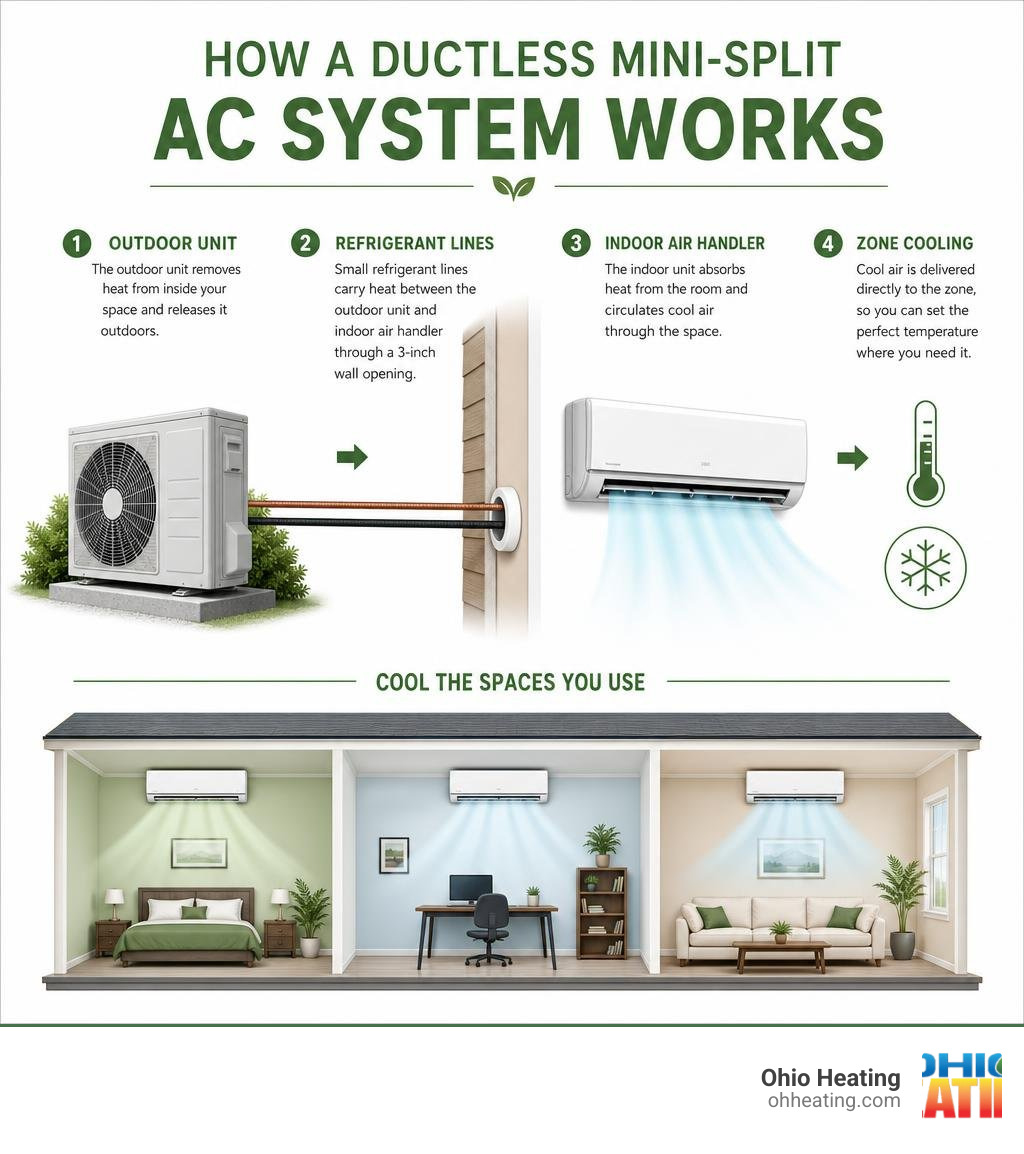
- What they are: A system with one outdoor compressor unit connected to one or more indoor air handlers via a small refrigerant line through a 3-inch wall opening
- How they cool: Refrigerant circulates between the indoor and outdoor units, absorbing heat from inside your space and releasing it outdoors
- Who they’re for: Ideal for property managers and business owners who need reliable, zoned cooling in spaces with no existing ductwork — or where central AC falls short
- Key advantage: No ducts means no duct losses, which can waste 25–40% of cooling energy in traditional central systems
- Efficiency: Modern units reach 22+ SEER2, and many qualify for ENERGY STAR certification and utility rebates
- Lifespan: With proper maintenance, most units last 15–20 years
If your building has rooms that are always too hot, spaces added after original construction, or no ductwork at all — a ductless AC system is likely your most practical and energy-efficient cooling solution.
I’m Jill Frattini, Service Coordinator in Columbus, OH, where I’ve spent years coordinating AC installations, repairs, and maintenance for ductless air conditioning units across residential and commercial properties throughout Central Ohio. In this guide, I’ll walk you through everything you need to know — from how these cooling systems work to what it takes to keep them running at peak performance.
Understanding Ductless Air Conditioning Units
To understand why ductless air conditioning units have taken the cooling world by storm in recent years, it helps to look at how they manage airflow.
Unlike traditional central air conditioning systems that rely on a network of hidden ducts to push cooled air through registers in your floors or ceilings, a ductless system delivers conditioned air directly into individual rooms.

The system is split into two primary components: an outdoor condenser unit and one or more indoor air handlers. These units are linked by a conduit containing power cables, control wiring, and copper refrigerant tubing. Because the air handlers are mounted directly on the wall or ceiling of the room they are cooling, there is no need for bulky ductwork.
This design allows for precise zone cooling. Each indoor unit operates independently with its own thermostat. If you have a guest room or a home office that is rarely used during the week, you can turn down the cooling in those specific areas without affecting the comfort of your main living spaces.
This localized approach to temperature control is one of the reasons why Ductless Split Units Are the Coolest Kids on the Block. It gives you the flexibility to manage your indoor climate room by room, ensuring perfect comfort where you want it, when you want it.
How Ductless Air Conditioning Units Differ from Central AC
When comparing ductless systems to traditional central air conditioners, the most significant difference lies in energy efficiency and physical design.
In a central AC system, cool air travels through long runs of metal or flexible ductwork. Over time, these ducts can develop leaks, loose joints, or poor insulation. According to industry data, duct loss can waste between 25% and 40% of the cooling energy produced by a central air conditioner.
Because ductless systems bypass ducts entirely, they completely eliminate this energy waste. The cooled air is blown directly from the indoor unit into your room, meaning 100% of the energy you pay for is used to keep you cool.
Additionally, central AC systems operate on an “all-or-nothing” basis. When the thermostat in your hallway calls for cool air, the entire building is cooled, regardless of whether anyone is occupying the upstairs bedrooms or the basement. Ductless systems, by contrast, offer independent zoning. You can cool only the rooms you are actively using.
Another notable difference is the operating noise. Central systems often create a noticeable rushing sound as air is forced through vents, along with the occasional pinging and popping of metal ducts expanding and contracting. Ductless indoor units are incredibly quiet, with some models operating at sound levels as low as 19 to 34 decibels—barely louder than a whisper. The loudest part of the system, the compressor, sits safely outside your home, where modern designs keep sound levels around 46 to 50 decibels.
| Feature | Ductless Mini-Split AC | Traditional Central AC |
|---|---|---|
| Ductwork Required | None (uses a 3-inch wall opening) | Extensive network of supply and return ducts |
| Energy Waste (Duct Loss) | 0% | 25% to 40% energy loss through duct leaks |
| Zoning Capabilities | Independent control for up to 8 zones | Single thermostat (whole-house cooling) |
| Noise Levels (Indoor) | Whisper-quiet (19–34 dB) | Moderate (rushing air and duct noises) |
| Aesthetics | Visible wall-mounted air handlers | Minimal visual impact (discreet vents) |
| Lifespan | 15 to 20 years | 10 to 15 years |
Key Components of a Ductless Cooling System
A ductless system relies on a few key components working in perfect harmony to keep your home cool during our humid Columbus summers:
- The Outdoor Compressor/Condenser: This is the powerhouse of the system. It contains the compressor, condenser coil, and a large fan. Its job is to compress the refrigerant gas, turning it into a hot liquid, and then blow outdoor air across the condenser coil to release the heat absorbed from inside your home.
- The Indoor Air Handler (Evaporator): Mounted on your wall, floor, or ceiling, this unit contains the evaporator coil, a quiet blower fan, and air filtration. As warm indoor air is drawn across the cold evaporator coil, the refrigerant absorbs the heat, leaving the air beautifully chilled.
- The Expansion Valve: Located within the system, this valve controls the flow of refrigerant, lowering its pressure and temperature before it enters the indoor evaporator coil.
- The Line Set: This is the bundle of tubes that connects the indoor and outdoor units. It includes copper refrigerant lines, a condensate drain line to remove moisture squeezed out of the indoor air, and control wiring. All of this fits through a small 3-inch hole drilled through your exterior wall.
Sizing and Selecting Your Ductless System
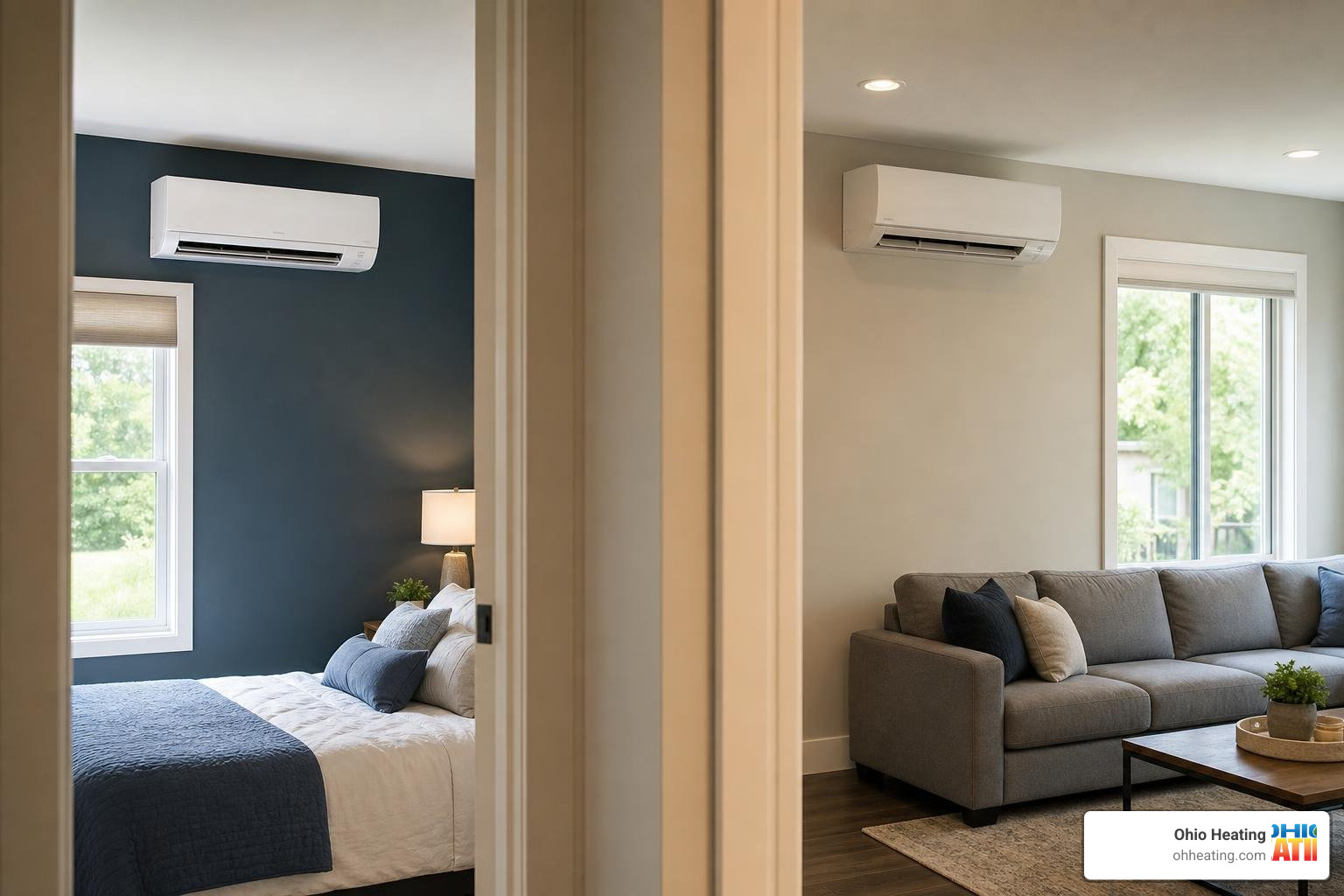
Choosing the right size for your ductless air conditioning units is critical. If a system is too small, it will run constantly, driving up your electric bills while failing to keep you cool on hot July afternoons. If it is too large, it will cool the room too quickly without running long enough to properly dehumidify the space, leaving you with a cold, clammy room.
Sizing Your Ductless Air Conditioning Units
To determine the correct system size, HVAC professionals measure cooling capacity in British Thermal Units (BTUs). As a general rule of thumb, you need about 20 BTUs of cooling capacity per square foot of living space. However, calculating the perfect size requires looking at more than just square footage.
Our technicians perform a detailed load calculation that takes several factors into account:
- Ceiling Height: Rooms with high or vaulted ceilings contain more volume of air to cool, requiring higher BTU ratings.
- Insulation Quality: Older homes in historic Columbus neighborhoods may have less insulation, requiring a slightly more powerful unit than a modern, tightly sealed building.
- Window Size and Sun Exposure: A room with large, south-facing windows that catch the afternoon sun will require more cooling power than a shaded room.
- Room Usage: Kitchens, home gyms, or rooms with lots of electronics generate more heat and need extra cooling capacity.
For example, a standard 12,000 BTU unit (often referred to as a 1-ton system) is typically perfect for cooling a medium-sized space of up to 500 to 600 square feet, such as the Daikin 12,000 BTU Oterra 20 SEER2 Single Zone Wall Mount Mini Split System – R32 | 115V – RXQ12ASBU9 / FTXQ12ASBU9 | HVACDirect.com.
Larger spaces, like a spacious open-concept living area up to 650 square feet, might require an 18,000 BTU system like the DELLA 18000 BTU Wifi 19 SEER Mini Split AC System, Cools 650 Sq.Ft, 1 Ton (JPB Series) – Walmart.com or the popular DIY 18,000 BTU 1.5-Ton 1-Zone 22 SEER Ductless Mini-Split AC with 18K & 25ft Line.
Energy Efficiency and SEER2 Ratings
When shopping for a ductless system, you will see efficiency represented by the SEER2 (Seasonal Energy Efficiency Ratio 2) rating. This rating measures the cooling output of the system divided by the total electric energy input during a typical cooling season.
The higher the SEER2 rating, the more efficient the system. While standard central air conditioners typically range from 13 to 16 SEER2, modern ductless cooling systems routinely achieve ratings of 20 to 25 SEER2, with some premium models reaching as high as 30+ SEER2.
This incredible efficiency is largely due to inverter-driven compressor technology. Traditional central air conditioners use single-speed compressors that operate on an “on/off” cycle. The system turns on at 100% capacity, cools the house down, turns off, and then turns back on when the temperature rises. This constant cycling consumes massive amounts of electricity.
Inverter compressors, however, operate like a dimmer switch. They run continuously at variable speeds, adjusting their output to match the precise cooling needs of the room. By running at lower, highly efficient speeds for longer periods, they maintain a perfectly stable temperature while using up to 40% less energy.
In June 2026, looking for ENERGY STAR certified models is more important than ever, as these high-efficiency systems not only lower your monthly utility bills but can also qualify you for valuable local utility rebates and federal tax credits.
Professional Installation and Maintenance Requirements
While some manufacturers offer “do-it-yourself” kits with pre-charged lines, we strongly recommend professional installation for the vast majority of ductless systems. A professional installation ensures that your system operates safely, complies with local building codes, and keeps your manufacturer’s warranty fully intact.
Improper installation can lead to refrigerant leaks, electrical issues, or water damage from poorly routed condensate lines. Working with certified experts ensures your system is set up correctly the first time. For more information on professional installation services in Central Ohio, check out our Residential HVAC Services – Ductless Systems page.
The Step-by-Step Installation Process
A typical single-zone ductless installation is surprisingly quick, often completed in just one day. Here is what you can expect during the process:
- Mounting the Indoor Unit: Our technician secures a mounting bracket to the wall of the room you want to cool. The indoor air handler is then carefully mounted to this bracket, ensuring it is perfectly level so that condensation drains correctly.
- Drilling the Access Hole: We drill a small, 3-inch hole through the exterior wall behind or beside the indoor unit. This hole is lined with a protective sleeve to run the line set through.
- Routing the Line Set: The copper refrigerant lines, control wires, and drain tube are bundled together and routed through the wall opening to the outside of the home.
- Setting Up the Outdoor Unit: The outdoor condenser is placed on a level concrete pad or mounted securely to the exterior wall using heavy-duty brackets.
- Making the Connections: The technician connects the refrigerant lines and electrical wiring to both the indoor and outdoor units.
- Evacuating and Testing the System: Using a specialized vacuum pump, our technician removes all air and moisture from the refrigerant lines. Once a deep vacuum is achieved, the technician releases the refrigerant, checks for leaks, and powers on the system to test the airflow and temperature drop.
Essential Maintenance for Peak Cooling Performance
Ductless systems are incredibly reliable, but they do require regular care to maintain their high efficiency and whisper-quiet operation.
The single most important task is cleaning the indoor air filters. Because these units sit directly in the rooms they cool, their filters catch dust, pet dander, and pollen quickly. We recommend checking and cleaning your filters every 4 to 6 weeks. Simply pop open the front panel of the indoor unit, slide the plastic filters out, rinse them under warm water, let them dry completely, and slide them back in.
Outside, you should periodically check the condenser unit to ensure that grass clippings, leaves, or weeds are not blocking the airflow. Keep at least two feet of clear space around the outdoor unit.
Additionally, scheduling an annual professional tune-up is vital. Our technicians will inspect the electrical connections, check the refrigerant charge, clean the indoor and outdoor coils, and ensure the condensate drain line is completely clear of blockages. For a complete guide on keeping your system in top-tier shape, take a look at What Your Ductless Mini Split Really Needs: A Maintenance Checklist.
Frequently Asked Questions About Ductless AC
Can ductless systems be integrated with smart home devices?
Yes! Modern ductless cooling units are highly advanced. Most models come equipped with built-in Wi-Fi or are compatible with smart adapters. This allows you to control the temperature, set schedules, and monitor energy usage directly from your smartphone using dedicated apps. Many systems can also be linked to smart home assistants like Amazon Alexa or Google Home, giving you the convenience of adjusting your cooling with simple voice commands.
How long do ductless air conditioners typically last?
With proper maintenance, a high-quality ductless air conditioner has an expected lifespan of 15 to 20 years. This is significantly longer than the typical 10 to 15-year lifespan of a traditional central AC system. The key to maximizing this lifespan is regular filter cleaning and annual professional maintenance to prevent the compressor from working harder than it needs to.
Are ductless systems suitable for commercial properties?
Absolutely. Ductless systems are an excellent choice for commercial buildings, office spaces, retail storefronts, and server rooms. They allow business owners to provide targeted cooling to specific offices or conference rooms without wasting energy cooling unoccupied areas of the building.
To learn more about how we help local businesses stay comfortable, read our detailed article on Ductless HVAC for Commercial Buildings.
Conclusion
Ductless air conditioning units offer an incredibly efficient, whisper-quiet, and flexible solution for keeping your property cool and comfortable throughout the year. By eliminating duct loss and offering precise, zone-by-zone temperature control, these systems help you lower your energy bills while enjoying unmatched indoor comfort.
At Ohio Heating, we have been serving the Columbus and Central Ohio communities since 1999. Our team of experienced, licensed HVAC professionals is dedicated to helping you find the perfect cooling solutions to keep your home or business running reliably.
Ready to experience the quiet, energy-efficient comfort of a modern mini-split system? Schedule your ductless AC consultation today with the team at Ohio Heating, and let us help you stay cool all summer long!