
What “Constant Air Volume HVAC” Actually Means (And Why It Still Matters in 2026)
A constant air volume HVAC system is one of the most straightforward cooling and ventilation approaches in the industry — and it’s more common than you might think.
Here’s the short answer if you need it fast:
| Feature | How CAV Works |
|---|---|
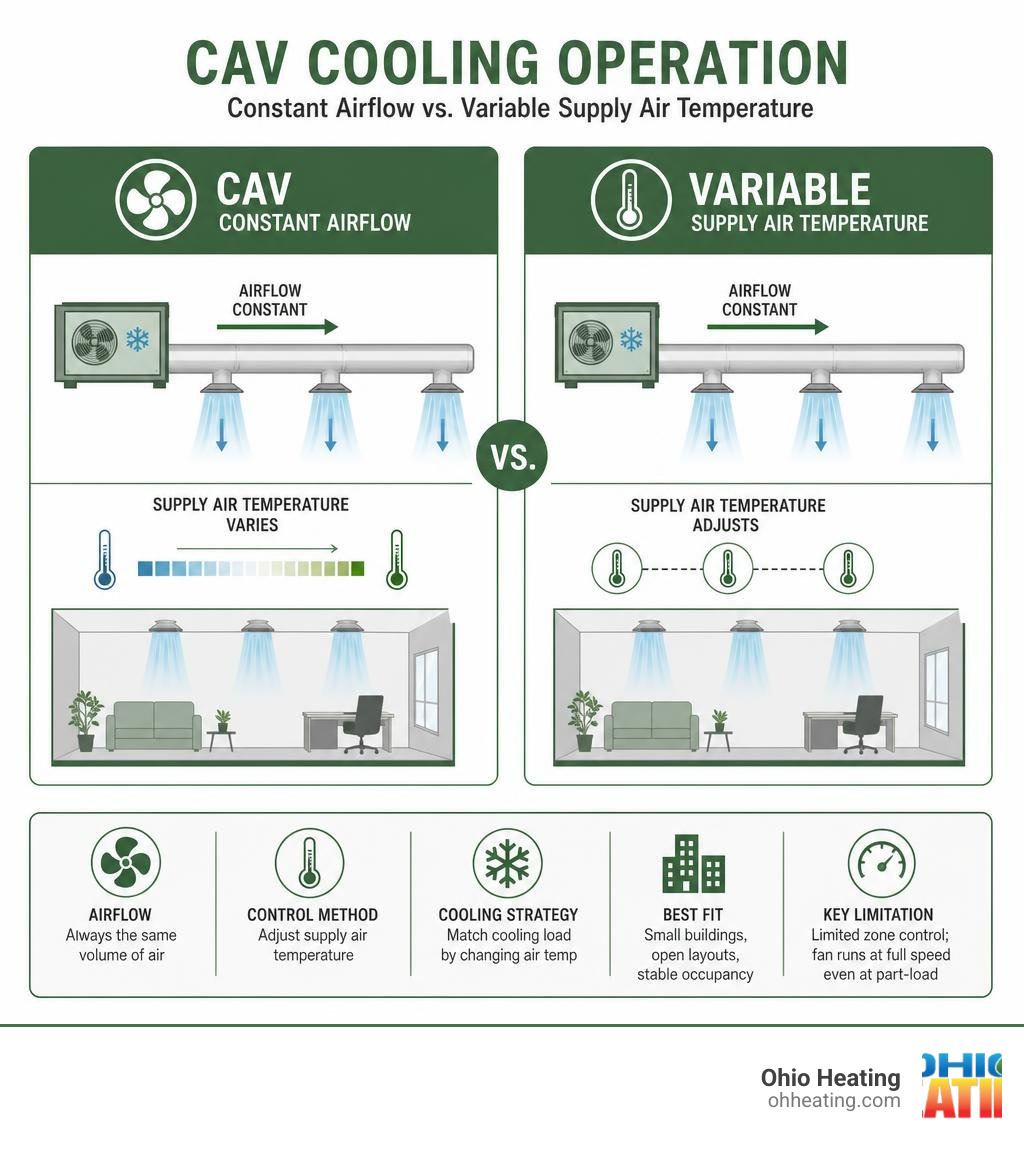
| Airflow | Fixed — always the same volume of air |
| Temperature control | Varies the supply air temperature to match the cooling load |
| Typical supply air temp | Around 55°F (13°C) |
| Best for | Small buildings, open layouts, stable occupancy |
| Key limitation | Limited zone control; fan runs at full speed even at part-load |
CAV systems keep airflow constant and adjust the temperature of that air to cool or condition a space. This is the opposite of a Variable Air Volume (VAV) system, which keeps temperature fixed and varies how much air is delivered.
For property managers and business owners in Columbus and beyond, understanding this distinction matters. The wrong system choice — or a poorly maintained one — can lead to comfort complaints, wasted energy, and costly operational disruptions.
I’m Jill Frattini, Service Coordinator at Ohio Heating, and I’ve spent years working with facilities across the region on constant air volume HVAC systems — from scheduling service calls to coordinating full system assessments. In the sections below, I’ll walk you through everything you need to make confident decisions about your CAV system.
Must-know constant air volume hvac terms:
What Is a constant air volume hvac System and How Does It Work?
To understand a constant air volume hvac system, think of it as an “all-or-nothing” airflow delivery method. The system’s supply fan operates at a fixed speed, pushing a constant volume of air—measured in cubic feet per minute (CFM)—through the ductwork and out of the diffusers into your occupied spaces.
Instead of changing how much air is delivered to satisfy the thermostat, a CAV system modulates the temperature of that air. It does this by adjusting the cooling output at the air handling unit (AHU). The return air is pulled back from the space, mixed with outdoor ventilation air, passed through a cooling coil to drop its temperature, and sent right back out.
For a detailed technical definition and history of these configurations, you can explore this Constant air volume overview.
The Basic Cooling Sequence in constant air volume hvac
When a CAV system runs, it follows a highly predictable mechanical sequence:
- Fixed CFM Delivery: The supply fan starts up according to an occupied schedule, immediately delivering 100% of its design airflow.
- The Thermostat Call: As the thermal load in the room rises, the thermostat detects a deviation from its cooling setpoint.
- Coil Action: A discharge-air sensor or space thermostat signals the cooling system. In a direct expansion (DX) system, the compressor cycles on to chill the cooling coil. In a chilled-water system, a control valve opens to allow cold water to flow through the coil.
- Air Tempering: Return air and outdoor air mix, pass through the chilled coil, and drop to the required supply temperature (typically around 55°F).
- Satisfying the Load: Once the space reaches the setpoint, the compressor cycles off or the chilled-water valve modulates closed. The fan, however, continues to run at full speed, circulating neutral air.
Constant Airflow Does Not Always Mean Constant Comfort
While sending a steady stream of air sounds like a great way to keep a building comfortable, it introduces unique challenges. In the real world, cooling loads are never static. Solar heat gain shifts from the east windows in the morning to the west windows in the afternoon. Conference rooms fill up with people and laptops, while adjacent offices sit empty.
Because a standard single-duct CAV system serves a single thermal zone, it cannot respond to these localized variations. If the thermostat is in the empty office, the busy conference room next door will quickly become stuffy and warm. Conversely, if the thermostat is in the hot conference room, the empty office will get overcooled, leaving its occupant shivering.
CAV vs. VAV: The Cooling-System Difference That Matters
When choosing or managing commercial cooling equipment, the biggest choice is between Constant Air Volume (CAV) and Variable Air Volume (VAV).
| Performance Metric | Constant Air Volume (CAV) | Variable Air Volume (VAV) |
|---|---|---|
| Airflow Volume | Constant (Fixed CFM) | Variable (Modulates fan speed) |
| Supply Air Temperature | Variable (Adjusts to match load) | Constant (Typically fixed at 55°F) |
| Fan Energy Consumption | High (Runs at 100% speed continuously) | Low (Saves up to 30% using VFDs) |
| Zoning Capability | Best for single, large open zones | Excellent for multi-zone layouts |
| First/Installation Cost | Low and budget-friendly | Higher initial investment |
| Control Complexity | Simple, conventional controls | Complex DDC and pressure-independent boxes |
Airflow, Temperature, and Fan Energy
The fundamental difference lies in what modulates. A CAV system changes the temperature of a constant stream of air. A VAV system does the exact opposite: it keeps the supply air temperature at a cold, constant 55°F and uses variable frequency drives (VFDs) to slow down or speed up the fan, delivering only the exact CFM needed to cool each space.
This difference has massive implications for energy bills. According to the laws of fan aerodynamics (the Fan Affinity Laws), fan power is proportional to the cube of the fan’s speed. If a VAV system can reduce its fan speed to 50% during part-load cooling hours, it uses only one-eighth (12.5%) of the fan energy required at full speed. Because CAV systems run at 100% fan speed all day long, they carry a heavy fan energy penalty. In fact, upgrading to a VAV system can save a facility up to 30 percent in overall energy costs.
Comfort, Controls, Cost, and Zoning
Despite the energy penalty, CAV systems remain highly popular for certain applications due to their low first cost and operational simplicity. They do not require complex pressure-independent VAV terminal boxes, electronic damper actuators, or sophisticated static pressure duct sensors.
However, when a single CAV system is stretched across multiple zones with different cooling needs, comfort complaints are common. To resolve these complaints without replacing the entire system, facilities often rely on customized control sequences. If you want to dive deeper into how modern controls bridge this gap, read The Ultimate Guide to HVAC Control Systems.
Main Types and Components of CAV Cooling Systems
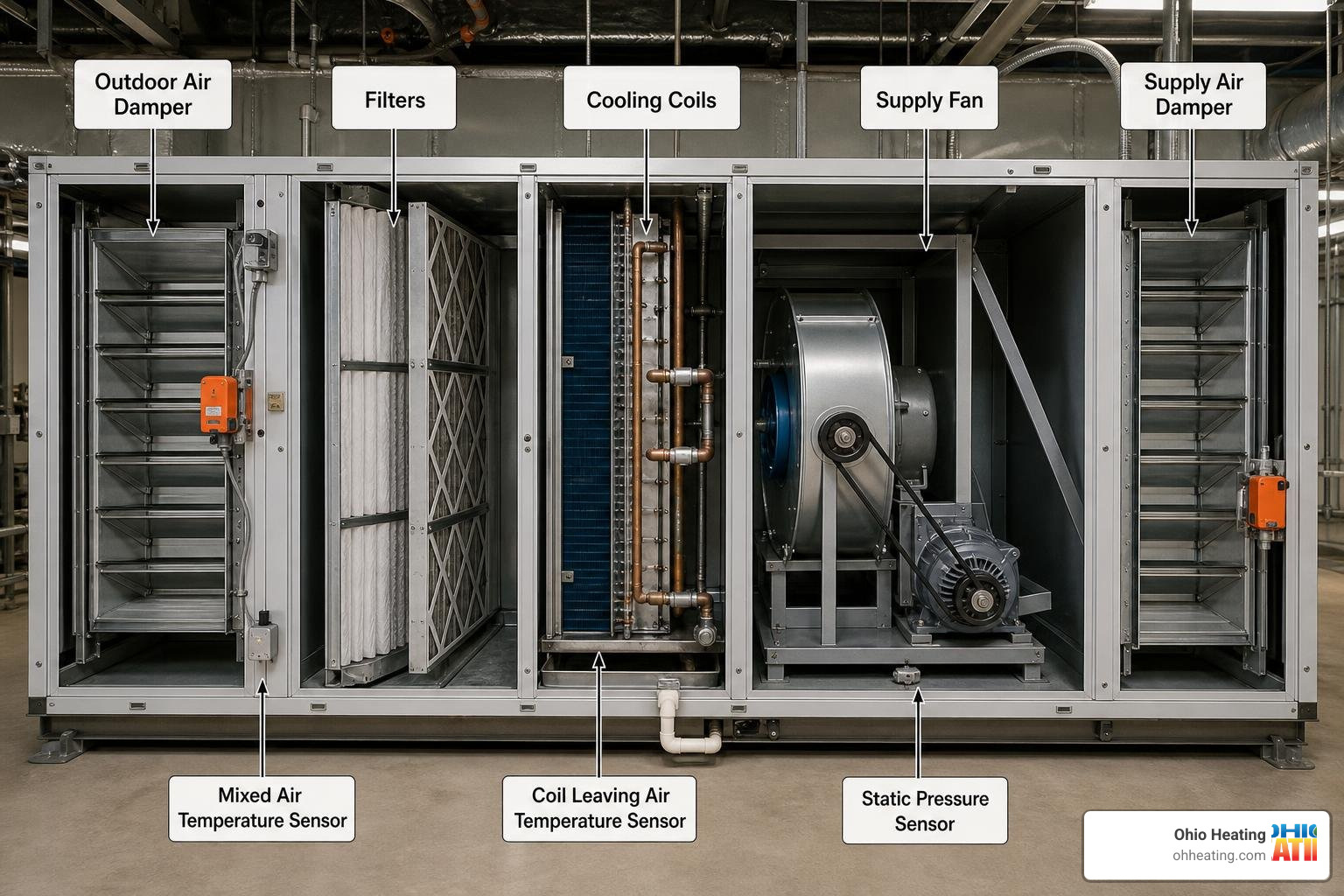
A constant air volume system relies on a set of core physical components to filter, cool, and distribute air:
- Air Handling Unit (AHU) or Rooftop Unit (RTU): The central metal casing housing the fan, coils, and dampers.
- Cooling Coils: Chilled-water or direct expansion (DX) coils that extract sensible and latent heat from the air.
- Supply Fan: A centrifugal or plenum fan designed to move a fixed volume of air against duct resistance.
- Filters: MERV-rated filters that clean the air before it reaches the coils and occupied spaces.
- Outdoor-Air Damper: Controls the volume of fresh ventilation air introduced to satisfy ASHRAE standards.
- Thermostats and Sensors: Devices that monitor space temperature, discharge air, and humidity, sending signals to the controller.
- Direct Digital Controls (DDC): Modern electronic processors that run the software sequences governing the system.
Single-Duct CAV Systems
The simplest configuration is the single-duct CAV system. It consists of one supply duct serving a single zone, such as a retail store, a school classroom, or a warehouse. The thermostat directly cycles the cooling source in the central unit. Because there are no downstream dampers or mixing boxes, single-duct systems are highly reliable, inexpensive to install, and incredibly easy to maintain.
Terminal Tempering, Dual-Duct, and Multizone CAV
To serve multiple zones with a single CAV fan, engineers historically developed three variations, though each comes with energy efficiency trade-offs:
- Terminal Tempering CAV: The central unit cools all supply air down to a cold 55°F to handle the maximum possible cooling load in the building. Before the air enters individual rooms, it passes through a terminal box containing a small tempering coil. If a specific room is too cold, the tempering coil adjusts the 55°F air back up to a comfortable temperature. While this provides excellent local comfort, it is highly inefficient because you are spending money to cool air, only to spend more money to temper it back up.
- Dual-Duct CAV: This system utilizes two parallel supply ducts running throughout the building—a “cold deck” carrying 55°F air and a “neutral/tempered deck” carrying uncooled or bypassed return air. At each zone, a mixing box blends air from both ducts to deliver the exact temperature requested by that zone’s thermostat, maintaining a constant total CFM.
- Multizone CAV: Similar to a dual-duct system, but the mixing dampers are located at the central air handler rather than out in the ceiling spaces. The air handler has separate hot and cold decks, and individual ducts run from the unit to each of the zones (usually limited to about eight zones due to physical space constraints at the unit).
Controls That Keep CAV Predictable
To keep these systems running reliably without wasting excessive energy, proper controls are vital. Modern DDC systems can implement “discharge-air temperature reset” sequences, which raise the cooling coil’s target temperature when outdoor temperatures are mild, reducing compressor runtimes.
To explore how these sequences are configured, check out our guide on Conventional Controls.
Temperature, Humidity, and Airflow Design Values for CAV Cooling
Designing and operating a constant air volume hvac system requires precise engineering math and strict adherence to design parameters.
To calculate the sensible cooling capacity of an air conditioning system, engineers use the standard sensible heat equation:
$$Q = 1.08 \times \text{CFM} \times \Delta T$$
Where:
- $Q$ = Sensible heat gain (BTU/hour)
- $\text{CFM}$ = Airflow rate (cubic feet per minute)
- $\Delta T$ = Temperature difference between room air and supply air (usually $75^\circ\text{F} – 55^\circ\text{F} = 20^\circ\text{F}$)
Typical Supply Air Temperatures and CFM Ranges
For effective commercial cooling, CAV systems typically target a discharge air temperature of 55°F (13°C). This temperature is cold enough to satisfy comfort demands and, crucially, cold enough to dehumidify the air.
If a specific zone has a design cooling load of 10,000 BTU/h and we use a standard 20°F temperature differential ($\Delta T$), the required airflow is:
$$\text{CFM} = \frac{10,000}{1.08 \times 20} \approx 463\text{ CFM}$$
In a CAV system, this 463 CFM is fixed. If the cooling load drops to 5,000 BTU/h in the afternoon, the CFM remains at 463, but the supply air temperature must be raised to approximately 65°F to prevent overcooling:
$$\Delta T = \frac{5,000}{1.08 \times 463} \approx 10^\circ\text{F} \implies \text{Supply Temp} = 75^\circ\text{F} – 10^\circ\text{F} = 65^\circ\text{F}$$
On a larger scale, small rooms might require around 3 cubic meters per second ($m^3/s$) of air, while massive commercial spaces can demand 20 to 30 $m^3/s$ to maintain proper circulation.
How CAV Controls Humidity During AC Operation
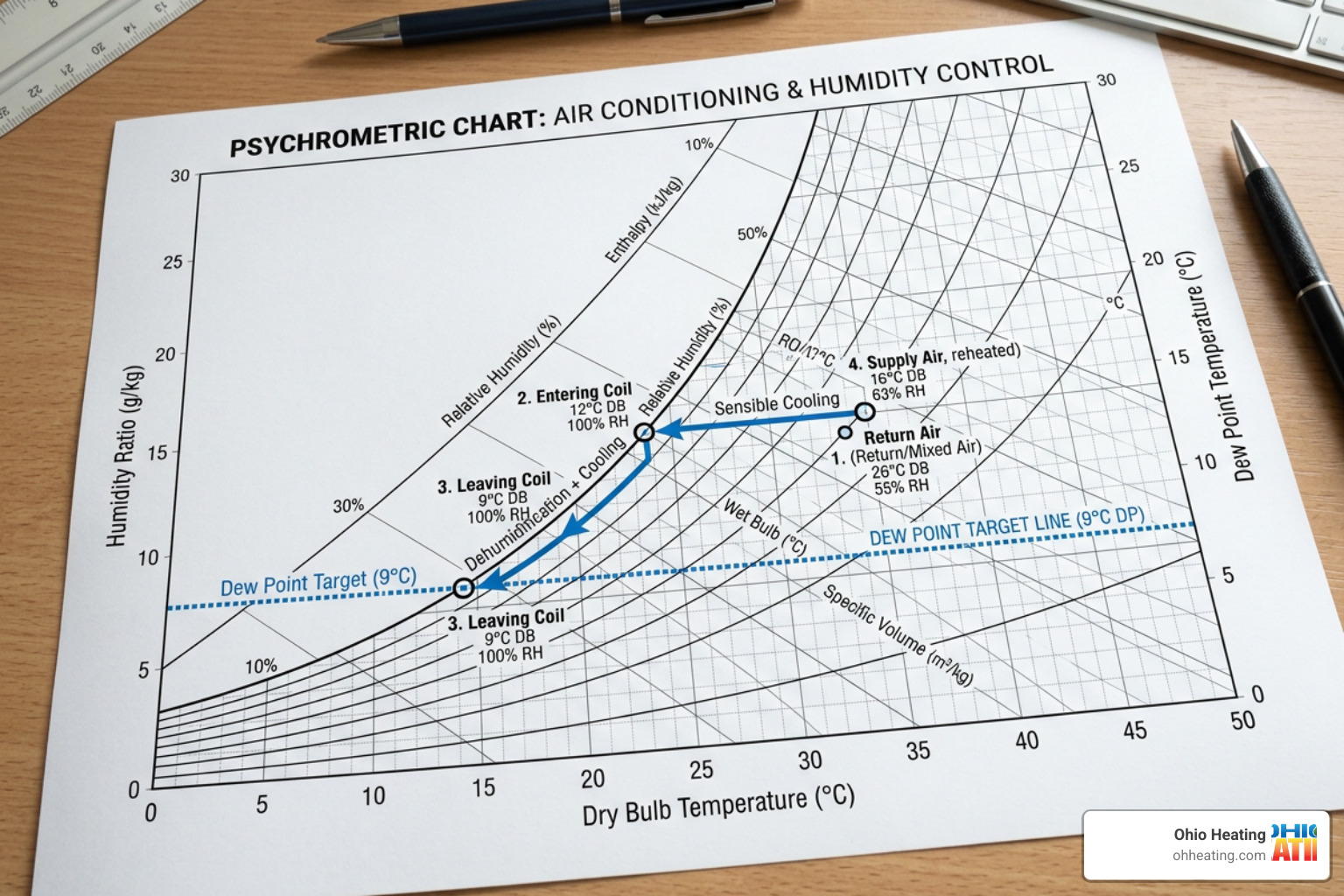
Air conditioning is about more than just lowering the temperature; it is also about removing moisture. When warm, humid return air passes over a 55°F cooling coil, the moisture in the air condenses onto the cold metal surface, drips into a condensate pan, and drains away.
However, if a CAV system satisfies the room’s temperature setpoint quickly, the compressor cycles off. Because the fan continues to run at 100% speed, it can blow standing water from the wet condensate pan right back into the ductwork, rapidly raising indoor humidity levels.
To prevent this, advanced CAV systems use a return-air humidity sensor. If the relative humidity (RH) rises above a target threshold (such as 65% RH), the system initiates a dehumidification override. The cooling coil runs to strip moisture, and downstream tempering coils are activated to keep the supply air from overcooling the space.
Why Balancing Matters in constant air volume hvac
Because a CAV system relies on fixed airflow paths, professional testing, adjusting, and balancing (TAB) is critical. If duct static pressure changes because of dirty filters or slipping fan belts, airflow to individual rooms will drift away from design values.
Regular maintenance checks are essential to keep dampers in their correct positions and ensure proper air distribution. You can keep your system balanced and efficient by partnering with our Commercial HVAC Maintenance Program.
Advantages, Drawbacks, and Best-Fit Applications
Like any mechanical design, constant air volume systems have distinct strengths and weaknesses.
Where constant air volume hvac Works Best in Cooling Applications
CAV systems excel in spaces with large, open layouts, consistent occupancy schedules, and uniform cooling loads. Excellent applications include:
- Residences and Small Offices: Where simple on/off cooling cycles are perfectly adequate.
- Classrooms and Retail Stores: Which operate on highly predictable, fixed daily schedules.
- Gymnasiums and Warehouses: Large open volumes where zoning is unnecessary.
- Operating Rooms and Laboratories: Where strict ventilation standards require a high, constant rate of outdoor air circulation to maintain indoor air quality.
Where CAV Systems Struggle
CAV systems are poorly suited for buildings with complex layouts, shifting occupant densities, or high solar exposure variations. Large, multi-tenant office buildings or conference centers with highly variable daily usage patterns will experience frequent comfort complaints and high energy waste if served by a central CAV system.
Energy Efficiency Implications in 2026
In 2026, building energy codes like the International Energy Conservation Code (IECC) and ASHRAE Standard 90.1 enforce strict limits on fan power. Because VAV systems offer a 23% fan electricity savings and a 19% reduction in cooling energy over traditional CAV systems, new central CAV installations in mid- to large-sized buildings have become rare.
For modern commercial properties, optimizing energy use is a top priority. Learn how to manage these costs effectively with our Energy Management strategies.
How to Optimize or Convert an Existing CAV AC System
If your facility currently operates an older CAV system, you do not necessarily have to invest in a complete mechanical replacement to achieve modern efficiency. There are several highly effective ways to optimize or convert your existing equipment.
High-Impact CAV Optimization Measures
- Install Variable Frequency Drives (VFDs): A classic study on single-duct constant volume system optimization demonstrated that installing VFDs to modulate fan speeds based on actual maximum zone loads—rather than running them at fixed design maximums—resulted in a 23% electricity savings and a 43% reduction in tempering energy consumption over a six-month period.
- Implement Discharge Air Temperature Reset: Program your DDC system to automatically raise the supply air temperature when outdoor conditions are mild, reducing compressor workload.
- Optimize Schedules and Damper Positions: Ensure outdoor air dampers close completely during unoccupied hours to eliminate unnecessary cooling loads.
To learn more about implementing these advanced sequences, explore our guide on Mastering the Art of HVAC Control Systems.
When to Convert From CAV to VAV or Single-Zone VAV
If your building suffers from persistent comfort complaints, high utility bills, or aging pneumatics, a VAV conversion may offer an excellent return on investment.
A conversion typically involves:
- Installing VFDs on the central supply and return fans.
- Adding VAV terminal boxes in the ductwork branches.
- Upgrading to a digital building automation system (BAS) to coordinate fan speed with damper positions.
For smaller, single-zone units, converting to a Single-Zone VAV (SZVAV) system—which slows the fan down during low-load periods—provides excellent dehumidification and comfort. Explore your options with our guide to Commercial HVAC System Upgrades.
Maintenance Priorities for Reliable Cooling
No optimization strategy will work if the basic mechanical components are neglected. To keep your cooling system running smoothly, prioritize these steps:
- Coil Cleaning: Dirty cooling coils restrict airflow and reduce heat transfer, forcing compressors to run longer.
- Condensate Drain Lines: Clear out algae and debris to prevent pan overflows and mold growth.
- Filter Replacements: High pressure drops across dirty filters increase fan energy use.
- Sensor Calibration: Out-of-calibration sensors can cause simultaneous cooling and tempering.
Keep your equipment in peak condition with a customized HVAC Preventative Maintenance Plan
Frequently Asked Questions About Constant Air Volume HVAC
Is a CAV system the same as forced-air AC?
Yes, a CAV system is a specific type of forced-air AC system. “Forced-air” simply means the system uses a motorized fan to blow air through ductwork. A CAV system is a forced-air system that maintains a constant, unchanging volume of airflow while running.
Can CAV systems provide good humidity control?
Yes, but they must be designed and controlled properly. Because they deliver a constant volume of air, if the compressor cycles off too quickly, humidity can rise. Implementing return-air humidity sensors and tempering coils for active dehumidification is essential for maintaining dry, comfortable indoor air during humid Ohio summers.
Should I replace a CAV system with VAV?
If you own a mid- to large-sized building with multiple zones, variable occupancy, and high energy bills, converting to a VAV system is highly recommended. The upgrade can save you up to 30% in energy costs and eliminate room-to-room temperature swings. For small, single-zone buildings, a well-maintained CAV or Single-Zone VAV system is often still the most practical, cost-effective option.
Partner with Ohio Heating for Reliable Commercial Cooling
Managing a commercial facility’s cooling system requires a balance of comfort, reliability, and energy efficiency. Whether you need to maintain an existing constant air volume HVAC system, optimize your fan controls for energy savings, or execute a complete VAV conversion, our team at Ohio Heating is here to help.
Since 1999, we have served businesses across Columbus and Central Ohio, delivering expert commercial installation, emergency repairs, and comprehensive preventative maintenance programs. We focus on keeping your operations running smoothly, preventing costly downtime, and keeping your energy bills under control.
Ready to optimize your building’s cooling performance? Contact us today to schedule a system assessment, or learn more about our control solutions by exploring Ohio Control Solutions conventional controls.