
The Secret to Hiring Great Local HVAC Pros
Why Finding the Right Local HVAC Technicians Can Make or Break Your Building’s Comfort
Local HVAC technicians are the professionals you call when your heating or cooling system fails — and choosing the right one determines how fast you’re back up and running, how much you pay, and whether the fix actually lasts.
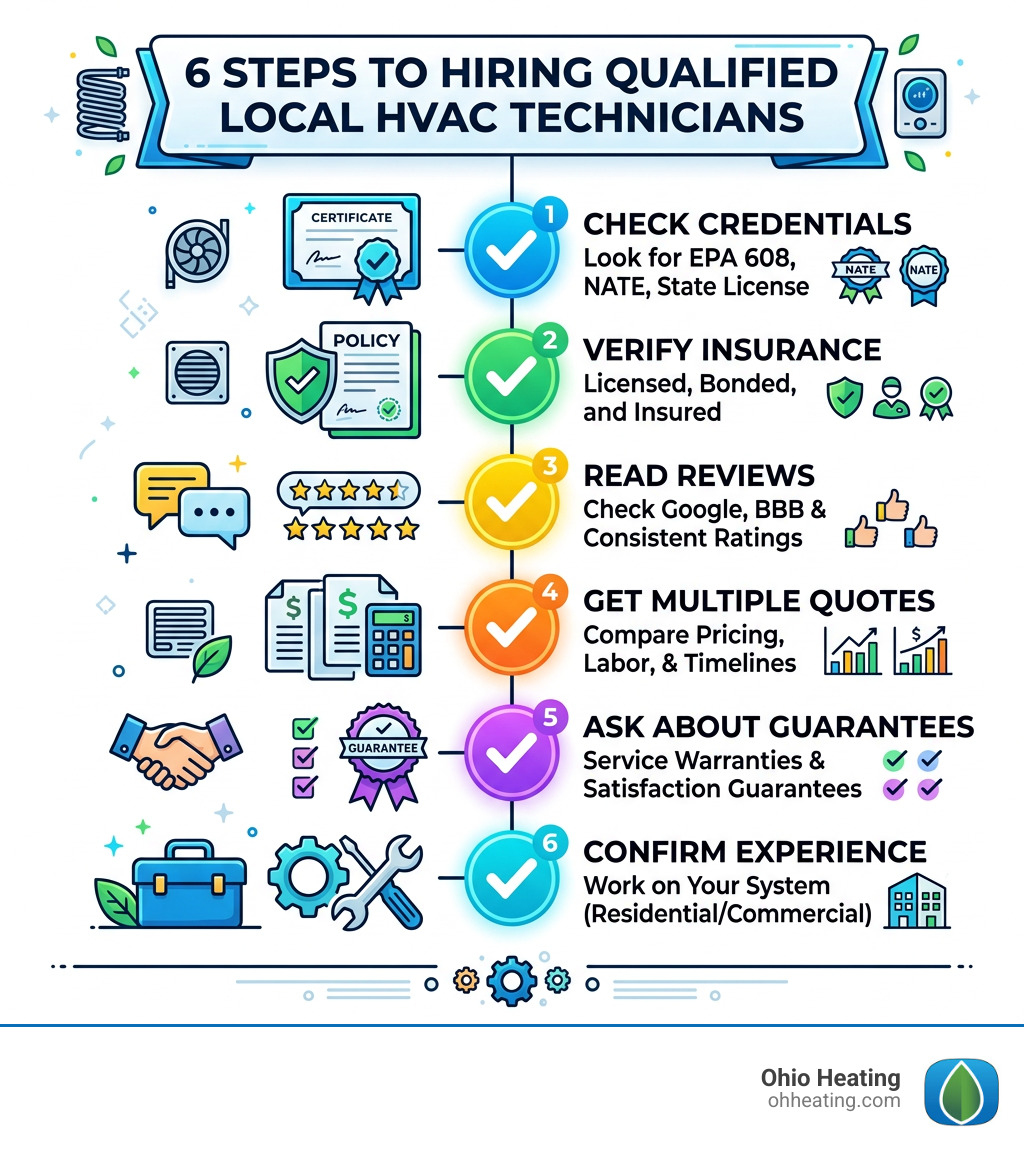
Here’s a quick guide to finding qualified local HVAC technicians:
| Step | What to Do |
|---|---|
| 1. Check credentials | Look for EPA 608, NATE certification, and a valid state license |
| 2. Verify insurance | Confirm they’re licensed, bonded, and insured |
| 3. Read reviews | Check Google, BBB, and other platforms for consistent ratings |
| 4. Get multiple quotes | Compare pricing, labor breakdowns, and timelines |
| 5. Ask about guarantees | Look for service warranties and satisfaction guarantees |
| 6. Confirm experience | Make sure they work on your system type (residential or commercial) |
HVAC systems don’t care about your schedule. They break down on the hottest day in July, on a holiday weekend, or in the middle of the night — right when you need them most. For property managers and business owners, a failed system isn’t just uncomfortable. It disrupts operations, frustrates tenants, and can damage assets.
The difference between a quick fix and a weeks-long headache often comes down to one thing: who you hire before the problem happens.
I’m Jill Frattini, a Service Coordinator at Ohio Heating in Columbus, OH, with years of experience coordinating HVAC service across residential, commercial, and industrial properties — which means I’ve seen what separates great local HVAC technicians from ones who leave you worse off. In this guide, I’ll walk you through everything you need to know to hire right the first time.
Simple guide to Local HVAC technicians terms:
Comprehensive Services Provided by Local HVAC Technicians
When you search for local HVAC technicians, you aren’t just looking for someone to “fix the air.” Modern HVAC systems are complex, interconnected networks of mechanical, electrical, and plumbing components. At Ohio Heating, we’ve seen that a truly comprehensive provider needs to master several distinct disciplines to keep a building running smoothly.

Core Residential and Commercial Services
Most Residential HVAC services focus on the comfort and safety of a single family. This includes standard furnace repair, central AC installation, and the increasingly popular high-efficiency heat pumps. However, Commercial HVAC demands a much higher level of technical expertise. Commercial systems are often larger, involve complex zoning, and require specialized knowledge of rooftop units (RTUs) and large-scale ventilation.
Our local HVAC technicians typically provide:
- Heating Solutions: From traditional gas furnace repair to modern boiler systems and heat pump conversions.
- Cooling Systems: Installation and repair of central air conditioners, ductless mini-splits, and evaporative cooling options.
- Indoor Air Quality (IAQ): This is a growing field. Technicians now handle advanced filtration systems, UV germicidal lights, and whole-home humidifiers to ensure the air you breathe is healthy.
- Emergency Services: Because systems love to fail at 2:00 AM on a Tuesday or during a holiday dinner, reliable pros offer 24/7 emergency response.
- Ductwork Maintenance: Cleaning and sealing ducts to ensure that the air actually reaches the rooms it’s supposed to.
- Smart Technology: Calibrating and installing programmable thermostats and building automation controls.
Knowing when to call is just as important as knowing who to call. We recommend keeping an eye out for these 7 Crucial Signs Your HVAC System Needs Immediate Repair, such as strange noises, spiking energy bills, or frequent cycling.
Residential vs. Commercial HVAC Specializations
It is a common misconception that a technician who can fix a home furnace can easily handle a warehouse’s climate control. The scale and complexity are vastly different.
Commercial systems involve intricate duct designs and heavy-duty electrical integrations. If a residential unit fails, one family is uncomfortable. If a commercial system goes down, it can lead to costly operational downtime, spoiled inventory, or a complete halt in business. This is why we specialize in Commercial AC Repair Columbus, focusing on rapid response to prevent these financial losses. Commercial maintenance requirements are also more stringent, often requiring quarterly inspections rather than just an annual tune-up.
How to Choose Reliable Local HVAC Technicians
Choosing the wrong person for the job doesn’t just cost money; it can be dangerous. Faulty wiring can cause fires, and poorly vented furnaces can lead to carbon monoxide leaks. When vetting local HVAC technicians, you need to look beyond the lowest price.
Check Reputation and Transparency
A reliable company should have a solid local reputation. In Columbus and Central Ohio, we suggest looking for:
- BBB Ratings: Look for an A+ rating and accreditation. This shows the company is committed to resolving customer disputes.
- Consistent Reviews: Don’t just look at the star rating. Read the comments. Are the technicians described as professional and knowledgeable? Do they arrive on time?
- Transparent Pricing: You should receive a clear breakdown of labor and materials. Be wary of “estimates” that seem too good to be true; they often lead to hidden fees later.
- Background Checks: At Ohio Heating, we ensure our technicians pass rigorous background checks and drug tests. You are letting these people into your home or business, so safety is paramount.
For more on what to look for throughout the year, check out our HVAC Technicians Tips for seasonal prep.
Essential Qualifications of Local HVAC Technicians
You wouldn’t hire an unlicensed doctor; don’t hire an uncertified HVAC tech. There are three major certifications that serve as the “gold standard” in our industry:
- EPA 608 Certification: This is legally required for any technician who handles refrigerants. It ensures they know how to manage these chemicals without damaging the environment or your health.
- NATE Certification: North American Technician Excellence is the leading non-profit certification program. It tests real-world working knowledge of HVAC systems.
- ESCO Group Standards: This organization provides specialized certifications and training that ensure technicians are up to date on the latest high-efficiency technologies.
Additionally, always verify that the company is licensed by the state of Ohio, carries significant liability insurance, and is bonded. This protects you if a technician is injured on your property or if accidental damage occurs during a repair.
Finding Top-Rated Local HVAC Technicians in Your Area
Don’t wait for an emergency to start your search. Use online directories, but supplement them with word-of-mouth recommendations from neighbors or fellow business owners. When you find a few candidates, request quotes for a standard maintenance visit. This gives you a chance to see their professionalism and verify their credentials before a high-stakes emergency occurs.
The Process for Diagnosing and Repairing HVAC Systems
What actually happens when a technician shows up at your door? A professional diagnostic process is methodical and data-driven, not based on guesswork.
The Diagnostic Steps
- Initial Inspection: The technician will listen to your concerns and perform a visual check of the thermostat, filters, and outdoor unit.
- Advanced Diagnostics: Using tools like multimeters, pressure gauges, and leak detectors, they will pinpoint the exact failure point—whether it’s a refrigerant leak, a failed capacitor, or a cracked heat exchanger.
- Cost Estimation: Once the problem is found, you should receive a firm quote. Many companies will waive the initial service call fee if you choose to move forward with the repair.
- The Repair: This might involve sealing leaks, replacing electrical components, or cleaning vital parts. For heating issues, we offer specialized Furnace Repair Services to get your heat back on safely.
- System Testing: A good tech doesn’t just pack up and leave. They test the system through a full cycle to ensure the fix is stable.
Common HVAC Problems and Repair Timelines
Time is of the essence, especially in extreme weather. Here is what you can generally expect for common jobs:
- Clogged Filters/Thermostat Malfunctions: These are usually “quick fixes” that take 1 to 3 hours.
- Refrigerant Recharge or Part Replacement: Depending on part availability, these typically take 3 to 5 hours.
- New System Installation: A full residential replacement usually takes 4 to 8 hours. Commercial installations can take several days depending on the scale.
Seasonal delays are real. During the first heatwave of the summer, every HVAC company in Central Ohio is flooded with calls. This is why proactive maintenance is your best friend.
The Real Cost of HVAC Maintenance and Repairs
Many people avoid calling local HVAC technicians because they fear the bill. However, the cost of neglect is always higher than the cost of maintenance.
National Averages vs. Local Reality
Nationally, the average cost for HVAC maintenance ranges from $150 to over $800, depending on the complexity of the system. However, many local providers offer introductory rates. For example, a $119 Clean & Tune service is a common way to ensure your furnace or AC is ready for the season.
| Service Type | Estimated Cost Range | Benefit |
|---|---|---|
| Annual Maintenance | $120 – $300 | Prevents breakdowns, extends life |
| Minor Repair (Sensor, Fuse) | $150 – $400 | Restores immediate function |
| Major Repair (Compressor, Motor) | $500 – $1,500 | Avoids total system replacement |
| System Replacement | $5,000 – $12,000+ | Maximum energy efficiency |
The Importance of Regular HVAC Maintenance for Homes and Businesses cannot be overstated. A well-maintained system can last 15 to 25 years, whereas a neglected one might fail in just 10. Furthermore, a clean system operates more efficiently, which can shave 10-20% off your monthly utility bills.
Professional Tips to Reduce HVAC Energy Costs
Our local HVAC technicians often share these simple tips to help you save money:
- Use Programmable Thermostats: Set them to adjust when you are sleeping or away from home.
- Change Filters Monthly: A dirty filter makes your blower motor work twice as hard.
- Clear Debris: Keep at least two feet of clear space around your outdoor AC unit to allow for proper airflow.
- Seal the Envelope: Use weatherstripping and caulk to keep the conditioned air inside your building.
Why Professional Service Beats DIY Repairs
In the age of YouTube tutorials, it’s tempting to try and fix your AC yourself. While changing a filter is a great DIY task, most HVAC repairs should be left to the pros.
The Risks of DIY
- Safety Hazards: HVAC systems involve high-voltage electricity and flammable natural gas. One wrong move can lead to electrocution or an explosion.
- Refrigerant Handling: It is illegal for an unlicensed individual to purchase or handle most types of refrigerant. These chemicals are highly regulated by the EPA because they contribute to ozone depletion.
- Warranty Protection: Most manufacturers’ warranties are voided if the system is serviced by someone other than a licensed professional. If you “fix” it yourself and the part fails a month later, you’re on the hook for the full cost.
- Specialized Tools: Professional local HVAC technicians carry thousands of dollars worth of specialized diagnostic equipment that the average homeowner simply doesn’t have.
- Building Codes: Professional repairs ensure your system remains compliant with local Ohio building codes, which is vital if you ever plan to sell your property.
Frequently Asked Questions about HVAC Services
How long does a typical HVAC repair take?
Most common repairs, such as replacing a capacitor or a fan motor, take between 1 and 3 hours. If a specialized part needs to be ordered, it may take a day or two to complete the job. Full system replacements generally take one full working day.
When should I replace my AC instead of repairing it?
A good rule of thumb is the “Rule of 5,000.” Multiply the age of the unit by the cost of the repair. If the total exceeds $5,000, replacement is usually the smarter financial move. Also, if your unit is more than 10-15 years old and uses R-22 refrigerant (which is being phased out), it’s time to upgrade to a modern, efficient system.
Are emergency HVAC services available 24/7?
Yes, most reputable local HVAC technicians offer 24/7 emergency services because heating and cooling failures don’t stick to business hours. At Ohio Heating, we prioritize emergency calls to ensure that no family is left in the cold and no business has to shut down due to temperature issues.
Conclusion
Hiring the right local HVAC technicians is about more than just fixing a broken machine; it’s about investing in the long-term comfort and safety of your property. By checking for certifications like NATE and EPA 608, reading local reviews, and prioritizing regular maintenance, you can avoid the stress of sudden system failures.
Since 1999, Ohio Heating has been the trusted partner for homes and businesses across Columbus and Central Ohio. We pride ourselves on our technical expertise, our transparent pricing, and our commitment to keeping our community comfortable year-round. Don’t wait for your system to fail during a record-breaking heatwave or a freezing winter night.
Contact us for expert service today and let our family take care of yours.