
What to Do When Your Home AC Has a Refrigerant Leak
AC leak repair is one of the most common — and most urgent — service calls homeowners and property managers face during cooling season. If your system is blowing warm air, icing up, or making a hissing sound, a refrigerant leak may be the cause.
Here is what you need to know right away:
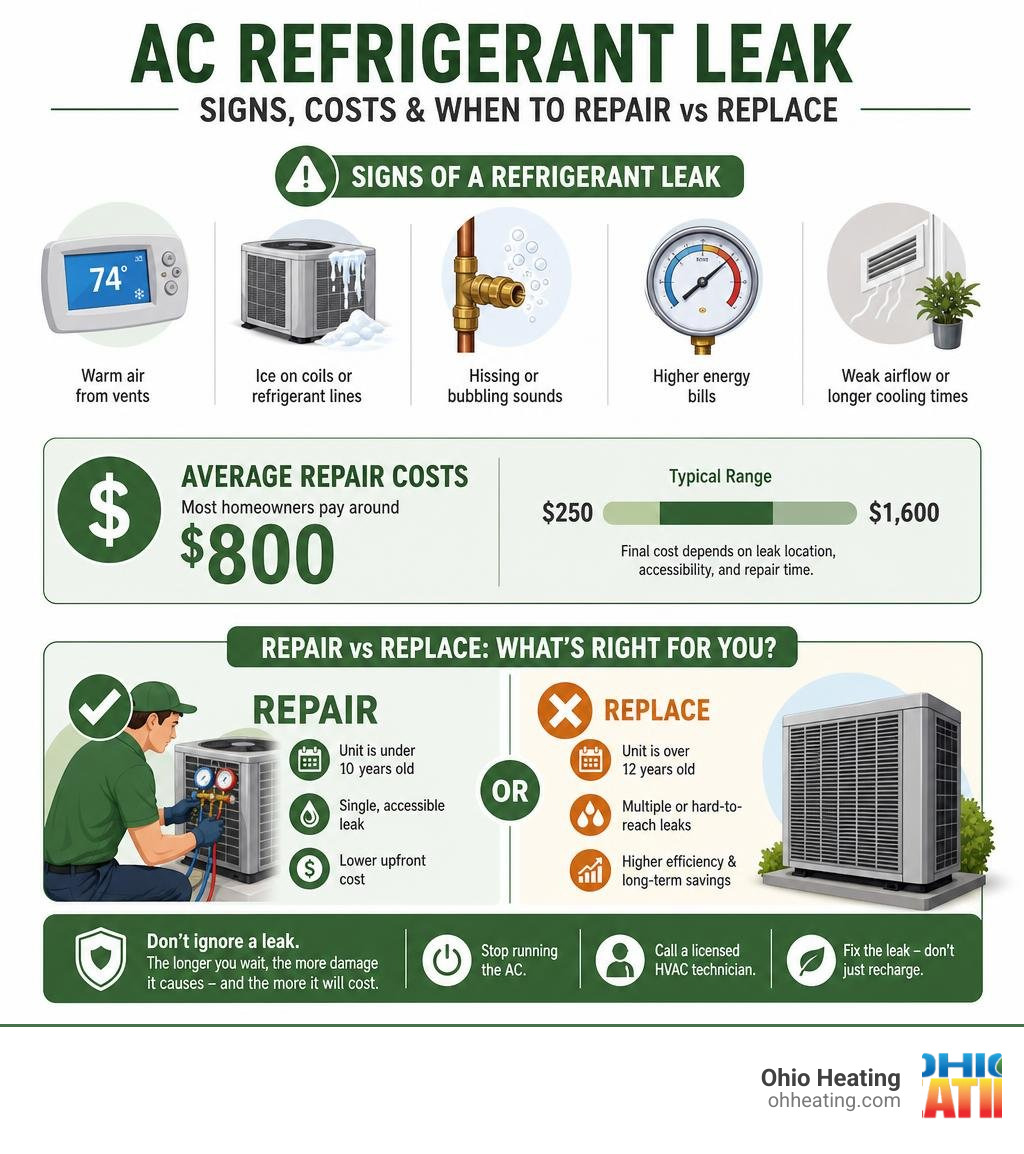
- Stop running the AC. Operating a system with a known refrigerant leak can destroy the compressor.
- Call a licensed HVAC technician. Federal law requires EPA Section 608 certification to handle refrigerants — this is not a DIY repair.
- Do not just recharge the system. Adding refrigerant without fixing the leak is a temporary fix that wastes money and damages the environment.
- Expect to pay $250–$1,600 for professional repair, with most homeowners paying around $800.
- Repair vs. replace: If your unit is under 10 years old with a single accessible leak, repair is usually the right call. Over 12 years old with multiple leaks? Replacement may cost less in the long run.
A refrigerant leak does not fix itself. The longer you wait, the more damage it causes — and the more expensive the repair becomes.
I’m Jill Frattini, Service Coordinator at Ohio Heating in Columbus, OH, with several years of experience coordinating AC leak repair diagnostics and service calls for residential and commercial cooling systems. In this guide, I’ll walk you through everything you need to know — from spotting the signs of a leak to understanding your repair options.
Ac leak repair vocab explained:
- ac technician near me
- air conditioner repair
Understanding AC Refrigerant Leaks and Why They Occur
Many homeowners think refrigerant is like the gasoline in a car—something that naturally gets used up and needs to be topped off every now and then. In reality, your air conditioner is a closed-loop system. The refrigerant flows back and forth between your indoor evaporator coils and your outdoor condenser unit in a continuous cycle, carrying heat out of your home.
If your refrigerant level is low, it means only one thing: you have a leak.
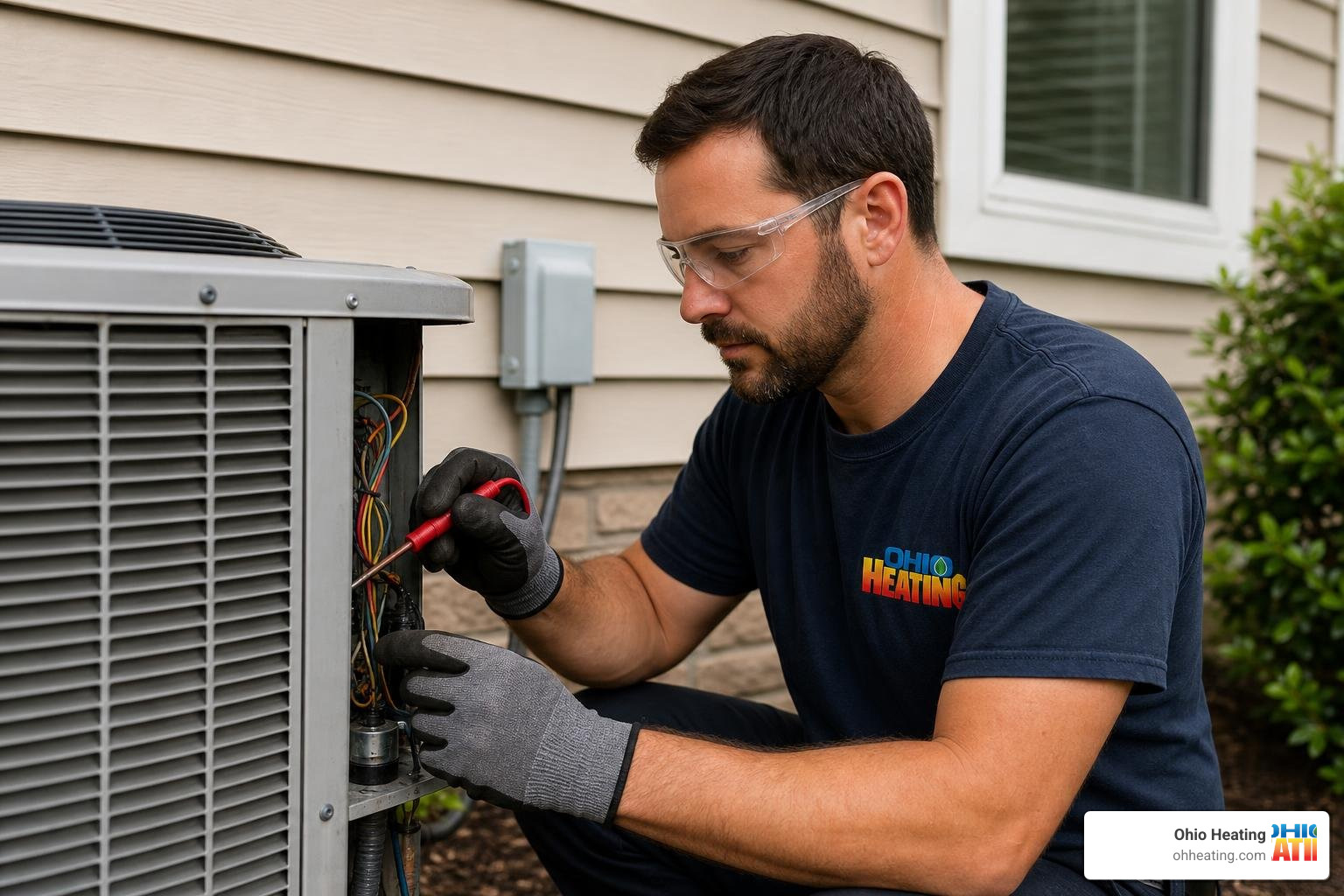
Refrigerant leaks are not uncommon and may occur gradually over 5 to 15 years. But why do they happen? Here are the primary culprits:
- Formicary Corrosion: This is the most common cause of pinhole leaks in copper coils. When copper reacts with household chemicals (like air fresheners, cleaning products, cosmetics, and paints) combined with moisture, it creates a microscopic chemical reaction that eats away at the metal.
- Vibration Damage: When your air conditioner is running, it vibrates. Over time, these constant micro-movements can cause copper lines to rub against each other or the metal casing of the unit, eventually wearing a hole right through the line.
- Weak Joint Connections: Your AC lines are joined together by brazing (a high-temperature welding process). If a joint wasn’t sealed perfectly during installation, or if thermal expansion and contraction weaken the joint over several years, a leak can develop.
- Environmental Factors: In Central Ohio, our outdoor units face everything from scorching summer humidity to nesting pests. Acidic dog urine on the outdoor condenser coil is a surprisingly frequent cause of localized corrosion and subsequent leaks.
Is AC Refrigerant Toxic or Dangerous?
Modern residential air conditioners in 2026 primarily use refrigerants like R-410A or newer alternatives like R-32. While these are significantly safer for the ozone layer than the old R-22 (Freon) systems, they are still chemical substances that require careful handling.
R-410A is not inherently toxic in low concentrations, but it poses a physical hazard if a major leak occurs in an enclosed space. Because refrigerant is heavier than air, a sudden, massive leak can displace oxygen in a room, leading to asphyxiation. Additionally, direct skin contact with escaping liquid refrigerant can cause severe frostbite.
From an environmental standpoint, venting refrigerant is illegal. It is a potent greenhouse gas, which is why federal environmental regulations strictly govern its recovery and disposal.
How Often Does a Home AC System Need a Recharge?
If your system is healthy and sealed, the answer is never.
Because an air conditioner is a hermetically sealed system, the refrigerant charge should last for the entire lifespan of the unit. You should only need a refrigerant recharge if a leak has developed and has been properly repaired. If an HVAC technician suggests simply “topping off” your refrigerant every summer without offering to find and fix the leak, they are costing you money and violating environmental practices.
Common Signs You Need AC Leak Repair
When your refrigerant levels drop, your air conditioner has to work twice as hard to do half the job. Knowing the early warning signs can save you from a complete system breakdown on a humid July afternoon in Columbus.
Here are the classic symptoms that call for professional ac leak repair:
- AC Blowing Warm Air: When there isn’t enough refrigerant to absorb heat from your indoor air, the air coming out of your vents will feel lukewarm or even hot. If you notice your AC blowing warm air, it is time to investigate.
- Ice Buildup on the Unit: This seems counterintuitive. How can a low refrigerant level cause ice? When refrigerant levels drop, the pressure inside the evaporator coil drops too. This causes the coil to get freezing cold, turning the condensation on the outside of the coil into solid ice. You might see ice on the indoor coil or on the copper line set running to the outdoor unit.
- Hissing or Bubbling Sounds: If you have a larger leak, you might actually hear the physical escape of the pressurized gas. A high-pitched hissing sound usually indicates a gas leak, while a bubbling sound suggests a leak in a line where the refrigerant is in a liquid state.
- Spiking Utility Bills: If your electric bill suddenly shoots up but your home doesn’t feel any cooler, your system is likely running constantly to try and make up for the lost cooling capacity.
For a deeper look into identifying these issues, check out our guide on the Signs Your Air Conditioning Needs Repair.
Identifying an AC Leak Repair Issue Early
Catching a leak early prevents a cascade of mechanical failures. When refrigerant is low, the compressor (the “heart” of your AC) has to work harder and run hotter. This extra strain can lead to short cycling—where the unit turns on and off rapidly—or can cause the compressor to overheat and fail entirely.
If you notice your home is taking much longer to cool down than usual, or if you find your AC won’t turn on after a period of poor performance, a low-pressure safety switch may have tripped to protect the compressor from running dry.
Water Leaking Inside vs. Refrigerant Leaks
It is incredibly common for homeowners to confuse a water leak with a refrigerant leak. If you see a puddle of water around your indoor air handler, it is usually not refrigerant (which evaporates into a gas at room temperature).
Instead, water pooling is typically caused by a clogged condensate drain line. As your AC cools the air, it removes moisture. That moisture drips into a condensate pan and flows out through a drain line. If algae, dirt, or dust clogs that line, the water backs up and overflows.
However, a frozen evaporator coil (caused by a refrigerant leak) will eventually thaw when the system turns off, releasing a massive amount of water all at once that can overwhelm your drain pan. If you are dealing with water pooling, read our troubleshooting tips for an AC leaking water inside to help identify the root cause.
How Professionals Diagnose and Fix AC Leaks
Finding a microscopic pinhole leak in a complex air conditioning system can feel like finding a needle in a haystack. Professional technicians use specialized tools to pinpoint the exact location of the leak before performing any repairs.
| Method | How It Works | Best For | Pros & Cons |
|---|---|---|---|
| Electronic Leak Detector | A highly sensitive hand-held “sniffer” detects the chemical signature of refrigerant in the air. | Quick, non-invasive initial searches. | Pros: Fast and highly accurate for open areas. Cons: Can give false positives near certain household chemicals. |
| Soap Bubble Test | A specialized soap solution is sprayed onto joints and coils. Escaping gas creates visible bubbles. | Confirming the exact spot of a suspected leak. | Pros: Low-cost, visual confirmation. Cons: Only works if the leak is in an easily accessible, visible location. |
| Nitrogen Pressure Test | The remaining refrigerant is removed, and the system is pressurized with dry nitrogen gas to listen and watch for pressure drops. | Hard-to-find leaks or verifying a complete repair. | Pros: Incredibly precise; can isolate specific sections of the system. Cons: Requires evacuating the system, which takes more time. |
| UV Dye Injection | A fluorescent dye is injected into the refrigerant cycle. A UV light is used to trace where the glowing dye escapes. | Slow, microscopic, or intermittent leaks. | Pros: Great for leaks that only appear when the system is running hot. Cons: Requires the system to run with the dye for several days first. |
The Professional AC Leak Repair Process
Once the leak is located, the actual ac leak repair process begins. This is a highly technical procedure that must be performed by an EPA Section 608 certified technician to comply with federal clean air laws.
- Refrigerant Recovery: The technician uses a recovery machine to safely pump all remaining refrigerant out of the system into a certified holding cylinder. It is illegal to vent refrigerant into the atmosphere.
- Preparing the Line: The damaged section of copper tubing or the compromised joint is cleaned and prepared. If the leak is in the evaporator coil, the entire coil assembly may need to be pulled out.
- Brazing the Repair: Using an oxygen-acetylene torch and a silver alloy filler rod, the technician brazes the leak shut or splices in a brand-new section of copper tubing.
- Pressure and Vacuum Testing: The system is pressurized with nitrogen to ensure the new weld holds perfectly. Next, a deep vacuum is pulled using a vacuum pump to remove all air, nitrogen, and moisture from the lines. Moisture is highly destructive to an AC system because it can mix with compressor oil to create acid.
- Refrigerant Recharge: Once the vacuum holds steady (proving there are no remaining leaks), the technician weighs in a fresh charge of refrigerant to the manufacturer’s exact specifications.
To learn more about what this service looks like in practice, explore our detailed breakdown of an AC refrigerant leak fix.
DIY AC Leak Sealants vs. Professional Repair
If you search online, you will find plenty of DIY products, such as direct-inject sealants designed to seal small leaks from the inside out. Some of these chemical formulas have sold millions of units, including products like the Leak Savers 6-Pack or the Leak Savers UV Direct Inject.
While these polymer-free sealants can be highly effective as a temporary fix for micro-leaks in older, out-of-warranty systems, they are not a permanent substitute for a professional repair.
If you do choose to use a sealant on an older unit to buy yourself some time before a full replacement, always ensure it is a high-quality, professional-grade product that is fully compatible with your specific refrigerant type.
Cost Factors and Repair vs. Replace Decisions
How much does ac leak repair actually cost? On average, most homeowners in Columbus and Central Ohio pay around $800 for a professional leak repair and recharge. However, the price can range from $250 to $1,600 depending on several factors:
- Location of the Leak: A simple leak on an exposed copper line joint is quick and easy to braze. A leak buried deep inside the indoor evaporator coil is much harder to access and repair.
- Refrigerant Type: Older systems running on R-22 are incredibly expensive to service because R-22 has been phased out and is in very limited supply. Upgrading or repairing an R-22 system can cost hundreds of dollars more in refrigerant costs alone compared to modern R-410A or R-32 systems.
- Labor Rates: HVAC labor rates typically range from $100 to $250 per hour depending on the complexity of the job and the region.
- System Size: Larger systems require more refrigerant to reach the proper operating charge, which increases the material cost of the repair.
When to Replace Your AC Compressor or Coil
If the leak is located in your evaporator coil or condenser coil, you will have to choose between replacing the damaged coil or replacing the entire air conditioning system.
If your air conditioner is under 10 years old and still under parts warranty, replacing the coil is almost always the most cost-effective choice. However, if your system is over 12 to 15 years old, the coils are likely heavily corroded. Replacing just one coil on an aging system often leads to another leak developing in the other coil shortly after.
Furthermore, if the system was run with low refrigerant for an extended period, the compressor may have suffered severe thermal damage. In these cases, investing in a Residential AC compressor repair or a full system replacement is a wiser long-term investment. While a major repair can cost up to $2,000, a complete central AC replacement typically ranges from $3,900 to $8,030 on average, giving you a brand-new warranty and vastly superior energy efficiency.
Can I run my air conditioner if it has a refrigerant leak?
No. You should turn off your air conditioner immediately if you suspect a refrigerant leak.
Running an AC with low refrigerant causes the system to run continuously without cooling your home. This places immense strain on the compressor. Because the compressor relies on the cool returning refrigerant gas to keep itself from overheating, running it with low refrigerant levels will quickly burn it out, turning a moderate repair bill into an expensive system replacement.
Conclusion
An AC refrigerant leak is not an issue you can safely ignore. It is a progressive problem that will continue to waste energy, harm the environment, and threaten the life of your compressor until it is professionally resolved.
The absolute best way to prevent future refrigerant leaks is through regular, proactive maintenance. During an annual tune-up, our technicians check your refrigerant levels, inspect your coils for early signs of corrosion, and ensure your line set is securely isolated from vibration.
If you suspect your cooling system has a leak, don’t wait for the hot Ohio summer to take its toll. At Ohio Heating, we have been keeping Columbus and Central Ohio comfortable since 1999. Our EPA-certified technicians will accurately diagnose your system, present you with honest options, and perform a lasting repair.
Schedule professional AC repairs with Ohio Heating today, or protect your system year-round with our comprehensive AC maintenance plan.