
Sheet Metal Fabrication in Columbus, Ohio: When Stock Ductwork Is the Problem
Sheet metal fabrication in Columbus, Ohio rarely crosses a building owner’s mind until the morning a piece doesn’t fit, and from that point on it’s the only thing anyone on site wants to talk about.
It tends to come up in common ways: a rooftop unit craned down onto a curb that doesn’t match it, a remodel that drops a beam exactly where the trunk line needs to run, or a new furnace with a bigger blower that a twenty-year-old return can’t feed.
Once you’re in that position, you can force stock fittings into place with a stack of adapters and a length of flex, or you can have the piece built for the building you actually have. Custom work usually goes in faster, and it holds up better once the system runs.
What sheet metal fabrication in Columbus, Ohio actually solves
The core issue is airflow. Every fitting, transition, and elbow you add puts more resistance in the path, and resistance is what your blower spends its life fighting.
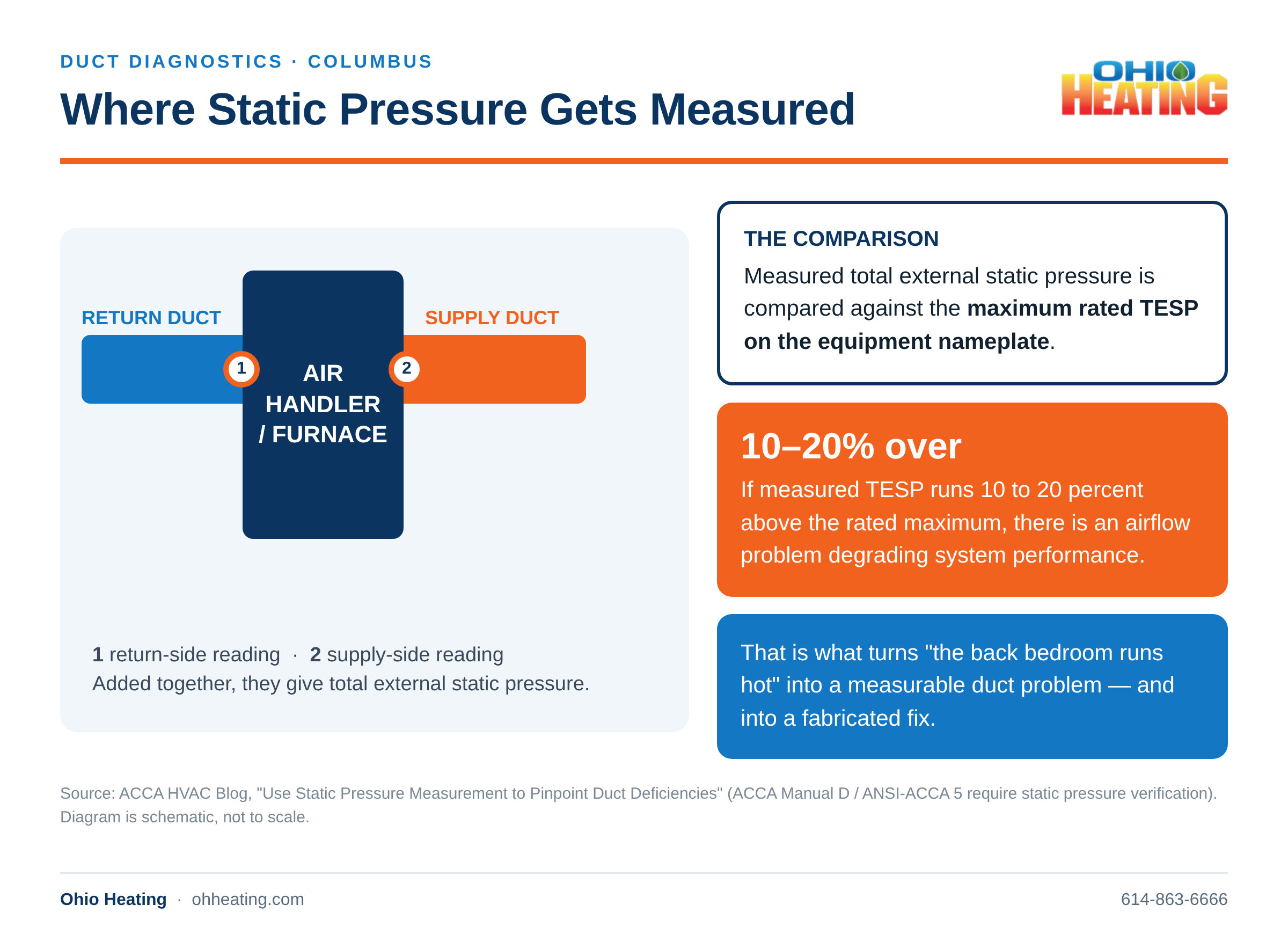
ACCA’s Manual D and ANSI/ACCA 5 require static pressure measurement to verify that an installed system performs. Measured total external static pressure is compared to the equipment’s rated maximum (ACCA HVAC Blog). If measured pressure runs 10 to 20 percent above that maximum, there is an airflow problem degrading performance (ACCA).
That number turns a vague complaint into something you can measure. “The back bedroom runs hot.” “The unit ices up.” “The blower is loud.” Very often the fix is metal, not equipment.
| Symptom | Common duct cause | What fabrication fixes |
|---|---|---|
| High total external static pressure. | Undersized return, sharp transitions, or crushed flex. | A properly sized return drop and smooth transitions. |
| Hot or cold rooms at the end of a run. | Trunk sized for a smaller load, or a run added later. | A resized trunk and correctly sized takeoffs. |
| Loud registers or a whistling system. | Air velocity too high for the duct size. | Larger sections at the noisy segments. |
| Coil icing in cooling season. | Airflow starved across the coil. | Return-side work that restores design airflow. |
| Rooftop unit will not seat on the old curb. | A replacement unit with a different footprint. | A curb adapter matched to both. |
| Duct cannot clear a beam, joist, or new wall. | Remodels, tenant fit-outs, building geometry. | An offset or flat oval section made for that space. |
Every one of those is a metal problem with a metal solution. Adapters and flex will get you through the afternoon, but precision sheet metal fabrication is what actually fixes it.
Rectangular, round, and flat oval
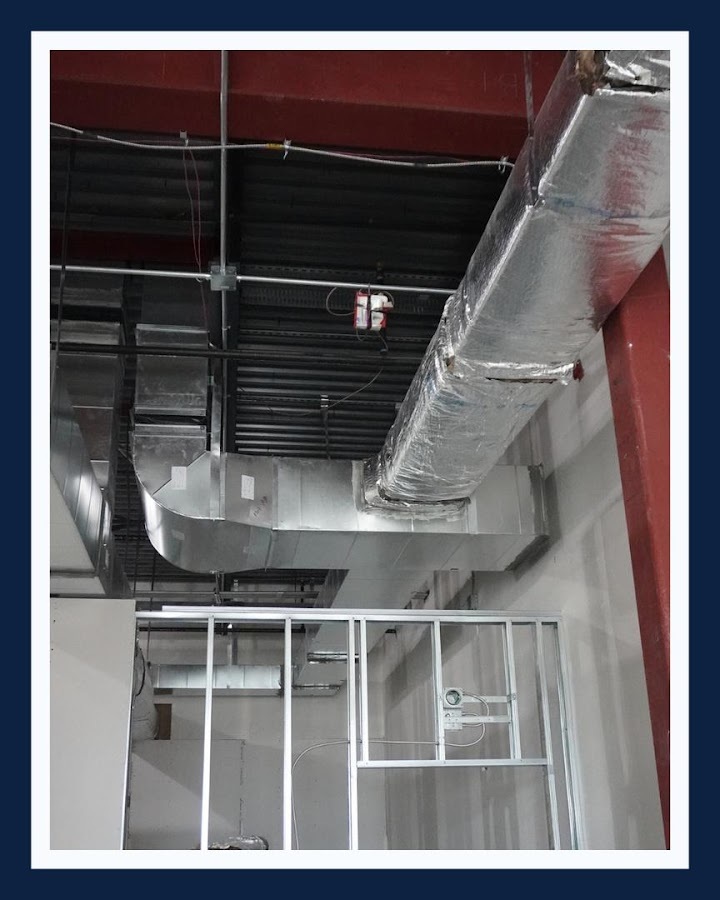
Duct construction is a precision trade. SMACNA’s HVAC Duct Construction Standards, Metal and Flexible covers rectangular, round, and flat oval work. It also covers joining, support, and flexible duct installation (SMACNA). A shop that builds to that standard is working to a written spec, producing precision metal for the job.
The shape matters more than people expect:
- Rectangular fits tight ceiling cavities and runs easily against structure. That is why it dominates trunk lines in finished spaces.
- Round spiral moves air better for the same cross-section. It also looks clean when exposed, which suits restaurants, breweries, and open offices around central Ohio.
- Flat oval is the middle ground for shallow spaces that still want round-like performance. SMACNA’s fourth edition added flat oval tables for positive and negative pressure work (SMACNA).
Choosing among them is a design decision. It depends on the space, the pressure class, and how much static budget is left. That is why fabrication and design belong on the same job.
Where a sheet metal fabrication shop earns its keep
On commercial work the custom pieces are rarely straight duct, but rather the parts nobody typically stocks. This includes curb adapters, plenum boxes, hoods and shrouds, transitions between two mismatched pieces of equipment, access sections placed where a technician can actually reach a damper, and stands that hold a unit level on an uneven roof.
Field measurement is necessary to make sure those parts fit. A shop that builds from as-built dimensions avoids the classic Wednesday problem- the part matches the drawing but not the building, because multiple change orders came after the drawing.
Planning a larger replacement? Our commercial HVAC system upgrades page covers how the metal scope fits the rest of the project.
Custom metal fabrication without measurement is guessing
The failure we see most is a duct system changed over the years with no testing. Rooms get added, registers get closed, and flex gets stuffed behind a joist. Each change made sense alone, but together they create a system that fights itself.
A measurement-first order keeps that from happening:
- Measure total external static pressure. Compare it to the equipment nameplate rating (ACCA).
- Split the reading into supply side and return side, so you know which half is the problem.
- Take room-by-room airflow readings, so the fix targets the rooms that are starved.
- Design the fabricated pieces to those numbers, built to SMACNA standards.
- Measure again after installation. Confirm the system is inside its rated range.
Step five often gets forgotten or overlooked, but it is the only proof the work did what it was meant to do.
Testing and adjusting the whole system is its own trade. If your complaint is uneven comfort rather than a breakdown, start with HVAC air balancing and the air balance report that documents it.
Want the duct problem measured before anyone quotes new equipment? Ask us to take the readings first.
Frequently asked questions
When is custom ductwork worth it instead of stock fittings? Any time the stock answer needs a chain of adapters or a long run of flex. Each of those adds resistance, and static pressure measurement exposes it (ACCA).
How do I know my duct system is undersized? Measure it. If total external static pressure is 10 to 20 percent above the equipment’s rated maximum, the ducts are restricting airflow (ACCA).
What standard should fabricated duct be built to? SMACNA’s HVAC Duct Construction Standards, Metal and Flexible covers rectangular, round, and flat oval construction, plus joining, sealing, and support (SMACNA).
Is round duct better than rectangular? Round performs better per unit of cross-section, but it needs depth. Flat oval exists for shallow spaces. SMACNA publishes construction tables for it (SMACNA).
Can new ductwork fix hot and cold rooms? Often, yes. That holds when the cause is an undersized trunk, poor takeoffs, or crushed flex. Confirm it with measurement first, then verify with balancing after.
Do I need custom metal fabrication if I am only replacing equipment? Sometimes. A new unit’s blower and cabinet rarely match the old one exactly. The transitions at those connections are usually where custom metal is needed.