
Why a Flooded Basement Is a Risk You Can’t Afford to Ignore
If you need to install a back up sump pump, here’s the short answer:
- Place the backup pump in the same sump pit as your primary pump.
- Set its float switch higher than the primary pump’s float.
- Connect a separate discharge line with a check valve.
- Hook it up to a deep-cycle marine battery (battery-powered) or your cold water supply line (water-powered).
- Test it by unplugging the primary pump and filling the pit with water.
Basement flooding is one of the most expensive problems a property owner can face. Remediation costs routinely exceed $25,000 — and the damage often happens fast, during the exact moments your primary sump pump can’t keep up.
The problem? Primary sump pumps run on electricity. When a storm knocks out the power, your pump stops working right when you need it most. Weather-related power outages from 2014 to 2023 were nearly double the number recorded from 2000 to 2009. That trend isn’t slowing down.
A backup sump pump is your safety net. It kicks in automatically when the primary pump fails — whether from a power outage, a stuck float switch, or a pump that simply gets overwhelmed by heavy rain.
I’m Jill Frattini, Service Coordinator at Ohio Heating (specializing in professional air conditioning and cooling solutions) in Columbus, OH, and I’ve spent years working with homeowners and property managers across Central Ohio who’ve learned the hard way why it’s worth knowing how to install a back up sump pump before disaster strikes. In this guide, I’ll walk you through everything you need to make the right choice and get it done.
Important install back up sump pump terms:
- indoor sewage pump system
- sump pump replacement
- sump pump services
Why You Need to install back up sump pump Systems in 2026
When heavy seasonal rains hit Central Ohio, water pressure builds up against your home’s foundation. Your primary sump pump is your first line of defense, but relying on a single mechanical device powered by the local grid is a major gamble.
If your primary pump fails, water quickly fills the pit and overflows onto your basement floor. This moisture is a direct threat to your home’s structural integrity, but it also directly impacts your indoor comfort systems. In many Columbus homes, the indoor components of your central air conditioning system—including the blower motor, sensitive electrical control boards, and the evaporator coil—are located in the basement.
A flooded basement can completely submerge and ruin these expensive AC components. Furthermore, standing water creates a breeding ground for mold and mildew, which your AC system will then distribute throughout your home, destroying your indoor air quality. Taking the time to install a back up sump pump is one of the smartest ways to protect your cooling system investment and keep your home safe.
For a deeper dive into how primary systems work, check out our guide on Sump Pump 101: Shielding Your Basement with Reliable Pump Types and Maintenance.
When Are Backup Sump Pumps Necessary?
Backup sump pumps are not a luxury; they are a necessity for homes with active sump pits, high water tables, or finished basements. They become absolutely critical during:
- Power Outages: Severe summer storms in Ohio frequently knock out power lines. Without utility power, your primary pump is useless.
- Primary Pump Overload: During extreme downpours, the sheer volume of water entering the pit can exceed what a single primary pump can handle. A backup pump acts as a second engine to double your pumping capacity.
- Mechanical Failures: Sump pumps are mechanical devices with moving parts. Switches wear out, motors burn out, and impellers clog.
If you are already experiencing issues with your current setup, you can learn more about professional intervention in The Ultimate Guide to Sump Pump Repair and Replacement.
Signs Your Primary Sump Pump Needs to Be Replaced
Before you add a backup, you must ensure your primary pump is in good working order. If your primary pump is showing any of the following warning signs, it may be time for a full replacement:
- Age over 7 years: Most residential submersible pumps have a lifespan of 5 to 15 years, but reliability drops significantly after year 7.
- Unusual noises: Rattling, grinding, or squealing noises point to worn-out bearings or a damaged impeller.
- Frequent cycling: If your pump turns on and off every few seconds, it is short-cycling, which wears out the motor prematurely.
- A stuck float switch: The float switch is the most common point of failure. If it hangs up on the side of the pit, the pump won’t run.
If you notice these signs, explore our sump pump sales services to get your primary system updated.
Comparing Battery-Powered vs. Water-Powered Backup Systems
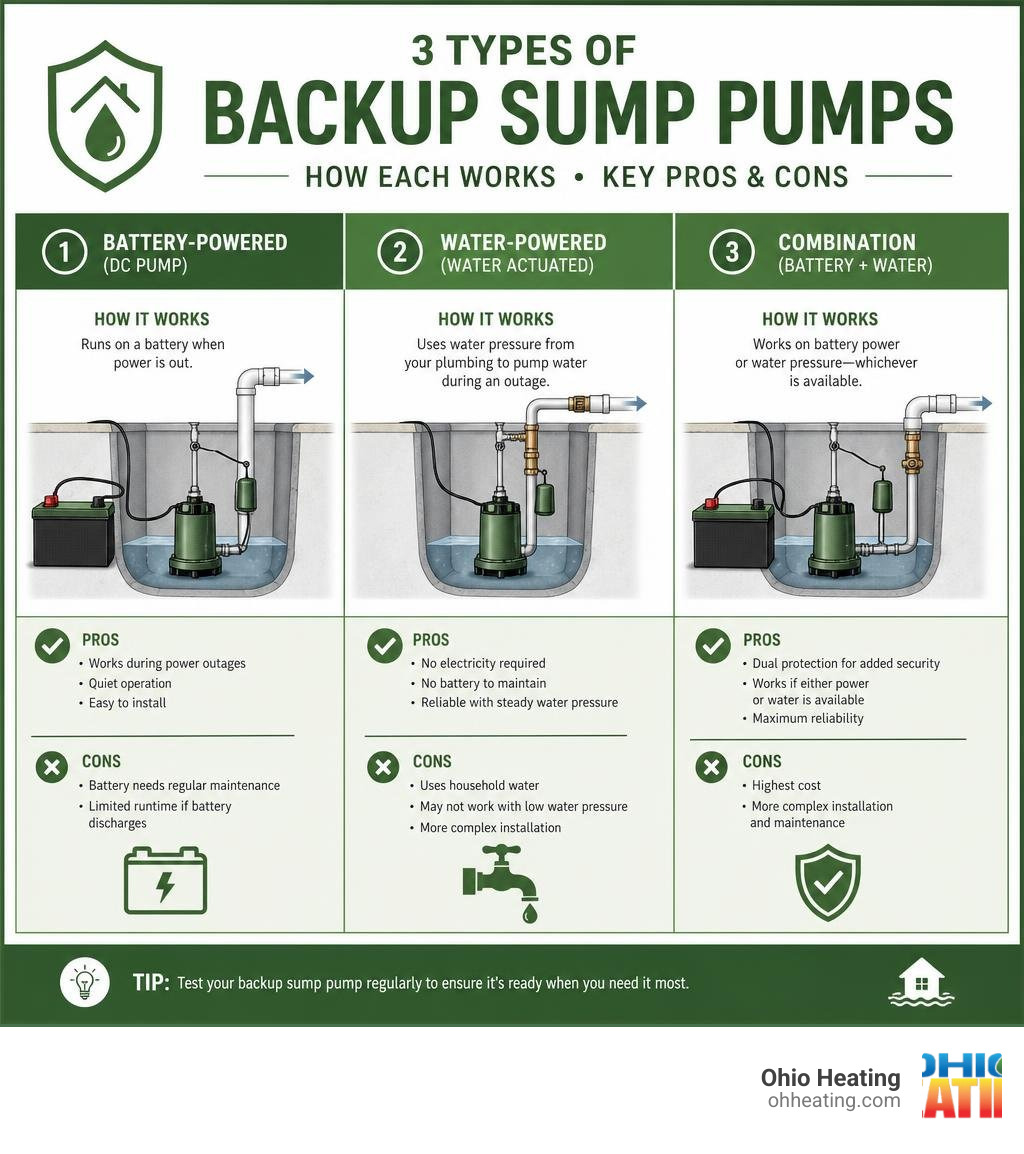
When looking to install a back up sump pump, you will primarily choose between two systems: battery-powered and water-powered.
| Feature | Battery-Powered Backup | Water-Powered Backup |
|---|---|---|
| Power Source | 12V Deep-Cycle Marine Battery | Municipal Water Pressure |
| Runtime | 7 to 8 hours of continuous pumping (days of intermittent use) | Unlimited (as long as municipal water flows) |
| Pumping Capacity | High (800 to 2,000+ GPH) | Moderate (varies with water pressure) |
| Water Usage | None | Uses 2 gallons of tap water per 1 gallon of sump water removed |
| Maintenance | Moderate (battery testing & replacement) | Low (no battery to maintain) |
| Well Water Compatible | Yes | No (requires municipal water pressure) |
How to Choose and install back up sump pump Systems
Selecting the right system depends on your home’s layout, your budget, and your water source.
For battery-powered systems, you can opt for standalone backup pumps or combination systems. Combination systems, like the DRY-Up Sump Pump Complete System (with barrel and battery backup pump) – 1/3 HP – Do-It-Yourself Basement Solutions , come pre-assembled with both the primary and backup pumps plumbed together in a single unit. This makes installation much simpler for DIYers.
When sizing your backup pump, you must match or exceed the Gallons Per Hour (GPH) capacity of your primary pump while accounting for “vertical lift” (the height the pump must push water up and out of the basement). Look for pumps constructed of cast iron rather than thermoplastic; cast iron dissipates heat much better, extending the life of the motor.
Modern high-end backups also feature smart WiFi monitoring, sending real-time alerts to your smartphone if the primary pump fails, if the battery is running low, or if a clog is detected. For more tips on fundamental pump installation, you can read How to Install a Sump Pump – This Old House .
Benefits and Drawbacks of Each Backup Type
Battery-Powered Systems
- Pros: Extremely high flow rates; works in any home (regardless of water source); easy low-voltage wiring.
- Cons: Batteries have a finite runtime (typically 7 to 8 hours of active, continuous pumping) and must be replaced every 3 to 5 years.
Water-Powered Systems
- Pros: Unlimited runtime because they do not rely on batteries; incredibly reliable with minimal moving parts.
- Cons: They require high, consistent municipal water pressure to create suction and cannot be used in homes with well water. They also use your clean municipal water to eject the dirty sump water, typically consuming 2 gallons of tap water for every 1 gallon of sump water removed. This can lead to a high water bill during prolonged use.
To learn more about the physical installation of battery backups, see How To Install a Battery-Operated Backup Sump Pump – This Old House .
Step-by-Step DIY Installation and Maintenance Guide
Before starting your DIY project, gather the necessary tools and materials:
- Backup sump pump kit (with float switch and controller)
- 12V deep-cycle marine battery (AGM or flooded lead-acid) and a protective plastic battery box
- 1.5-inch PVC pipe, PVC primer, and PVC cement
- Two high-quality check valves (one for each pump)
- Teflon tape and silicone sealant
- Hacksaw or PVC pipe cutter
- Screwdriver, tape measure, and zip ties
If your home has an active radon mitigation system, your sump pit lid will be sealed airtight. You will need to carefully cut the silicone seal around the lid, drill a new hole for the backup discharge pipe, and use fresh silicone sealant to restore the airtight radon barrier once your installation is complete. You can learn more about local utility and environmental guidelines in Columbus from Sump Pump – Blueprint Columbus .
Step-by-Step: How to install back up sump pump Systems Yourself
Follow these steps to install a battery-powered backup system:
- Disconnect the Power: Unplug your primary sump pump to avoid any electrical hazards while working in the pit.
- Clean the Pit: Remove any rocks, dirt, or debris from the bottom of the sump pit that could clog the pumps.
- Install the Check Valves: Apply Teflon tape to the threads of your check valves. Install one check valve on the primary pump’s discharge outlet and another on the backup pump’s outlet. Check valves prevent water from flowing back down into the pit.
- Position the Backup Pump: Place the backup pump in the pit. Set its float switch slightly higher than the primary pump’s float switch. This ensures the backup only turns on if the water rises past the primary pump’s normal activation point.
- Connect the Discharge Pipes: Cut your 1.5-inch PVC pipe to size. Connect the discharge lines of both pumps using a “Wye” fitting so they share the main discharge line leading out of your home. Secure all connections with PVC primer and cement.
- Set Up the Battery: Place the deep-cycle battery inside its protective plastic box on a shelf or elevated surface near the pit (never directly on the basement floor where water could reach it).
- Make Low-Voltage Connections: Connect the backup pump’s power cables to the battery terminals, matching positive (red) to positive and negative (black) to negative. Plug the battery charger/controller into a dedicated, non-switched GFCI outlet.
- Test the System: Fill the sump pit with a bucket of water to test the primary pump first. Next, unplug the primary pump and continue filling the pit. Verify that the backup pump activates automatically once the water reaches the higher float switch and successfully clears the pit.
For additional perspectives on battery-powered installations, you can read Sump Pump Installation: Basement Protection Guide 2026 .
Steps to Install a Water-Powered Backup Sump Pump
If you opt for a water-powered system, the process is slightly different:
- Mount the Pump: Water-powered pumps are typically mounted higher up in the sump pit or even on the ceiling joist above the pit.
- Tap into the Cold Water Line: Run a dedicated cold-water supply line (usually 3/4-inch copper or PEX) from your home’s main water line to the inlet of the backup pump.
- Install a Backflow Preventer: You must install a code-compliant backflow prevention valve on this water line. This prevents dirty sump water from ever siphoning back into your home’s clean drinking water supply.
- Connect the Suction Pipe: Run a suction pipe from the water-powered pump down to the bottom of the sump pit, equipping it with a strainer to keep debris out.
- Route the Discharge Line: Connect a separate discharge line from the pump to the exterior of your home. Because water-powered systems combine sump water with municipal water, they discharge a high volume of water and require their own dedicated exit line.
- Test the Water Pressure: Turn on the water supply and lift the float switch manually to ensure the municipal water pressure creates strong suction, drawing water out of the pit.
While water-powered backup sump pumps typically cost between $200 and $900 for the unit itself, professional plumbing modifications to tap your main water line can add to the total project cost.
Maintaining Your Backup Sump Pump for Long-Term Reliability
Your backup pump is only useful if it works when the power goes out. Keep it in top shape with these simple maintenance habits:
- Quarterly Testing: At least once every three months, unplug your primary pump and pour five gallons of water into the pit to make sure the backup pump kicks on and pumps the water out.
- Clean Battery Terminals: Inspect battery terminals annually. Clean off any corrosion with a wire brush and a mixture of baking soda and water.
- Monitor Battery Lifespan: Even high-quality AGM batteries lose their charge capacity over time. Plan to replace your backup battery every 3 to 5 years.
- Keep the Pit Clean: Periodically check the pit for silt, debris, or toys that could block the float switches from moving freely.
Taking these proactive steps will help you Minimize Plumbing Problems and keep your basement dry year-round.
Frequently Asked Questions About Backup Sump Pumps
Can I install a backup sump pump if my pit is sealed for radon?
Yes. Many Central Ohio homes require radon mitigation systems, which use a sealed sump lid. To install a backup, you must carefully slice the existing silicone seal to remove the lid. Drill a new hole through the lid that matches the diameter of your backup discharge pipe. Once the backup pump is installed, run the new pipe through the hole, and apply a generous bead of high-quality silicone sealant around the pipe penetration and the entire perimeter of the lid to ensure it is completely airtight.
Do water-powered backup pumps work with well water?
No. Water-powered backup pumps require consistent municipal water pressure (usually at least 40 to 50 PSI) to function. If your home uses well water, your well pump runs on electricity. During a power outage, your well pump will shut down, leaving you with zero water pressure to run a water-powered backup. If you are on a well system, a battery-powered backup is your only reliable option.
How long does a backup battery typically last during an outage?
A fully charged, high-quality deep-cycle marine battery typically provides 7 to 8 hours of active, continuous pumping time. Because sump pumps run intermittently rather than constantly (usually cycling on for a minute or two every 10 to 15 minutes during a storm), a healthy battery backup system can easily protect your basement for several days of intermittent power loss.
Conclusion
Installing a backup sump pump is one of the most effective ways to protect your basement from devastating water damage. Beyond saving your drywall and personal belongings, keeping your basement dry protects the indoor air conditioning equipment that keeps your home cool and comfortable during hot, humid Ohio summers.
While a DIY installation is a rewarding weekend project for an experienced homeowner, we understand that handling plumbing lines, backup batteries, and municipal water connections can feel overwhelming.
If you prefer the peace of mind that comes with professional installation, we are here to help. At Ohio Heating, we have served Columbus and Central Ohio since 1999, providing expert air conditioning and cooling system protection services to ensure your home remains safe, dry, and comfortable no matter what the weather brings. Contact us today to schedule your professional backup sump pump installation through our sump pump sales services.