
Why Air Handler Control Is the Heart of Your Commercial Cooling System
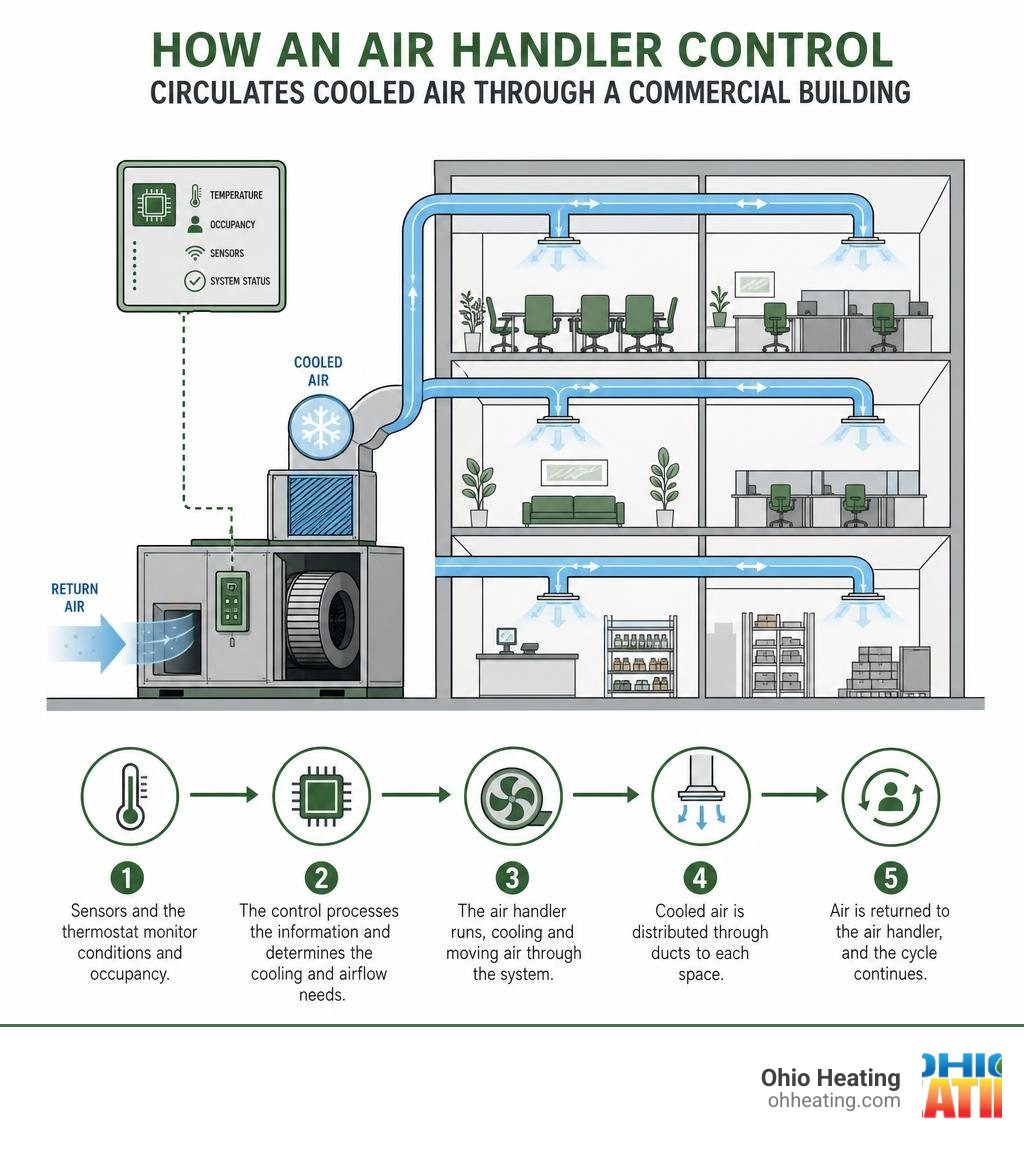
Air handler control is the system that tells your indoor HVAC unit when to run, how fast to move air, and how to respond to temperature and occupancy changes — all automatically.
If you manage a commercial property, here is what you need to know at a glance:
| What It Does | Why It Matters |
|---|---|
| Signals the blower motor to start and stop | Keeps conditioned air moving through your building |
| Reads thermostat and sensor inputs | Responds to actual conditions, not guesswork |
| Coordinates with the AC system | Ensures cooling happens at the right time and capacity |
| Manages fan speed and airflow | Reduces energy waste and hot/cold spots |
| Triggers safety shutdowns | Protects equipment and occupants |
Cooling system operation accounts for a massive portion of a commercial facility’s energy consumption. That means a poorly controlled air handler is not just a comfort problem — it is a budget problem.
Most building owners only think about their air handler when something breaks. By then, the damage is already done: occupants are uncomfortable, equipment has been strained, and repair bills are higher than they needed to be.
I’m Jill Frattini, Service Coordinator at Ohio Heating in Columbus, OH, with several years of hands-on experience coordinating air handler control service, repair, and installation for commercial clients. In this guide, I’ll walk you through everything you need to know to keep your system running efficiently and reliably.
Terms related to air handler control:
What is an Air Handler and How Does It Manage Cooling?
To understand air handler control, we first need to understand what an air handler actually does. Think of your air conditioner as a team. The outdoor condenser unit is the powerhouse that rejects heat, but the indoor air handler is the delivery driver. It is the component responsible for circulating, cooling, filtering, and regulating the air before it flows through your ductwork.
In a typical split-system air conditioner, the air handler houses several critical parts that work in perfect harmony:
- Evaporator Coil: This coil is filled with cold refrigerant. As warm indoor air is pulled across the coil, the refrigerant absorbs the heat, leaving the air beautifully chilled and ready for distribution.
- Blower Motor: The fan that physically moves the air. It pulls warm, humid air from your rooms through the return ducts and pushes the newly cooled air back out.
- Air Filter: Positioned before the coil, it traps dust, pollen, and airborne particles, protecting both your indoor air quality and the delicate fins of the evaporator coil.
- Expansion Valve: This device regulates the flow of refrigerant into the evaporator coil, ensuring optimal cooling efficiency.
- Condensate Pan and Drain: As warm air meets the cold evaporator coil, moisture condenses out of the air (just like sweat on a cold glass of iced tea on a humid Columbus afternoon). The condensate pan catches this moisture and channels it safely out of your building.
Without a smart, responsive air handler control system, these components would just be an expensive collection of metal and wires. The control system acts as the brain, coordinating the cooling cycles to maintain perfect comfort. To dive deeper into the overarching logic that governs these setups, take a look at our guide on Mastering the Art of HVAC Control Systems.
Blower Motor Technologies and Cooling Efficiency
The blower motor is the single largest consumer of electricity within your indoor unit. How your control board manages this motor has a massive impact on your monthly utility bills. Modern air handlers utilize three primary types of blower motors:
- Single-Speed Motors: These are either 100% on or 100% off. When your thermostat calls for cooling, the fan roars to life at maximum speed. Once the target temperature is met, it shuts off completely. This leads to frequent cycling, temperature swings, and higher energy spikes.
- Multi-Speed Motors: These motors feature pre-set speed taps (typically low, medium, and high). The control board can select a specific speed depending on whether the system is running a standard cooling cycle or a high-demand dehumidification cycle.
- Variable-Speed ECM (Electronically Commutated Motors): These are the gold standard of modern cooling. Instead of running at fixed speeds, an ECM can modulate its output anywhere from 100% down to roughly 40% capacity.
By running continuously at a lower, gentler speed, a variable-speed motor keeps the air moving without consuming much electricity. In fact, variable-speed motors running continuously at half speed use up to 25% of the power required to move the same amount of air at full speed. This continuous circulation also ensures superior air filtration and exceptional humidity control.
| Blower Motor Type | Energy Consumption | Comfort & Temperature Consistency | Humidity Control |
|---|---|---|---|
| Single-Speed | High (frequent start/stop spikes) | Poor (creates hot/cold spots) | Basic (only dehumidifies when cooling) |
| Multi-Speed | Moderate | Fair | Improved (can drop fan speed for dehumidification) |
| Variable-Speed ECM | Very Low (up to 75% savings at partial load) | Excellent (steady, uniform temperatures) | Superior (extended run times pull more moisture) |
Understanding the Core Functions of Air Handler Control
At the center of every air handler sits the control board—often referred to as the Integrated Motor Control (IMC) or the main circuit board. This board serves as the central communications hub. It receives low-voltage signals from your thermostat, processes sensor data, and switches high-voltage relays to power the blower motor and coordinate with the outdoor AC condenser.
Modern control boards manage several vital cooling functions:
- Time-Delay Relays: When your AC cycle ends, the control board keeps the blower fan running for an extra 30 to 45 seconds. This simple step harvests the remaining coolness left on the evaporator coil, squeezing every drop of efficiency out of your system.
- Compressor Protection: To prevent damaging “short-cycling,” the board enforces a minimum off-time (usually 5 minutes) before allowing the outdoor compressor to restart.
- Low-Voltage Routing: It safely steps down line voltage (usually 120V, 240V, or 485V in commercial spaces) to 24-volt AC power to run your thermostat and safety sensors.
If you want to understand how these circuit boards fit into the broader context of building automation, check out The Ultimate Guide to HVAC Control Systems.
How Thermostats and BAS Communicate with an Air Handler Control
How does the command to cool actually reach the air handler? In residential and light commercial settings, this communication happens via standard 24VAC thermostat wiring. When the thermostat detects a temperature rise, it closes a switch, sending 24 volts down the “Y” wire (for cooling) and the “G” wire (for fan), which alerts the air handler’s control board to start the cooling cycle.
However, in larger commercial buildings throughout Central Ohio, a simple wall thermostat isn’t enough. These facilities rely on a Building Automation System (BAS) or a Direct Digital Control (DDC) network.
Instead of simple on/off signals, a BAS uses communication protocols like BACnet or Modbus to talk to the air handler. This allows the building manager to monitor real-time sensor data, adjust fan speeds remotely, and track energy usage from a single computer screen. For local businesses, implementing a robust BAS System in Columbus Ohio is the most effective way to keep utility costs under control.
Advanced controllers, such as the Air Handling Unit Controller, offer modular digital controls that can scale from simple single-zone systems to complex variable air volume (VAV) networks, providing precise control over every zone in your facility.
Sequence of Operations and Sensor Inputs
To automate cooling without human intervention, the air handler control board relies on a strict “sequence of operations.” This is a pre-programmed set of logic statements (if/then rules) that dictates how the unit responds to various sensor inputs.
For example, a typical cooling sequence of operations looks like this:
- Occupancy Check: The controller reads the internal schedule or occupancy sensor. If the building is “occupied,” the outdoor air damper opens to its minimum position to introduce fresh air.
- Cooling Call: The space temperature sensor reports that the room is at 74°F, which is above the 72°F setpoint.
- Fan Proving: The controller starts the supply fan. A static pressure sensor or current switch must “prove” that the fan is actually moving air within 180 seconds. If airflow is verified, the sequence continues; if not, the system locks out to prevent the evaporator coil from freezing.
- Cooling Activation: The control board signals the outdoor condenser to start. If the system has multiple stages, it may start with Stage 1 cooling. If the temperature doesn’t drop within a set timeframe, it engages Stage 2.
- Dehumidification Mode: If a humidity sensor detects indoor relative humidity above 60%, the control board slows down the variable-speed blower. Slower airflow across the cold evaporator coil allows more moisture to condense out of the air, rapidly lowering indoor humidity without over-cooling the space.
For a deeper look into how these microprocessor-driven logic sequences are structured, you can read the CONTROL SYSTEM GUIDE FOR AIR HANDLERS.
Advanced Airflow and Fan Control Strategies
In commercial cooling, managing airflow is just as important as managing temperature. Modern systems use advanced airflow strategies to optimize comfort and drastically reduce energy waste.
Two primary strategies dominate the industry:
- Constant Air Volume (CAV): The fan runs at a constant speed whenever the system is active. While simple and reliable, it is highly inefficient for spaces with varying occupancy.
- Variable Air Volume (VAV): The fan speed modulates dynamically using a Variable Frequency Drive (VFD). As cooling demands change, the VFD adjusts the motor’s frequency and voltage to match the exact airflow required.
To make VFDs work effectively, controllers monitor duct static pressure. As zone dampers close because certain rooms are cool enough, pressure builds up in the main duct. The static pressure sensor detects this and tells the VFD to slow down the fan, saving significant fan energy.
Additionally, many forward-thinking businesses in Columbus use CO2 sensors for Demand-Controlled Ventilation (DCV). If a conference room is empty, CO2 levels remain low, and the control system keeps the outdoor air dampers closed to avoid cooling hot, humid outside air. When the room fills up with people, CO2 levels rise, prompting the controller to open the dampers and bring in fresh air. This smart strategy is a cornerstone of modern Energy Management.
Troubleshooting Common Air Handler Control Issues
When an air handler control system experiences an issue, it can bring your entire cooling system to a grinding halt. Here are the most common control-related issues we diagnose in the field:
- Fan Proving Failure (AP or FS Alarms): If the control board doesn’t receive a signal from the air-proving switch within a designated window (typically 180 seconds), it shuts down cooling to protect the evaporator coil. This is often caused by a broken blower belt, a failing fan motor, or a clogged pressure tube.
- Dirty Filter Alarms: Many commercial units monitor the pressure drop across the air filter. When the filter becomes loaded with dust, the static pressure increases, triggering a “dirty filter” alarm on the control panel or BAS.
- Sensor Calibration Drift: Temperature and humidity sensors can drift out of calibration over time. If a sensor reads 5°F warmer than actual conditions, the air handler will over-cool the building, wasting energy and freezing out occupants.
- Short Cycling: If the compressor turns on and off rapidly, it can indicate a faulty thermostat, a misconfigured deadband on the control board, or an oversized cooling system.
If your commercial system is showing signs of control trouble, acting quickly is essential. Learn how to prevent a total system shutdown by reading our guide on Commercial HVAC Control Systems Don’t Let Your Building Have a Meltdown.
Upgrading Your Air Handler Control for Maximum Efficiency
If your commercial facility is relying on an older, inefficient air handler, upgrading the control package can yield massive savings. However, simply slapping a new controller onto an old, mismatched system won’t solve your problems.
According to AHRI, mismatched air conditioning systems are at least 30 percent less efficient than properly matched systems. When we perform an upgrade, we ensure that the indoor air handler’s capacity, SEER2 rating, and communication protocols are perfectly matched to the outdoor condensing unit.
Once installed, the system must undergo professional commissioning. This is the process of testing and balancing the system under various load conditions to ensure the dampers, VFDs, and sensor thresholds are configured exactly as designed. For a detailed reference on configuring these settings, consult the Microprocessor Controller Reference Guide.
Frequently Asked Questions About Air Handler Controls
What does an air handler control board do in a cooling system?
The control board serves as the “brain” of the indoor unit. It receives signals from the thermostat or BAS, routes those signals to the proper relays, coordinates the fan speeds, manages time delays to harvest residual cooling, and monitors safety sensors to shut down the system if a failure occurs.
How does a variable-speed air handler control humidity?
Because variable-speed air handlers can run at lower speeds for longer periods, they keep air in contact with the cold evaporator coil for more time. This allows the coil to pull significantly more moisture out of the air. Some advanced controls feature a dedicated dehumidification mode that automatically drops the fan speed when high humidity is detected, lowering moisture levels without over-cooling your space.
What safety features are integrated into modern air handler controls?
Modern air handler control boards feature several critical safety lockouts:
- Condensate Overflow Switch: Shuts down cooling if the drain line clogs and water backs up in the pan, preventing water damage.
- Freeze Protection: Disables the compressor if the evaporator coil temperature drops too close to freezing, preventing ice buildup.
- Refrigerant Leak Detection: Automatically opens outdoor dampers and runs the exhaust fan if a leak is detected (especially critical for systems using newer A2L refrigerants).
- Fire Shutdown: Integrates with the building’s fire alarm system to immediately shut off the blower fan if smoke is detected, preventing the spread of smoke through the ductwork.
Conclusion
Your air handler control system is the key to maintaining a comfortable, energy-efficient, and reliable commercial facility. By understanding how these systems work—and partnering with experienced professionals to maintain them—you can keep your cooling costs low and your occupants perfectly comfortable all summer long.
Since 1999, Ohio Heating has been the trusted name for commercial and residential AC installation, repair, and maintenance throughout Columbus and Central Ohio. Our expert technicians are fully equipped to handle everything from basic control board swaps to complex building automation integration.
Don’t let a malfunctioning control board disrupt your business operations. Whether you need an emergency repair, a system upgrade, or a customized maintenance plan, we are here to help. Contact us today to schedule a consultation, and let’s make sure your cooling system is operating at peak performance. For more information on our control solutions, visit our page on Conventional Controls.