
The Basement System That Keeps Your Property Running — Even When You Don’t Notice It
An indoor sewage pump system is a submersible pump setup installed inside your building — typically in the basement — that moves wastewater uphill to the main sewer line when gravity can’t do the job on its own.
Here’s what you need to know at a glance:
| Question | Quick Answer |
|---|---|
| What does it do? | Pumps sewage and wastewater from below-grade fixtures to the main sewer line |
| Who needs one? | Any property with basement bathrooms, laundry rooms, or fixtures below the sewer line |
| How high can it pump? | Typically up to 30 feet vertically |
| Can it handle solids? | Yes — residential systems handle solids up to 2 inches in diameter |
| What does installation cost? | Roughly $850–$3,800, with a typical cost around $2,325 |
Most property owners never think about this system — until something goes wrong. A basement bathroom backs up. A laundry room floods. A foul smell creeps through the building. That’s usually when the calls start coming in.
If your property has any plumbing fixtures located below the main sewer line — or if your AC system drains condensate to a below-grade location — this system is working quietly in the background every single day to protect your space.
I’m Jill Frattini, Service Coordinator at Ohio Heating in Columbus, OH, and I’ve spent years working alongside plumbing and air conditioning teams troubleshooting exactly these kinds of issues — including how an indoor sewage pump system intersects with your building’s cooling and drainage setup. Let’s walk through everything you need to know to keep yours running reliably.
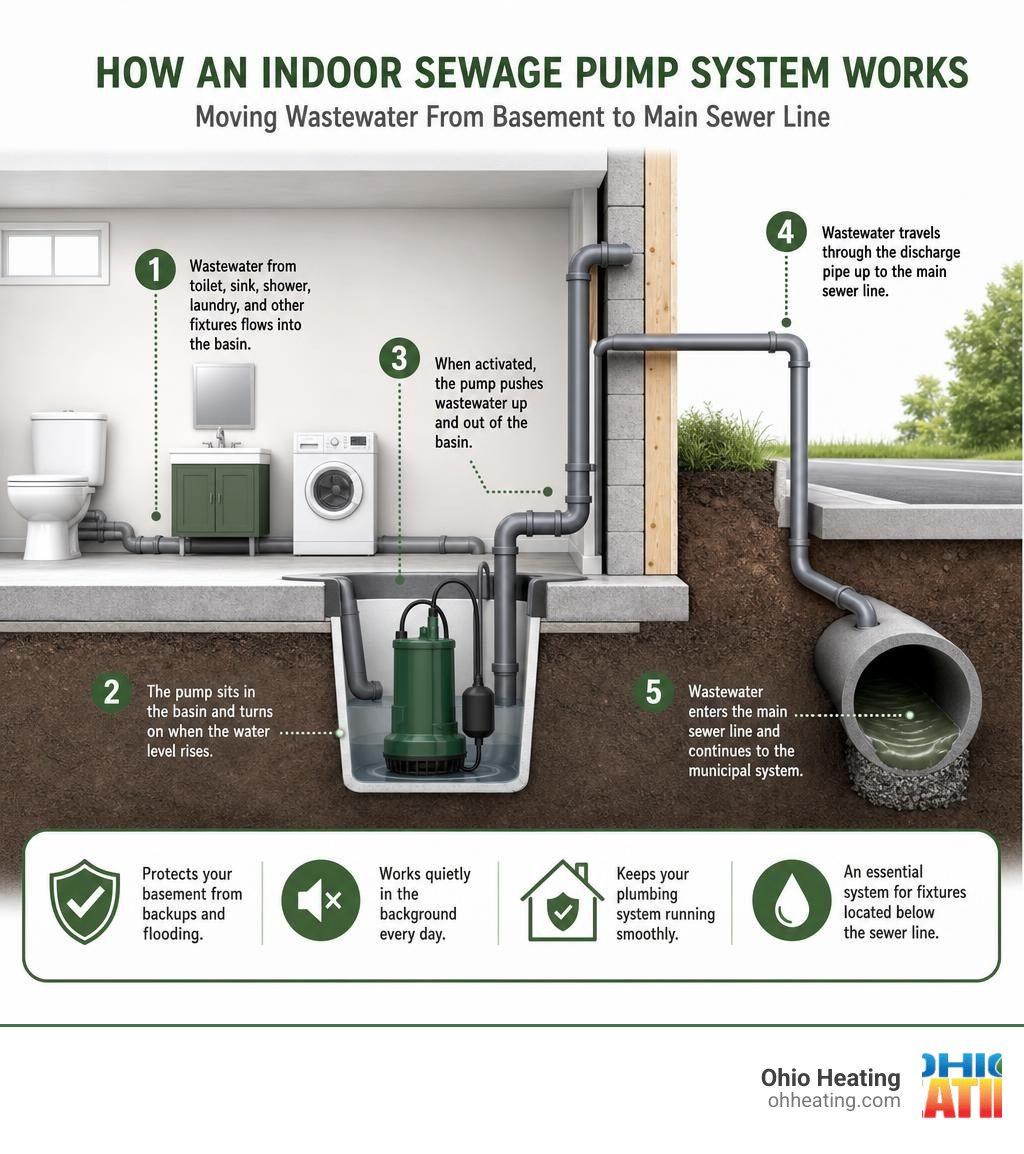
Important indoor sewage pump system terms:
What is an Indoor Sewage Pump System and How Does It Support Your AC?
When people think about keeping their homes or commercial properties cool and comfortable during the humid Columbus summer, they usually think of their air conditioning units. They picture the outdoor condenser humming along and cold air blowing out of the registers. What they often overlook is the complex water management system required to keep that AC running.
An indoor sewage pump system acts as the foundation of this drainage network. When you run a high-efficiency central air conditioning system, it doesn’t just cool the air—it also dehumidifies it. This process extracts gallons of moisture from your indoor air every single day. If your AC evaporator coil is located in a basement or a below-grade utility room, that water cannot drain out of your home via simple gravity. It needs to be collected and pumped up and out, which is where specialized wastewater systems come into play.
By integrating your cooling system’s condensate drainage with a robust indoor sewage ejector setup, you ensure that high-volume summer moisture is handled safely without risking basement flooding. This setup protects your property from water damage, mold growth, and structural issues. To understand how these systems protect your lower levels, it helps to read our comprehensive guide on Sump Pump 101: Shielding Your Basement with Reliable Pump Types and Maintenance, which outlines the fundamentals of below-grade water management.
Furthermore, trusted manufacturers like Zoeller emphasize that proper solids-handling pumps are critical for maintaining sanitary conditions when mixing greywater and blackwater in residential basements. You can learn more about how these specialized heavy-duty pumps operate directly from the experts at Sewage Ejectors – Zoeller Pump Company.
How the Indoor Sewage Pump System Differs from a Sump Pump
It is incredibly common for property owners to confuse a sump pump with an indoor sewage pump system. While both sit in a basin carved into your basement floor and both pump water upward, they are designed for entirely different jobs.
- The Sump Pump: A standard sump pump is designed to handle clean groundwater. It collects water that pools around your home’s foundation and pumps it away to prevent basement flooding. Because it only deals with clear water, a sump pump cannot handle solid waste, debris, or even heavy laundry lint. If solids enter a standard sump pump, it will quickly clog, burn out the motor, and fail.
- The Indoor Sewage Pump: This system is built to handle both liquids and solids. It manages raw sewage from basement toilets, thick soapy water from washing machines, and heavy grime from floor drains. The basin of a sewage pump is completely sealed and vented to prevent toxic sewer gases from escaping into your living space, whereas a sump pump basin is often open or has a loose-fitting lid.
If you attempt to use a standard sump pump to manage sewage or wastewater containing solids, you are looking at an immediate plumbing disaster. For a deeper dive into how these two systems differ and why choosing the right one is critical for your home’s structural health, refer to our detailed comparison in Sump Pump 101: Shielding Your Basement with Reliable Pump Types and Maintenance.
Why Your Air Conditioning Condensate Drain Needs an Indoor Sewage Pump System
During the peak of a hot, humid Columbus summer, a standard residential air conditioner can produce up to 5 to 20 gallons of condensate water per day. Commercial cooling systems produce even more. This water must go somewhere.
If your air handler or evaporator coil is located in the basement, gravity drainage to the outside is rarely an option. The main sewer line leaving your home is typically suspended several feet above the basement floor. This means your AC condensate drain line must run into a collection basin.
While small, dedicated condensate pumps can lift light amounts of clear water, they are highly prone to clogging from algae, slime, and dust that washes off the AC coils. Connecting your AC condensate line directly to a heavy-duty indoor sewage pump system provides a much more robust, clog-resistant solution. The powerful motor of a sewage ejector pump easily handles any biological buildup or sediment from your cooling system, ensuring that your AC can run continuously on the hottest days of the year without backing up.
Choosing and Installing the Right System for Summer Comfort
Selecting the perfect indoor sewage pump system requires evaluating several physical demands: the horsepower of the motor, the physical size of the basin, the vertical height the water must be lifted, and whether a pre-assembled package or a custom setup is right for your space.
For local business owners, making the wrong choice can lead to code violations, operational downtime, and expensive emergency repairs. To understand how commercial plumbing decisions impact your bottom line, take a look at our guide on What You Should Know About Plumbing Costs for Businesses.
Pre-assembled vs. Custom Setups for Cooling Season Reliability
When installing an indoor sewage pump system, you have two primary paths:
- Pre-assembled Systems (Packaged Systems): These are factory-assembled units where the pump, float switch, and internal piping are pre-installed inside a heavy-duty polyethylene basin. They are highly reliable because they are engineered to fit together perfectly, reducing the risk of installation errors. For homeowners looking for a reliable, quick-to-install option, packages like the Sewage Pump Systems offer a great balance of durability and ease of maintenance.
- Custom Setups: A custom setup allows you to select a specific pump motor, float switch style, and basin size independently. This is often necessary for commercial properties or homes with unique structural layouts where standard basin sizes won’t fit.
For residential basements, a simplex (single-pump) pre-packaged system is usually the gold standard. A prime example of a job-ready, highly reliable residential package is the 912 Simplex 24″ x 24″ Sewage Package System with M267 – Zoeller Pump Company. This system features a powerful 1/2 HP pump pre-plumbed inside a durable 24″ x 24″ basin, complete with a clear observation port to make visual inspections easy during the heavy-use summer cooling season.
Sizing Your Pump for Heavy AC Condensate and Wastewater Loads
To size your pump correctly, you must calculate the “Total Dynamic Head” (TDH), which is the vertical lift height combined with the friction loss created by the length and diameter of the discharge pipe. If your pump is under-powered, it won’t be able to push the water all the way up to your main sewer line, causing the pump to run continuously until it burns out.
You also need to ensure the basin has adequate switching volume. A basin that is too small will cause the pump to “short-cycle”—turning on and off rapidly every few minutes. Short-cycling is the number one killer of electric pump motors. For tight spaces or concealed floor installations, specialized compact systems like the DrainLift BOX-32/8DS U | Wilo provide an excellent solution. This unit features a deposit-free interior design and an integrated alarm system to ensure that high-volume wastewater and AC runoff are managed seamlessly without sediment buildup.
Maintenance and Troubleshooting to Prevent Summer Backups
Summer is the ultimate stress-test for your property’s water management. High humidity levels keep your air conditioning system draining water constantly, while summer showers and household activities increase overall water usage. If your sewage pump fails during a hot July week, the resulting backup can ruin finished basements and disrupt your entire home.
Regular maintenance is your best defense. If you want to understand how to keep all your below-grade pumps in peak condition, read The Ultimate Guide to Sump Pump Repair and Replacement for expert tips on testing, cleaning, and replacing worn-out components.
Essential Maintenance for Your Pump During Peak Cooling Months
To prevent unexpected failures when your AC is working its hardest, we recommend performing these simple maintenance steps at the start of every summer:
- Clean the Basin: Over time, soap scum, grease, hair, and AC dust can form a thick layer of sludge inside the basin. This sludge can trap the float switch or clog the pump’s intake. Carefully remove the sealed lid and flush out any debris.
- Test the Float Switch: The float switch is the mechanical trigger that tells the pump when to turn on. Pour several gallons of water into the basin to ensure the float rises freely and activates the pump, then drops back down to shut it off.
- Check the Vent Pipe: Because sewage basins must be completely airtight to contain odors, they rely on a vent pipe running to the outdoors to equalize air pressure. If this vent becomes clogged by insects or debris, a vacuum will form inside the basin, preventing wastewater from entering or leaving.
For compact, pre-wall installations where space is limited, using a high-quality unit designed for easy access is key. Systems like the San.iQ cut V | HOMA Pumpen feature a built-in cutting system and an integrated activated carbon filter for odor control. This design makes it much simpler to perform routine inspections without releasing unpleasant odors into your home.
Warning Signs Your Pump Needs Urgent Repair or Replacement
Your indoor sewage pump system will usually tell you it is struggling before it fails completely. Watch out for these warning signs:
- Unusual Noises: If you hear loud grinding, rattling, or thumping sounds coming from the basement floor when the pump runs, the impeller may be damaged or a foreign object may be trapped inside the pump housing.
- Continuous Running: If the pump runs constantly without stopping, the float switch may be stuck in the “on” position, or the pump has lost its prime and is no longer moving water.
- Foul Odors: A strong sewer gas smell in your basement or utility room indicates that either the basin seal has degraded, the vent pipe is blocked, or a P-trap in an infrequently used drain has dried out due to heavy AC use drying out the indoor air.
Ignoring these warning signs can lead to catastrophic property damage. If you run a local business, a sewage backup can shut down your operations instantly. Learn how to spot these critical issues early by reading about the Urgent Signs Your Commercial Plumbing Needs Help.
Frequently Asked Questions About Basement Wastewater and AC Drainage
Can an AC condensate line drain into a sewage pump?
Yes, absolutely. In fact, draining your air conditioning condensate line into an indoor sewage pump system is often the safest and most reliable way to handle AC runoff in a basement. Because sewage pumps are designed to handle heavy wastewater and small solids, they easily manage the dust, lint, and biological slime that naturally accumulates in AC condensate pans. Just ensure that the connection is made using an indirect drain setup with a proper air gap to prevent any potential backflow of sewer gases into your cooling system’s ductwork.
How long do residential sewage ejector pumps last?
With proper installation and regular maintenance, a high-quality residential sewage ejector pump typically lasts between 7 to 10 years. Factors that can shorten this lifespan include:
- Pumping highly abrasive materials or harsh chemicals.
- Frequent short-cycling caused by an undersized basin.
- Allowing heavy sludge or debris to accumulate in the basin, forcing the motor to work harder.
If your pump is approaching the 7-year mark, it is wise to have it inspected by a professional before the heavy summer storm and cooling season begins.
What is the average cost to install a basement sewage pump?
The cost to install a residential indoor sewage pump system typically ranges from $850 to $3,800, with the average installation costing around $2,325.
The final price depends on several factors:
- Whether you are replacing an existing pump or cutting into concrete to install a brand-new basin.
- The horsepower and brand of the pump you choose.
- The complexity of running the discharge and vent piping to your home’s main line and exterior.
For commercial properties, the installation costs can be higher due to the need for larger duplex (two-pump) systems and strict commercial building codes. To get a clearer picture of commercial plumbing and wastewater management expenses, check out our guide on What You Should Know About Plumbing Costs for Businesses.
Conclusion
Your indoor sewage pump system is truly the unsung hero of your basement, working quietly below the floorboards to protect your property from wastewater backups, structural damage, and heavy AC condensate flooding. Keeping this system in peak condition is essential for maintaining a clean, dry, and comfortable indoor environment all summer long.
At Ohio Heating, we have been keeping homes and businesses in Columbus, Central Ohio, and the surrounding areas comfortable and operationally reliable since 1999. Our expert team is always here to provide professional installation, routine maintenance, and emergency repairs to protect your property from costly downtime.
Don’t wait for a basement backup to think about your sewage pump. Whether you need a routine inspection or a complete system upgrade, we’ve got you covered. For expert support and high-quality pump solutions, visit our Professional Sump Pump Sales and Services page today to schedule an appointment with our trusted team!