
Radiant Tube Heater Startup Checks for Central Ohio Warehouses and Shops
On a central Ohio distribution floor, a lot can change over the summer. Someone adds a row of pallet racking, a forklift charging station moves under the heaters, and a scissor lift starts parking by the dock door. When the radiant tube heater fires for the first time this fall, some of that may now sit inside its clearance zone, where the tube runs a temperature of hundreds of degrees.
Tube heaters are simple and durable, which is part of why they get ignored until a cold morning. A fall startup check catches the problems that build up while they sit idle, and it takes far less time than a mid-winter shutdown.

How a tube heater warms a building
A low-intensity tube heater burns gas in a burner box at one end. Hot combustion gases then travel through a long steel tube before they leave through the vent. The tube gets hot and radiates heat down to the floor, equipment, and people below. A reflector above the tube sends the upward heat back toward the floor.
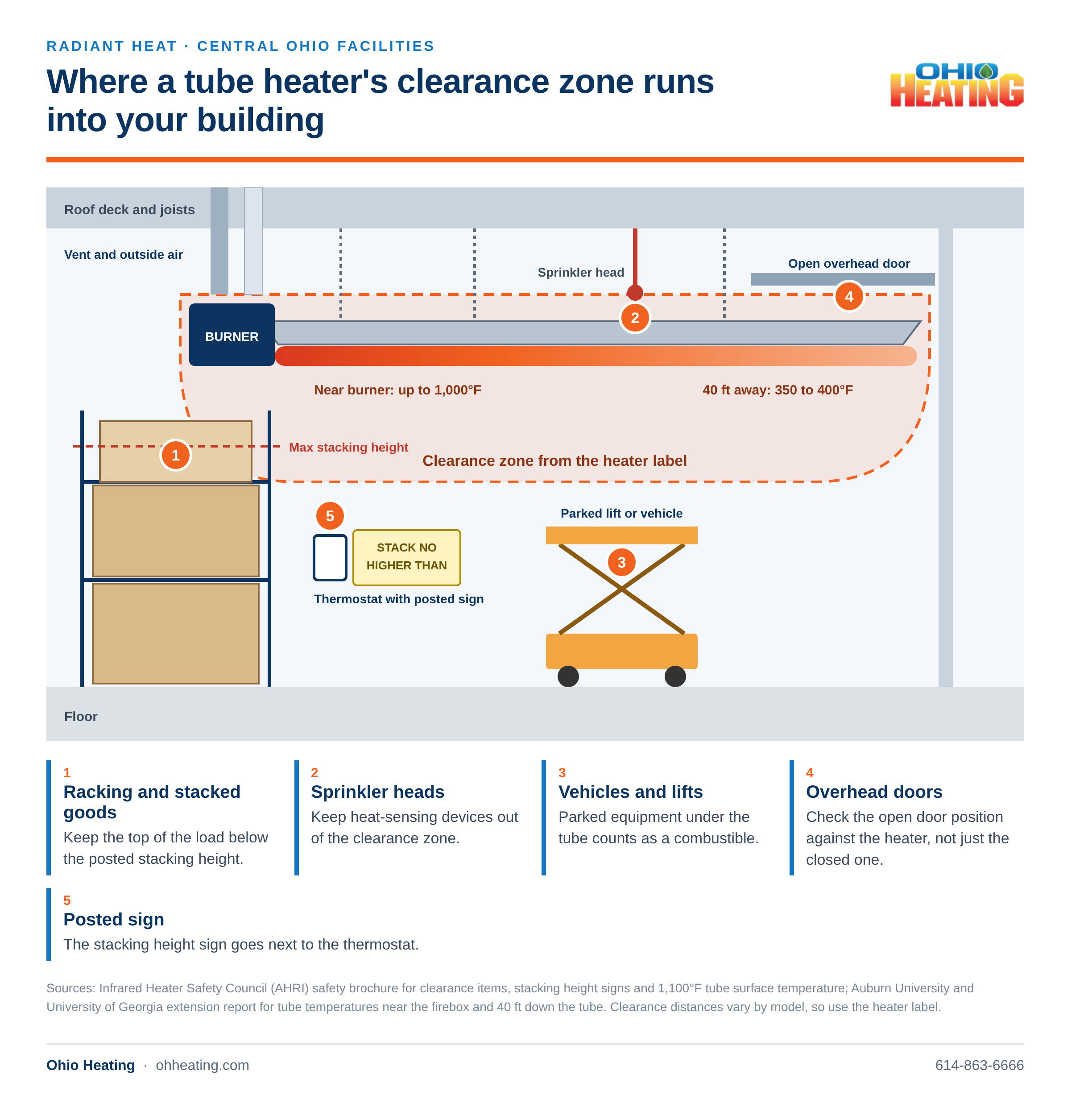
The Infrared Heater Safety Council, an AHRI initiative, puts tube surface temperatures near 1,100°F and calls tube heaters the most popular choice for heating a whole building (IRSC safety brochure). Extension engineers at Auburn University and the University of Georgia measured a similar pattern in farm buildings. Tube temperature near the firebox can reach 1,000°F, and 40 feet down the tube it may still sit at 350°F to 400°F (Auburn and UGA extension report on radiant tube heaters).
That temperature spread matters for your checks, because heat peaks right after the burner, so clearances there deserve the most attention.
What Ohio code requires for infrared radiant heaters
Ohio adopts the International Fuel Gas Code as the Ohio Fuel Gas Code. Section 630 covers infrared radiant heaters in four short rules (Ohio Fuel Gas Code 2021, Chapter 6).
| Section | What it says | What to check on site |
|---|---|---|
| 630.1 General. | Heaters must be listed to ANSI Z83.19 or Z83.20 and installed per the manufacturer’s instructions. | Find the rating plate and the installation manual, and confirm the gas type matches. |
| 630.2 Support. | Heaters must hang independent of the gas and electric lines, on noncombustible hangers and brackets. | Look for chain wear, bent hangers and gas piping that carries heater weight. |
| 630.3 Ventilation. | Unvented heaters need outdoor air at 4 cfm per 1,000 Btu/h of total heater input, with exhaust openings above the heaters. | Confirm exhaust fans and louvers still run and have not been blocked by new storage. |
| 630.4 Garages and hangars. | Overhead heaters in garages for more than three vehicles, or in aircraft hangars, follow Sections 305.9 to 305.11. | Check heater height and clearance above vehicles in service bays. |
IRSC guidance repeats the ventilation figure for unvented heaters and adds that heaters must be vented per the National Fuel Gas Code, NFPA 54, when the rating plate calls for it.
Clearances change when your building changes
Each tube heater carries a clearance-to-combustibles label, and the installation manual lists the same distances. The IRSC lists the items that most often end up too close. These include storage racks, parked vehicles, overhead doors, vehicle lifts, cranes, hoists, partitions, PVC conduit and sprinkler heads (IRSC safety brochure).
Storage height is the one that creeps up. The ANSI Z83.20 standard and NFPA 54 require a posted sign in storage areas stating the maximum stacking height that keeps the required clearance. The sign goes next to the heater thermostat, or in a visible spot if there is no thermostat. If your team restacked product this year, walk the aisles and compare the top of the load to that sign.
IRSC guidance also flags four situations that call for extra attention before the heaters run. These are a remodel since the last inspection, added heaters or racking, a long period without operation, and a change in how the building is used. A space that went from dry storage to a maintenance shop is a good example.
A fall startup checklist for tube heaters
It is recommended that a qualified person handle installation, service and the annual inspection. This checklist is a good starting point for a walk-through with your contractor.
- Reflectors. Clean, free of dust, and resting on their brackets rather than on the tube.
- Tubes and hangers. Tubes connected and hung securely, with no holes, cracks or sagging, especially along the top. Check chains and ceiling attachments for wear.
- Vent and air inlet. Clear of dirt, bird nests, insect nests, cracks and gaps at sealed joints.
- Gas connection. No leaks, and a listed flexible connector between the building piping and the heater.
- Burner box. Clean observation windows, clean blower wheel and motor, clean burner and orifice.
- Igniter and controls. No cracks or erosion on the igniter, and no exposed or damaged wiring at thermostats and sensors.
- Labels and manual. Clearance placards posted and readable, and the installation manual stored where the next technician can find it.
For the gas connection, the IRSC says to use a flexible connector per NFPA 54 and to avoid copper piping to the heater. Tubes grow as they heat, so the connection has to allow for that movement. Your building’s gas piping should not carry any of the heater’s weight. If you find hard pipe running straight into a burner box, have it corrected before the season starts. Our team handles gas pressure testing and inspections for commercial buildings if you want the whole line checked.
Where tube heaters do not belong
According to the IRSC, most heaters certified to the infrared standards are not approved for residential living or sleeping areas. It also excludes process heating, such as paint booths, grain bins and material drying, and hazardous Class 1 or 2 locations. If a space changed use, confirm the heaters still fit the new use before you turn them on.
Frequently asked questions
How often should a tube heater be inspected? The Infrared Heater Safety Council recommends an annual inspection by a qualified person. Fall is the natural time, before the first sustained cold weather.
Can I stack product closer to the heater if it is only for a few weeks? Keep the full clearance on the label for as long as the heater is in service. The posted stacking height sign exists for that reason.
Why does my tube heater click and then shut off? Common causes include a blocked vent or air inlet, a dirty or worn igniter, and a failed blower or pressure switch. A technician should trace it, since these heaters shut down on purpose when a safety check fails.
Do tube heaters need outside air? Many models can draw combustion air from outdoors, which helps in dusty or harsh environments. Unvented installations need outdoor ventilation air at 4 cfm per 1,000 Btu/h of input under Ohio code.
Can a tube heater run on either natural gas or propane? Only on the gas listed on the nameplate. A conversion needs the manufacturer’s kit and a qualified technician.
Ohio Heating services radiant heat systems as part of our commercial HVAC repair and replacement work, and our commercial maintenance agreements keep startup checks on the calendar. To protect your staff and inventory before the first cold week, call 614-863-6666 or schedule your radiant tube heater inspection at ohheating.com.