
When Columbus Summers Push Your AC to the Limit
Columbus AC replacement is one of the most important investments you can make as a property owner in Central Ohio. Here’s a quick summary of what you need to know:
Quick Answer: Columbus AC Replacement at a Glance
| Question | Answer |
|---|---|
| When should I replace my AC? | When it’s 10-15+ years old, needs frequent repairs, or can’t keep up with summer heat |
| What does it cost in Columbus? | Typically $3,800–$7,500 for central AC; $4,500–$8,000 for ductless mini-splits |
| How long does installation take? | Most jobs are completed in one day (4–8 hours) |
| Do I need a permit? | Yes — Columbus requires a mechanical permit for AC replacement |
| Are rebates available? | Yes — AEP Ohio and federal programs offer incentives for qualifying equipment |
Columbus summers are no joke. The city regularly sees 13 to 15 days above 90°F each year, and high humidity pushes the heat index even higher. For property managers and business owners, a failing AC system isn’t just an inconvenience — it’s an operational risk that can disrupt tenants, damage equipment, and drive up emergency service costs.
The good news? A planned replacement on your terms is far less stressful and costly than an emergency breakdown in mid-July.
I’m Jill Frattini, Service Coordinator at Ohio Heating in Columbus, OH, with several years of hands-on experience coordinating AC replacement projects across Central Ohio. Having worked through the full range of Columbus AC replacement situations — from aging commercial units to urgent mid-summer failures — I’ll walk you through everything you need to make a confident, informed decision.
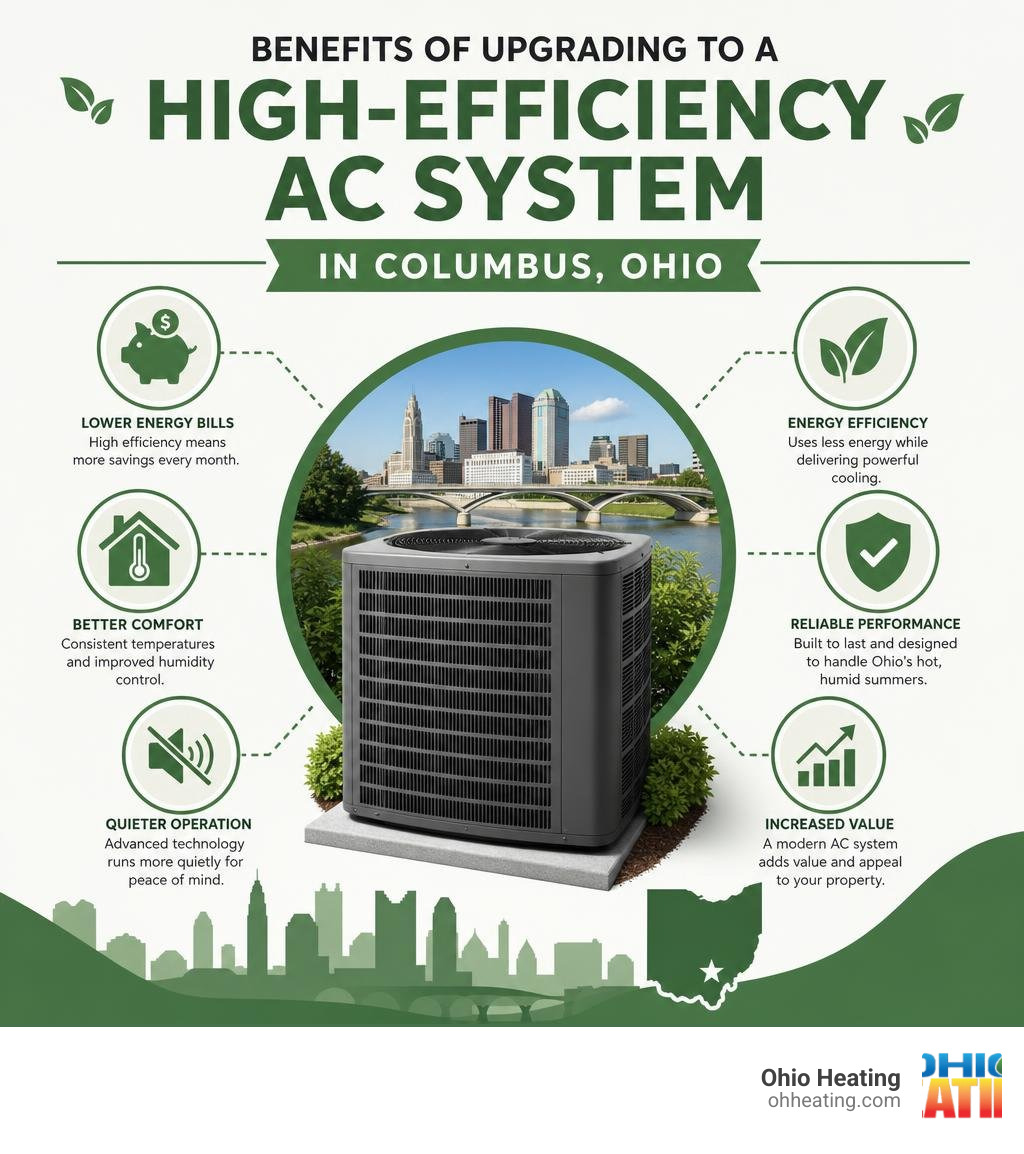
Signs It Is Time for a Columbus AC Replacement
It is easy to ignore your air conditioning system when it is tucked away outside or in a utility closet, but it will eventually let you know when it is ready to retire. Recognizing these signs early allows you to plan your replacement on your own schedule, rather than during a sweltering July heatwave.
System Age
Most central air conditioning systems are designed to last between 10 and 15 years. Even if an older unit is still running, its internal components are likely worn, and its efficiency has dropped significantly compared to modern systems. If your system is approaching or has passed this age range, it is time to start exploring replacement options.
Frequent Breakdowns
Are you on a first-name basis with your AC technician? If you are calling for repairs multiple times a summer to patch up refrigerant leaks, replace failing capacitors, or fix electrical issues, those costs add up quickly. Investing that money into a new, reliable system is often the smarter financial move.
Poor Airflow and Inconsistent Cooling
If some rooms in your home feel like an icebox while others feel like a sauna, your system is struggling to distribute air evenly. Weak airflow from your vents is another common sign that the compressor or blower motor is nearing the end of its lifespan. To help you weigh your options, you can read our guide to Find Out Whether to Repair or Replace Your Air Conditioning Unit.
Evaluating the Cost of Repair vs. Columbus AC Replacement
When faced with a sudden system failure, homeowners often struggle to decide whether to pay for another repair or commit to a full system replacement. To make this decision easier, we recommend using the $5,000 Rule.
Multiply the cost of the recommended repair by the age of your air conditioner in years. If the total exceeds $5,000, a replacement is generally the more sensible investment. For example:
- A $600 repair on a 12-year-old system equals $7,200. Because this exceeds $5,000, replacing the unit is the wiser long-term choice.
- A $300 repair on a 6-year-old system equals $1,800. In this case, repairing the system makes perfect sense.
Certain high-ticket failures almost always tip the scales toward replacement. A failed compressor — the heart of your AC system — is incredibly expensive to replace. Additionally, if your older system runs on R-22 refrigerant (which has been phased out due to environmental regulations), repairing a leak is cost-prohibitive because the refrigerant itself is scarce and extremely expensive. If you are noticing these issues, check out our guide on Expert AC HVAC Repair in Westerville What to Look For to see how local repair costs stack up against a fresh installation.
How Columbus Summers Impact Aging Air Conditioners
Central Ohio summers feature a challenging mix of high temperatures and heavy humidity. When outdoor temperatures climb past 90°F, your air conditioner must run longer cycles to pull heat and moisture out of your indoor air.
For an aging system, this constant operation is incredibly taxing. The combination of clay-heavy soil in Columbus (which can settle and cause outdoor units to tilt) and frequent summer thunderstorms (which bring electrical surges) further stresses older electrical components. By replacing an unstable unit before the peak of summer, you protect your household from emergency cooling failures and avoid the premium rates associated with emergency service calls during high-demand periods.
Understanding the Cost of New Air Conditioning in Central Ohio
When planning for a columbus ac replacement, understanding the financial landscape is key. Upfront pricing clarity helps you budget effectively without worrying about hidden fees.
Key Factors Influencing Your Columbus AC Replacement Cost
No two homes in Central Ohio are identical, which is why installation costs can vary. The final price of your project is determined by several core factors:
- System Tonnage (Size): Air conditioners are sized in “tons,” which measures their cooling capacity. A larger home requires a higher-tonnage system to cool effectively, and each additional ton of capacity typically adds $400 to $900 to the equipment cost.
- SEER2 Rating (Efficiency): Seasonal Energy Efficiency Ratio 2 (SEER2) measures how much electricity your system uses to cool your home. Standard systems start at the regional minimum of 13.4 SEER2, while premium high-efficiency systems can exceed 20 SEER2. Higher efficiency units cost more upfront but generate substantial monthly energy savings.
- Ductwork Condition: Your new AC is only as good as the ductwork distributing its cold air. If your home has leaky, undersized, or disconnected ducts, we will need to repair or seal them. This is crucial because duct leaks can reduce system efficiency by 30% or more.
- Labor and Permit Fees: Labor costs in the Columbus area run slightly above the national average. Additionally, proper municipal permits and inspections are required to protect your warranty and ensure code compliance.
For a deeper dive into these variables, explore our article on Air Conditioning Installation Costs Columbus Ohio Insights or consult the Columbus, OH HVAC Replacement Cost 2026 | Local Pricing Guide for regional data.
Average Price Ranges for Central Air and Ductless Systems
To help you visualize your options, here is a breakdown of typical installation costs in the Columbus area:
| Cooling System Type | Typical Cost Range | Best Suited For |
|---|---|---|
| Standard Central AC | $3,800 – $7,500 | Homes with existing, functional ductwork |
| Ductless Mini-Split (Single Zone) | $3,500 – $5,500 | Sunrooms, home additions, or localized cooling |
| Ductless Mini-Split (Multi-Zone) | $6,000 – $10,000+ | Older homes without ductwork |
| High-Efficiency Variable-Speed AC | $7,500 – $12,000+ | Homeowners prioritizing maximum energy savings and comfort |
To avoid overpaying or falling victim to high-pressure sales tactics, review our guide: Don’t Get Quoted 30k: Understanding New AC Unit Costs. This resource will help you understand what a realistic, fair quote looks like in Central Ohio.
Selecting Your System and Navigating the AC Installation Process
Choosing the right equipment and the right team to install it ensures your system will perform reliably for the next 15 years. At Ohio Heating, we have been helping local homeowners navigate this process since 1999. Learn more about our comprehensive approach on our Residential HVAC Services page.
Selecting the Correct AC Size and SEER2 Rating
A common mistake in the industry is sizing a system based solely on a home’s square footage. An oversized air conditioner will cool the home too quickly and shut off before it can remove humidity, leaving you with a cold, clammy house. This is known as “short-cycling,” and it places immense wear on the compressor. Conversely, an undersized system will run constantly, driving up your energy bills and failing to keep you cool on hot days.
We use professional Manual J Load Calculations to design your system. This scientific method considers:
- Total square footage and ceiling heights.
- The quality and thickness of your home’s insulation.
- The number, size, and orientation of your windows.
- Local climate data for Central Ohio.
For efficiency, we recommend choosing a system in the 15 to 17 SEER2 range for our local climate. This range offers the fastest return on investment, balancing a reasonable purchase price with excellent monthly utility savings.
What to Look For in a Local AC Installation Professional
Your installation is only as good as the technicians performing the work. When researching local contractors, ensure they meet these professional standards:
- NATE Certification: North American Technician Excellence (NATE) is the gold standard for technician certification. It ensures your installers have proven their technical knowledge through rigorous testing.
- Permits and Inspections: A reputable contractor will always pull the required local mechanical permits (which typically cost $140 to $275 in Columbus) and schedule the final municipal inspection. This ensures the work is safe and complies with all local building codes.
- Local Experience: Contractors who understand local building styles — such as the historic homes in German Village or the newer builds in suburban developments — can anticipate unique installation challenges.
We proudly serve communities across the metro area. If you live in these suburbs, check out our localized guides for Air Conditioning Replacement in Dublin and Air Conditioning Replacement in Powell.
Pre-Installation Assessment and Load Calculations
Before installation day, a thorough pre-installation assessment is essential. This step involves examining your existing electrical panel to ensure it can handle the electrical load of a modern AC unit (typically requiring a dedicated 20 to 30-amp circuit). We also measure your ductwork’s static pressure to verify it can handle the airflow of your new system. If you are located in the western suburbs, you can learn more about this preparation process in our guide on Air Conditioning Replacement in Hilliard.
Installation Day and System Commissioning
On the day of your installation, our technicians follow a strict protocol to ensure your system is commissioned perfectly. We don’t just swap the equipment; we engineer it for long-term reliability.
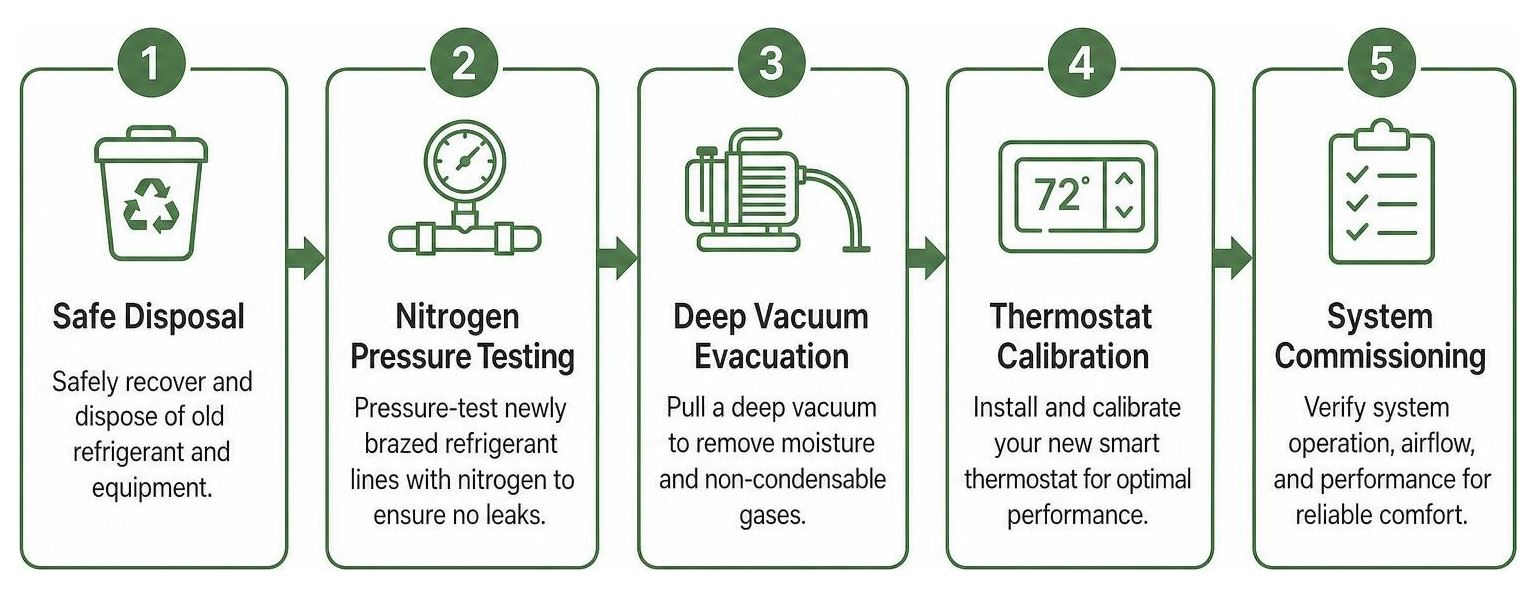
Our commissioning process includes:
- Safe Disposal: We safely recover and dispose of old refrigerant and equipment according to EPA regulations.
- Nitrogen Pressure Testing: We pressure-test the newly brazed copper refrigerant lines with nitrogen to guarantee there are no microscopic leaks.
- Deep Vacuum Evacuation: We pull a deep vacuum on the lines to remove all moisture and non-condensable gases, which protects the compressor from premature failure.
- Thermostat Calibration: We install and calibrate your new smart thermostat, ensuring it communicates perfectly with your new indoor and outdoor units.
Whether you need Air Conditioning Replacement in Upper Arlington or Air Conditioning Replacement in Westerville, our team is committed to delivering this high standard of precision on every single job.
Frequently Asked Questions About Columbus AC Replacement
How long does a new AC unit installation typically take?
For a straightforward replacement where we are matching new equipment to your existing, functional ductwork, the installation is almost always completed in a single day — typically taking between 4 and 8 hours. If your project requires ductwork modifications, electrical panel upgrades, or if you are installing a multi-zone ductless system, the process may take 1 to 2 days. We always provide a clear timeline before work begins so you can plan your day accordingly.
Are there rebates or financing options available for new AC systems in Ohio?
Yes! Upgrading to an energy-efficient cooling system qualifies you for various savings programs. AEP Ohio offers instant rebates on qualifying smart thermostats and high-efficiency cooling equipment. Additionally, federal programs often provide tax credits for qualifying high-efficiency air conditioners and cooling systems.
To help make your purchase more manageable, we offer flexible financing options with convenient monthly payments for qualified buyers. This allows you to start enjoying lower utility bills immediately without a massive upfront cash outlay.
What warranties should be included with a new air conditioner?
When investing in a new air conditioner, you should look for two distinct warranties:
- Manufacturer Parts Warranty: Most major brands offer a 10-year parts warranty upon registration. This covers major components, including the compressor and coils, if they fail due to manufacturing defects. Note: You must register your equipment online within 60 to 90 days of installation to receive the full 10-year term; otherwise, it may drop to 5 years.
- Labor Warranty: This is provided by the installation contractor and covers the cost of labor if a repair is needed. A reputable contractor will offer at least a 1-year labor warranty, with premium options extending even longer.
To protect your system and keep these warranties valid, regular professional maintenance is required. If you are looking to keep your current system running a bit longer before replacing it, scheduling a professional AC tune-up is highly recommended. If you are facing an active cooling crisis, reaching out to a trusted local technician for immediate emergency AC repair will ensure your home stays safe and comfortable.
Conclusion
A new air conditioner is more than just a home improvement purchase; it is an investment in your family’s comfort, health, and financial peace of mind. By replacing an aging, inefficient system, you can look forward to lower energy bills, quieter operation, and reliable cooling through the hottest summer days.
Since 1999, Ohio Heating has been Central Ohio’s trusted partner for honest, professional, and reliable cooling solutions. We don’t believe in high-pressure sales or cutting corners. Our NATE-certified technicians take the time to measure your home, design the perfect system, and install it with absolute precision.
Don’t wait for your old AC to leave you stranded in the summer heat. Schedule your professional cooling service today to request your free, no-obligation system replacement estimate!