
Why Building Control Systems Are Central to Smarter, More Efficient Air Conditioning
Building control systems are automated platforms that manage a facility’s mechanical and electrical equipment — primarily air conditioning and ventilation — to keep occupants comfortable, reduce energy waste, and prevent costly downtime.
Quick answer: What are building control systems?
| Feature | What It Means for Your Facility |
|---|---|
| What they do | Automatically manage AC, ventilation, humidity, and related equipment |
| How they work | Sensors feed data to controllers, which adjust equipment in real time |
| Who uses them | Offices, schools, hospitals, data centers, retail, and multi-site portfolios |
| Key benefit | Up to 30% reduction in HVAC energy use in commercial buildings |
| Why it matters | Systems tied to building controls represent up to 70% of a building’s total energy use |
Here’s something worth sitting with: we spend up to 90% of our time inside buildings. That means the systems quietly running in the background — controlling air temperature, humidity, and air quality — have a direct impact on how we feel, work, and stay healthy every day.
For property managers and business owners, a poorly configured or outdated control system isn’t just uncomfortable — it’s expensive. Misconfigured systems alone account for roughly 20% of building energy use, or about 8% of total U.S. energy consumption nationwide.
This guide breaks down everything you need to know about building control systems in plain language — what they are, how they work, and how to choose the right setup for your facility.
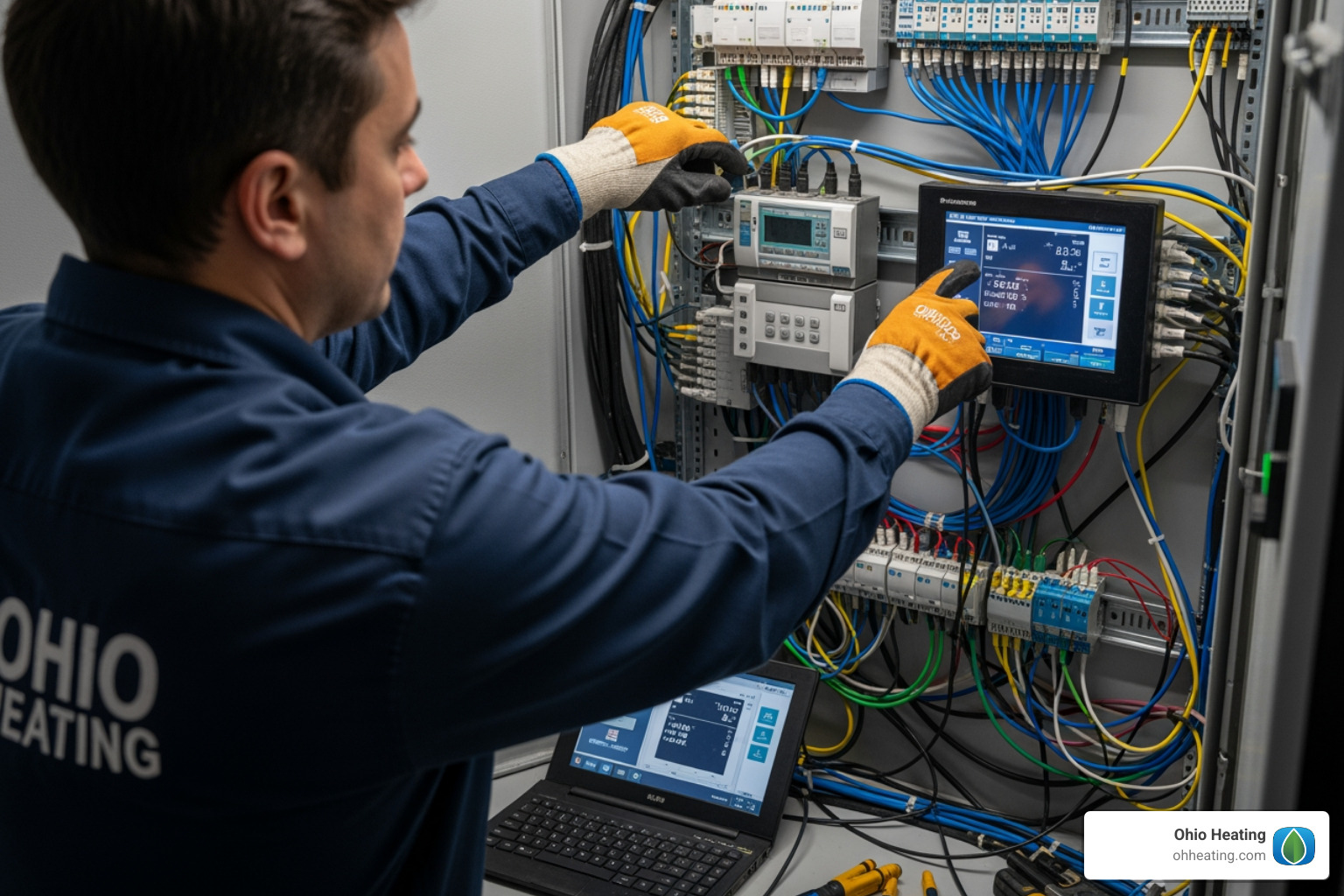
My name is Jill Frattini, and as a Service Coordinator at Ohio Heating in Columbus, OH, I’ve spent years working alongside HVAC professionals who install, commission, and service building control systems across commercial facilities of all sizes. That hands-on experience is what shapes everything you’ll find in this guide.
What Are Building Control Systems and Why They Matter for AC Performance
Think of building control systems as the nervous system of a commercial building’s cooling operation. They gather information from the field, make decisions, and send commands back out to equipment. If the building gets warmer, more crowded, more humid, or starts using too much power, the control system reacts.
For AC performance, that matters a lot. Without controls, equipment often runs longer than necessary, spaces cool unevenly, humidity drifts, and facility teams end up fighting comfort complaints one thermostat at a time. With a properly designed system, cooling becomes more stable, more efficient, and much easier to manage.
How building control systems work in real time
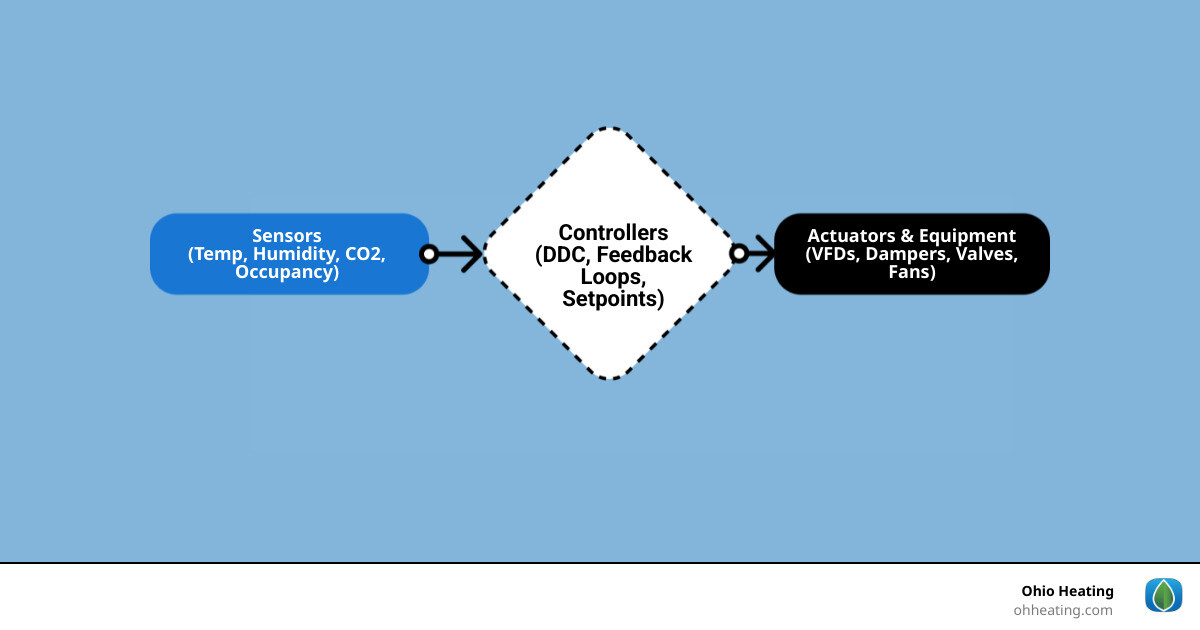
At the most basic level, a control system follows a loop:
- Sensors measure conditions such as temperature, humidity, occupancy, airflow, pressure, or carbon dioxide.
- Controllers compare those readings to setpoints and schedules.
- The system sends commands to actuators or equipment.
- The equipment responds, and the sensors verify whether the change worked.
That feedback loop runs constantly. In a modern office, for example, a sensor may detect a conference room filling up at 2 p.m. The controller sees the room temperature rising and occupancy increasing, then adjusts airflow or cooling output. If the room empties at 3 p.m., the system scales back instead of blasting conditioned air into empty chairs. Chairs, sadly, do not file comfort complaints.
Modern systems also support:
- Scheduling by time of day
- Alarm notifications for abnormal conditions
- Remote monitoring from a workstation or mobile device
- Trend logs for performance analysis
- Fault detection that flags issues before they become breakdowns
Why building control systems are essential for cooling-only operations
Even when we focus only on air conditioning and ventilation, controls are essential. Cooling is not just about making air colder. It is about maintaining the right temperature, humidity, ventilation rate, and equipment runtime for the space.
For cooling-only operations, controls help with:
- Matching AC output to actual occupancy
- Preventing overcooling and wasted energy
- Managing ventilation in high-density spaces
- Improving humidity control
- Reducing peak electrical demand
- Catching failures early before they cause downtime
Occupancy sensors and advanced control strategies can reduce energy use by up to 40% through more precise ventilation and lighting control. On the AC side, that means less unnecessary runtime and more targeted cooling where and when it is actually needed.
If you want a closer look at how this fits into broader facility strategy, our building and energy management services page expands on the operational side.
Where building control systems are used most often
We most often see building control systems deliver strong value in facilities where cooling demands shift throughout the day or where uptime is critical, including:
- Office buildings
- Schools and universities
- Healthcare facilities
- Data centers
- Retail environments
- Laboratories
- Multi-building campuses
- Multi-site portfolios
These are also the environments where poor control can get expensive fast. In a school, one bad schedule can cool empty classrooms all weekend. In a data center, poor airflow control can threaten uptime. In a healthcare setting, unstable temperature or humidity can affect sensitive spaces.
For a technical government overview, the Department of Energy’s building controls basics is a useful external reference.
Core Components of a Modern AC Control System
A modern AC control system is not one box on a wall. It is an ecosystem of field devices, control logic, interfaces, and communication networks working together.
Sensors and meters that drive better cooling decisions
Sensors are the eyes and ears of the system. If they provide bad data, the rest of the system makes bad decisions very efficiently.
Common cooling-related sensors include:
- Temperature sensors
- Humidity sensors
- CO2 sensors
- Occupancy sensors
- Airflow sensors
- Static pressure sensors
- Differential pressure sensors
- Power meters
These devices tell the system what is happening in the space and in the equipment. For example:
- Occupancy sensors help reduce unnecessary cooling in empty spaces
- CO2 sensing can support demand-based ventilation
- Pressure sensors can help verify fan and filter performance
- Power metering helps identify inefficient runtime or load spikes
- Trend logs reveal patterns that are hard to catch in a quick walk-through
Research shows advanced sensing and occupancy-based control can cut energy use by up to 40% in some applications. That is one reason sensor placement, calibration, and maintenance matter so much.
Controllers, actuators, and sequences for stable AC operation
If sensors gather information, controllers are the brains. They process data and decide what should happen next.
In AC systems, controllers may manage:
- Rooftop units
- Air handlers
- Variable frequency drives
- Dampers
- Valves
- Zone-level cooling
- Ventilation sequences
- Chilled water distribution where applicable
Actuators are the muscles. They physically move dampers, modulate valves, or change fan speeds based on controller commands.
This is where direct digital control, or DDC, becomes important. DDC allows precise control over cooling sequences instead of simple on/off operation. Rather than full blast or nothing, the system can make smaller, smarter adjustments to maintain stable conditions.
A good sequence of operation may include:
- Occupied and unoccupied schedules
- Supply air temperature reset
- Static pressure reset
- Demand-based ventilation
- Zone prioritization
- Alarm thresholds for failure or drift
Dashboards, mobile access, and analytics for facility teams
The user interface is what turns raw control into something useful for people. A dashboard lets operators see temperatures, alarms, schedules, trends, and equipment status from one place.
Modern interfaces often include:
- Web-based dashboards
- Mobile access
- Custom graphics
- Alarm summaries
- Historical trends
- Energy benchmarking
- Analytics and reporting
This gives facility teams a practical way to manage cooling across a building or portfolio without running from mechanical room to mechanical room like they are in a very unfun obstacle course.
For a deeper look at controls from an HVAC perspective, see our guide on mastering the art of HVAC control systems.
Types of Building Control Systems for Different Facility Needs
Not every building needs the same architecture. The right setup depends on facility size, complexity, budget, existing equipment, and future goals.
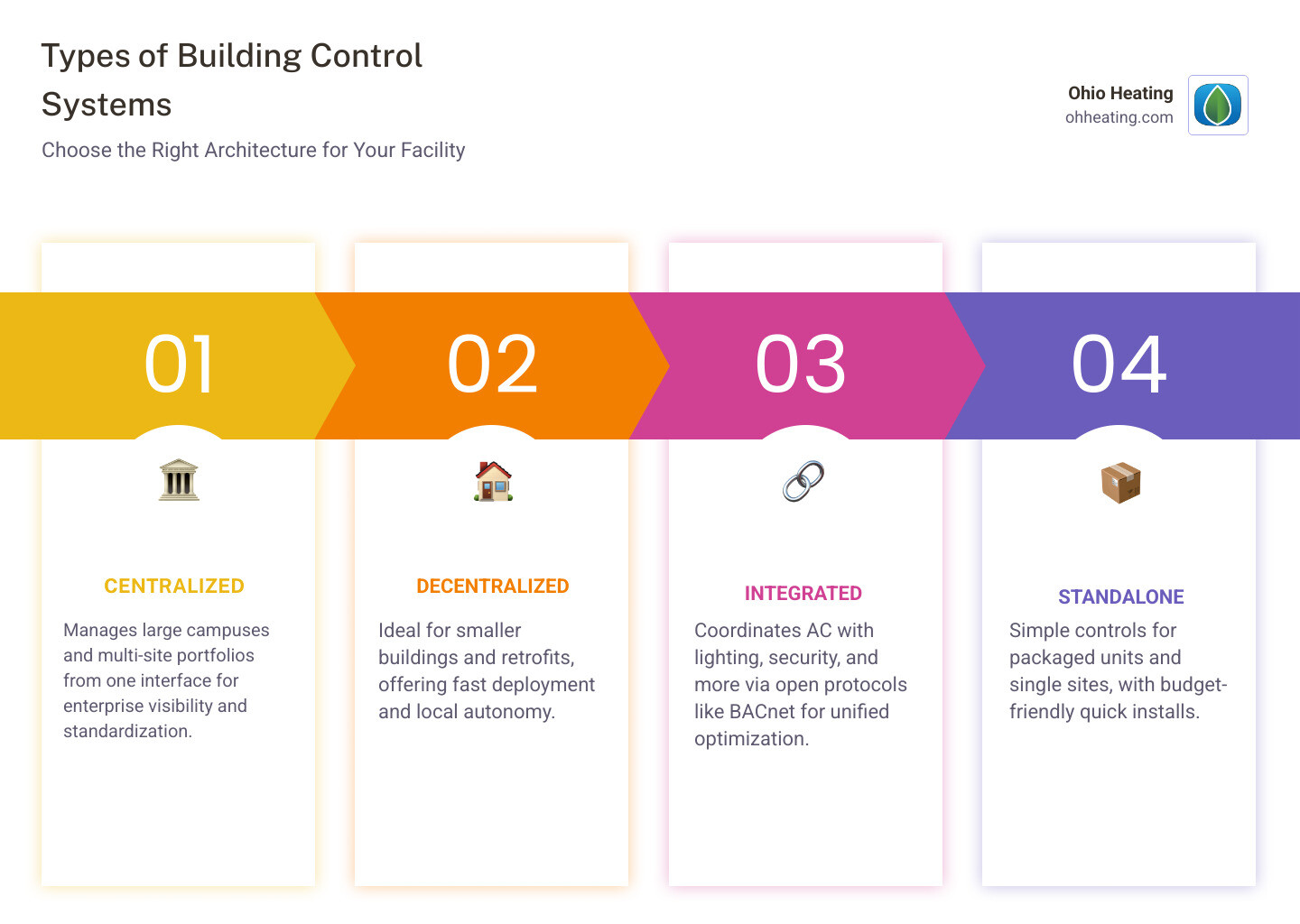
| System Type | Best For | Main Advantage | Main Limitation |
|---|---|---|---|
| Centralized | Campuses, large offices, multi-site portfolios | One interface for broad visibility | Higher complexity and upfront planning |
| Decentralized | Smaller buildings, simple retrofits, standalone equipment | Faster deployment and local autonomy | Less portfolio-wide visibility |
| Integrated | Facilities coordinating AC with other systems | Unified data, alarms, and optimization | Requires good interoperability planning |
Centralized building control systems for campuses and large properties
Centralized systems bring multiple cooling assets into a single platform. This is useful for campuses, large office properties, healthcare environments, and facilities with multiple buildings or many zones.
Benefits include:
- Enterprise-wide visibility
- Standardized schedules and alarms
- Easier benchmarking across buildings
- Better oversight for critical spaces
- Simplified reporting
For larger properties in Columbus and Central Ohio, centralized control can make it much easier to see which building is using too much energy, which unit is short-cycling, or which area keeps generating complaints.
Decentralized and standalone controls for smaller AC applications
Decentralized controls are often the better fit for smaller facilities or simpler retrofit projects. In this model, each unit or area has more local control and may operate independently.
This approach works well for:
- Small commercial buildings
- Standalone rooftop unit replacements
- Budget-conscious retrofits
- Spaces where local autonomy matters
The tradeoff is that data can stay fragmented. When every unit is its own island, it is harder to see building-wide trends or optimize cooling across the full site.
Integrated systems for smarter cooling, lighting, and security coordination
Integrated systems connect cooling controls with other building systems through open communication standards. Even if your main goal is AC performance, integration can improve occupancy response, scheduling, alarms, and overall efficiency.
The key concept here is interoperability. Protocols such as BACnet and LonTalk help different devices and systems communicate. Without standards, buildings can become collections of isolated systems that do not share data well.
If you are exploring BAS options locally, our page on BAS systems in Columbus Ohio covers this in more detail.
Benefits of Building Control Systems: Energy, Comfort, and Reliability
The benefits of building control systems go well beyond convenience.
Energy savings and sustainability gains from better AC control
This is the headline most people care about first, and for good reason.
According to the research cited above:
- High-performance control can reduce HVAC energy use in commercial buildings by 30%
- Broad deployment could cut more than 3% of total U.S. energy consumption
- Systems connected to a building management platform often account for about 40% of a building’s energy use
- When lighting is included, that can approach 70%
- Misconfigured control systems can account for about 20% of building energy usage
That means controls are not a side issue. They are central to building performance.
For cooling specifically, savings often come from:
- Better scheduling
- Occupancy-based cooling
- Optimized ventilation
- Fan speed control
- Faster identification of inefficient operation
For a general overview of the concept, building automation offers background on how these systems are used across facilities.
Occupant comfort, indoor air quality, and operational efficiency
A building can save energy and still feel miserable if the controls are poorly tuned. The goal is balance.
Good controls improve:
- Temperature stability
- Humidity control
- Ventilation precision
- Complaint response time
- Equipment visibility
- Maintenance prioritization
That matters in every commercial setting, but especially in schools, healthcare spaces, and high-occupancy offices where comfort and indoor air quality affect concentration, productivity, and well-being.
A modern dashboard also helps facility teams spend less time guessing. Instead of reacting to complaints after the fact, they can see trend data, recurring alarms, and problem zones before issues spread.
Security, alarms, and business continuity in mission-critical spaces
As control systems become more connected, cybersecurity becomes part of facility reliability. That is especially true when operational technology overlaps with IT networks and cloud-based access.
A strong system should support:
- Role-based access
- Encrypted communication where available
- Secure remote access
- Alarm prioritization
- Audit visibility
- Fast fault notifications
In mission-critical cooling environments, that translates into better continuity. Remote diagnostics can catch a failing sensor, stuck damper, or abnormal runtime before it turns into downtime.
For more on efficiency and ongoing performance, visit our energy management page.
Evolution, Standards, and Challenges in Building Control Systems
Building controls did not start smart. They got there one upgrade at a time.
From manual controls to AI-driven building control systems
Early building controls relied on manual adjustments, basic thermostats, and pneumatic or electromechanical components. Later, digital logic and software platforms made more sophisticated control possible. Today, cloud access, analytics, connected devices, and early forms of AI-assisted optimization are pushing the industry further.
The evolution roughly looks like this:
- Manual and pneumatic controls
- Electromechanical control panels
- Direct digital control
- Networked building automation
- Cloud-connected analytics
- Fault detection, predictive maintenance, and AI-assisted optimization
We are also seeing more IoT-connected devices feeding richer operational data into dashboards and analytics tools. Predictive maintenance is a major trend: instead of waiting for a failure, the system looks for abnormal patterns and alerts teams sooner.
Why protocols and standards matter for performance
Standards are what keep a control system from turning into a technological family reunion where no one speaks the same language.
Important protocols and frameworks include:
- BACnet
- LonTalk
- TCP/IP-based networking
- Secure connectivity options for encrypted communication
BACnet is especially important in commercial AC applications because it helps devices from different manufacturers share data more reliably. Open protocols reduce the risk of vendor lock-in, improve retrofit flexibility, and make it easier to integrate legacy and new equipment.
When interoperability is poor, buildings suffer from data silos, fragmented alarms, and limited visibility.
Common adoption barriers and how to overcome them
The most common challenges we see include:
- Upfront costs
- Unclear ROI
- Legacy equipment compatibility
- Commissioning gaps
- Cybersecurity concerns
- Staff training needs
The Department of Energy notes that installation and commissioning can range from tens of thousands to millions of dollars depending on the project. That is real money, so planning matters.
The best ways to reduce risk are:
- Start with a clear audit of existing equipment
- Prioritize high-impact cooling problems first
- Use phased upgrades when needed
- Choose open protocols where possible
- Commission thoroughly
- Train staff after installation, not just before handoff
- Review performance data regularly
If your facility still relies heavily on older hardware, our page on conventional controls may help frame next steps.
How to Choose, Implement, and Maintain the Right AC Control Strategy
Choosing the right system is less about chasing the fanciest dashboard and more about matching the solution to the building.
Step-by-step selection checklist for facilities teams
Use this checklist when evaluating options:
- Building size and number of zones
- Type and age of AC equipment
- Need for open protocols such as BACnet
- Remote monitoring requirements
- Alarm and notification needs
- Trend logging and reporting needs
- Budget for first cost and lifecycle cost
- Expansion plans for future equipment
- Cybersecurity requirements
- Internal staff skill level
- Sustainability or energy targets
A small office with a few packaged units may need a much simpler system than a campus with multiple air handlers, server rooms, and critical occupancy schedules.
Best practices for installation, commissioning, and ongoing maintenance
Even the best-designed system can underperform if installation and startup are rushed. Commissioning is where performance becomes real.
Best practices include:
- Point-to-point checkout for every control signal
- Sequence testing under real operating conditions
- Sensor calibration
- Air balance coordination
- Dashboard and alarm setup
- Trend log verification
- Staff onboarding and documentation
- Preventive maintenance reviews
- Periodic software and security updates
Ongoing maintenance should include seasonal reviews, setpoint verification, alarm tuning, and sensor recalibration. Controls drift over time. So do buildings. Space use changes, equipment ages, and schedules get messy. A control strategy should be maintained like any other critical asset.
Our customer services page explains how support and service planning help keep systems performing as intended.
Real-world cooling applications by building type
Different facilities use controls in different ways:
- Commercial offices: scheduling, zone control, complaint reduction
- K-12 schools: occupancy-based ventilation, after-hours scheduling, energy visibility
- Hospitals and healthcare spaces: tighter environmental control and reliability
- Labs: stable temperature and ventilation response
- Data centers: precise cooling and alarm-driven uptime protection
- High-occupancy spaces: demand-based ventilation and humidity management
For a more application-focused read, see commercial HVAC control systems don’t let your building have a meltdown.
Frequently Asked Questions About Building Control Systems
How much can building control systems reduce AC energy use?
In commercial buildings, high-performance controls have been shown to reduce HVAC energy use by up to 30%. In some cases, occupancy sensing and more precise ventilation control can drive even larger reductions in targeted areas, with figures up to 40% cited for advanced systems and occupancy-based strategies.
Actual savings depend on:
- How inefficient the building is today
- Equipment type
- Schedule quality
- Sensor accuracy
- Ventilation strategy
- Whether the system is properly commissioned
Are building control systems worth it for existing buildings?
Yes, often very much so. Existing buildings usually have the biggest opportunity because they often suffer from outdated schedules, limited visibility, sensor drift, and equipment that runs harder than necessary.
Retrofits can be phased. You do not always need a full rip-and-replace project. In many cases, we can integrate legacy equipment, add supervisory control, improve sensing, and target the biggest cooling pain points first.
The payoff is usually a mix of:
- Lower energy costs
- Better comfort
- Fewer emergency service calls
- More visibility into problems
- Longer equipment life through smarter runtime
How often should AC building controls be checked and updated?
At a minimum, controls should be reviewed seasonally and anytime space use changes significantly. We also recommend regular calibration and periodic recommissioning, especially in larger commercial facilities.
Typical intervals include:
- Seasonal schedule and setpoint review
- Annual sensor calibration checks
- Ongoing alarm review and tuning
- Software and security updates as recommended
- Recommissioning after major equipment or occupancy changes
If nobody has looked at your dashboard logic in years, that is usually a sign it is time.
Conclusion
Building control systems give facilities a smarter way to manage cooling, reduce waste, improve comfort, and protect uptime. When designed and maintained well, they can help cut AC energy use significantly while making day-to-day operations much easier for building teams.
At Ohio Heating, we help businesses across Columbus, Central Ohio, and surrounding Ohio communities build cooling strategies that support long-term reliability, better performance, and practical ROI. If you are evaluating upgrades, troubleshooting an underperforming system, or planning a smarter BAS approach, explore Ohio Control Solutions to take the next step.