
Breathe Better with These Top Home Ventilation Solutions
Why Indoor Air Quality Makes Home Ventilation Solutions Essential
Home ventilation solutions are systems and strategies that replace stale indoor air with fresh outdoor air — protecting your health, controlling moisture, and keeping your property running efficiently.
Here’s a quick look at the most effective options:
| Solution | Best For | Effort/Cost |
|---|---|---|
| Exhaust fans (80+ CFM) | Kitchens, bathrooms | Low |
| Opening windows (cross-ventilation) | General freshness | Free |
| Ceiling fans | Air circulation | Low |
| Supply/exhaust balanced systems | Whole-home air exchange | Medium |
| Heat Recovery Ventilator (HRV) | Cold, dry climates | High |
| Energy Recovery Ventilator (ERV) | Warm, humid climates | High |
| Air purifiers with HEPA filters | Allergen and particle removal | Low–Medium |
Most people don’t think about their indoor air — until something feels wrong. That heavy, stuffy feeling. Condensation on windows. Dust that never seems to go away. These are signs your building’s air isn’t moving the way it should.
The stakes are real. The EPA estimates that indoor air can be up to 5 times more polluted than outdoor air, and poor air quality has been linked to serious health problems including asthma, cardiovascular disease, and respiratory illness. Modern buildings are built tight for energy efficiency — which is great for your utility bills, but it also means pollutants, moisture, and stale air have nowhere to go without a proper ventilation strategy.
I’m Jill Frattini, Service Coordinator at Ohio Heating in Columbus, OH, and I’ve spent years helping property managers and homeowners find the right home ventilation solutions to protect their buildings and the people inside them. In this guide, I’ll walk you through everything you need to make a confident, informed decision.
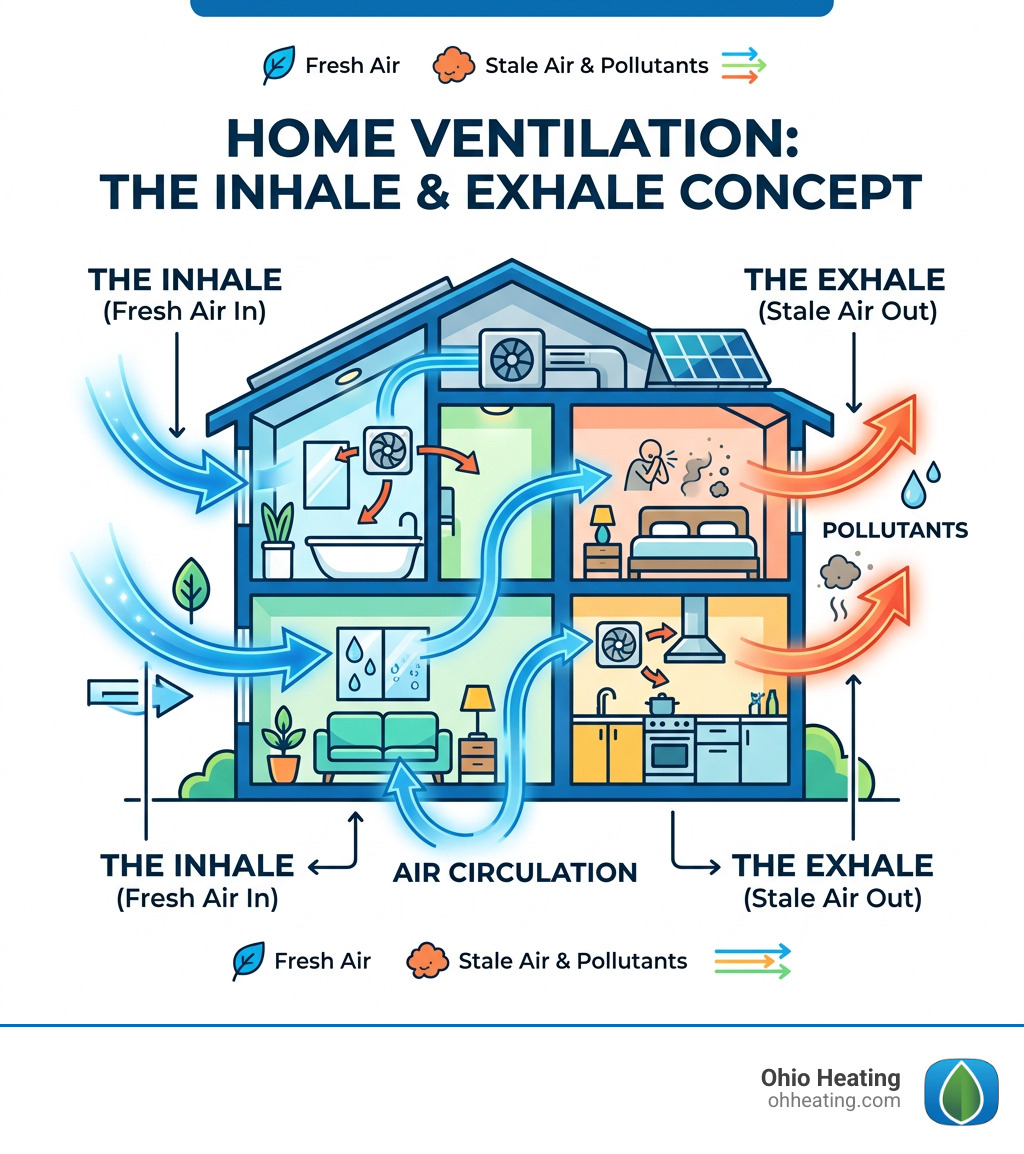
Simple guide to Home ventilation solutions:
Why Your Property Needs Modern Home Ventilation Solutions
In the past, houses were “leaky.” While that wasn’t great for your heating bill, it meant fresh air was constantly whistling through gaps in windows, doors, and floorboards. Today, we build homes with airtight construction to maximize energy efficiency. While this keeps the heat in during a Columbus winter, it also traps everything else inside.
Without proper home ventilation solutions, your indoor environment becomes a reservoir for Volatile Organic Compounds (VOCs). These are chemicals emitted as gases from everyday items like cleaning supplies, new furniture, paints, and even carpets. When these gases linger, they can cause headaches, dizziness, and long-term respiratory issues.
Another major concern in Central Ohio is Radon—a colorless, odorless radioactive gas that can seep in from the soil. Without a way for your home to “exhale,” radon levels can climb to dangerous heights. This is where our Indoor Air Quality services become vital. We help ensure your home has the right exchange rate to dilute these invisible threats.
Moisture is the other silent enemy. Everyday activities like showering, cooking, and even breathing add gallons of water to your indoor air daily. If that moisture isn’t managed, it leads to mold growth and structural rot. Proper ventilation maintains humidity between 30% and 50%, which is the “sweet spot” for both comfort and health. By adhering to Technical standards for air exchange, we can ensure your home receives fresh air every 30 to 90 minutes, significantly reducing carbon dioxide levels and allergens like pet dander and dust mites.
Primary Types of Mechanical Ventilation Systems
When natural breezes aren’t enough, mechanical systems take over. These systems use fans and ductwork to guarantee a specific amount of air exchange regardless of the weather outside.
- Exhaust Ventilation Systems: These work by depressurizing your home. The system exhausts air out, and fresh air is drawn in through leaks in the building shell or passive vents. They are relatively inexpensive to install but can sometimes draw in unwanted pollutants from crawlspaces or garages.
- Supply Ventilation Systems: These do the opposite—they pressurize the home. A fan brings outdoor air in, and indoor air escapes through holes in the shell or intentional vents. This allows for better filtration of the incoming air, which is a huge plus for allergy sufferers.
- Balanced Systems: These are the “gold standard.” They use two fans—one to bring fresh air in and one to exhaust stale air out. This ensures that the pressure inside your home stays neutral.
Achieving the right Air Balance in Columbus Ohio is critical. If your home is too pressurized or depressurized, you might experience whistling doors, backdrafting fireplaces, or high energy bills. In some cases, especially in larger homes or commercial spaces, we might recommend a Make-Up Air Unit in Columbus Ohio to replace the air being pulled out by high-powered kitchen hoods or laundry vents.
Heat Recovery Ventilators (HRV) as Home Ventilation Solutions
For our neighbors in Central Ohio, the HRV is a popular choice. Why? Because we have cold winters. An HRV works by using the heat from the warm, stale air it’s exhausting to pre-heat the cold, fresh air it’s bringing in.
The two air streams never actually touch or mix, but they pass through a heat exchanger where up to 80% of the thermal energy is transferred. This means you get fresh air without your furnace having to work overtime to heat it from 20 degrees up to 70 degrees. It’s an incredibly efficient way to manage Ventilation Systems while keeping condensation off your windows and keeping your toes warm.
Energy Recovery Ventilators (ERV) as Home Ventilation Solutions
While an HRV only transfers heat, an Energy Recovery Ventilator (ERV) transfers both heat and moisture. In the humid Ohio summers, this is a game-changer.
An ERV uses “enthalpic technology” to pull humidity out of the incoming fresh air and dump it into the outgoing exhaust stream. This keeps your indoor air drier and more comfortable, reducing the load on your air conditioner. In many cases, using an ERV can remove nearly half of the moisture from incoming air before it even enters your living space. If you still struggle with dampness, we often pair these with Whole House Dehumidifiers for total climate control.
According to Energy-efficient air exchange research, ERVs can recover 70% to 80% of the energy in the exiting air. Here is a quick comparison:
| Feature | HRV | ERV |
|---|---|---|
| Primary Function | Recovers Heat | Recovers Heat + Moisture |
| Best Climate | Cold, Dry Winters | Humid Summers / All Seasons |
| Moisture Control | Reduces Indoor Humidity | Balances Indoor Humidity |
| Winter Benefit | Prevents Dry Air | Keeps Humidity Inside |
Practical Strategies for Better Residential Airflow
You don’t always need a high-tech system to start breathing better today. There are several “low-tech” home ventilation solutions that every homeowner should practice.
Natural Ventilation & Cross-Ventilation The simplest solution is often the best: open your windows. To make this effective, use cross-ventilation. Open windows on opposite sides of the house to create a “wind tunnel” effect that flushes out stale air in just 10-15 minutes.
Exhaust Fans Your bathroom and kitchen are the primary sources of moisture and odors. Ensure your exhaust fans are rated for at least 80 CFM (cubic feet per minute). A pro tip: run your bathroom fan for at least 20 minutes after you finish showering to ensure all the steam is cleared out.
Attic and Ceiling Fans Attic ventilation is crucial for protecting your roof and lowering cooling costs. Solar-powered attic fans are a great way to keep your attic cool without adding to your electric bill. Inside the home, remember to switch your ceiling fan direction. In the summer, they should rotate counter-clockwise to create a cool breeze. In the winter, reverse them to clockwise at a low speed to push warm air down from the ceiling.
Air Quality and Maintenance If you have “dead zones” where air doesn’t seem to move, check your furniture arrangement. Placing a sofa directly over a floor vent or tight against an exterior wall can block airflow and encourage mold. For spaces that need extra help, Whole House Air Cleaners and air purifiers with HEPA filters can capture 99.97% of particles as small as 0.3 microns.
Frequently Asked Questions about Home Ventilation
What are the main signs of poor indoor ventilation?
If you aren’t sure if your home needs help, look for these tell-tale signs:
- Condensation: Seeing “sweat” or frost on the inside of your window panes in the morning.
- Lingering Odors: If you can still smell last night’s fish dinner the next afternoon, your air isn’t moving.
- Dust Buildup: Rapid dust accumulation can indicate negative pressure, which pulls dust in from attics and wall cavities.
- Visible Mold: Check corners of bathrooms or behind furniture on exterior walls.
- The “Stuffy” Factor: A general feeling of heaviness or “stale” air when you walk into a room.
How often should ventilation systems be maintained?
Maintenance is the key to longevity. We recommend changing your HVAC filters every 30 to 90 days depending on whether you have pets or allergies. For whole-house systems like HRVs or ERVs, the heat exchanger core should be cleaned or vacuumed annually.
A professional inspection once a year is the best way to ensure sensors are calibrated and ducts are sealed. To learn more about the technical side of keeping your air clean, check out our guide on Indoor Air Quality 101.
Are there specific building codes for home ventilation?
Yes! Most modern homes are built to satisfy ASHRAE 62.2 standards, which dictate the minimum local exhaust and whole-building ventilation rates. In Columbus, local building codes also incorporate IECC (International Energy Conservation Code) requirements. These standards ensure that as we make homes tighter and more energy-efficient, we don’t sacrifice the health of the occupants. If you are renovating or building, work with a team that understands these specific requirements to stay in compliance.
Conclusion
At Ohio Heating, we’ve been the trusted HVAC experts in Columbus and Central Ohio since 1999. We know that every home is unique—what works for a 1,200-square-foot ranch might not be the right fit for a 4,000-square-foot modern build. Our goal is to ensure your comfort and operational reliability through expert system sizing and professional installation.
Whether you need a simple exhaust fan upgrade or a sophisticated Energy Recovery Ventilator, our team is here to help you navigate home ventilation solutions. Don’t let stale air compromise your health or your home’s integrity. Breathe easier with professional Air Balance in Columbus Ohio and give us a call today to schedule your air quality assessment!