
What an HVAC Branch Controller Does — and Why It Matters for Multi-Zone AC
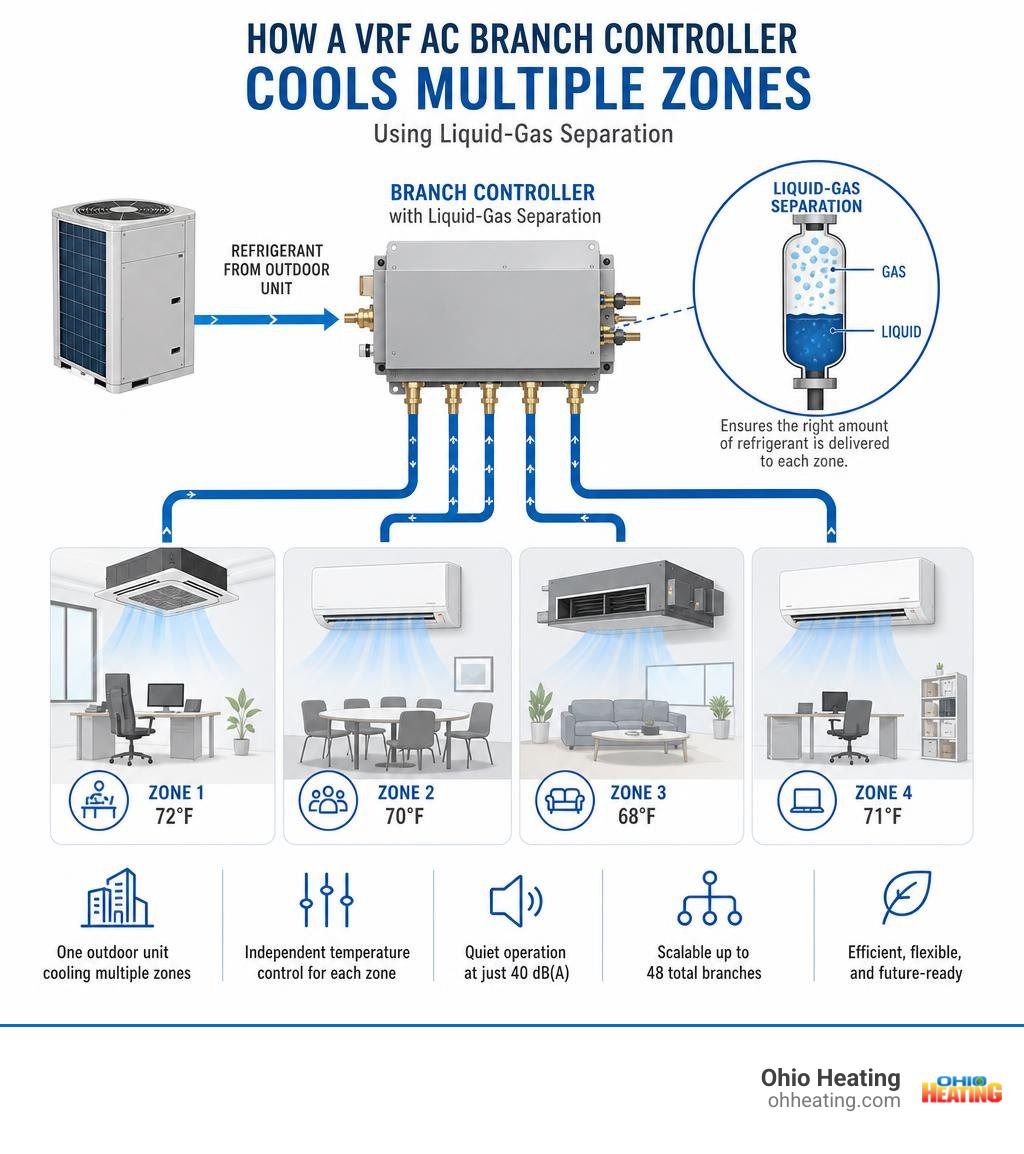
A branch controller HVAC component is the central distribution hub in a Variable Refrigerant Flow (VRF) multi-zone air conditioning system. It uses a built-in liquid-gas separator to route refrigerant to multiple zones at the same time — so different areas of your building can be cooled independently from a single outdoor unit.
Quick answer: What does a branch controller do?
- Routes refrigerant from one outdoor unit to multiple indoor zones
- Enables simultaneous, independent temperature control across zones
- Uses liquid-gas separation technology inside a compact, ceiling-mounted enclosure
- Operates at just 40 dB(A) — quieter than a normal conversation
- Supports up to 48 total branches using main and sub-controller configurations
For property managers and business owners, this means one system can cool your interior server room while handling your perimeter offices — without running separate equipment.
That kind of flexibility used to require much more complex infrastructure. Now, a single branch controller makes it possible — and that’s exactly why this technology is changing how commercial buildings manage air conditioning.
I’m Jill Frattini, Service Coordinator at Ohio Heating in Columbus, OH, and I’ve worked closely with contractors and project teams on commercial HVAC installations where branch controller HVAC design plays a central role in system performance. In this guide, I’ll walk you through how these systems work, how to size them, and what to expect during installation and maintenance.
Branch controller hvac helpful reading:
Understanding the Branch Controller HVAC Architecture in VRF Air Conditioning
To appreciate what makes a branch controller HVAC system special, we first need to look at traditional multi-zone cooling setups. Historically, if you had a building in Central Ohio with ten distinct cooling zones—each with different solar heat gain, occupancy, and thermal equipment loads—you either installed ten separate rooftop units or ran massive, power-hungry ducted systems.
Variable Refrigerant Flow (VRF) technology completely revolutionized this approach by circulating liquid refrigerant directly to individual fan coils throughout a facility. However, the real secret sauce that unlocks complete multi-zone flexibility is the branch circuit controller.
The branch controller acts as the traffic cop for your air conditioning network. Connected between a high-efficiency outdoor condensing unit and multiple indoor evaporator fan coil units, it regulates precisely how much liquid and gas refrigerant flows to each distinct zone. By integrating advanced liquid-gas separator technology, the branch controller enables two-pipe refrigerant distribution networks that deliver custom-tailored air conditioning across every corner of your commercial facility.
What Is a Branch Circuit Controller and How Does It Route Cooling Refrigerant?
At its core, a BRANCH CIRCUIT (BC) CONTROLLER is a sophisticated manifold box containing electronic expansion valves, solenoid valves, microprocessors, and internal heat exchangers. When your outdoor unit compresses refrigerant, it delivers a two-phase mixture of liquid and gas to the branch controller through a streamlined two-pipe system.
Inside the controller, a liquid-gas separator splits this mixture into distinct states:
- High-pressure liquid refrigerant is metered directly to zones requiring active cooling.
- Subcooled liquid state refrigerant is delivered efficiently across long pipe runs to maintain sensible and latent cooling capacity without flash-gas loss.
Because each indoor zone connects to an individual circuit outlet on the controller, the unit adjusts internal electronic valves dynamically based on real-time thermostat demands. If your south-facing glass conference room demands max cooling at 1:00 PM while a north-facing corner office needs only gentle dehumidification, the branch controller scales refrigerant flow to each air handling unit down to the exact Btu needed. This level of precision eliminates over-cooling, stabilizes humidity levels, and lowers overall kilowatt consumption across your property.
How Main and Sub Branch Controller HVAC Configurations Expand Cooling Zones
No two commercial buildings in Columbus are identical. A boutique historic office building in German Village might only need six cooling zones, whereas a multi-story corporate center near Polaris might require dozens of individually controlled spaces.
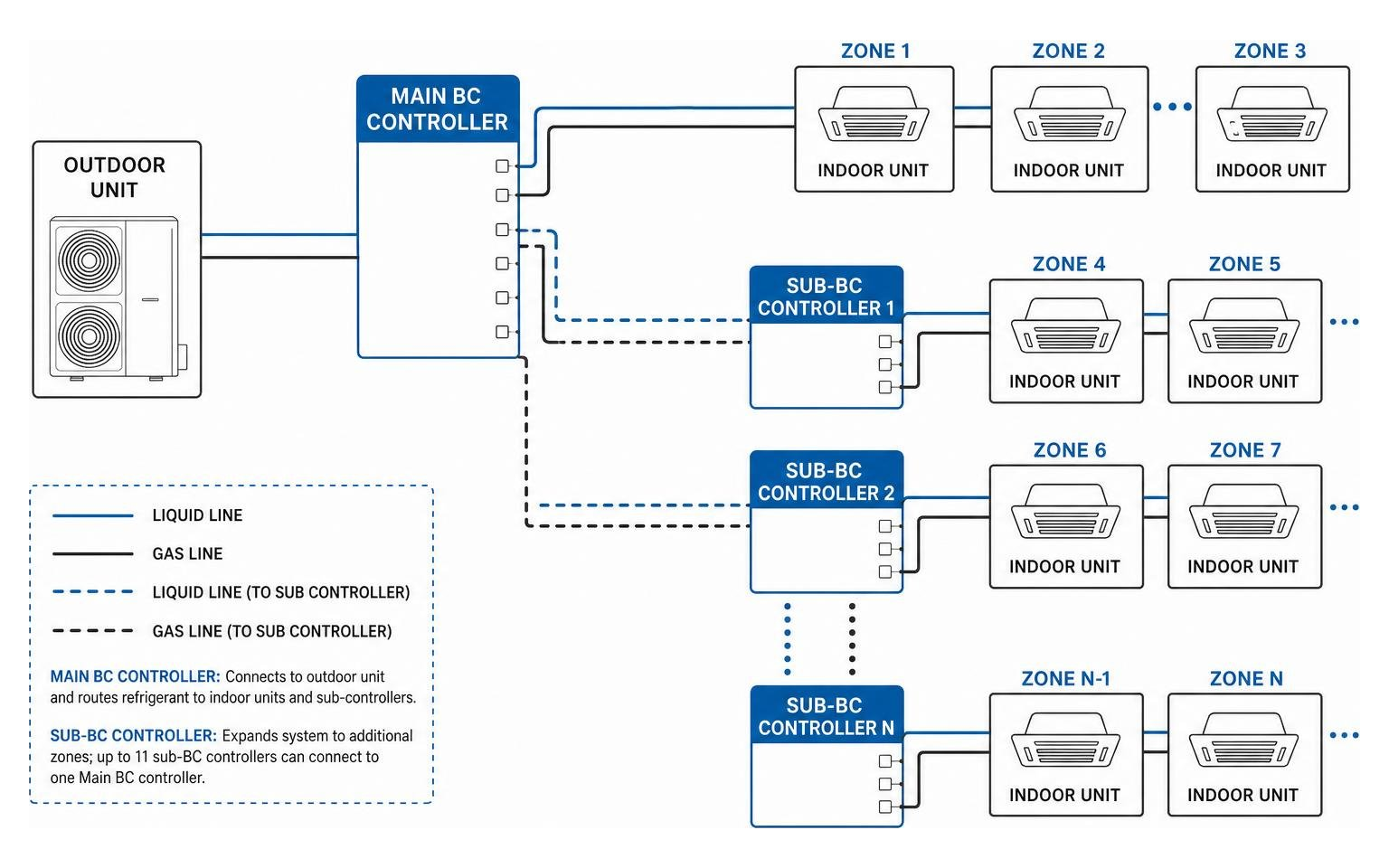
To adapt to complex architecture, manufacturers design branch controllers in modular configurations:
- Single BC Controller: A standalone unit designed for small-to-medium facilities. It typically features 5 to 16 individual branch ports and connects directly to a single VRF outdoor condensing unit.
- Main BC Controller: Used in large-scale multi-zone setups. The Main BC housing connects directly to the outdoor unit and routes refrigerant downstream both to local indoor fan coil units and to connected sub-controllers.
- Sub-BC Controller: Expansion boxes placed deeper within the building layout (closer to remote zone clusters). Up to 11 sub-BC controllers can be daisy-chained to a single Main BC controller!
By deploying a line-branching configuration with Sub-BC controllers, an engineer can expand a single VRF system to support up to 48 individual cooling branches. This modular layout allows us to design tailored commercial HVAC control systems that drastically reduce total line pipe lengths, lower total system refrigerant charge, and preserve valuable building architecture.
Key Features and Engineering Innovations of Modern AC Branch Controllers
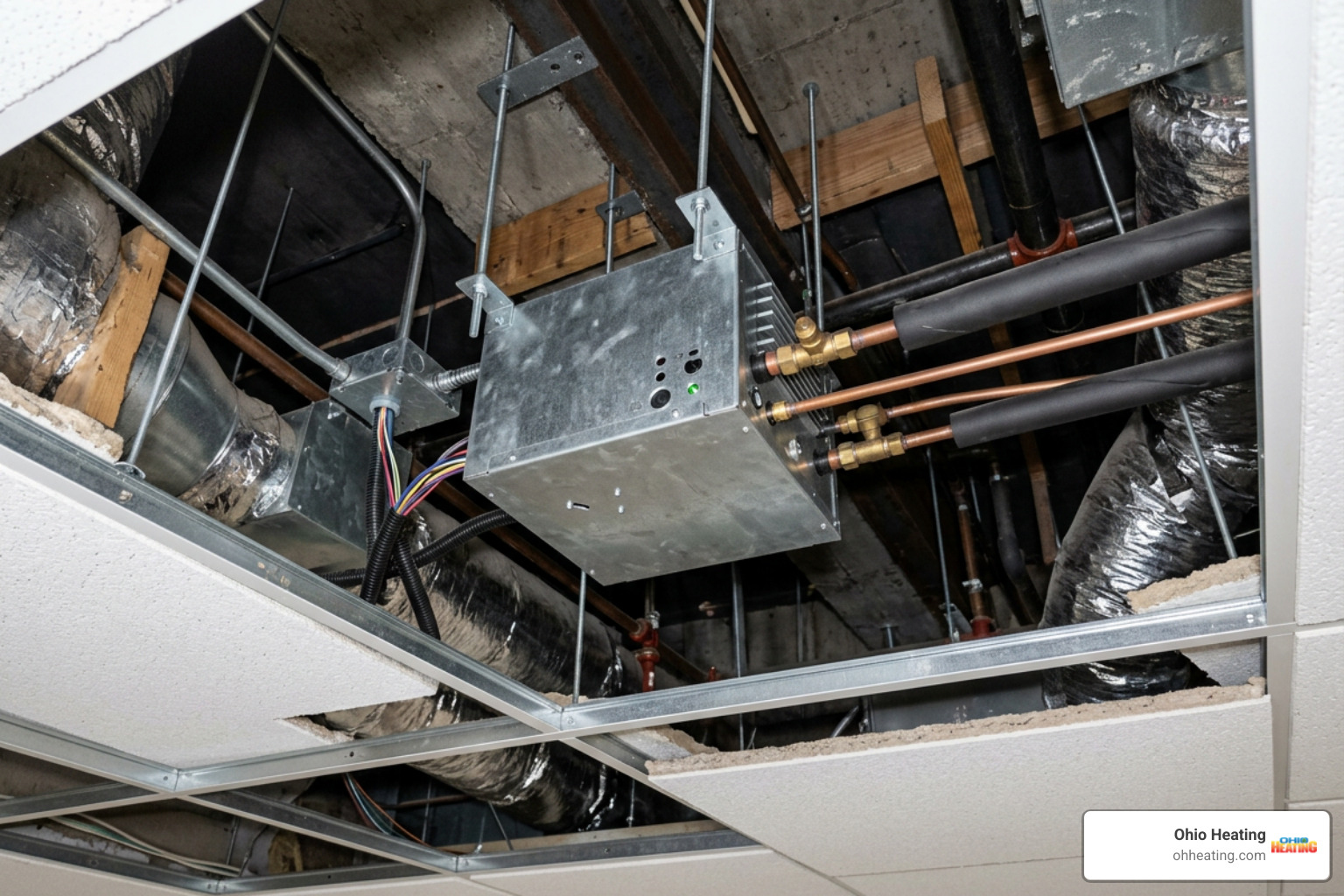
In recent years, HVAC manufacturers have introduced impressive design upgrades to branch controller HVAC hardware, making these systems lighter, quieter, easier to install, and significantly more energy-efficient.
Here are the primary technical innovations engineered into modern branch circuit controllers:
- Factory Pre-Installed Ball Valves: Older branch box models required technicians to manually braze separate field isolation valves onto every single circuit port. Modern controllers feature factory pre-installed ball valves that are leak- and pressure-tested up to 700 PSIG directly at the factory. This guarantees leak-tight integrity straight out of the box and cuts field installation labor costs substantially.
- Ultra-Quiet Acoustic Performance: Commercial buildings require whisper-quiet indoor environments. Modern branch controllers incorporate dynamic bypass valves and noise-dampening insulation that restrict sound production during valve switching to just 40 dB(A). That is noticeably quieter than a standard conversation in a private office setting!
- Tube-in-Tube Heat Exchangers: To boost cooling efficiency, advanced controllers include internal tube-in-tube heat exchangers. These units accomplish subcooling directly inside the controller housing without routing refrigerant back to the main outdoor unit. This cuts compressor stress and drastically lowers energy consumption during peak summer cooling days.
- Ultra-Compact Ceiling Footprint: Ceiling plenum space in modern office buildings and retrofitted historic structures is always at a premium. Premium branch controllers are designed with a low-profile chassis height of just 246 mm (under 10 inches). This slim height allows contractors to tuck the entire controller inside standard drop-ceiling grids without compromising access or aesthetic appeal.
How to Select and Size an AC Branch Controller for Multi-Zone Air Conditioning
Choosing the right branch controller HVAC setup requires balancing connected cooling capacity, line length limitations, and zone layout flexibility. The table below breaks down the technical parameters commonly evaluated when selecting branch controllers for commercial air conditioning systems.
| Specification Parameter | Single BC Controller | Main BC Controller | Sub-BC Controller |
|---|---|---|---|
| Branch Port Count Options | 5, 6, 8, 10, 13, or 16 ports | 8 to 16 main ports | 4 to 8 sub-ports |
| Max Sub-Controllers Connected | 0 (Standalone) | Up to 11 Sub-BC units | N/A (Connects to Main) |
| Max Capacity Per Single Branch | 54,000 Btu/h | 54,000 Btu/h | 54,000 Btu/h |
| Twinned Branch Capacity | Up to 96,000 Btu/h | Up to 96,000 Btu/h | Up to 96,000 Btu/h |
| Max Total Branches Supported | 16 branches | Up to 48 total branches | Extends system branches |
| Max Distance to Indoor Units | 90 meters (295 ft) | 90 meters (295 ft) | 90 meters (295 ft) |
| Unit Chassis Height | 246 mm (~9.7 inches) | 246 mm (~9.7 inches) | 246 mm (~9.7 inches) |
| Sound Level Rating | ~40 dB(A) | ~40 dB(A) | ~40 dB(A) |
Sizing and Selecting the Right Branch Controller HVAC Setup for Your Space
When our engineering team at Ohio Heating evaluates a commercial space for VRF multi-zone cooling, we carefully calculate both the total connected load and the specific cooling requirements of each individual room.
Here are the crucial capacity and sizing thresholds to keep in mind:
- Single Branch Load Limits: A single branch port on a controller typically supports up to 54,000 Btu/h of cooling capacity and can serve up to two or three smaller indoor fan coil units in a single zone (provided those units operate together).
- Branch Twinning for Large Open Zones: What if you have a massive open-plan office suite or a high-ceiling lobby requiring 75,000 or 90,000 Btu/h of cooling? Modern branch controllers allow you to “twin” two adjacent branch outlets using a factory twinning kit. This doubles the branch capacity up to 96,000 Btu/h from a single combined outlet!
- Piping Distance Limits: Centralized branch controllers offer incredible installation flexibility, allowing refrigerant pipe runs up to 90 meters (295 feet) from the controller to the furthest indoor fan coil unit. Furthermore, if the piping distance from the Main BC controller exceeds 60 meters, adding a Sub-BC controller brings the distribution manifold closer to the air handlers, ensuring full cooling performance without pressure drops.
Integrating smart controller design directly aligns with comprehensive building energy management goals by preventing oversized equipment purchases while maintaining full comfort across peak cooling conditions.
Integrating Controllers with VRF Condensers, Air Handlers, and Smart Thermostats
A branch controller doesn’t work in isolation—it serves as the central communication bridge connecting your outdoor VRF condensing unit, indoor air handlers, and smart thermostat networks.
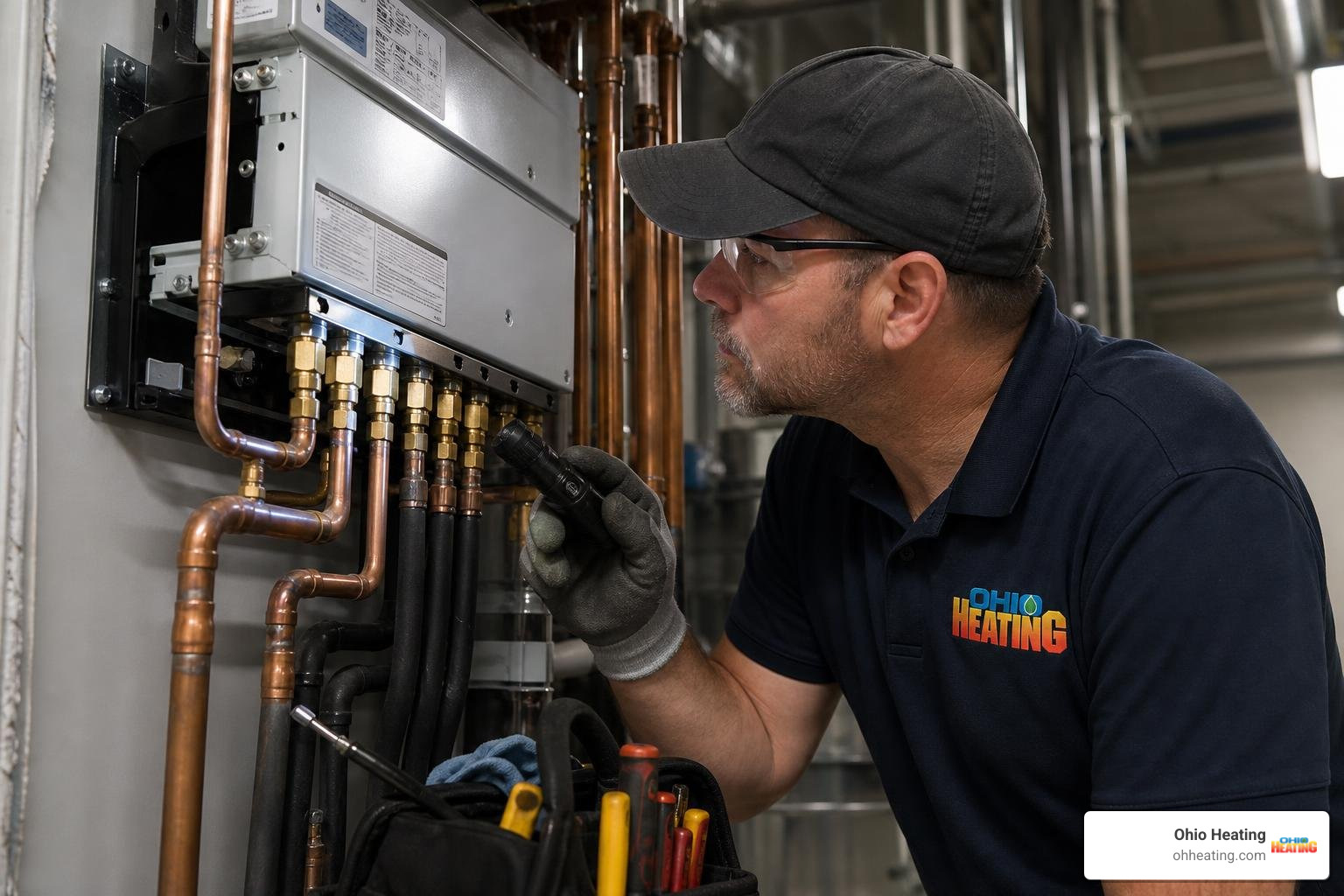
Modern commercial systems pair branch controllers with a versatile array of ductless and ducted indoor equipment:
- Ceiling Concealed Ducted Units: Tucked above drop ceilings for seamless, whisper-quiet air distribution.
- 4-Way and 1-Way Ceiling Cassettes: Perfect for open office layouts, featuring dynamic louver controls and fresh air ventilation intakes.
- Multi-Position Air Handlers & Wall-Mounted Units: Great for localized spots, utility rooms, or perimeter spaces.
You can browse various indoor unit options and technical combinations on Trane’s indoor units & branch controllers directory.
To direct this hardware, advanced wall controllers like the Wired Smart Controller – KSACN1701AAA link seamlessly into the system. These controllers feature built-in diagnostic menus (like iCheck self-diagnostics) that allow technicians to verify real-time sensor data, network connectivity, and electronic valve statuses instantly.
For larger commercial sites in Central Ohio, branch controllers integrate natively into centralized building automation software via BACnet or Modbus communication protocols. Exploring a centralized BAS system in Columbus Ohio allows facility management teams to monitor cooling performance, adjust schedule setpoints, and receive automated diagnostic alerts across dozens of cooling zones from a single dashboard screen.
How to Install and Maintain Branch Controllers for Peak AC Performance
Installing and maintaining VRF branch controller HVAC systems requires specialized equipment, proper training, and rigorous field practices. Because these systems handle high-pressure R-410A or next-generation transition refrigerants like R-454B, quality workmanship during installation directly impacts long-term system reliability.
Here are the essential installation and preventive maintenance best practices our technicians follow at Ohio Heating:
- Brazed Connections & Nitrogen Purging: When connecting field refrigerant piping to copper branch ports, technicians must purge dry nitrogen through the lines at low pressure during brazing. This eliminates internal oxidation and scale formation that could otherwise clog delicate electronic expansion valves inside the controller.
- High-Pressure Nitrogen Leak Testing: After brazing, the system must undergo a multi-stage nitrogen pressure hold test (typically up to 600–700 PSIG for 24 hours) to verify 100% leak-free integrity across every branch line prior to charging refrigerant.
- Service Access Clearance: Even though branch controllers are compact (246 mm tall), never bury them behind fixed drywall ceilings without access panels! Always install the controller above accessible lay-in ceiling tiles or install dedicated access hatches directly beneath the bottom service panel. This ensures technicians can access electronic control boards, thermistors, and valves easily.
- Isolation Valve Strategy: Always install ball valves on every branch port (or utilize controllers with factory pre-installed valves). If a single indoor fan coil unit ever requires maintenance or replacement in the future, technicians can isolate that single branch without shutting down cooling to the rest of the building!
- Routine Diagnostic Checks: Annual preventive maintenance should include checking communication wiring connections, inspecting thermistor resistance values, clearing internal drain pans (if applicable), and checking system operating pressures via diagnostic smart tools.
For facility managers looking to optimize existing controls or upgrade legacy equipment, exploring options for conventional controls provides a solid path toward modernizing commercial building management systems.
Frequently Asked Questions About HVAC Branch Controllers
What is the primary function of a branch controller in an AC system?
The primary function of a branch controller in an AC VRF system is to act as a centralized distribution hub for refrigerant. It uses an internal liquid-gas separator and electronic pulse valves to direct exact amounts of liquid refrigerant to multiple indoor air handling units, enabling precise multi-zone temperature control from a single outdoor condenser.
How quiet is an HVAC branch controller during cooling operation?
Modern branch controllers are engineered for ultra-quiet operation, producing acoustic sound levels as low as 40 dB(A) during normal operation and mode changes. This noise level is quieter than background ambient conversation in a typical commercial office, allowing the unit to be installed in ceiling plenums directly above occupied work spaces without disrupting occupants.
What is the maximum piping distance allowed between a branch controller and indoor fan coils?
Standard VRF branch controllers permit a maximum refrigerant piping length of up to 90 meters (295 feet) from the central branch controller to the furthest indoor fan coil unit. If long building layouts require even greater distances, contractors can install Sub-BC controllers up to 60 meters downstream from the Main BC controller to extend zone coverage even further.
Conclusion
A branch controller HVAC system offers modern commercial properties an unparalleled level of multi-zone cooling precision, operational efficiency, and installation versatility. By eliminating the need for bulky ductwork networks and multiple rooftop condensing units, VRF branch technology empowers building owners to deliver customized comfort across every individual office, suite, or common room.
Whether you are designing a brand-new commercial facility, retrofitting a historic building in Central Ohio, or looking to resolve persistent cooling imbalances in your office, choosing the right branch controller architecture is key to long-term reliability and low energy bills.
At Ohio Heating, our team of certified commercial HVAC technicians has been delivering top-tier cooling installation, service, and maintenance across Columbus and Central Ohio since 1999. If you’re ready to upgrade your facility’s cooling infrastructure or need expert diagnostic service on your VRF network, contact the control specialists at Ohio Heating today to keep your business running cool and smooth all summer long!