
Breaking Down Average AC Unit Service Cost: Diagnostics to Major Repairs
When your cooling system stops blowing cold air in the dead of summer, understanding the true ac unit service cost helps you stay in control of your budget. Total repair bills are generally composed of three distinct elements: the diagnostic fee, required replacement parts, and technician labor. Knowing how these pieces fit together ensures you never overpay for standard service.
To dive deeper into standard pricing structures across the industry, review this HVAC Repair Cost: 2026 Pricing Guide.
Diagnostic Fees and Technician Labor Rates
Before a technician turns a single wrench, they must pinpoint the root cause of the breakdown. A standard service call or diagnostic fee ranges from $75 to $200. This charge covers travel time, operational overhead, and the professional expertise required to evaluate your cooling system safely.
In Columbus and across Central Ohio, hourly labor rates for certified technicians typically range between $75 and $200 per hour. Labor accounts for roughly 50% to 70% of most repair invoices.
If your air conditioner breaks down after hours, over a weekend, or during a holiday heatwave, expect emergency fees. After-hours callouts often carry a 20% to 100% surcharge, adding $40 to $80 or more per hour to standard rates.
To learn more about local service call dynamics, read our comprehensive Average Cost of Central Air Repair Guide.
Average AC Unit Service Cost by Component
The actual cost to fix your air conditioner depends heavily on which internal part has failed. Minor electrical components can be swapped quickly, whereas sealed-system components demand extensive labor and specialized equipment.
| Component | Raw Wholesale Part Cost | Fair Installed Price Range | Typical Labor Time |
|---|---|---|---|
| Run/Start Capacitor | $10 – $45 | $100 – $400 | 0.5 – 1 hour |
| Electrical Contactor | $15 – $70 | $100 – $450 | 0.5 – 1 hour |
| Condenser Fan Motor | $100 – $400 | $300 – $800 | 1 – 2 hours |
| Blower Motor | $350 – $1,150 | $450 – $1,200 | 1.5 – 3 hours |
| Evaporator Coil | $600 – $2,000 | $1,000 – $3,000+ | 3 – 6 hours |
| AC Compressor | $800 – $2,200 | $1,500 – $3,500 | 4 – 8 hours |
As shown above, the gap between part cost and installed price reflects the technical skill, licensing, specialized equipment, and warranty coverage behind every professional installation.
Refrigerant Leak Repair and 2026 R-410A Phase-Out Costs
Air conditioners operate on a closed loop; refrigerant is never “used up” like gasoline. If your cooling system is low on charge, you have an active leak that must be identified and repaired. Simply adding fresh refrigerant without fixing the leak guarantees future breakdowns and wasted money.
Refrigerant service costs break down into two main parts: leak detection/repair and the chemical recharge itself.
- Leak detection and isolation testing: $100 to $300 using electronic sniffers, ultraviolet dyes, or nitrogen pressure tests.
- Leak repair: $200 to $1,500 depending on location (e.g., braze point vs. coil replacement).
- R-410A recharge: $40 to $75 per pound ($100 to $320 installed for typical top-offs).
- R-22 recharge: $100 to $200 per pound ($600 to $1,800 installed). Because the EPA completely banned R-22 production in 2020, remaining stockpiles carry extreme scarcity pricing.
Under the EPA AIM Act phase-down, R-410A production is decreasing significantly, driving a industry shift toward next-generation A2L refrigerants (such as R-454B and R-32). If you own an older unit running on R-22 or an aging R-410A system, rising chemical costs mean major leak repairs require careful financial consideration.
Repair vs. Replacement: Evaluating AC Service Math
Facing a major repair bill leaves many property owners asking: Is it smarter to fix the existing unit or invest in a new air conditioner?
Upgrading to modern equipment aligned with current SEER2 efficiency standards can cut monthly summer utility bills by 20% to 40%, helping offset initial equipment investments over time. Check out our detailed Guide to Repair vs Replace AC Decision for additional financial insights.
The 50 Percent Rule and the $5,000 Formula
To eliminate guesswork when reviewing major quotes, rely on two proven industry formulas:
- The 50 Percent Rule: If a single repair quote equals or exceeds 50% of the cost of a completely new cooling system, replacement is almost always the smarter long-term decision.
- The $5,000 Formula: Multiply the age of your air conditioning unit (in years) by the exact repair quote (in dollars). If the total product exceeds $5,000, invest in a replacement instead of sink money into aging equipment.
Example: A 12-year-old air conditioner needs a $600 fan motor repair. $$12 \text{ years} \times \$600 = \$7,200$$ Because $7,200 exceeds the $5,000 threshold, placing those funds toward a modern unit offers superior value.
Always verify active parts warranties before approving quotes. Most major cooling equipment manufacturers provide 5- to 10-year parts warranties upon initial registration. If your unit is still under warranty, replacement parts may be fully covered, leaving you responsible only for technician labor costs.
Red Flags in Quotes: How to Avoid AC Service Scams
While the majority of AC contractors operate with integrity, fraudulent quotes and aggressive sales tactics do occur. Protecting yourself starts with recognizing warning signs early.
To benchmark your estimates against current industry guidelines, check the consumer-focused AC Repair Cost Fairness Guide.
Common Misdiagnoses and Unnecessary Upsells
The most common misleading tactic in air conditioning repair is the capacitor-or-compressor trick. When an inexpensive run capacitor fails, the compressor cannot draw electrical current to start, causing it to hum loudly or trip circuit breakers. Dishonest or poorly trained technicians may claim your entire compressor is “dead” and demand $2,000+ for a replacement, when a simple $150 capacitor swap would restore cooling instantly.
Other common predatory tactics include:
- Phantom Refrigerant Leaks: Claiming a unit is low on charge and charging for a top-off without performing a pressure test to prove a leak exists.
- Aggressive Coil Cleaning Upsells: Quoting $500+ for routine coil rinsing that should be covered under basic maintenance.
- High-Pressure Scare Tactics: Claiming your system is an immediate safety hazard to force an immediate on-the-spot replacement sign-off.
Read our analysis on whether Are Cheap Local AC Service Specials Worth It? to protect yourself against low-ball hook-and-switch offers.
Green Flags of an Honest, Itemized Estimate
A trustworthy AC company provides absolute transparency. Look for these green flags on every written quote:
- Complete Part Itemization: Clear separation of exact part numbers, materials, and technician labor charges.
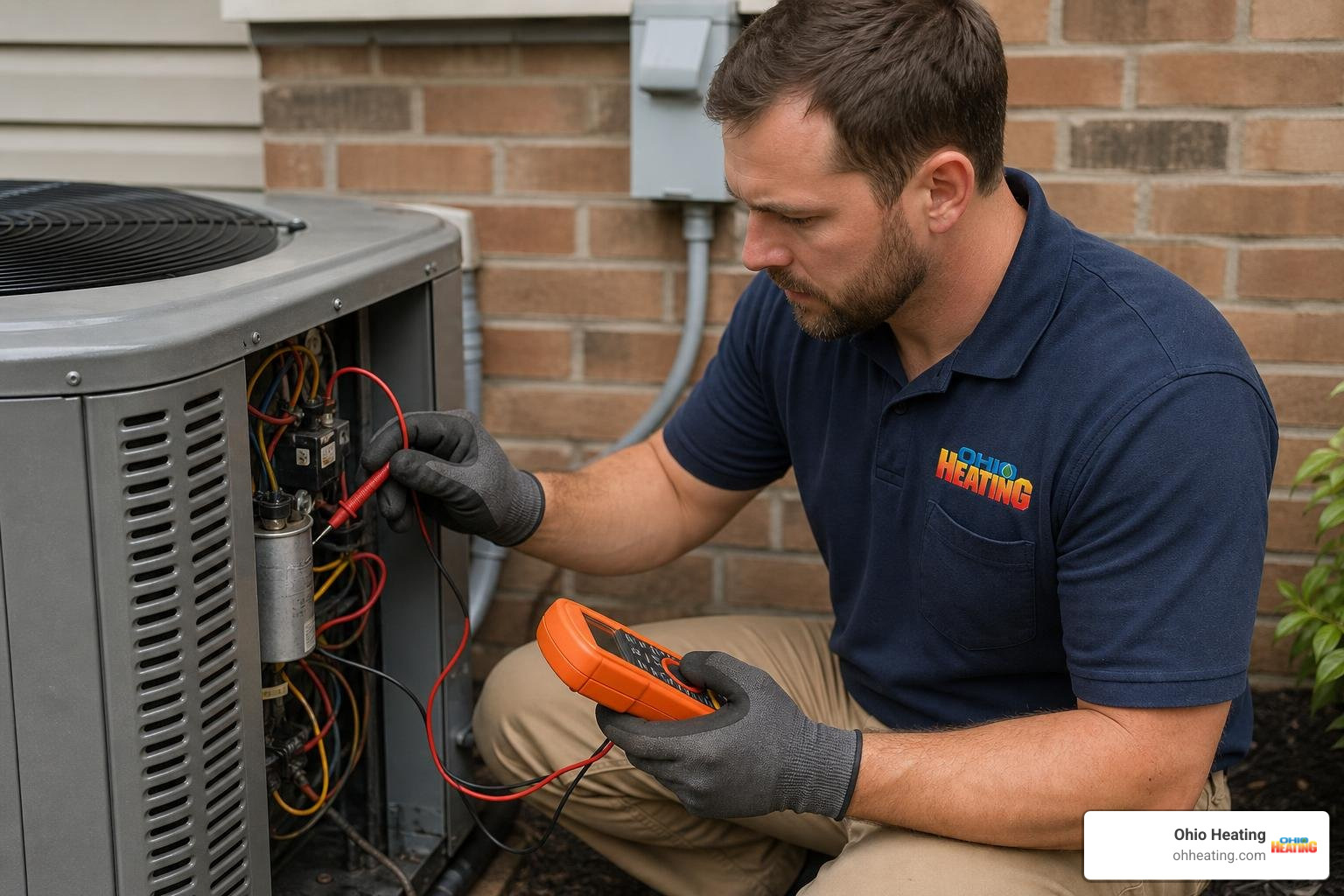
- Diagnostic Proof: Written multimeter readings (e.g., microfarad readings for capacitors) or photo proof of corroded coils and damaged parts.
- Diagnostic Credit: Applying the initial diagnostic fee toward total repair costs upon estimate approval.
- Written Warranties: Minimum 90-day to 1-year labor guarantees alongside manufacturer parts coverage.
- EPA Certification: Verification that attending technicians hold valid EPA 608 certification for safe refrigerant handling.
What Routine AC Maintenance Includes and How to Save
Preventative maintenance is the single most effective tool for preventing summer breakdowns and avoiding sudden repair bills. The national average cost for a routine AC tune-up ranges between $70 and $189 ($99 national average).
A comprehensive professional tune-up includes:
- Coil Washing: Rinsing debris, dust, and lawn clippings from outdoor condenser coils to lower system pressure.
- Electrical Testing: Measuring voltage, checking electrical contactors for pitting, and testing capacitor capacitance.
- Condensate Line Flushing: Clearing drain lines and trap pans to prevent indoor water leaks and property damage.
- Airflow Optimization: Checking blower motor amperage, inspecting cabinet insulation, and examining air filters.
- Refrigerant Check: Verifying operating pressures and subcooling/superheat values to ensure leak-free performance.
How to Lower Your AC Unit Service Cost and Protect Your Wallet
Keep your annual maintenance and repair expenses manageable with these practical approaches:
- Schedule During Shoulder Seasons: Book maintenance during early spring (March/April). Homeowners who book early often save 10% to 25% compared to peak summer emergency rates.
- Replace Air Filters Regularly: Change standard 1-inch air filters every 60 to 90 days. Clean filters preserve proper airflow, reducing utility draw and protecting blower motors from overheating.
- Enroll in Annual Service Agreements: Annual AC maintenance plans (typically $150 to $500 per year) provide discounted tune-ups, priority emergency scheduling, and waived callout fees.
- Opt for Standard MERV 8 Filters: High-pleat specialty filters can restrict system airflow if your equipment wasn’t designed for them. Standard MERV 8 filters provide excellent filtration without overburdening your blower motor.
Explore our guides on The Truth About AC Yearly Service Costs and our complete Guide to AC Maintenance Service Costs for deeper budget-planning tips.
Frequently Asked Questions About AC Service Costs
What is the average cost of an AC diagnostic service call in 2026?
The standard fee for an AC diagnostic service call ranges between $75 and $200. This charge covers technician travel, system evaluation, and root-cause troubleshooting. Many reputable contractors credit this fee toward the final bill if you approve the recommended repair during the same visit.
How much does it cost to fix an AC refrigerant leak and recharge the unit?
Fixing an active refrigerant leak and recharging the system typically costs $300 to $1,500+. Diagnostic leak isolation tests run $100 to $300, line repairs cost $200 to $1,000, and R-410A refrigerant recharges run $40 to $75 per pound installed. Legacy R-22 refrigerant recharges cost significantly more ($100 to $200 per pound) due to federal phase-out supply limits.
Can a faulty capacitor be mistaken for a dead AC compressor?
Yes. A failed capacitor cannot supply the electrical charge required to start the compressor motor, causing symptoms identical to a dead compressor (loud humming, clicking, or tripped breakers). Always ensure a technician tests the capacitor with a multimeter before approving a major compressor replacement estimate.
Conclusion
Understanding your ac unit service cost protects your financial peace of mind. Whether you require a basic $99 spring tune-up, a $175 capacitor replacement, or an evaluation of an aging cooling system, demanding clear written estimates and checking key formula thresholds ensures you receive fair service every time.
At our cooling service company, we have served homeowners and commercial property managers across Columbus and Central Ohio since 1999. Our team is committed to transparent, upfront pricing, expert diagnostic accuracy, and dependable cooling comfort when you need it most.
Ready to protect your cooling system against unexpected breakdowns? Schedule your expert tune-up or inspection today through our dedicated Air Conditioning Maintenance Services portal!